

The SpaceX listing pushed on-chain share trading to an all-time high in June 2026. The same month, dollar tokens suffered their sharpest contraction since 2022. Together, these two moves tell one story about where digital-asset capital is actually going.
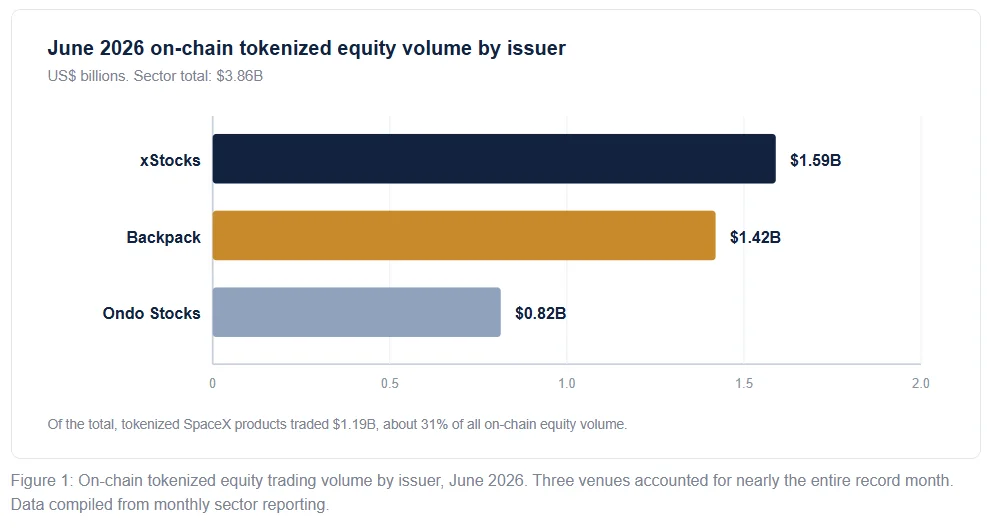
The tokenised equity market recorded its biggest month ever in June 2026, with on-chain trading volume jumping 145% to roughly $3.86 billion. One event drove almost all of it. On 12 June, Space Exploration Technologies Corp. listed on Nasdaq under the ticker SPCX after raising $75 billion in its largest initial public offering in history. Crypto venues raced to wrap that listing in a token. Meanwhile, the stablecoin market that funds most on-chain trading moved in the opposite direction, shrinking by $7.70 billion.
That divergence is the point. Investors did not leave the digital-asset market in June. Instead, they rotated. Understanding where they rotated to and what the tokenised wrapper actually delivered during testing matters more than the headline growth rate.
In Summary
Tokenised equity volume reached a record $3.86 billion in June 2026, a 145% increase from the previous month, and SpaceX tokens alone accounted for $1.19 billion, or roughly 31% of the total.
The tokenised equity sector’s market capitalisation climbed to a record $1.53 billion, marking its fifteenth consecutive monthly gain.
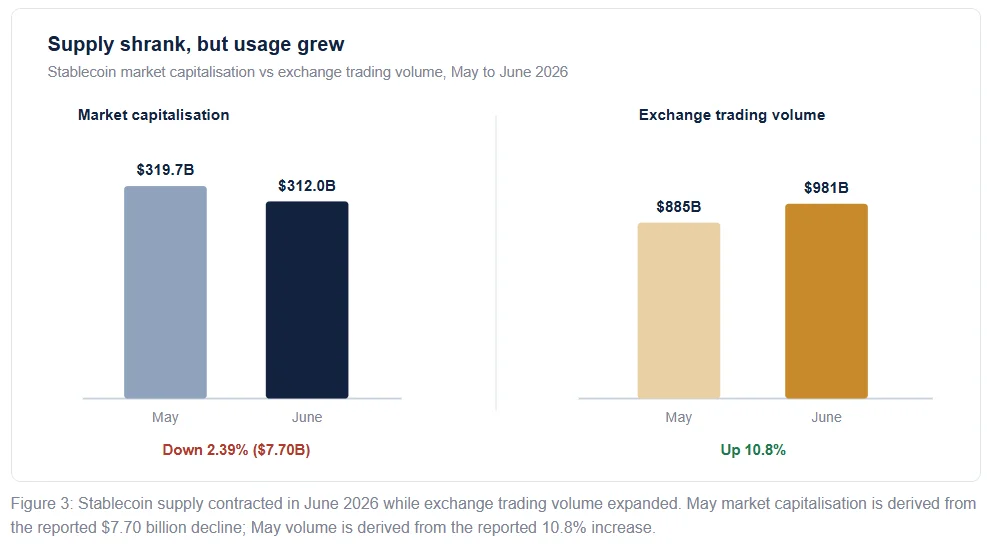
Stablecoin market capitalisation fell 2.39% to about $312 billion, the steepest monthly contraction since the TerraUSD collapse of May 2022. Yet exchange trading volumes in stablecoins rose 10.8% to $981 billion.
Three-dollar tokens broke parity in June for three different reasons: collateral value, liquidity depth and reserve verification.
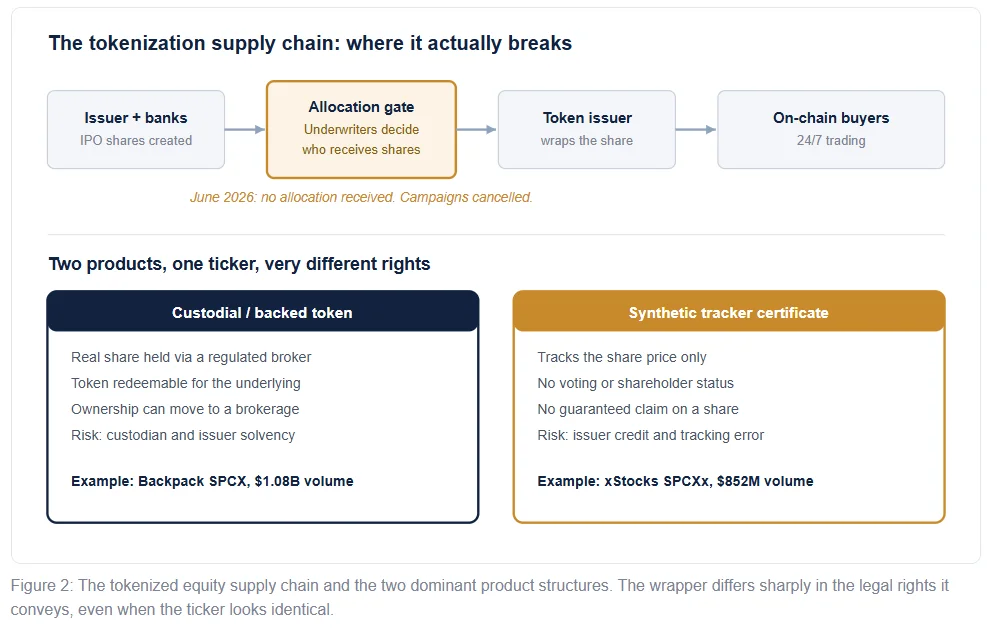
The SpaceX episode exposed the sector’s real constraint. Blockchains can efficiently distribute a share, but they cannot manufacture one. Underwriter allocation remains the gate.
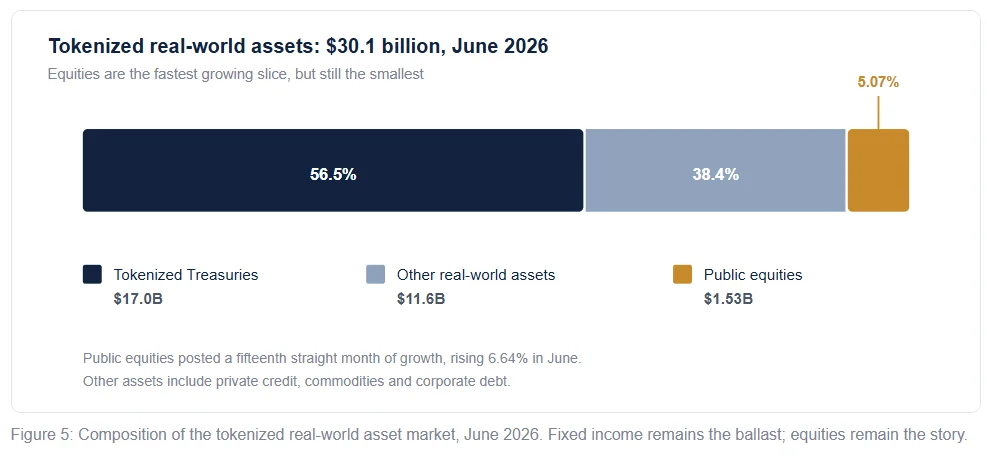
Tokenised treasuries, not equities, still anchor the real-world asset market, accounting for roughly $17.0 billion of the $30.1 billion total.
Table of Contents
- Table of contents will be generated automatically when the page loads.

What the record tokenised equity trading volume actually measures
First, a distinction that many headlines blur. Trading volume is not the same as assets held. The $3.86 billion figure counts the dollar value of tokens changing hands during the month. The sector’s market capitalisation, meaning the value of tokenised shares actually outstanding, reached only $1.53 billion.
Volume therefore turned over more than twice the outstanding stock in a single month. That ratio signals speculation rather than settled long-term ownership. Furthermore, the concentration was extreme. Three issuers produced almost the entire figure.
Why the SpaceX IPO became the sector’s biggest trading event
SpaceX priced 555.6 million shares at $135 each, valuing the company at nearly $1.77 trillion. The stock opened at $150 and closed its first session around $160.95, a gain of 19.2%. Consequently, the listing eclipsed Saudi Aramco’s 2019 record by a wide margin and made Elon Musk the world’s first trillionaire on paper.
Retail appetite was the engine. SpaceX reserved an unusually large slice of the deal for individual investors, and orders still overwhelmed supply. When conventional brokerages cannot satisfy that demand, unmet buyers look for substitutes. Tokenised wrappers offered one, promising round-the-clock exposure without a brokerage account.
However, scale deserves perspective. On listing day alone, SPCX shares traded roughly $33 billion in the conventional market, more than the day’s dollar volume in the two largest US index ETFs combined. Tokenised SpaceX products managed $1.19 billion across the entire month. The on-chain venue is growing quickly, yet it remains a rounding error next to the exchange it mirrors.
The allocation failure that exposed tokenisation’s real bottleneck
The most instructive part of June was not the record. It was the failure that preceded it.
Several large wallets and exchanges marketed pre-IPO subscription campaigns offering tokenised exposure to SpaceX. They routed those campaigns through a single tokenised equity provider, which in turn had to source real SpaceX shares through the same underwriting pipeline used by conventional brokers. It could not. As a result, the campaigns were cancelled on listing day, and subscribers were refunded in full. One platform’s campaign alone had locked roughly $557 million in stablecoins from about 27,700 wallet addresses.
This was not a blockchain malfunction. Nothing broke technically, no funds were lost, and refunds were processed quickly. Rather, it was a supply-chain lesson. A token can only represent a share that someone actually owns. Where the underlying asset is rationed by underwriters, the wrapper inherits the rationing.
Same ticker, different rights: what tokenised SpaceX buyers really owned
Two products dominated SpaceX trading, and they were not equivalent. Backpack’s SPCX token accounted for $1.08 billion of volume and is presented as backed by an actual share held through a regulated US broker-dealer account, with redemption into a conventional brokerage possible. By contrast, the xStocks SPCXx token traded $852 million and functions as a tracker certificate, conveying price exposure without shareholder status.
Therefore, two investors could hold what appeared to be the same asset while owning fundamentally different assets. One holds a claim on a share. The other holds a claim on an issuer. In a stress event, that difference is the whole investment case.
Stablecoin market capitalisation fell while stablecoin usage rose
Now turn to the other half of June. Total stablecoin market capitalisation dropped 2.39% to roughly $312 billion, its first month-end decline in five months. The $7.70 billion contraction was the largest since TerraUSD imploded in May 2022. Live supply figures are tracked publicly on DefiLlama.
Nevertheless, the activity told a different story. Stablecoin trading volumes on centralised exchanges rose 10.8% to $981 billion, the first monthly increase in five months. Meanwhile, stablecoin dominance in the digital-asset market climbed to 14.7% from 12.4% as other tokens fell more sharply.
Read carefully; these numbers describe redemption, not abandonment. Some holders converted tokens back into bank dollars during a risk-off month. Those who stayed traded more actively. In other words, the plumbing kept working while the reservoir drained slightly.
Three depegs, three completely different failure modes
June also delivered a cluster of peg breaks. Crucially, each one failed for a separate structural reason. Investors who lump all dollar tokens together miss this entirely.
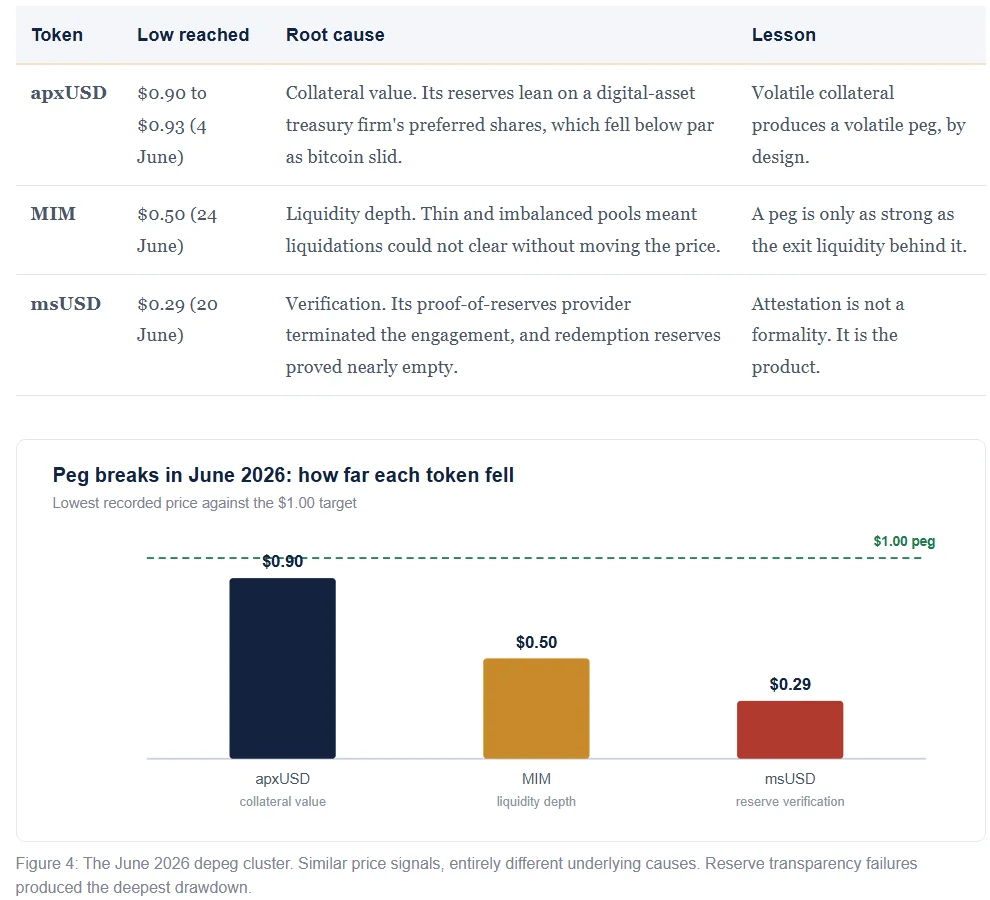
Notably, none of these was the fully reserved, cash-and-Treasury tokens that dominate the market. The large fiat-backed issuers held parity throughout. Consequently, the correct conclusion is not that stablecoins failed. It is that collateral design determines survival, and the market is finally pricing that distinction.
Tokenised treasuries, not equities, still anchor the real-world asset market
For all the attention on shares, the real-world asset market remains a fixed-income story. Total tokenised asset market capitalisation rose 1.75% to a record $30.1 billion in June. Tokenised Treasuries led at roughly $17.0 billion, or 56.5% of the total. Public equities represented just 5.07%. Category-level data is published openly by RWA.xyz.
Within that Treasury segment, Circle’s USYC extended its lead over BlackRock’s BUIDL, a reversal that began in March 2026 and has held since. The reason is instructive. USYC grew largely because a major exchange adopted it as off-exchange collateral for institutional derivatives. In short, tokenised Treasuries won by becoming useful, not merely available.
Regulation is the gate, not the ledger
Investors often assume tokenisation stalls because of technology. It does not. It stalls because of law and access.
The US Securities and Exchange Commission has been unambiguous. In July 2025, Commissioner Hester Peirce wrote that blockchain “does not have magical abilities to transform the nature of the underlying asset”. On 28 January 2026, staff across three SEC divisions issued a joint statement formalising that view and confirming that tokenised securities remain securities regardless of whether ownership is on-chain or off-chain. A proposed “innovation exemption” would permit limited trading of tokenised securities on new platforms, but it is deliberately incremental.
Elsewhere, the direction is toward regulated integration rather than regulatory escape. Japan’s Financial Services Agency approved Ripple’s RLUSD as an electronic payment instrument under the revised Payment Services Act, with distribution through a licensed local exchange, according to Ripple’s own announcement on 24 June 2026. Furthermore, national exchanges and central securities depositories are advancing their own tokenisation pilots. The likely destination is convergence, not competition.
What investors should watch next in the tokenised equity market
Three questions will decide whether June was a turning point or a spike.
1. Does volume persist without a mega-listing?
Roughly 31% of June’s record came from a single ticker. July and August will show whether baseline demand exists once the novelty fades. Watch whether market capitalisation continues to compound even if volume normalises.
2. Do issuers secure primary-market access?
Until tokenised platforms can obtain genuine IPO allocations, they will remain secondary-market venues that mirror prices set elsewhere. Partnerships with broker-dealers and transfer agents are the leading indicator here.
3. Does the sector standardise disclosure?
Investors currently cannot easily tell a backed token from a tracker certificate. Consistent labelling of redemption rights, custody arrangements, and reserve attestations would do more to drive adoption than any marketing campaign.
The bottom line
June 2026 was a genuine milestone for tokenised equity and a genuine warning. Demand exists, and it is large enough to move records within days of a catalyst. However, the plumbing connecting that demand to real shares still runs through the same underwriters, custodians, and regulators it always has.
Investors should therefore treat tokenisation as a distribution technology rather than an asset class. It changes how quickly and how widely an asset can be traded. It does not change what the asset is, who controls its supply, or what happens when the collateral behind it falls in value. June proved all three of those propositions in a single month.