


The European Central Bank (ECB) surprised almost no one, yet it still changed the narrative. On 11 June 2026, the Governing Council raised its three key interest rates by 0.25 percentage points. As a result, the deposit rate climbed from 2.00% to 2.25%. Crucially, this was the first hike since September 2023.
Why does a modest quarter-point move deserve close attention? Because it reverses direction. For two years, the ECB cut rates. Now it has pivoted. Moreover, the trigger is unusual: a war-driven energy shock rather than overheating demand.
This analysis unpacks what the ECB did, why it acted, and how the decision ripples toward bonds, equities, and crypto. Throughout, technical terms are presented in plain language, and a short glossary appears at the end.
In Summary
The ECB lifted its deposit rate to 2.25%, effective 17 June 2026.
This is the first increase since September 2023, when the rate peaked at 4.0%.
An energy shock tied to the war in Iran pushed eurozone inflation to 3.2% in May.
The ECB cut its 2026 growth forecast to 0.8%, signalling a risk of stagflation.
Higher safe yields raise the opportunity cost of holding non-yielding assets like Bitcoin.
Markets had priced the move in, so the immediate reaction stayed muted.
What the ECB Actually Decided
The Governing Council moved all three policy rates by 25 basis points. Consequently, the deposit rate rose to 2.25%, the main refinancing rate to 2.40%, and the marginal lending rate to 2.65%. These new levels took effect on 17 June 2026.
The deposit rate matters most. It is the lever through which the ECB steers borrowing costs across the eurozone. Therefore, when it rises, savings yields and loan rates tend to follow.
Importantly, President Christine Lagarde pushed back on a popular label. Several analysts called the move an “insurance hike,” meaning a precautionary step. However, Lagarde rejected that framing and stressed a data-dependent path ahead.
Why the ECB Reversed Course
For most of 2024 and 2025, the ECB eased policy. In fact, it cut rates eight times from June 2024 to June 2025, lowering the deposit rate from 4.0% to 2.0%. So what flipped the script?
The Energy Shock From the Middle East
A widening conflict involving Iran disrupted global oil flows. Notably, roughly one-fifth of global oil supply passes through the Strait of Hormuz. When tensions rise, traders price in supply risk almost instantly.
The effect showed up fast in prices. Energy costs surged nearly 11% in May across the euro area. Furthermore, those costs feed into transport, food, and services, broadening the inflation problem.
Inflation Breaks Above Target
Headline inflation climbed to 3.2% in May, up from 3.0% in April. That reading was the highest since September 2023. Meanwhile, core inflation, which strips out food and energy, rose to 2.5% from 2.2%.
Both figures sit above the ECB’s 2% target. As a result, policymakers worried that high prices could become “sticky.” In plain terms, the ECB wanted to stop today’s shock from reshaping long-term expectations.
Reading the Rate U-Turn
The chart below tracks the deposit rate from its 2023 peak to today. Visibly, the journey forms a long descent followed by a small but symbolic step up.
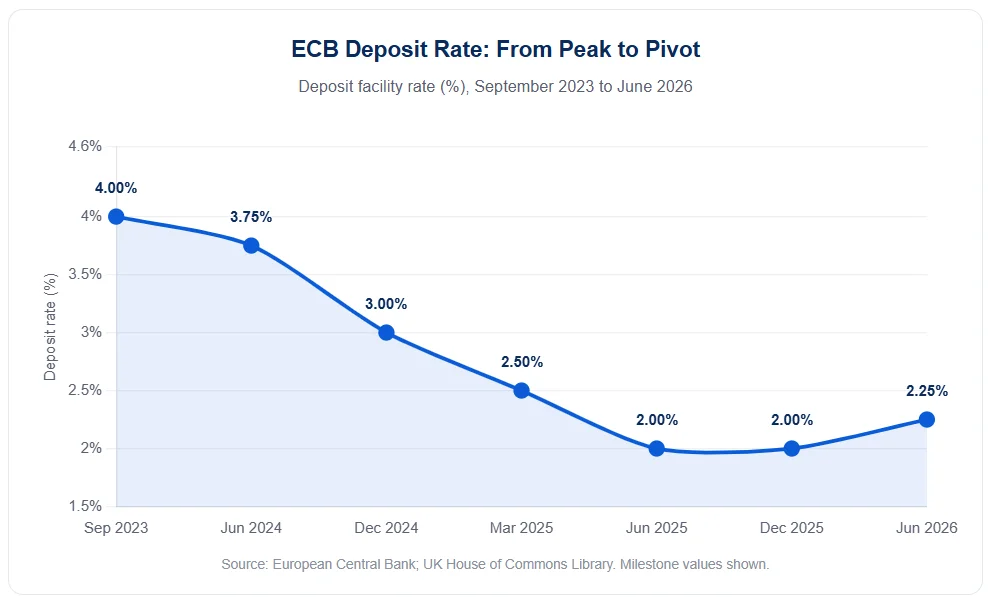
Two points stand out. First, the cutting cycle was deep and steady. Second, the new hike barely dents that easing. Still, direction matters more than size. A pivot signals to markets that the next phase could differ sharply from the last.
The Stagflation Tightrope
The ECB now faces an awkward mix. On one side, inflation runs hot. On the other, growth looks fragile. Consequently, the bank trimmed its 2026 growth forecast to 0.8%, down from 0.9%.
Its inflation projections also shifted higher. In the baseline, the ECB expects headline inflation to average 3.0% in 2026, 2.3% in 2027, and 2.0% in 2028. The next chart sets that path against expected growth.
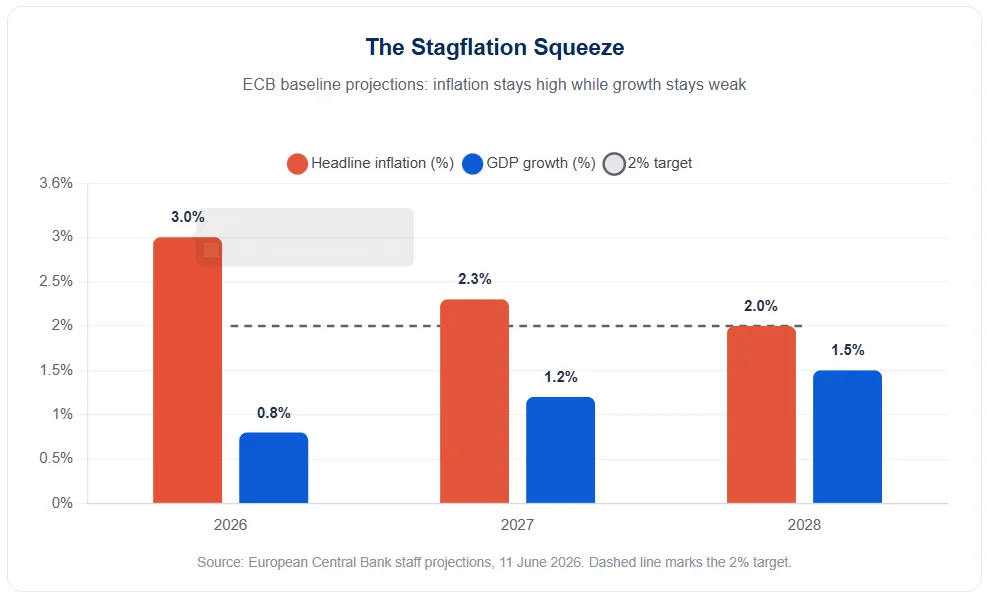
This combination explains the policy dilemma. Raise rates too hard, and weak growth could tip into recession. Move too slowly, and inflation could embed itself. Therefore, the ECB chose a small, defensive step.
Analysts disagree on what follows. Deutsche Bank’s Mark Wall expects one more hike in September, then a stop. By contrast, Governing Council member Joachim Nagel hinted that another increase could come as soon as next month.
How Rate Hikes Ripple Into Crypto and Risk Assets
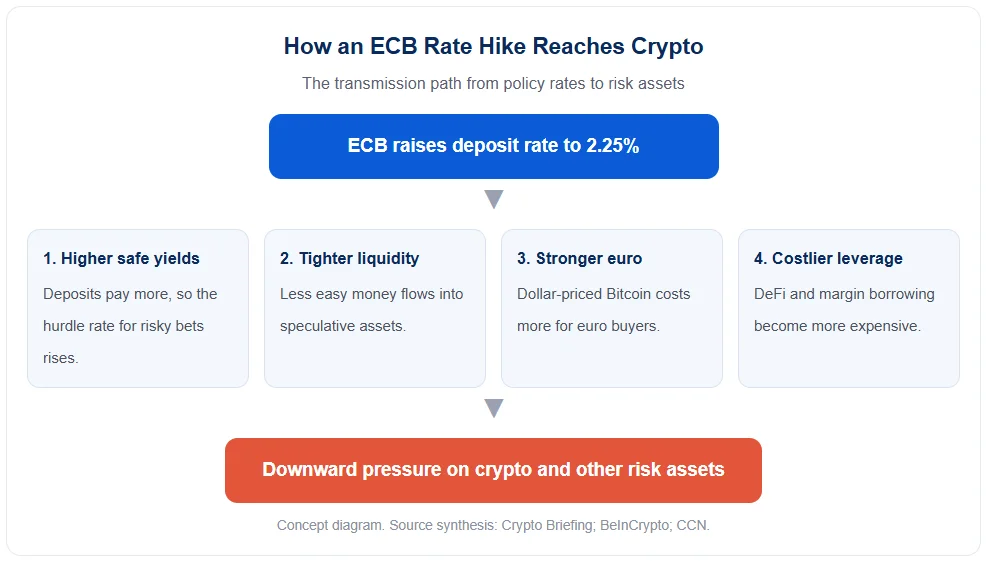
Higher rates rarely stay contained inside the banking system. Instead, they travel outward into asset prices. The diagram below maps the main channels.
The Opportunity-Cost Channel
When safe deposits pay more, speculative bets look less appealing. In other words, the “hurdle rate” rises. If investors can earn a risk-free rate of 2.25% or more on ECB-linked deposits, they demand greater potential gains from volatile assets.
Bitcoin offers no yield by design. Consequently, higher rates increase the opportunity cost of holding it. The same logic pressures growth stocks and other long-duration bets.
The Liquidity and Leverage Channel
Tighter policy also drains easy money from the system. Historically, the 2022 crypto winter coincided with aggressive rate hikes. Moreover, a stronger euro can make dollar-priced Bitcoin more expensive for European buyers.
Leverage adds another layer. Many DeFi platforms rely on cheap borrowing. As borrowing costs climb, that activity tends to cool.
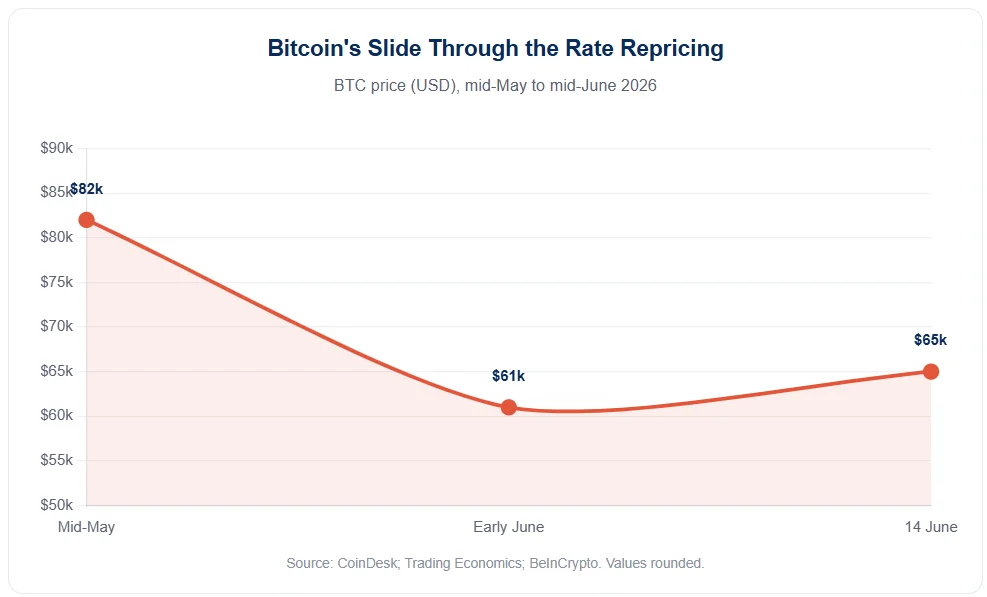
Yet the actual market reaction stayed calm. Because traders had already priced the hike in, crypto markets showed little concern. In fact, Bitcoin edged higher on the day, helped by softer US inflation data. The bigger move had come earlier: Bitcoin slid from about $82,000 in mid-May to the low $60,000s as hopes of rate cuts faded.
How the ECB Compares Globally
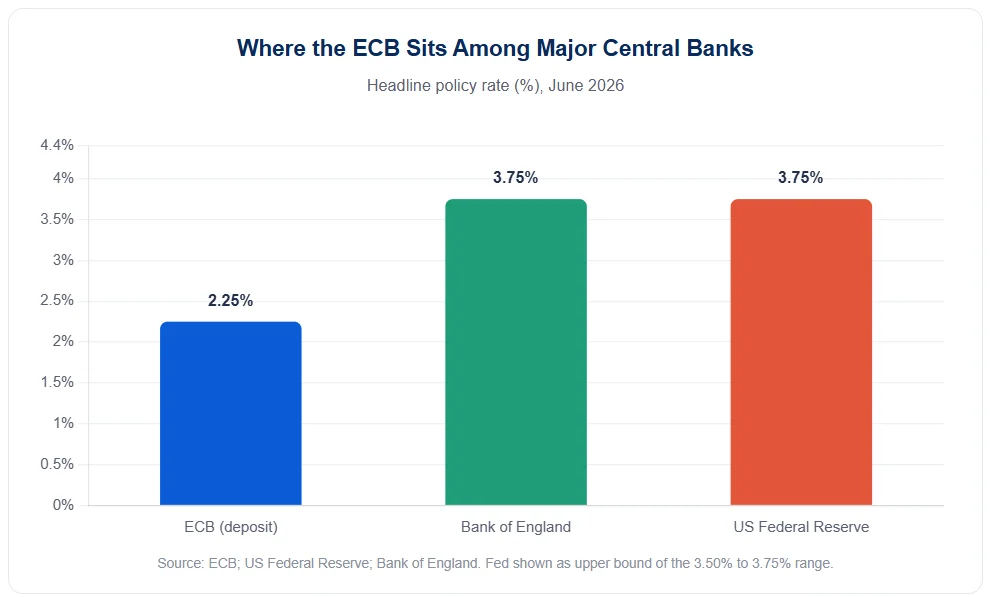
Context helps here. Even after the hike, the ECB remains the loosest of the three major central banks. The Federal Reserve is at 3.50%-3.75%, and the Bank of England is at 3.75%. Bitcoin, meanwhile, had already repriced through this cycle.
The crypto chart tells the parallel story. Bitcoin fell from roughly $82,000 in mid-May to the low $60,000s in early June before recovering to around $65,000. Notably, most of that drop came before the ECB even acted.
What Comes Next
Attention now turns to the data and the calendar. The ECB’s next scheduled meeting ends on 23 July. Until then, energy prices and the conflict in the Middle East will shape expectations.
The path depends on the shock’s persistence. If oil prices ease, the ECB may pause quickly. However, if the conflict drags on, further hikes become likely. For now, the bank has signalled vigilance without committing to a fixed route.
What This Means for Investors and Students
For investors, the lesson is about regime change. A central bank shifting from cuts to hikes alters the backdrop for nearly every asset. Therefore, watching the direction of policy often matters more than any single decision.
For students, the episode is a clean case study. It shows how a supply shock, in this case energy, can force a central bank to tighten even when growth is weak. Additionally, it demonstrates the link between interest rates and asset valuations.
One caveat deserves emphasis. This analysis is educational, not financial advice. Markets move on many factors at once, and past patterns never guarantee future results.
The ECB raised its deposit rate to 2.25% on 11 June 2026 because a widening conflict involving Iran disrupted global oil flows, sending energy costs up nearly 11% across the euro area. That pushed eurozone headline inflation to 3.2% in May, its highest level since September 2023 and well above the ECB’s 2% target. Core inflation also rose to 2.5%. Policymakers acted to prevent today’s shock from reshaping long-term price expectations, even as growth remained fragile at a forecast 0.8% for 2026.
Higher rates raise the opportunity cost of holding non-yielding assets like Bitcoin. When ECB linked deposits pay 2.25% or more risk-free, investors demand greater potential returns from volatile assets to justify the trade-off. Tighter policy also drains easy money from the system and raises borrowing costs on DeFi platforms that rely on cheap leverage. That said, because markets had fully priced in the June hike, the immediate reaction was muted, Bitcoin actually edged higher on the day. The bigger repricing had already happened: Bitcoin fell from around $82,000 in mid-May to the low $60,000s in early June as hopes of rate cuts faded.
The ECB’s next scheduled monetary policy meeting ends on 23 July 2026. Whether the bank hikes again or pauses will depend largely on energy prices and how the conflict in the Middle East evolves. Deutsche Bank expects one more hike in September followed by a stop, while ECB Governing Council member Joachim Nagel has hinted a further increase could come as early as July.