

Stocks rallied, then tumbled, as Democrats won Congress. Here is what a split Washington means for tariffs, the Fed, oil and crypto.
· Data as of 6 November 2026 close
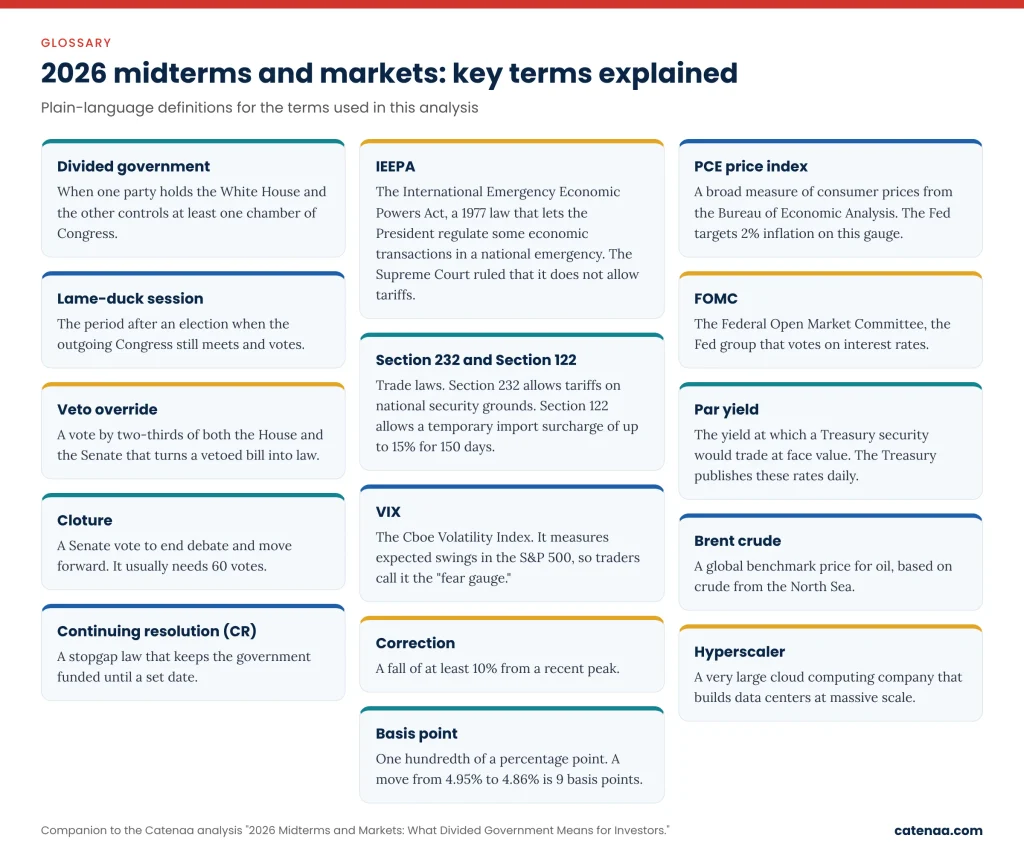
The 2026 midterms and markets collided in one of the wildest weeks of the year. Democrats won control of both the House and the Senate on 3 November, according to Fidelity’s post-election analysis. As a result, President Donald Trump will govern alongside a Democratic Congress from January. Stocks cheered first and then slumped. Meanwhile, oil fell, bond yields eased and bitcoin slipped. So what does a divided Washington really change for investors? This analysis explains the market moves, the balance of power and the historical record in plain language.
In Summary
The 2026 midterms and markets story so far: a relief rally, then a sharp AI sell-off. The S&P 500 rose 1.6% on 4 November and fell 4.36% the next day.
Divided government starts on 3 January 2027. Democrats will run Congress, but the President keeps the veto. Overriding it takes two-thirds of both chambers.
Tariff repeal is harder than it sounds. So far, the courts have done more than Congress to limit tariffs.
Oil and yields fell after the vote. Even so, inflation is 3.6%, and two Fed officials dissented in favor of a rate hike in October.
Crypto lost its fastest route to new law. The CLARITY Act stalled in September, so agencies now set most of the rules.
History favors stocks after midterms. All 19 midterms since 1950 were followed by 12-month gains. Still, history is a guide, not a guarantee.

What happened in the 2026 midterm elections
Voters handed Democrats both chambers of Congress. Fidelity’s Greg Lowman said the result “sets up divided government in 2027, with Democrats controlling Congress and Republicans the White House.” A few races are still being counted, so final seat totals may shift. However, the overall outcome is settled.
The new majority has already set out its agenda. On 4 November, House Democratic Leader Hakeem Jeffries announced his bid for Speaker in a letter to colleagues. In it, he put affordability first among three priorities. He also listed five working groups: housing, healthcare, groceries and goods, gas and utilities, and caregiving.
His first-100-days list matters most for markets. Jeffries wrote that House Democrats “must act to reverse the Medicaid cuts, restore SNAP funding, extend the Affordable Care Act tax credits, eradicate the Trump tariffs and stop the reckless war of choice in Iran.” That is an ambitious list. Yet, as we explain below, the President can veto almost all of it.
Timing matters too. Under the 20th Amendment, the terms of new members begin at noon on 3 January. Until then, the outgoing Republican-led Congress stays in charge.
How markets reacted to the 2026 midterm results
The first three trading days after the vote felt like a roller coaster. On election day, the S&P 500 closed at 7,568.92, according to Cboe index data. On Wednesday, it jumped 1.6% to 7,688.62. At the same time, the Cboe Volatility Index (VIX) fell to 16.61, a sign of calmer nerves.
Investors liked the clarity. “Markets like gridlock and that’s what we got,” said Jurrien Timmer, Fidelity’s director of global macro. Oil also helped. Charles Schwab reported that oil futures plunged about 8% that day. Traders expected a Democratic Congress to press the White House to end the war in Iran.
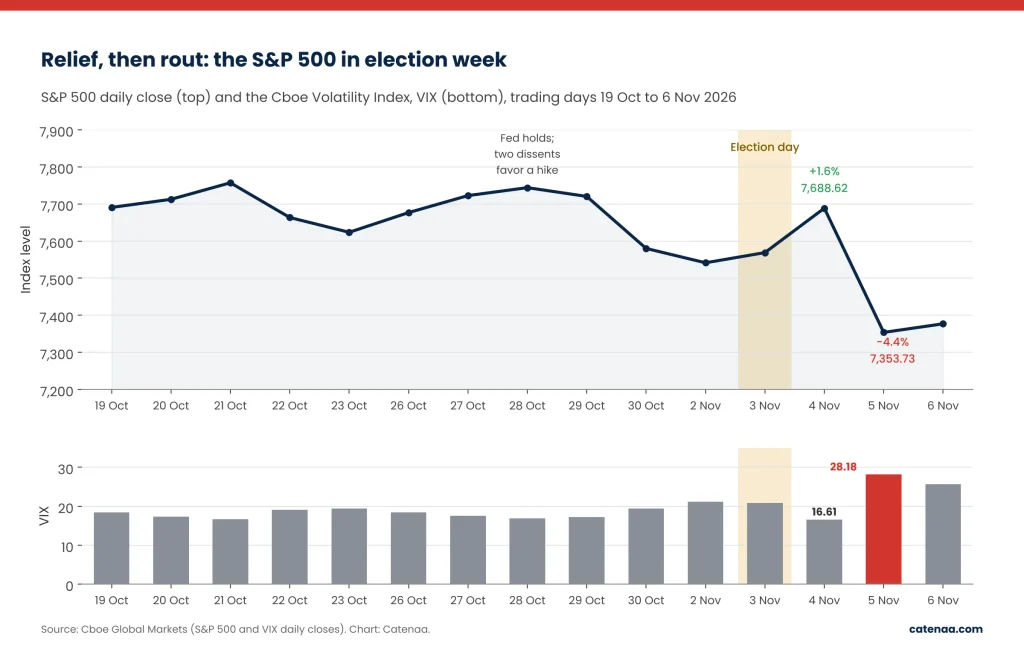
Then the mood flipped. On Thursday, the S&P 500 sank 4.36% to 7,353.73. The Dow lost 1,833.06 points, or 3.44%. Moreover, the Nasdaq Composite dropped about 5.5% and entered correction territory, roughly 12% below its record, according to Schwab. The VIX closed at 28.18, nearly 70% higher than a day earlier.
By Friday’s close, the S&P 500 stood at 7,376.86. That left it 5.7% below its 6 October record of 7,818.93. Even so, the index was still up 7.8% for 2026.
Why a Democratic Congress spooked AI and tech stocks
The Thursday sell-off had a clear political trigger. According to Schwab, the drop “was fueled by fears a Democratic Congress could more strictly regulate data centers, with some profit-taking likely contributing.” Nathan Peterson of the Schwab Center for Financial Research put it simply: “the blue sweep just exacerbated that concern.”
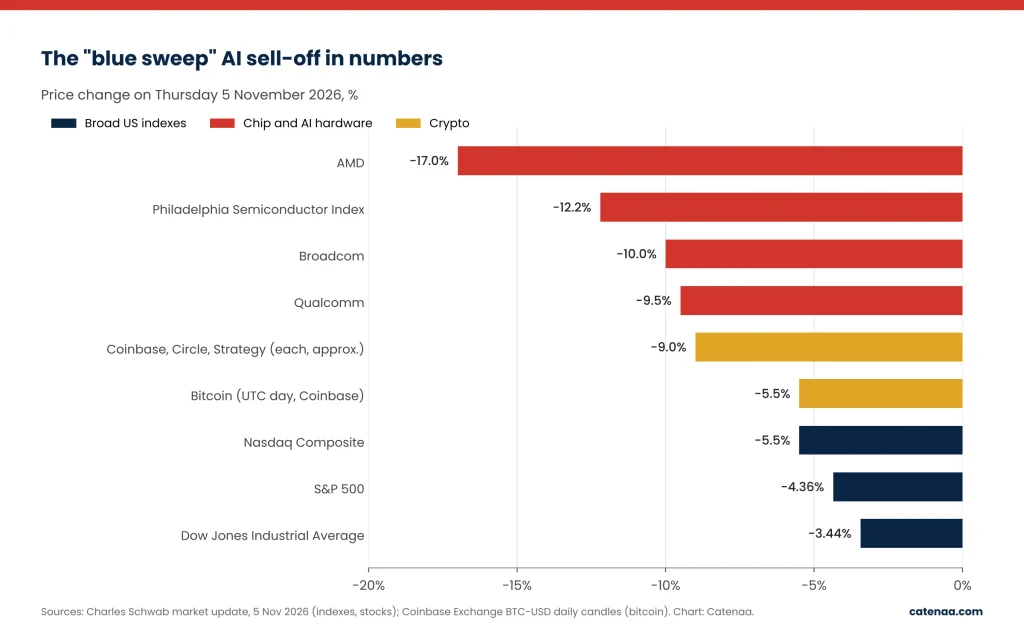
Note the word “exacerbated.” Investors already had doubts about AI spending. Schwab noted worries about returns at big cloud companies, many of which “have turned free cash flow negative.” In other words, the election did not create the fear. Instead, it gave nervous investors a reason to sell.
Chip stocks took the brunt. The Philadelphia Semiconductor Index fell 12.2%, and AMD lost 17%. Broadcom dropped 10%, while Qualcomm fell 9.5%. By contrast, the Dow, with fewer tech names, fell less.
Is the fear justified? Partly. A Democratic Congress can hold hearings, issue subpoenas and slow Senate confirmations. However, any new AI law would still need the President’s signature. Therefore, the bigger near-term risk is headline pressure, not sweeping legislation.
Divided government explained: who controls what in 2027
To see how the 2026 midterms and markets connect, it helps to map who holds each lever. The diagram below shows how power splits across the White House, Congress, the Federal Reserve and the courts.
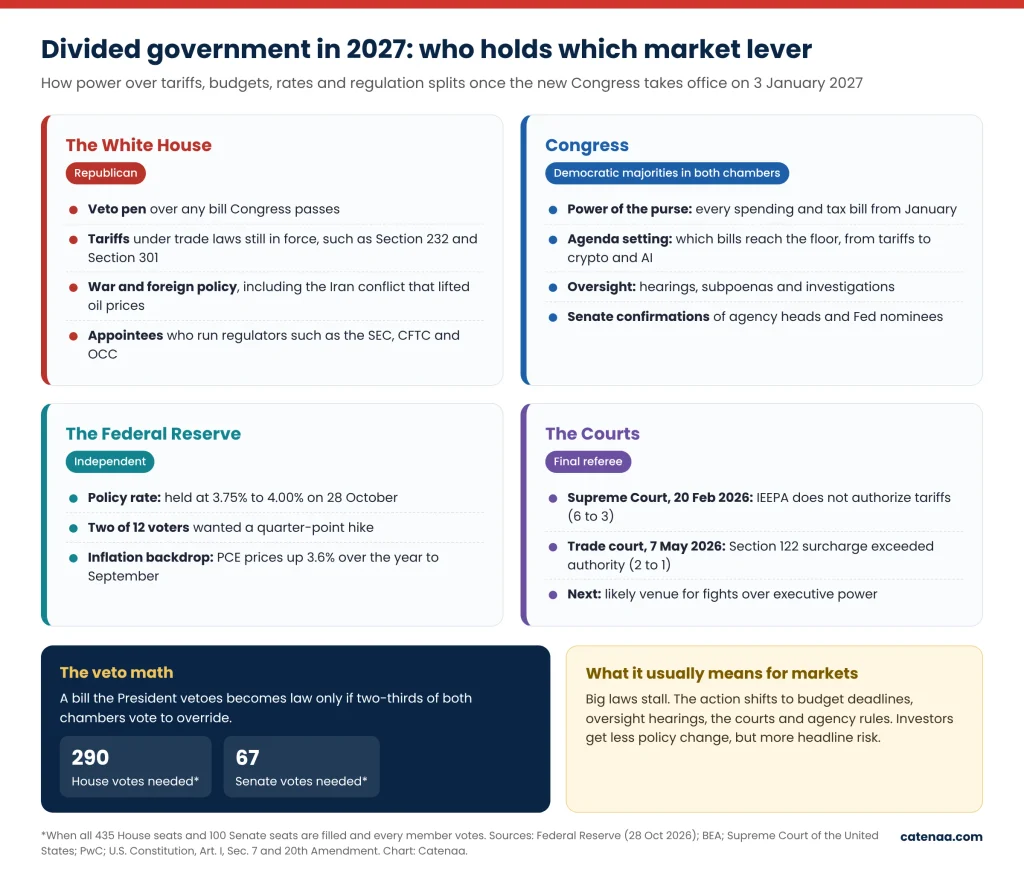
The key rule comes from Article I, Section 7 of the Constitution. A vetoed bill becomes law only if two-thirds of both chambers vote to override. With every seat filled, that means 290 House votes and 67 Senate votes. The new Democratic majorities fall well short of those levels. As a result, both sides need each other to pass anything big.
Tariffs after the midterms: why repeal is harder than it sounds
Tariffs were a central campaign theme. Yet the courts have shaped them more than Congress has. On 20 February 2026, the Supreme Court ruled in Learning Resources, Inc. v. Trump that the International Emergency Economic Powers Act (IEEPA) “does not authorize the President to impose tariffs.” The vote was 6 to 3.
The White House then switched tools. It imposed a 10% surcharge on all imports under Section 122, starting on 24 February. That law caps such duties at 150 days, so the surcharge was due to expire on 24 July, notes Global Trade Alert. Before that deadline, the Court of International Trade weighed in. On 7 May, it ruled 2 to 1 that the surcharge also exceeded the President’s authority, PwC reports.
However, these rulings left sector tariffs under Section 232 untouched. Those duties cover steel, aluminum, copper, lumber and autos, among others. Democrats now want to “eradicate the Trump tariffs.” Yet a repeal bill would face a near-certain veto. For that reason, investors should not price in fast tariff relief from Congress. Courts, trade deals and expiring authorities remain the likelier paths.
Oil, inflation and the Fed after the election
Energy prices were a big part of the campaign backdrop. US Energy Information Administration (EIA) data show Brent crude jumped from $77.24 on 2 March to $126.69 on 31 March. It then peaked at $138.21 on 7 April. In September, US gasoline averaged $4.35 a gallon, according to the EIA’s Short-Term Energy Outlook.
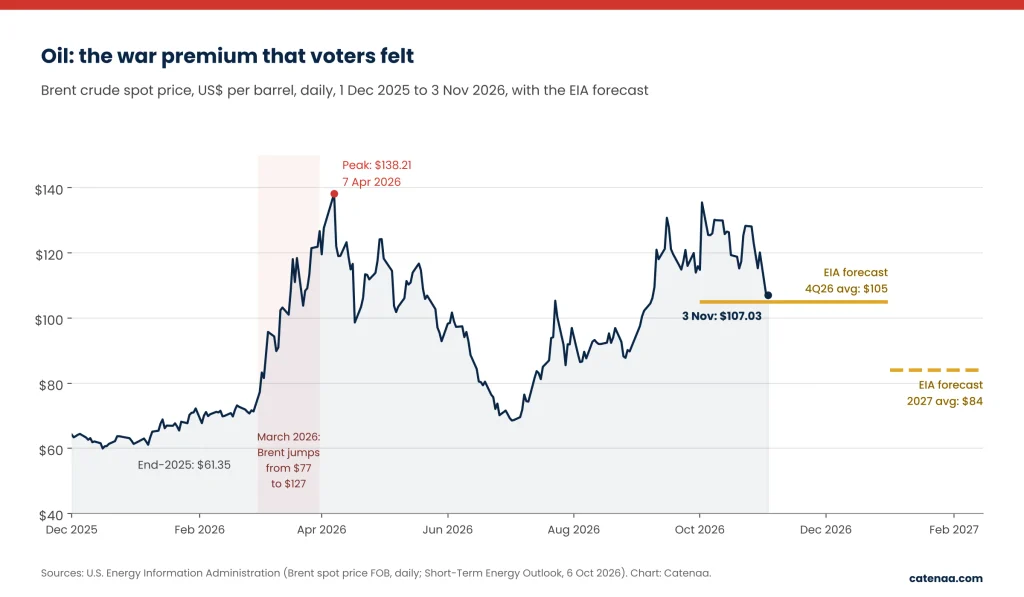
Brent stood at $107.03 on election day. Looking ahead, the EIA expects it to average $105 in the fourth quarter and $84 in 2027. Its forecast assumes Middle East exports recover gradually, helped by convoys through the Strait of Hormuz and bypass routes.
Inflation, however, remains the bigger story for the Fed. The PCE price index rose 3.6% over the year to September, up from 3.4% in August. That is well above the Fed’s 2% goal. On 28 October, the Fed held its policy rate at 3.75% to 4.00% in a 10 to 2 vote. Notably, Lisa Cook and Beth Hammack preferred a quarter-point hike. The statement also said, “The Committee will deliver price stability.”
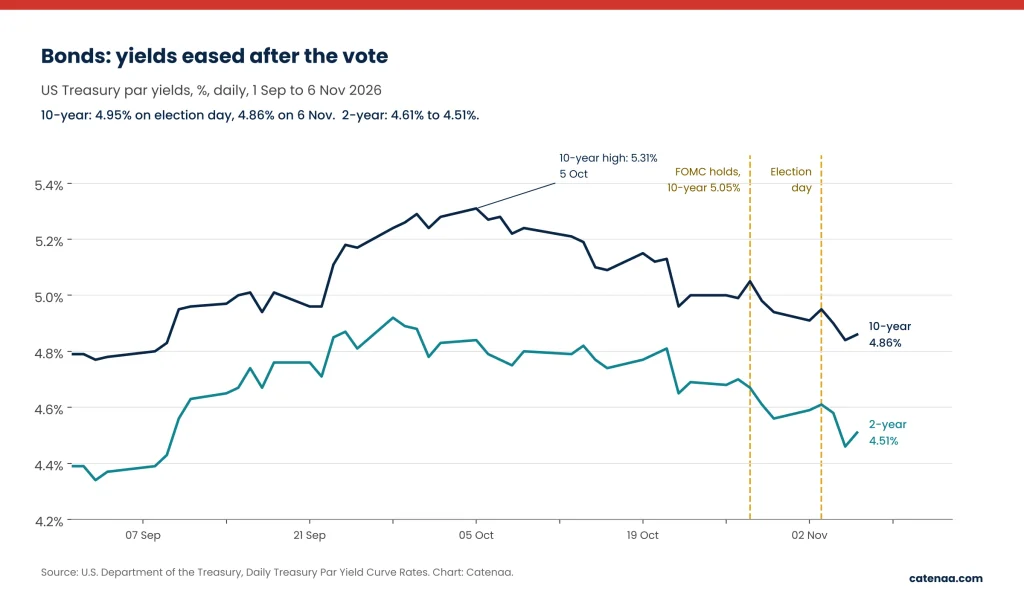
Bond markets responded quickly. The 10-year Treasury par yield fell from 4.95% on election day to 4.86% on 6 November. Over the same days, the 2-year yield slid from 4.61% to 4.51%. Market-implied odds of a December hike also fell, Schwab reported. They stood at 67% late on 5 November, down from around 80% before the sell-off.
Why the shift? Lower oil eases price pressure. In addition, gridlock usually means less new fiscal stimulus. Both effects can cool inflation at the margin. Even so, the Fed sets rates on data, not elections. The Senate also confirms Fed nominees, so a Democratic Senate will vet any new picks from January. The Fed itself is now led by Chairman Kevin Warsh.
What the midterms mean for crypto regulation
Crypto had hoped for a durable law on market structure. The House passed the CLARITY Act on 17 July 2025 by 294 to 134, with 78 Democrats voting yes. However, the bill stalled in the Senate. On 15 September 2026, a Senate cloture vote on the motion to proceed failed 49 to 50. That left it 11 votes short of the 60 needed, Troutman Pepper Locke notes.
Bills that do not pass by the end of a Congress expire. So, any new version would have to start again in 2027 under Democratic committee chairs. Meanwhile, regulators are filling the gap. The SEC proposed “Regulation Crypto Assets” on 18 August 2026. The CFTC is also exploring rules under its existing powers.
Markets read the shift quickly. Bitcoin fell 5.5% on 5 November, to $75,969, based on Coinbase Exchange daily data (UTC). Coinbase, Circle and Strategy shares each fell about 9%, according to Schwab. The lesson is simple. Agency rules can change with each administration, whereas laws are far harder to undo.
Do stocks rise after midterm elections? What history says
History offers some comfort for anyone weighing the 2026 midterms and markets. We calculated S&P 500 price changes using Robert Shiller’s long-run market data. We measured from the October average of each midterm year to the October average a year later.
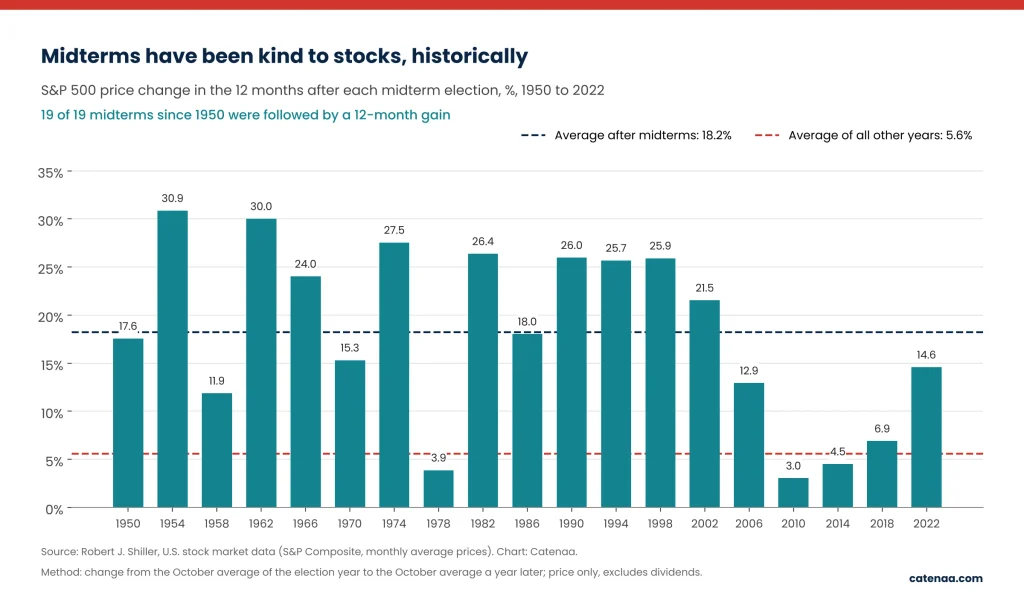
The results are striking. All 19 midterms since 1950 were followed by a 12-month gain. The average rise was 18.2%, compared with 5.6% for all other years. Even the weakest case, after 2010, still delivered 3.0%.
Still, treat this pattern with care. Nineteen cases is a small sample. Our figures also exclude dividends and use monthly averages. More importantly, 2026 has unusual features: inflation near 3.6%, a Fed debating hikes, an oil shock and heavy reliance on AI stocks. Consequently, history sets a hopeful baseline, but it cannot replace analysis.
The lame-duck session: four dates investors should watch
- 25 November: The BEA releases October PCE inflation. This is the Fed’s preferred price gauge.
- 8 and 9 December: The Fed’s final 2026 meeting, with fresh economic projections.
- 11 December: Government funding runs out. Congress cleared a stopgap through that date in early September, CRFB reports. Without a new deal, a shutdown could follow.
- 3 January 2027: New members take office, and divided government begins.
The funding fight deserves attention. Jeffries’s letter recalls a 43-day shutdown during the current Congress. A repeat would add another layer of uncertainty to markets.
What investors can learn from the 2026 midterms
Looking at the 2026 midterms and markets together, four practical lessons stand out. First, separate noise from policy. Big legislative change is hard when a veto stands in the way. Second, watch the Fed and inflation more closely than Congress. Rates still drive valuations across stocks, bonds and crypto. Third, check your concentration risk. The 5 November sell-off showed how much index returns now depend on a narrow group of AI and chip stocks. Finally, expect more headline risk. Oversight hearings and subpoenas can move single stocks, even when no law changes.
This analysis is for education only and is not investment advice. Always consider your own goals and risk tolerance.