

The TRON network Q2 2026 data show a chain handling record transaction volumes while charging far less per transfer. Here is who pays, who gains, and what it means for TRX.
In Summary
USDT on TRON rose 4.0% to $88.0bn in Q2 2026, while USDT across all chains grew just 0.4%.
TRON’s share of all dollar stablecoins climbed from 27.4% to 28.8% in the quarter, and to 30.3% by 19 September.
A 2025 energy price cut halved the burn-paid cost of transfers. Together with more use of staked energy, that helped cut TRX fees burned by 45.7% year on year to $89.7m.
Only about 12% of the TRON DAO’s $722m revenue figure was TRX actually burned; the rest appears to value staked energy.
TRX supply grew by about 86.9m tokens in Q2, so the token is now mildly inflationary.
USDT is 98.6% of stablecoins on TRON, which ties the network closely to Tether’s reserves and US rules.

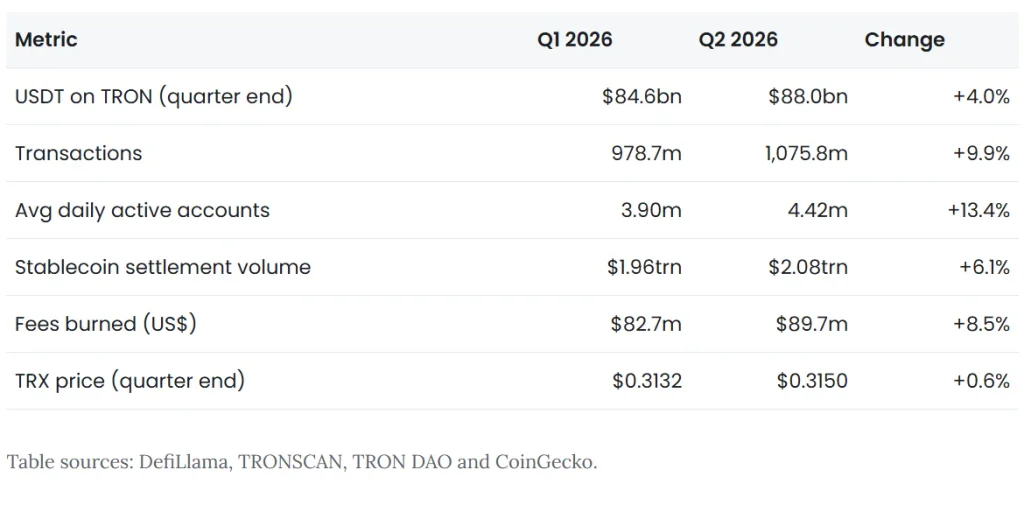
The TRON network Q2 2026 results show a blockchain that kept growing while the wider stablecoin market shrank. USDT on TRON rose 4.0% in the quarter to $88.0bn, according to DefiLlama data on Tether. Across all chains, USDT supply grew just 0.4%, and total stablecoin supply fell 1.1%. In other words, TRON took share in a flat-to-falling market.
However, the story has a second half. The fees TRON users actually burned fell 45.7% from a year earlier. So the network processes more transactions than ever, yet it charges far less for each one. This analysis explains how the rail works and who pays for it. It also shows why that matters for TRX holders.
TRON network Q2 2026 at a glance
First, the scorecard. TRONSCAN data show the TRON network processed 1.08bn transactions in Q2 2026, up 9.9% on the quarter and 37.1% on the year. Average daily active accounts rose 13.4% to 4.42m. The TRON DAO Q2 2026 report puts stablecoin settlement volume at $2.08trn, up from $1.96trn in Q1.
Meanwhile, the token itself barely moved. TRX closed the quarter at $0.3150, a gain of 0.6%, based on CoinGecko price data. That flat result looks strong beside bitcoin. Based on the Bloomberg closing prices cited in Tether’s reserve reports, bitcoin fell about 14% in the quarter. By 19 September, TRX traded near $0.339, giving it a market value of roughly $32.2bn.
Why TRON gained stablecoin market share as the market shrank
The key shift in the TRON network’s Q2 2026 data happened between TRON and Ethereum. On Ethereum, USDT supply slipped from $80.5bn to $78.8bn during Q2. On TRON, it climbed from $84.6bn to $88.0bn. As a result, TRON’s share of all USDT rose from 45.9% to 47.6%. By 19 September, it passed half, at 50.5%.
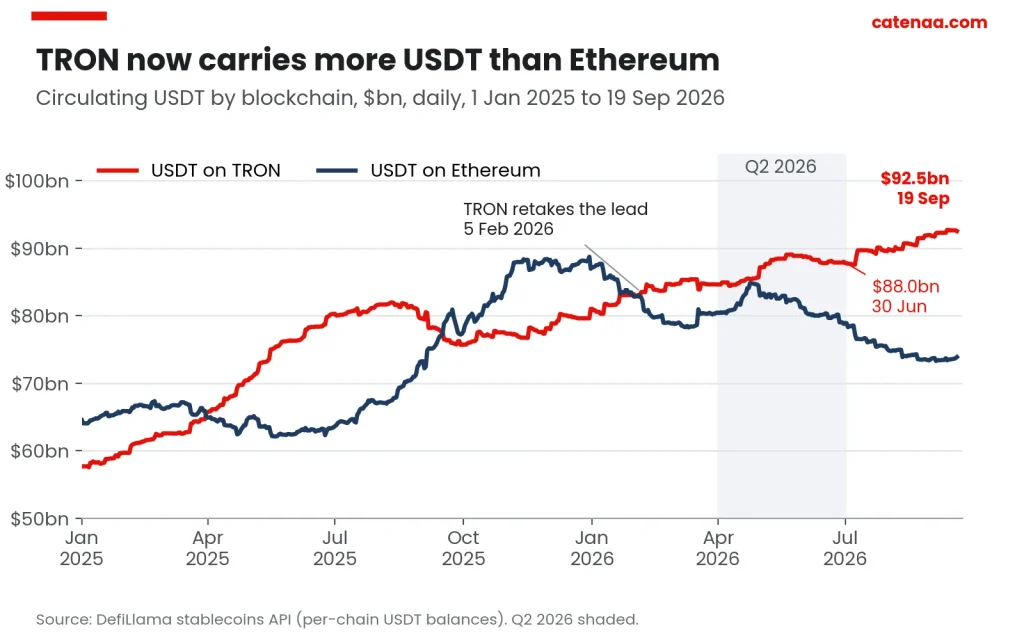
This was not always the case. Ethereum carried more USDT from mid-September 2025 until late January 2026. After a brief swap, TRON has led every day since 5 February. The broader picture tells the same story. TRON’s share of all dollar stablecoins rose from 27.4% in March to 28.8% in June. By 19 September, it had reached 30.3%.
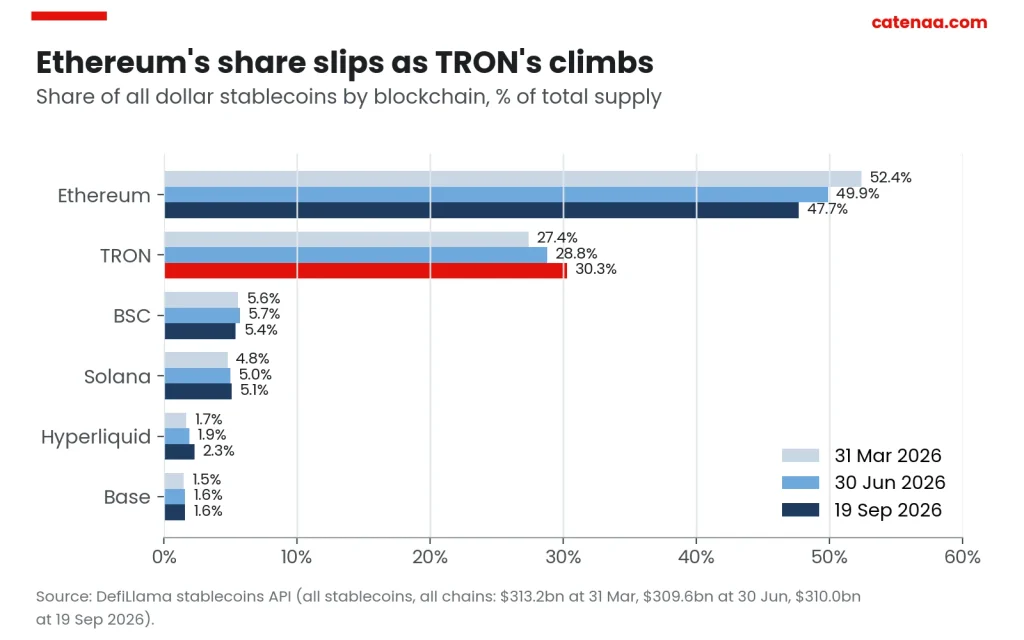
Why does this matter? Relatively little of TRON’s dollar supply sits in DeFi apps. DefiLlama puts TRON’s DeFi total value locked at about $4.4bn at the end of June, against $88bn of USDT. Most of the rest likely moves between wallets, exchanges and payment firms. Consequently, TRON’s growth points to demand for transfers and settlement, not just crypto trading.
How TRON’s energy price cut changed its fee economics
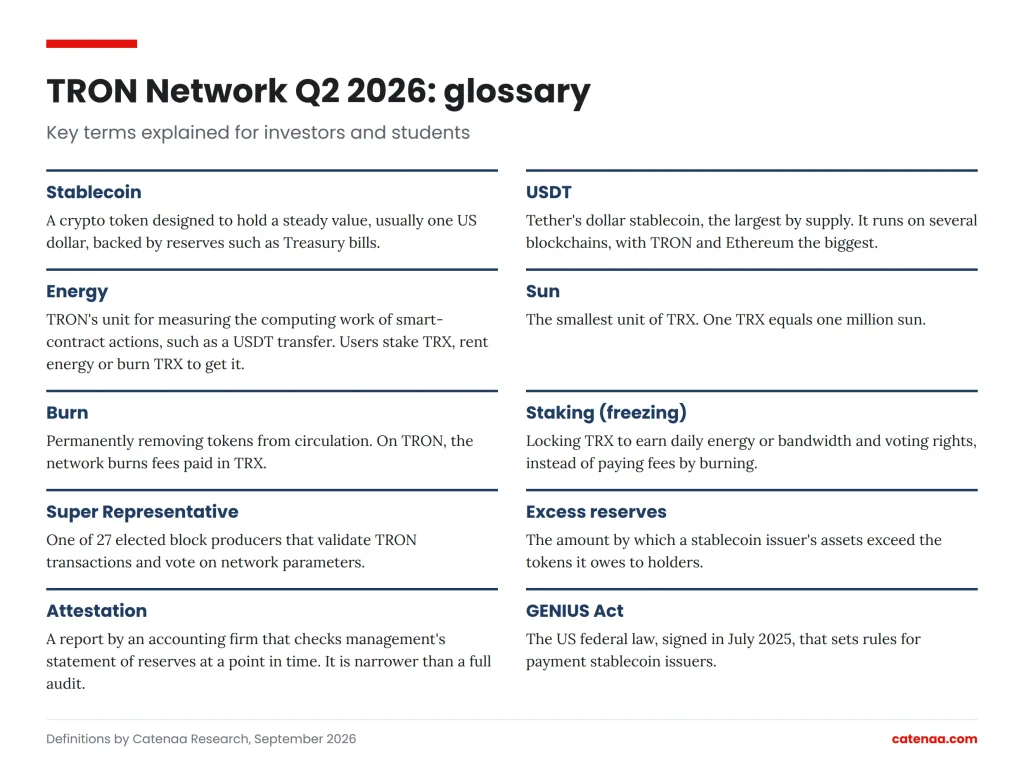
To understand the TRON network’s fees in Q2 2026, start with its resource model. Every smart-contract action, including a USDT transfer, consumes a unit called energy. Users can get energy in two main ways. They can freeze (stake) TRX to earn a daily energy allowance, or rent it from stakers. Alternatively, they can burn TRX to pay on the spot. The TRON developer documentation describes both routes.
In August 2025, validators changed the price. Proposal #104 cut the energy price from 210 sun to 100 sun per unit, a 52.4% reduction. It took effect around 29 August 2025. One sun is a millionth of a TRX. Because the energy price halved, the burn-paid cost of a USDT transfer also halved.
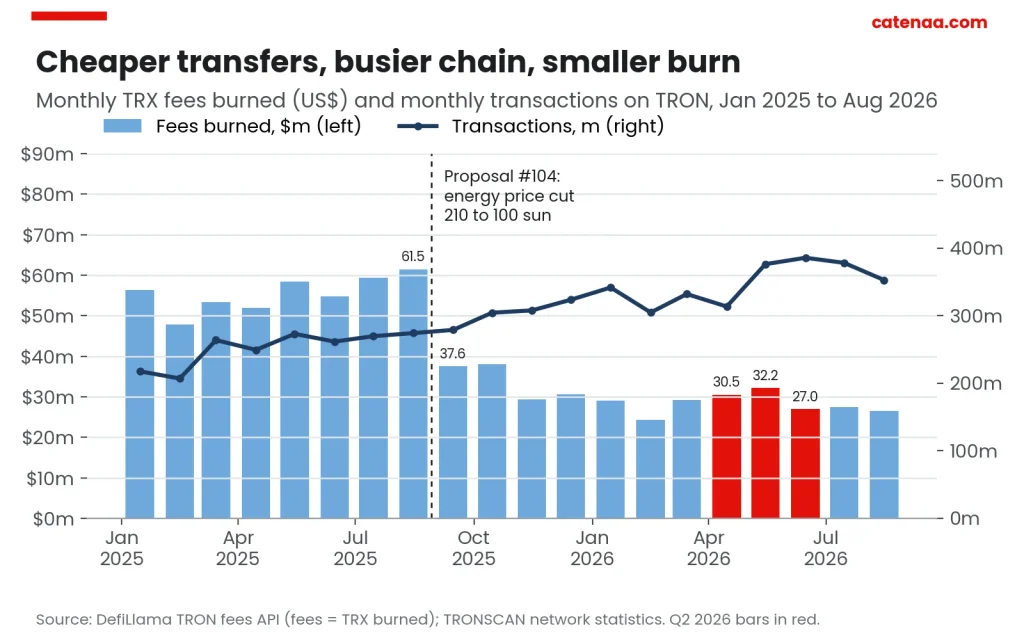
The effect was immediate. Monthly fees burned fell from $61.5m in August 2025 to $37.6m in September, based on DefiLlama TRON fee data. Activity, on the other hand, kept rising. Monthly transactions climbed from about 274m in August 2025 to 386m in June 2026. Lower costs likely supported that growth, although transactions were already rising before the cut. Five months later, TRON also regained the USDT lead from Ethereum.
The cost shows up in the fee line. During Q2 2026, TRON network users burned $89.7m worth of TRX, up 8.5% on Q1. Yet that was 45.7% below the $165.2m burned in Q2 2025. Put simply, TRON now burns less TRX per transaction: about $0.08 of fees in Q2 2026, against about $0.21 a year earlier. It relies on volume growth to make up the gap.
Who pays for a USDT transfer on TRON?
This question sits at the heart of TRON’s numbers, because headline revenue figures can mislead. A standard USDT transfer to an address that already holds USDT uses about 64,285 energy. A transfer to a brand-new holder uses about 130,285. At 100 sun, those cost 6.43 TRX and 13.03 TRX if paid by burning. At the quarter-end TRX price, that is roughly $2.02 and $4.10, before bandwidth charges.
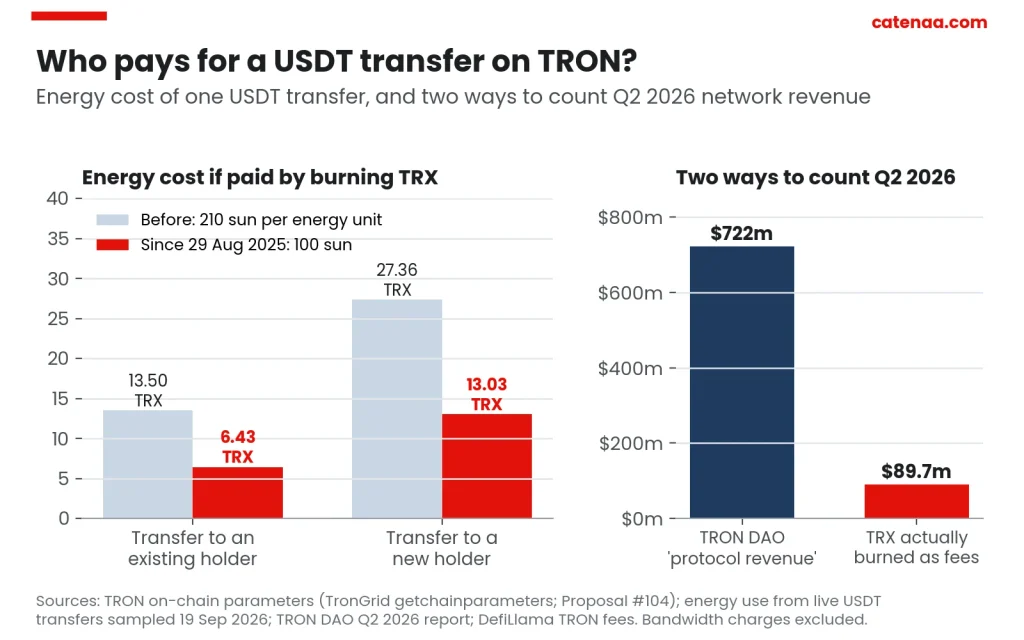
In practice, most heavy users do not burn. Exchanges, payment firms and wallet providers stake TRX or rent energy from those who do. Catenaa checked 40 live USDT transfers, all from a single moment on 19 September. Only 3 burned TRX for energy. The rest used staked or rented energy. Treat this as an illustration rather than a measurement.
That explains the gap between two numbers. The TRON DAO reports $722m of “fee revenue” for Q2, up from $604m in Q1. By its own account, that growth was “primarily fueled by an increase in staking for energy”. Yet the same report says TRX staked for energy fell 2% in the quarter. The DAO also does not publish its method. In contrast, users burned only $89.7m of TRX to pay fees. The first figure appears to include the value of staked resources used. The second captures fees actually removed from supply. Investors should not treat them as the same thing.
TRX supply: from deflation to mild inflation
For TRX holders, the TRON network’s Q2 2026 burn figures matter because burning removes tokens from supply. Meanwhile, the network mints new TRX as rewards for block producers and voters. When burns exceed new issuance, supply shrinks. Throughout the first three quarters of 2025, that is what happened.
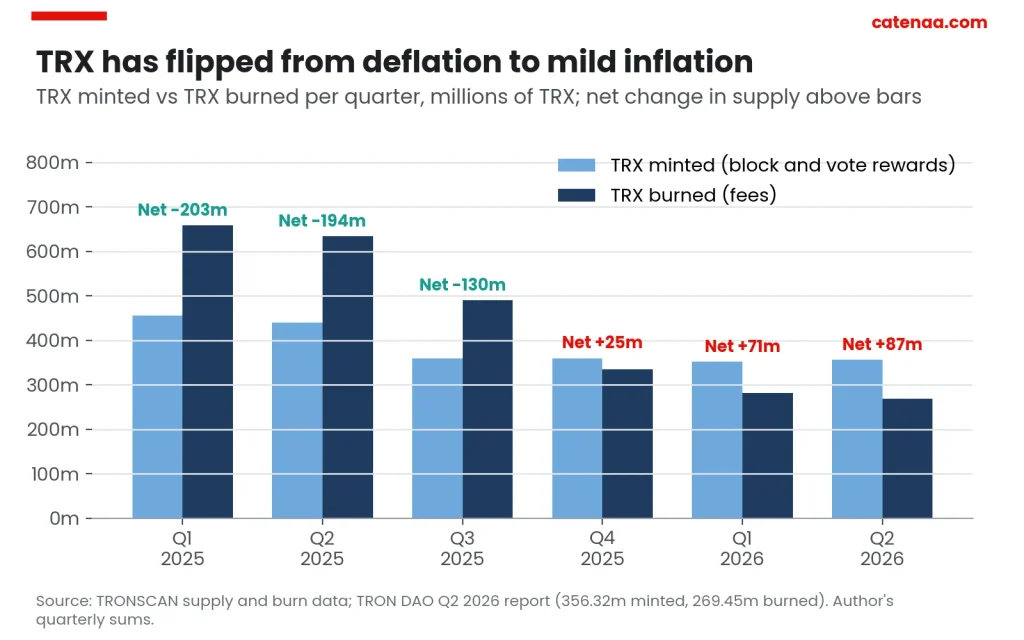
Since the fee cut, the balance has flipped. In Q2 2026, the TRON network minted 356.3m TRX and burned 269.5m, so supply grew by about 86.9m TRX. The TRON DAO report shows the same figures. That is inflation of about 0.37% a year, which is modest. Still, it reverses the deflationary story that once supported the token.
Earlier, validators had already trimmed issuance. Under Proposal #102, effective 13 June 2025, block producer rewards fell from 16 to 8 TRX per block. Voter rewards fell from 160 to 128 TRX per block. Even so, the later fall in burns outweighed those cuts. Separately, holders had staked 48.2% of TRX supply by the end of June. That reduces the float available to trade.
The concentration risk: one issuer, one asset
The TRON network’s Q2 2026 growth also highlights its main exposure. USDT made up 98.6% of all stablecoins on TRON at the end of June. Consequently, Tether’s balance sheet, regulators and business choices shape TRON’s future.
Tether’s latest BDO-attested reserves report shows $187.8bn of assets against $183.6bn of liabilities at 30 June 2026. That leaves $4.11bn of excess reserves, down from $8.23bn in March, as shown in the Q1 report. The report’s equity table shows a financial result of minus $3.17bn for the first half of 2026. The Q1 report had shown a positive result of $1.04bn, which implies a second-quarter loss of about $4.2bn. Meanwhile, Tether’s own press release cites a $1.5bn “net operating profit” for the quarter. It also points to “significant volatility across gold and Bitcoin”. The two figures measure different things, and Tether publishes no reconciliation. Either way, the thinner buffer is worth watching.
Regulation adds a second layer. The US GENIUS Act became law on 18 July 2025. Under the statute text, it takes effect on 18 January 2027, or 120 days after final rules if that comes sooner. From 18 July 2028, US digital asset service providers may only offer payment stablecoins from permitted issuers. Foreign issuers from comparable regimes have a separate route. Tether has prepared a US route. In January 2026 it launched USAT, a separate US-regulated stablecoin issued by Anchorage Digital Bank. However, that launch does not cover USDT, the token that runs on TRON.
Compliance is the third layer. Because a central issuer controls USDT, it can freeze tokens. Tether, TRON and TRM Labs run a joint T3 Financial Crime Unit. By May 2026, it had frozen more than $450m. For legitimate users, that is reassuring. For TRON, however, it shows that the chain’s main asset answers to an off-chain authority. Governance power also sits in few hands. According to the TRON DAO report, the top 11 Super Representatives hold 60% of voting weight.
TRON outlook for H2 2026: what to watch
So far, the second half has extended the TRON network’s Q2 2026 trend. USDT on TRON reached $92.5bn on 19 September, and TRON’s stablecoin share rose to 30.3% on 19 September, close to its highest level since August 2025. Four signals will decide whether that growth also rewards TRX holders.
- Fee capture. Watch whether fees burned grow with volume. If transfers rise but burns stay near $30m a month, TRX remains mildly inflationary.
- Governance changes. Validators can raise or cut the energy price again. Any change would reset the trade-off between cost and burn.
- Tether’s reserves. The next attestation will show whether the excess buffer rebuilds from $4.11bn.
- US rules. Final GENIUS Act regulations will shape how US platforms can list USDT, and therefore how much volume stays on TRON.
In short, TRON has become one of the busiest dollar rails in the world. It won that role by being cheap and dependable. The open question is whether a rail that competes on price can also reward its native token.
Frequently asked questions
How much USDT is on the TRON network?
DefiLlama data show $88.0bn of USDT on the TRON network at the end of Q2 2026, up 4.0% on the quarter. By 19 September 2026, the figure had reached $92.5bn, about half of all USDT in circulation.
Why are TRON fees lower in 2026?
TRON validators passed Proposal #104 in August 2025. It cut the energy price from 210 sun to 100 sun per unit. That halved the burn-paid cost of a USDT transfer. Along with wider use of staked energy, it helped push fees burned in Q2 2026 45.7% below a year earlier.
Is TRX inflationary or deflationary?
TRX was deflationary through most of 2025, when burns exceeded new issuance. Since Q4 2025 it has been mildly inflationary. In Q2 2026, net supply grew by about 86.9m TRX, or roughly 0.37% a year.