

The same dollar can exist as dozens of contracts, across dozens of networks, under different bridge assumptions and legal wrappers. Stablecoin fragmentation is no longer a technical footnote. It is a liquidity, security, compliance and execution problem.
717
Stablecoin deployments counted by RWA Foundation.
189–193
Distinct stablecoin assets in late-August/September reports.
$307.1B
Stablecoin market cap tracked by DeFiLlama.
78.5%
Share of tracked supply on Ethereum + Tron, our calculation.
RWA Foundation data reported by Crypto Briefing; DeFiLlama stablecoin market data, accessed 5 October 2026. The 78.5% Ethereum + Tron share is calculated from DeFiLlama figures.12
One dollar should be one dollar. Crypto has managed to turn it into hundreds of separate markets.
The RWA Foundation’s latest count of 717 stablecoin deployments sounds, at first, like a simple adoption statistic. It is considerably more candid than that. In the late August and September reports, there were only approximately 189 to 193 unique stablecoin assets, which suggests that each asset has been deployed approximately 3.7-3.8 times if the two totals are mechanically averaged.1 The arithmetic does not accurately represent the actual distribution, as major tokens are deployed more broadly than small ones. However, it does illustrate the structural point the industry is multiplying representations at a faster rate than it is multiplying monetary units.
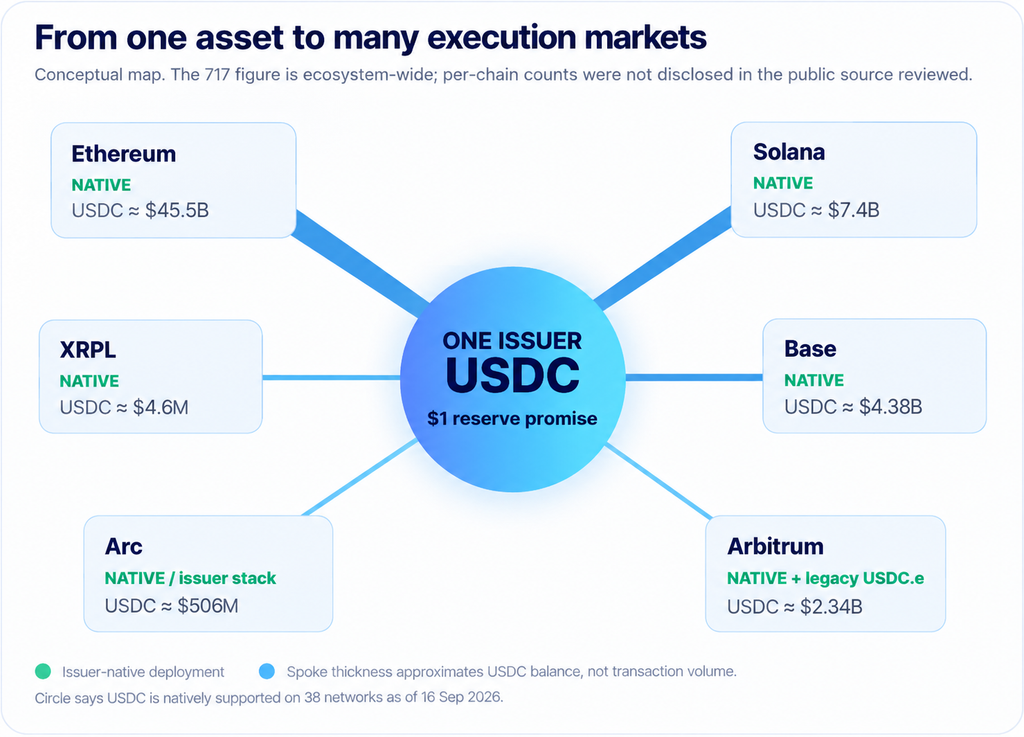
That leads to a paradox. Even if the market around the promise stays the same (one coin can be exchanged for one dollar), the promise itself can stay the same. An Ethereum, Solana, Base, XRPL, or Arc stablecoin is part of a different pool of liquidity. It can be used for different things and has different transaction costs, bridge routes, and sometimes a different regulatory path. The setting where the code is run is different from the ticker.
The useful unit of analysis is no longer “USDC” or “USDT.” It is issuer × legal entity × chain × token representation × venue.
For traders, that tells them how fast they can enter or leave a size. For treasurers, it tells them where to keep their working cash. It changes which infrastructure gets fees from investors. For regulators, it brings up a tougher question: which version of the economic claim is being offered when it moves between contracts and jurisdictions?
What 717 deployments actually means
The stable coin itself is an asset. A deployment is a copy of that asset that is used in a certain blockchain or infrastructure environment. This is important because each operation can have its own contract, integrations, exchange listings, liquidity providers, and way to send money across chains. The public report doesn’t give a good breakdown of the 717 deployments chain by chain, so this study doesn’t make one up.1
There are two ways to read the number. The upside is that stablecoins are spreading and are now commonly used for payment on more blockchains. The market-structure view is fragmentation: each new deployment makes a new spot where liquidity needs to be added, market makers need to keep inventory, and users need to know exactly what they bought.
Both interpretations can be true at the same time.
The stablecoin market is multi-chain but liquidity is not evenly distributed
DeFiLlama was keeping track of about $307.1 billion worth of stablecoins. A little over $146.3 billion was in Ethereum, and $94.8 billion was in Tron. Based on our calculations, that’s about 78.5% of the market as a whole. Next came Solana with $16.6 billion, then BNB Chain with $13.3 billion, Base with about $5.2 billion, XRPL with $1.32 billion, and Arc with about $512 million.23
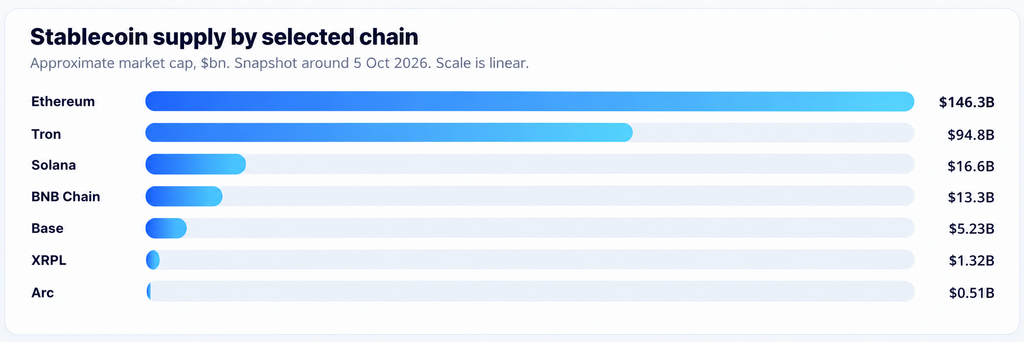
There is a lesson in the linear scale. Arc can be important from a strategic point of view even if it is not as liquid as Ethereum. XRPL can grow quickly even if it doesn’t give people as many ways to leave. Base can have a big and busy application economy and still make up less than 2% of the stablecoin supply.
For that matter, chain supply is just a rough guess. A trader doesn’t bet against the whole market value of all the stablecoins on a chain. Execution takes place in a specific pool, order book, or lending venue. It can be easy to make a $1 million move, but it costs a lot to make a $1 million swap into a thin pair. So, “How many stablecoins are on this chain?” but “How much depth exists in the exact contract and venue I need to exit?”
“The same stablecoin” can mean three different things
1. Native
Issuer-native token
The issuer mints the stablecoin directly on the destination chain. Circle says USDC is natively supported on 38 networks. With CCTP, supported transfers burn native USDC on the source chain and mint native USDC on the destination, avoiding a separate wrapped IOU.12
2. Wrapped
Bridged representation
A bridge can lock or otherwise account for an original asset and issue a representation elsewhere. On Arbitrum, for example, native USDC and the older bridged USDC.e have co-existed; Circle explicitly distinguishes the two and does not issue USDC.e.13
3. Regulatory
Same currency, different legal issuer
Regulation can create another layer of “sameness.” AllUnity launched USDAU on 30 Sep 2026 as a fully reserved MiCAR compliant USD e-money token. It targets the same $1 unit as USDC or USDT, but it is a different issuer, reserve pool and legal claim.14
Why the distinction matters
A wallet can show “$1.00” for all three. Yet redemption rights, bridge dependencies, counterparty exposure, accepted venues and regulatory treatment can differ. Price similarity is not identity.
World Chain shows how representation can change over time. Circle says the network has moved from using a Bridged USDC Standard implementation to using native USDC.15 That upgrade isn’t just for looks. It changes who gives out the token, how it can be redeemed, and the routes that can be taken between chains.
Where value leaks when a user moves the “same” dollar
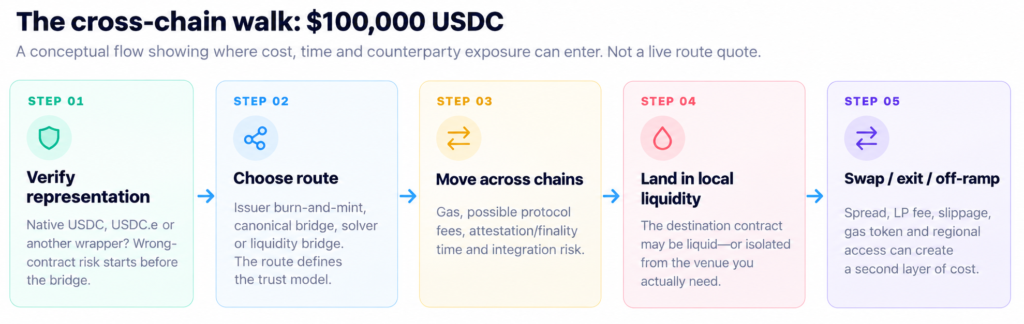
Let’s say a trader has $100,000 of native USDC on Ethereum that they want to use in an app that runs on a smaller chain. The destination may also say “USDC,” but fragmentation costs money on the way between the two balances.
A small basis-point leak becomes a treasury line item
No single percentage describes “the cost of fragmentation.” Gas changes, route pricing changes, and slippage depends on size and pool depth. A more useful way to think about it is sensitivity analysis.
| Illustrative all-in Friction | Cost on $100K Move | Cost on $1M Move | 52 × $1M Moves / Year |
|---|---|---|---|
| 5 bps | $50 | $500 | $26,000 |
| 10 bps | $100 | $1,000 | $52,000 |
| 25 bps | $250 | $2,500 | $130,000 |
| 50 bps | $500 | $5,000 | $260,000 |
This is why advanced users might be willing to pay a little extra to stay on a smaller number of deeper venues. “Chain A gas is cheaper than Ethereum” is not a good comparison. It’s total cost of acquiring, moving, deploying and later exiting the position.
Bridge risk is a hierarchy, not a yes/no label
What extra claim is being added when you call every cross-chain route a “bridge”? That is the key distinction. With native burn-and-mint, users do not rely on a separate wrapped token backed by a locked pool. This reduces wrapped-token backing risk, but it does not eliminate issuer risk, destination-chain risk, or integration and message verification risk.
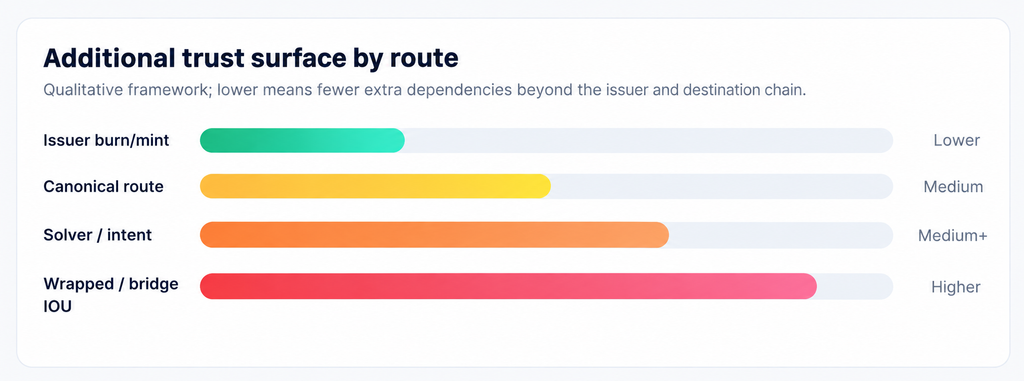
In August 2026 incident involving Allbridge’s CCTP router on Base shows why native settlement rails do not eliminate integration risk. The attacker submitted a fabricated CCTP-style message accompanied by a valid Circle attestation. That attestation was valid for the submitted message; however, it did not establish that USDC had actually been transferred. Allbridge’s deposit-verification logic incorrectly treated the attestation as proof that the required USDC deposit had occurred, enabling the reported loss of approximately $191,000 in USDC. The vulnerability was in Allbridge’s deposit verification, not Circle’s attestation system.16
This distinction matters for risk analysis. An issuer-native transfer method can reduce wrapped-token solvency risk, but the application or router that uses it can still mishandle message validation, recipient checks, or verification that the required deposit actually occurred. Users therefore need to assess not only the token they hold, but also the route, router contract, and deposit-verification logic that processed the transfer.
Arc shows how an issuer can solve fragmentation by building another silo
Circle launched Arc’s public mainnet on September 16, 2026. More than 100 institutional and ecosystem builders were revealed at launch, and Arc was fully integrated into Circle’s stack.17 Arc to someone else’s chain is not the same from a strategic point of view; the stablecoin issuer is helping to control the execution environment.
That’s important because a vertically linked chain can make it easier for things to work together. The user path can be made easier with stablecoin native gas, integrated settlement, and issuer-aligned tools. It does, however, make a new place where liquidity needs to build up.
The bullish reading
Issuer owned infrastructure can make a canonical version of the stablecoin easier to use, reduce dependence on third party wrappers and give institutions a purpose-built environment for credit and settlement.
The fragmentation reading
Arc is still another liquidity domain. A better silo can still be a silo if users have to rebalance inventory between Arc and the rest of the market.
The strain is made real by Morpho’s Arc deployment. Crypto Briefing said that deposits had hit $500.27 million by October 2, which was just over two weeks after the mainnet went live.18 At this point in time, DeFiLlama’s Arc page showed about $512 million worth of stablecoins, with USDC being the most popular. Gross protocol deposits and stablecoin supply are not the same thing they are measured in different ways but the fact that they are close to each other shows how quickly one place can become systemically important in a young chain.
For investors, it’s not enough to know if Arc TVL goes up. The question is whether Arc creates new demand for stablecoin credit or just moves amounts that would have been on Ethereum, Base, Solana, or centralized venues.
Visa is taking the opposite approach: hide the chain
Circle is building further into the stack, but Visa is trying to hide the stack from users. Visa said in April 2026 that its stablecoin settlement pilot had grown to include nine blockchains and a settlement run rate of $7 billion per year.19 Visa said in September that stablecoin settlement volume had topped $20 billion a year, that more than 160 stablecoin-linked card programs were live, and that payment volume on these programs had grown by almost 200% year over year.20
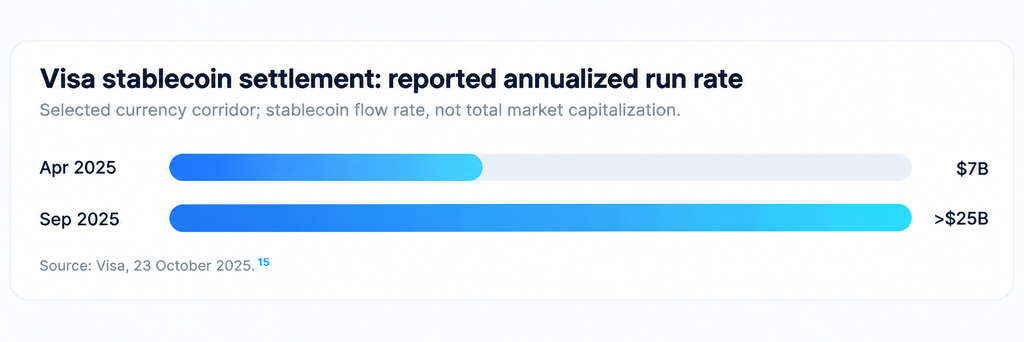
Separately, Visa reported on 1 October 2026 that approximately 17% of stablecoin-linked card volume in FY26 to date came from business and commercial card programmes. This is a card-programme payment-volume measure, not a stablecoin settlement run-rate measure, so the two figures should not be compared directly.21
That could make things easier for customers while making things more complicated for the treasury behind the scenes. Someone still needs to keep track of supplies, credit lines, or routing capacity across all of those chains if a payments network settles across many of them. It moves into the infrastructure layer, but fragmentation doesn’t go away.
Regulation can create fragmentation even when technology removes it
The most important 2026 development may be that stablecoin fragmentation is no longer driven only by blockchains. It is increasingly driven by legal perimeter.
Europe is the most clean example. Circle says that its French branch is allowed to issue USDC and EURC as MiCA regulated e-money tokens in the EEA. Circle France is also allowed to offer custody and transfer services for these tokens.22 AllUnity, a European company, released USDAU on September 30, a fully guarded U.S. dollar stablecoin that works with MiCAR.23 So, two tokens can aim for the same dollar price even though they have different legal claims under the same set of rules.
| Regime | Status | Fragmentation effect |
|---|---|---|
EU · MiCA | MiCA transitional periods for crypto-asset service providers expired across the EU on 1 July 2026; Circle operates MiCA-authorized USDC/EURC structures and new European USD tokens such as USDAU are entering the market. | Legal issuer and authorization can matter as much as chain. Regulated desks may prefer or require specific wrappers. |
United States · GENIUS Act | The Act was enacted in July 2025, but OCC implementation remained in rulemaking in 2026, including proposed issuance rules and AML/CFT requirements. | Permitted-issuer status and foreign-issuer treatment can gate distribution independent of technical interoperability. |
Hong Kong | HKMA’s 2025 annual report says the first batch of two licensed stablecoin issuers was announced in April 2026. | Local licensing can create jurisdiction-specific stablecoin liquidity and distribution channels. |
Singapore | MAS opened consultation on amendments to implement its stablecoin framework on 1 Sep 2026; comments close 16 Oct. The proposal includes multi-jurisdictional issuance and recognition of some foreign-issued stablecoins. | Recognition rules could either reduce fragmentation through equivalence or formalize separate regulated lanes. |
Because of this, the regulatory overlay is not a name that can be put on a blockchain. It is linked to offers, issuers, entities, and service providers. A token may be legally able to be sent across borders, but its legal distribution depends on the area where it is used.
Technology is trying to collapse stablecoin copies into canonical cross-chain money. Regulation may be creating new, legally distinct copies at the same time.
The investment angle: who captures value from a fragmented dollar?
Fragmentation is costly for users, but cost to one participant is often revenue to another.
- Issuers benefit when native deployments expand distribution and redemption reach, especially if they can standardize transfers through their own interoperability layer.
- Payment networks can capture value by abstracting chain choice and presenting a common interface to businesses.
- Routers, solvers and aggregators become more valuable when the cheapest path is not obvious.
- Market makers are needed to keep local pools aligned around $1 and to warehouse inventory on multiple networks.
- Lending venues can turn locally trapped stablecoin balances into productive credit, as the Arc/Morpho launch illustrates.
- Custodians and compliance infrastructure gain importance because “USDC” is no longer enough information; institutions must whitelist exact chains, contracts and legal entities.
Users who think that the ticker is enough due diligence are the ones who lose. It is possible for a retail trader to pick the wrong contract. There is a chance that an active fund will lose basis points every time it switches between ecosystems. There are times when a company’s bank has cash that is in the wrong legal or technical form for its next payment.
The contrarian case: fragmentation may become invisible before it disappears
It’s possible that in the future, the number of deployments will keep going up while the user experience gets easier. There is less need for wrapped versions with Circle’s CCTP and other burn-and-mint systems. The solver can pick routes for you automatically. Gas can be taken out of wallets. Settlement chains can be hidden by payment networks. A program can ask for “$10,000 USDC,” and the software will figure out where to get the money and where to settle it.
If that works, 717 can become an infrastructure statistic rather than a user problem.
And there is a force that is against it. With each new institutional chain, jurisdiction specific issuer, regulatory license, and application ecosystem, liquidity needs to live in a different place. Arc is a great example because it can add another market outside of Circle’s stack while reducing division inside of it.
The key question for 2027 is therefore not whether deployment counts rise or fall. It is whether interoperability grows faster than fragmentation.
What traders and investors should watch next
1. Liquidity per deployment
If deployment counts grow faster than aggregate liquidity, the long tail is becoming thinner.
2. Native vs wrapped share
A higher native share can reduce wrapped-asset backing dependence, though it does not remove integration risk.
3. Cross-chain peg dispersion
Watch the same stablecoin across chains and venues. Persistent spreads can reveal exit friction before headlines do.
4. Arc retention after launch
Track whether deposits diversify across apps and whether growth represents new demand rather than relocated balances.
5. Regulatory recognition
Foreign-issuer equivalence and multi-jurisdiction rules could either consolidate compliant liquidity or split it further.
6. Payment abstraction
If Visa-style systems make users indifferent to the settlement chain, fragmentation moves from the consumer layer to treasury infrastructure.
Conclusion: one dollar, many markets
Stablecoins are moving toward a common economic unit, but their infrastructure is still different. There are now many issuers, legal entities, native contracts on dozens of chains, bridged contracts, lending markets, payment networks, and rules for distribution that are specific to each jurisdiction that can all stand for a US dollar.
That’s why the news about the 717 launch is important. It’s not proof that there are 717 stablecoins that can stand on their own. It shows that the same promise of money is being made in hundreds of different execution environments.
Fragmentation shows up for users as bridge decisions, contract-address mistakes, slippage, and liquidity that is stuck. In the case of organizations, it shows up as inventory and compliance costs. It opens up a second chance for investors: the biggest value pools may not go to the chain with the most stablecoins, but to the infrastructure that makes users not care which chain their dollar is on.
The stablecoin market is becoming more connected and more fragmented at the same time. The winner may be whoever can make those two facts feel like one.
- Cryptobriefing.com : https://cryptobriefing.com/rwa-foundation-717-stablecoin-deployments/ ↩︎
- Defillama.com : https://defillama.com/stablecoins/chains ↩︎
- Cryptobriefing.com : https://cryptobriefing.com/rwa-foundation-717-stablecoin-deployments/ ↩︎
- Cryptobriefing.com : https://cryptobriefing.com/rwa-foundation-717-stablecoin-deployments/ ↩︎
- Circle.com : https://www.circle.com/usdc ↩︎
- Defillama.com : https://defillama.com/stablecoins/ethereum ↩︎
- Defillama.com : https://defillama.com/stablecoins/solana ↩︎
- Defillama.com : https://defillama.com/stablecoins/base ↩︎
- Defillama.com : https://defillama.com/stablecoins/arbitrum ↩︎
- Defillama.com :https://defillama.com/stablecoins/xrpl ↩︎
- Defillama.com : https://defillama.com/stablecoins/arc ↩︎
- Circle.com : https://www.circle.com/blog/migrate-to-cctp-v2-ahead-of-cctp-v1-legacy-deprecation ↩︎
- Circle.com : https://www.circle.com/multi-chain-usdc/arbitrum ↩︎
- Allunity.com : https://allunity.com/news/allunity-launches-usdau-a-fully-reserved-micar-compliant-us-dollar-stablecoin-and-introduces-instant-fx-capabilities ↩︎
- Circle.com : https://www.circle.com/multi-chain-usdc/world-chain ↩︎
- Blockchainbreaches.com : https://www.blockchainbreaches.com/en/breaches/allbridge-august-2026 ↩︎
- Circle.com : https://www.circle.com/pressroom/circle-launches-arc-mainnet-an-economic-operating-system-for-the-internet ↩︎
- https://cryptobriefing.com/morpho-500m-deposits-circle-arc/ ↩︎
- Visa.com : https://investor.visa.com/news/news-details/2026/Visa-Accelerates-Stablecoin-Momentum-Adding-Five-Blockchains-for-Settlement/ ↩︎
- Visa.com : https://www.visa.com/en-us/thought-leadership/innovation/financing-stablecoin-linked-card-programs ↩︎
- Visa.com : https://usa.visa.com/about-visa/newsroom/press-releases.releaseId.22806.html ↩︎
- Circle.com : https://www.circle.com/blog/circle-france-receives-approval-to-offer-crypto-asset-services-under-mica ↩︎
- Allunity.com : https://allunity.com/news/allunity-launches-usdau-a-fully-reserved-micar-compliant-us-dollar-stablecoin-and-introduces-instant-fx-capabilities ↩︎
- Europa.eu : https://www.esma.europa.eu/sites/default/files/2026-04/ESMA75-113276571-1679_Statement_on_the_end_of_transitional_periods_under_MiCA.pdf ↩︎
- Circle.com : https://www.circle.com/blog/circle-france-receives-approval-to-offer-crypto-asset-services-under-mica ↩︎
- Allunity.com : https://allunity.com/news/allunity-launches-usdau-a-fully-reserved-micar-compliant-us-dollar-stablecoin-and-introduces-instant-fx-capabilities ↩︎
- Treas.gov : https://occ.treas.gov/news-issuances/bulletins/2026/bulletin-2026-3.html ↩︎
- Treas.gov : https://www.occ.treas.gov/news-issuances/bulletins/2026/bulletin-2026-28.html ↩︎
- Hkma.gov.hk : https://www.hkma.gov.hk/media/eng/publication-and-research/annual-report/2025/16_International_Financial_Centre.pdf ↩︎
- Mas.gov.sg : https://www.mas.gov.sg/news/media-releases/2026/mas-consults-on-legislative-amendments-to-implement-stablecoin-regulatory-framework ↩︎