

The meme coins Q2 2026 crash gave way to a 36% rebound in Q3, then to a sharp October slide. Here is what moved, what the venues earned, and where attention went.
In Summary
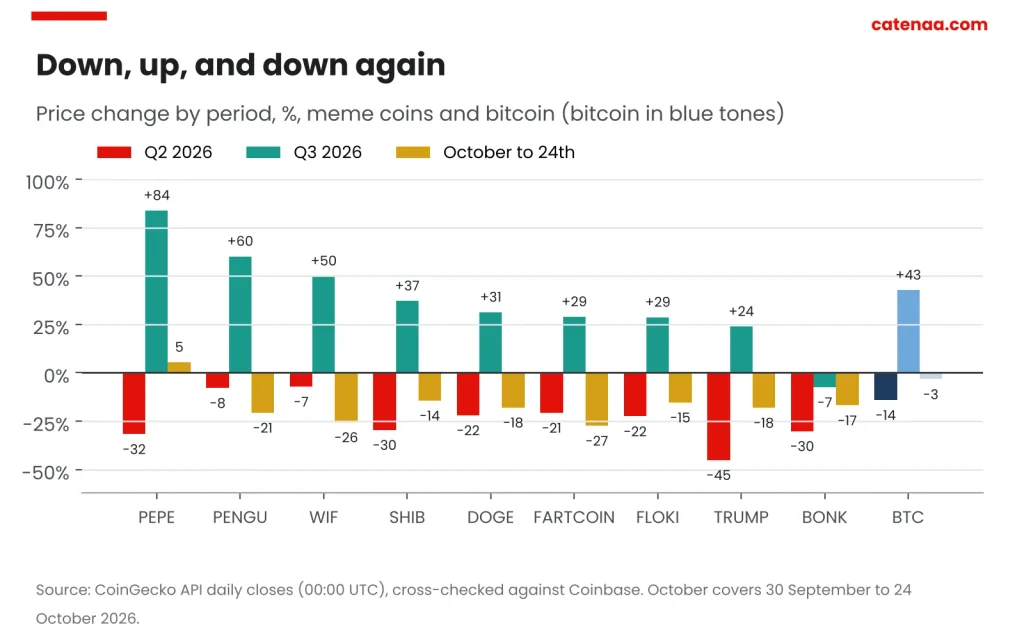
A Catenaa basket of nine leading meme coins lost 23.8% of its market value in Q2 2026. It then gained 36.4% in Q3, before falling 15.5% in the first 24 days of October.
The Q3 rebound trailed the market. Bitcoin rose 42.7% in the quarter, and only three of the nine coins beat it.
October was worse still. Eight of the nine fell, while Bitcoin lost just 3.3%. PEPE was the only gainer.
Venue revenue tells the same story. The main Solana venues earned about $90m in September, then roughly $63m across the first 24 days of October.
A new launchpad, StonkFun, earned $28.7m in September alone. The two leading venues’ share of tracked revenue fell from 92% to 72%.
Attention did not shrink, it was outbid. Meme coins’ share of attention edged up to 12.3%, but the Robinhood ecosystem overtook them with 13.2%.
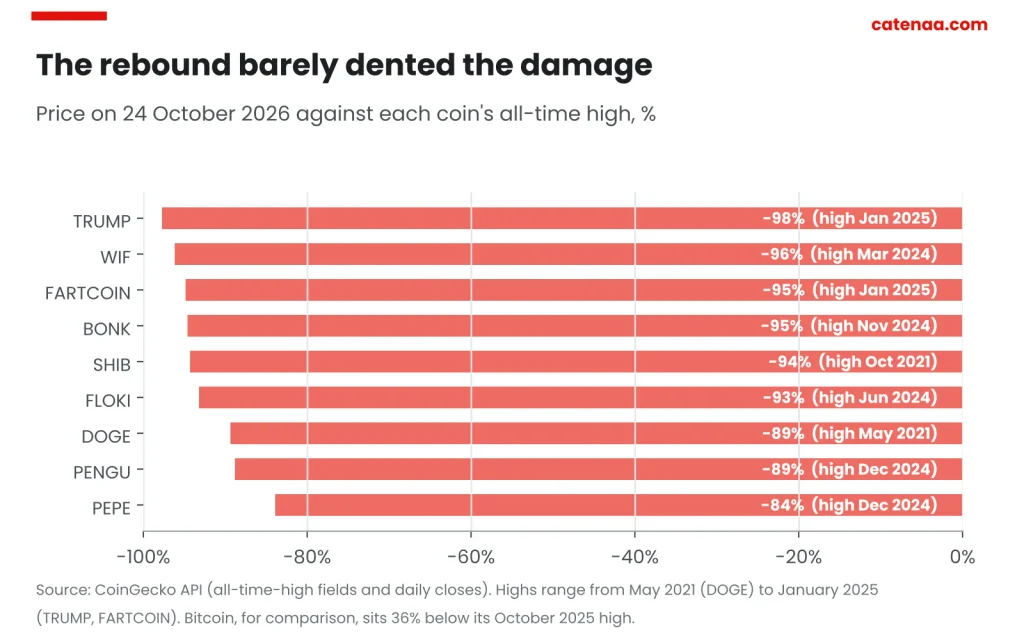
Even after the rebound, the nine coins trade 84% to 98% below their record highs.

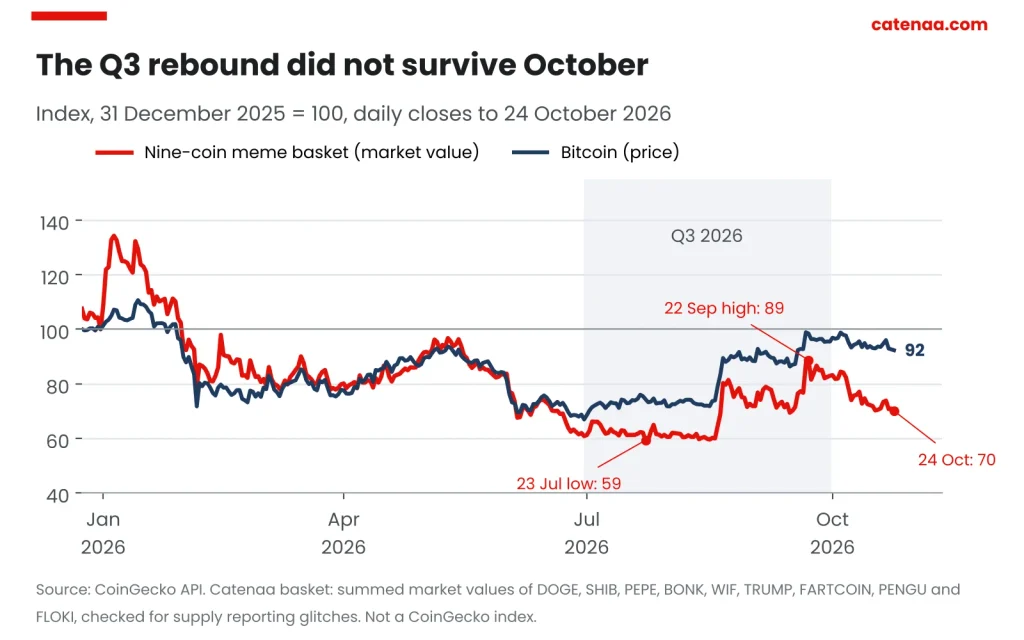
The meme coins Q2 2026 scorecard was brutal, and the two quarters since have been a round trip. A Catenaa basket of nine leading meme coins lost 23.8% of its market value between 31 March and 30 June. It then gained 36.4% in the third quarter. By 24 Octobe,r it had lost 15.5% of its value again, surrendering more than half of that gain.
Three moves, three lessons. A bust shows how fast attention drains. The rebound proved that the sector can still rally hard. October then showed that it rallies last and falls first. This analysis traces all three, with data to 24 October 2026.
How meme coins performed in Q2 2026
First, the scorecard. Based on CoinGecko price data, the Official Trump token (TRUMP) was the worst performer, down 45.0% in the quarter. PEPE fell 31.7%, BONK 30.1% and SHIB 29.5%. Dogecoin (DOGE), the largest meme coin, dropped 21.9%. Only two coins lost less than Bitcoin. Dogwifhat (WIF) and Pudgy Penguins (PENGU) each fell by about 7% to 8%.
The timing of the fall matters. Meme coins rallied into mid-May, and the basket hit its Q2 2026 high on 10 May. From there to 30 June, it fell 37.1%. The slide then ran into July. The basket touched its lowest point of the past year on 23 July.
Q2 also deepened an existing slump. The basket had already lost 20.2% in the first quarter. Across the first half of 2026, it fell 39.2%, from $26.7bn to $16.2bn. By comparison, bitcoin lost 33.1% over the same six months. So meme coins did not start falling in April. Rather, Q2 extended a slide that was already underway in late 2025.
The Q3 rebound, and the October reversal
After the meme coins Q2 2026 slump, the third quarter looked like a turning point. The basket climbed 36.4%, from $16.2bn to $22.1bn of market value. PEPE led with 83.9%, followed by PENGU at 60.1% and WIF at 50.0%. DOGE added 31.3%. Only BONK fell, by 7.4%.
Even so, the rally lagged the market it belonged to. Bitcoin rose 42.7% over the same three months, so just three of the nine coins beat it. The wider market did better still. CoinGecko’s Q3 report puts total crypto market value up 39.6%, at about $3.0trn, which ended three straight quarters of decline.
October then reversed much of the recovery from the meme coins Q2 2026 low. Between 30 September and 24 October, the basket lost 15.5%, while bitcoin fell only 3.3%. Eight of the nine coins declined, led by FARTCOIN at 27.3% and WIF at 25.5%. PEPE alone rose, by 5.4%, which leaves it the only coin in the basket up on the year.
That sequence is the real finding. Meme coins did not simply fall in 2026, nor did they simply recover. They amplified the market in both directions, and they gave back gains faster than bitcoin did.
Why the meme coin market lost liquidity
To understand the meme coins Q2 2026 bust, think of the sector as an attention economy. A meme coin has no cash flows. Its price depends on how many people want to hold it, and how much money they bring. Attention is limited, but the supply of new tokens has no real ceiling. When launch tools make tokens nearly free to create, new coins compete for the same pool of buyers.
This creates a dilution problem, much like a company that keeps printing shares. Each new token splits the same attention and the same dollars more thinly. Early buyers can profit if they sell to later arrivals. However, once new money slows, prices across the sector fall together. That is broadly what happened as the wider market cooled in 2026.
The numbers show how extreme this became. According to CoinGecko Research, 11.6m crypto tokens listed on GeckoTerminal failed in 2025 alone. That compares with 1.38m in 2024. The number of listed projects grew from 428,383 in 2021 to nearly 20.2m by 2025. CoinGecko attributes the surge to launchpads that make it easy to launch “low-effort” meme coins. Its count includes only pump.fun tokens that graduated, so the true total is higher.
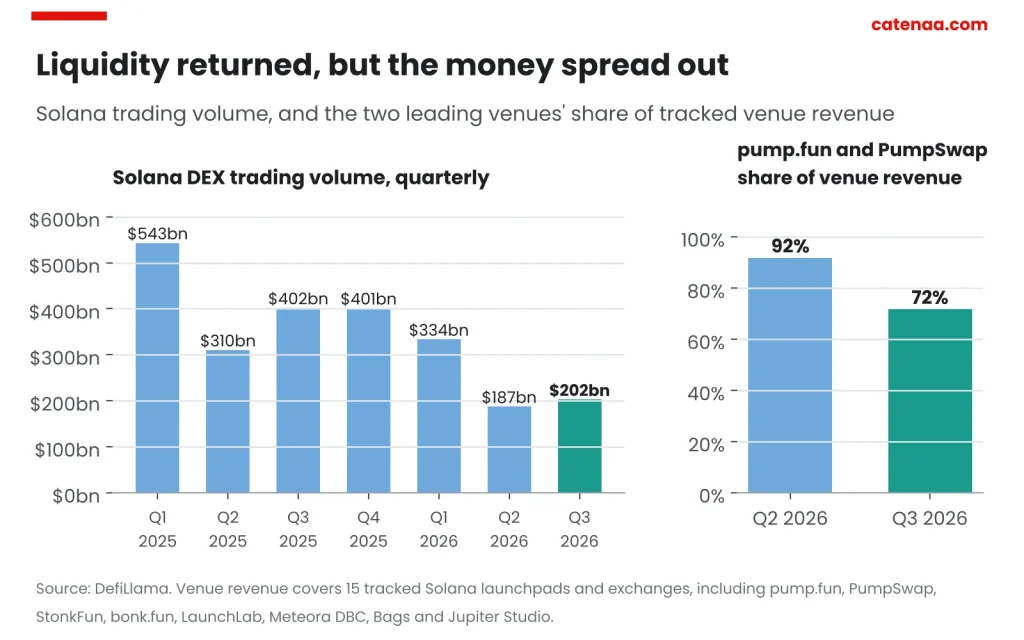
Meanwhile, the money to absorb those tokens shrank. Solana is a main home of meme coin trading. Its decentralized exchange (DEX) volume fell 43.8% in Q2 2026 to $187.3bn, according to DefiLlama. That was about 66% below Q1 2025, at the height of the frenzy.
Q3 brought the first increase in four quarters, to $202.5bn. October has slowed again, with about $48bn in the first 24 days. That works out at roughly $2.0bn a day, against $2.6bn a day in September. Liquidity returned briefly, then thinned.
The launchpad business: pump.fun revenue and buybacks
Launchpads sit at the center of the meme coin economy. Their results track the swings in meme coins closely. Pump.fun, the largest, lets anyone create a token with no platform fee, beyond Solana network costs. Its fee schedule then sets a 1.25% fee on trades along the bonding curve. Of that, the platform keeps 0.95 percentage points and the token’s creator 0.30. Consequently, its revenue tracks speculative appetite closely.
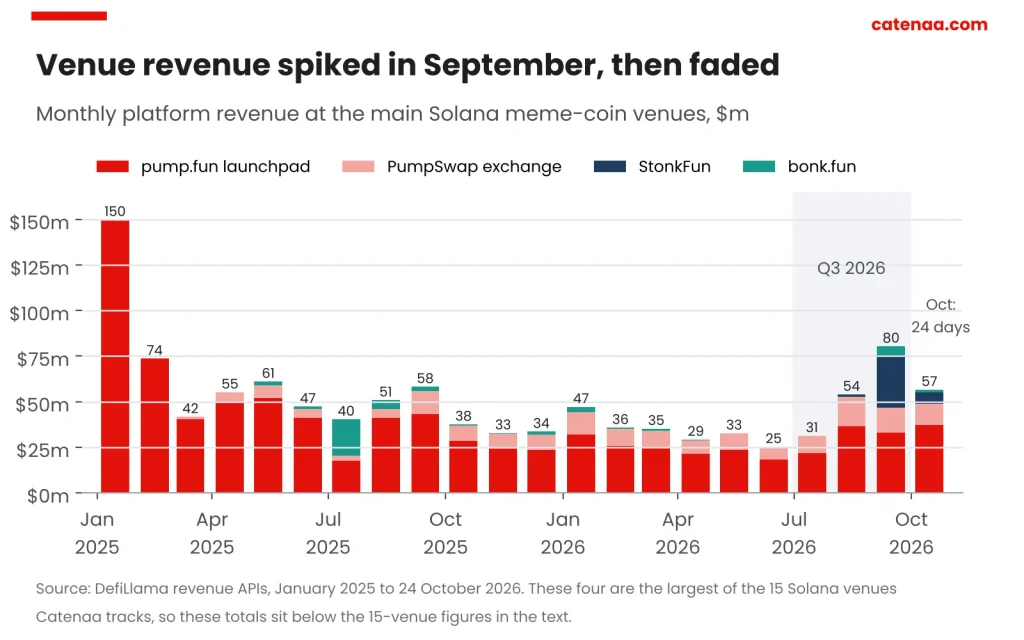
In Q2 2026, pump.fun revenue fell 23.4% to $63.1m, based on DefiLlama data. Trading volume on its bonding curve dropped 21.8%. Its linked exchange, PumpSwap, saw volume fall 38.2%. June marked the low point, with about $26m of revenue across the tracked Solana venues.
Q3 reversed the meme coins Q2 2026 pattern. pump.fun revenue rose 44.9% to $91.5m, and PumpSwap earned $38.9m. September alone produced about $90m across all 15 tracked Solana venues, the best month since January 2025. The four largest of them accounted for $80m of it. The first 24 days of October then delivered about $63m, a slower pace. One caveat applies to that figure. Pump.fun added a separate app platform fee of 0.45% on 17 October 2026. Part of October’s revenue therefore reflects a new charge rather than new demand.
A new name explains part of the swing. StonkFun, a launchpad for stock-themed tokens, earned nothing before late July. It then took $28.7m in September alone. CoinGecko’s Q3 report calls these “stock-based memecoins” a challenge to pump.fun’s dominance. It also notes that such launchpads “are starting to lose steam”. October’s numbers fit that: StonkFun earned $6.2m in 24 days.
Concentration fell largely as a result. The two leading venues earned 92% of tracked Solana venue revenue in Q2, but 72% in Q3. The business is recovering and fragmenting at the same time.
Buybacks also shrank, but partly by design. Pump.fun uses revenue to buy back its PUMP token. Its official dashboard, read on 19 September 2026, showed buybacks of $56.7m in Q2, down 52.2% from Q1. However, on 29 April the platform cut the share of daily revenue used for buybacks. It fell from about 100% to about 50%. Therefore, roughly half of that decline reflects a policy change rather than weaker demand. The dashboard reports Q2 revenue of $86.3m, on a broader basis than DefiLlama. One caveat applies. Since custom trading pairs arrived, the dashboard “does not correctly reflect the revenue and buyback amount”.
Who loses money in meme coins?
Among meme coins, Q2 2026 losses fell hardest on late buyers, and the rebound barely helped them. Drawdowns from peak prices show the scale. By 24 October, TRUMP traded 98% below its all-time high. WIF was 96% lower, and BONK and FARTCOIN about 95%. Even DOGE, the most established meme coin, sat 89% below its 2021 record. Bitcoin, for comparison, was 36% below its October 2025 peak.
For smaller tokens, the odds are worse. Blockchain analytics firm Chainalysis studied more than 2 million tokens launched in 2024. It found that 3.59% showed patterns that could point to pump-and-dump schemes. In about 94% of the trading pools involved, the address that created the pool appears to have drained it. Moreover, only 1.7% of 2024 tokens had traded in the prior 30 days when Chainalysis checked.
A separate study by compliance firm Solidus Labs looked at pump.fun tokens from January 2024 to March 2025. It counted over 7 million tokens with at least five trades. Of those, only 97,000 kept more than $1,000 of liquidity. The study comes from a compliance vendor, so treat its exact figures with care. Even so, the direction is clear. Most newly launched meme coins lose almost all of their value.
What survived, and why
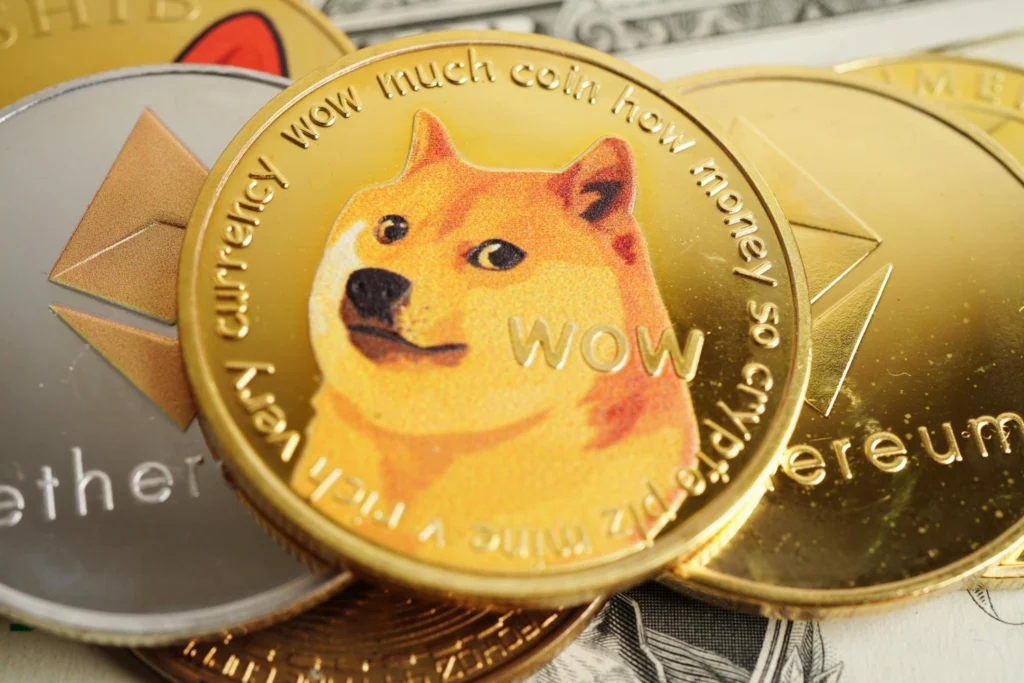
Not every meme coin is the same. DOGE alone made up 68.7% of the Catenaa basket’s value at the end of June. In Q2 2026, it fell less than most rivals but still trailed bitcoin. Its deep liquidity and wide exchange listings keep it the default meme coin for larger investors.
Among the meme coins Q2 2026 survivors, the leaders keep changing. PENGU and WIF fell least in Q2, rebounded strongly in Q3, then gave back more than most in October. PEPE is the odd one out. It was the second worst performer in Q2, yet it led the Q3 rebound. It is also the only coin in the basket up on the year, by 11.7%. Steady it is not.
BONK is the counter-example. It fell in Q2, in Q3 and again in October, and it is down 57.7% for the year. Revenue at bonk.fun, a launchpad linked to the BONK community, collapsed 86.7% in Q2 to $0.6m. It then recovered to $5.3m in Q3, based on DefiLlama data. So the venue revived while the token did not. Put simply, recoveries have been uneven, and past popularity offers little protection.
Attention did not shrink, it was outbid
The most telling change since the meme coins Q2 2026 bust is not in prices. CoinGecko’s Q3 2026 report shows meme coins slipping to second place by user attention. Their share actually rose, from 12.1% in Q2 to 12.3% in Q3. The Robinhood ecosystem simply grew faster, taking first place with 13.2%. Its three related categories together took 22.3%.
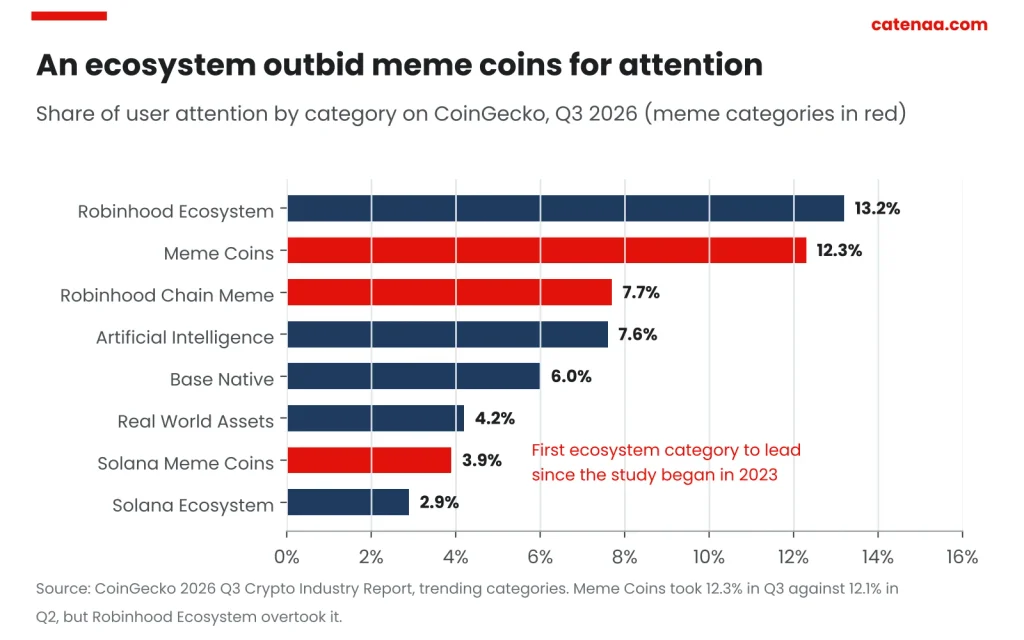
CoinGecko notes that this is the first time an ecosystem category has led since the study began in late 2023. Meme coins or AI had held the top spot until now. Attention still clusters around memes, because the Robinhood Chain Meme category alone took 7.7%. However, the gravity has shifted toward a venue rather than a theme.
Regulation: classified, but barely protected
US policy has not stood in the way. In February 2025, SEC staff issued a statement on meme coins. In its view, trading in the meme coins it described does “not involve the offer and sale of securities”. It added that federal securities laws do not protect buyers or holders of such coins. That is a staff view, not a formal rule. Also, fraud remains illegal under other laws.
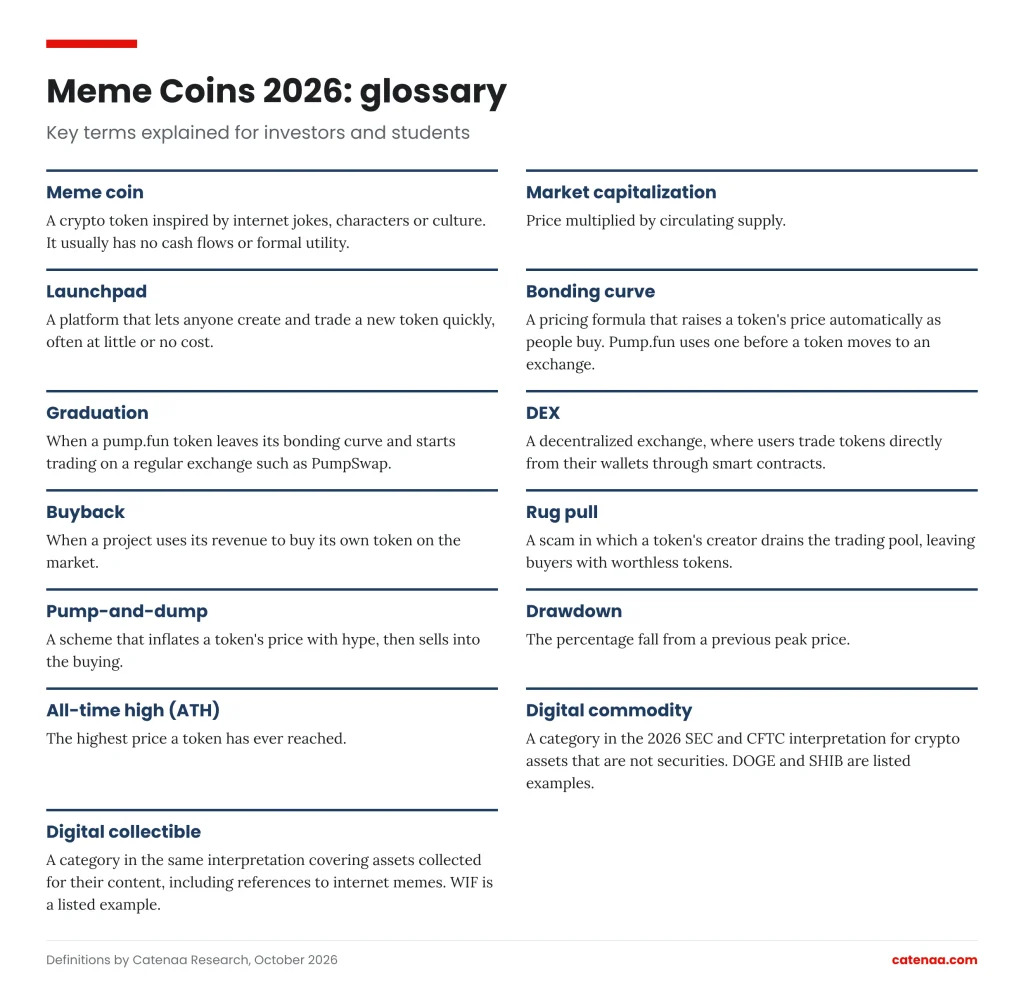
Since then, the position has hardened into something firmer. A joint SEC and CFTC interpretation, effective 23 March 2026, sorts crypto assets into five categories. The published text lists DOGE and SHIB among “digital commodities” and WIF among “digital collectibles”. It defines collectibles to include “references to internet memes”. It then states that “a digital commodity itself, as described in this release, is not a security”. This is a Commission-level interpretation, so it carries more weight than staff guidance.
Market structure legislation, by contrast, is still stuck. The House passed the CLARITY Act in July 2025 by 294 votes to 134. On 15 September 2026, a Senate procedural vote to begin debate failed, winning 49 votes against the 60 needed. A motion to reconsider followed the same day, according to the official bill record. The bill is stalled rather than dead. For buyers, the message is unchanged. Classification is not protection.
Meme coin outlook: signals to watch into 2027
The honest summary is a cyclical bounce inside a structural decline. Prices, trading volume and venue revenue all improved in Q3, and all three weakened again in October. CoinGecko’s meme category was worth $28.8bn on 25 October. Category membership changes over time, so the nine-coin basket is the cleaner gauge. It stood at $18.7bn on 24 October, against $22.1bn at the end of September.
Four signals will show which force wins:
- Venue revenue. September delivered about $90m across the tracked Solana venues, and October is running near $63m in 24 days. Two months back above $90m would mark real demand.
- Solana trading volume. Q3’s $202.5bn broke a losing streak. A second rising quarter would confirm that liquidity is returning.
- Relative strength against bitcoin. Meme coins trailed bitcoin in their best quarter of the year, and lagged it badly in October. A genuine revival would reverse that.
- Where attention sits. Meme coins lost the top category spot in Q3. Regaining it would signal that the crowd, and its money, have come back.
Overall, the meme coins Q2 2026 bust showed that attention alone cannot sustain prices. The Q3 rebound showed that the sector can still rally hard when liquidity returns. October showed how quickly those gains reverse. For readers, the practical point is about risk. In this corner of the market, position size matters more than coin selection.
Frequently asked questions
How did meme coins perform in 2026?
A Catenaa basket of nine leading meme coins lost 23.8% of its market value in Q2 2026. It gained 36.4% in Q3, then fell 15.5% between 30 September and 24 October. Bitcoin fell 14.0% in Q2, rose 42.7% in Q3 and lost 3.3% in October.
Is the meme coin market recovering?
Only partly. Prices, Solana trading volume and venue revenue all rose in the third quarter of 2026, and pump.fun revenue gained 44.9%. However, October reversed much of that, and the leading coins still trade 84% to 98% below their record highs.
Are meme coins securities in the US?
No, according to current US guidance. SEC staff said in February 2025 that transactions in the meme coins it described do not involve securities. A joint SEC and CFTC interpretation, effective 23 March 2026, goes further. It lists DOGE and SHIB as digital commodities and WIF as a digital collectible. Fraud rules still apply.