

Ethereum ETF losses now run into the billions, while BlackRock’s bitcoin ETF investors sit near breakeven. Timing, ether itself, and a missing yield explain the gap.
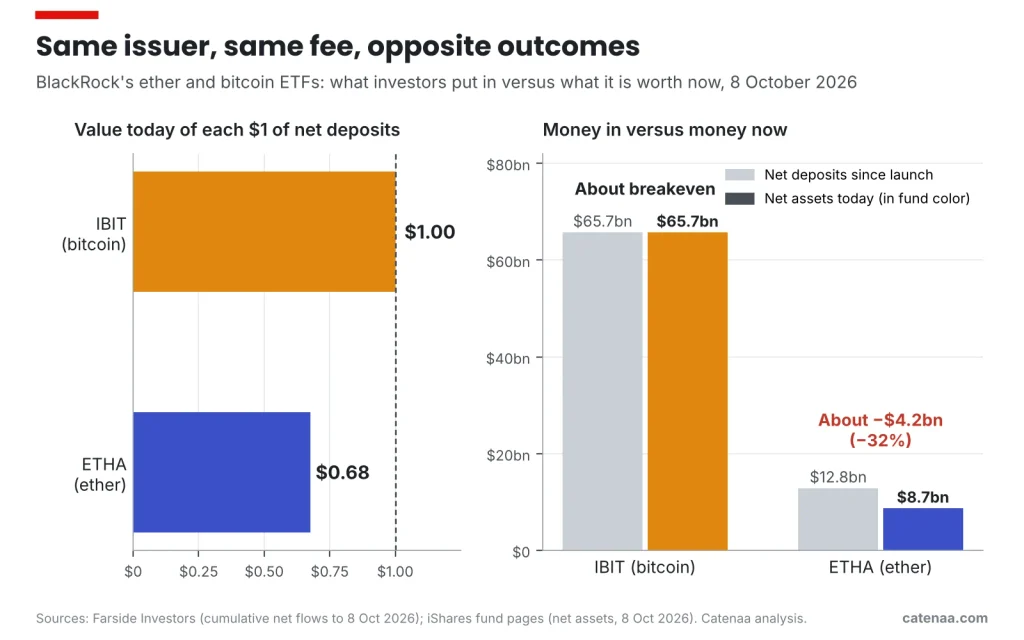
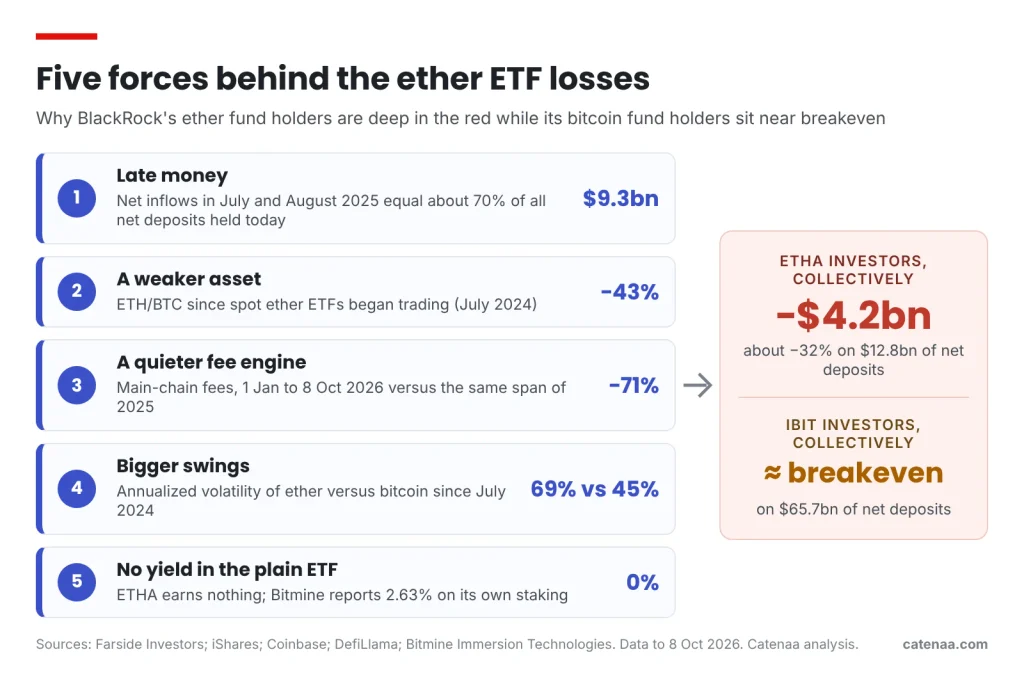
Start with BlackRock’s iShares Ethereum Trust (ETHA), the biggest money magnet among US spot ether funds. It has taken in about $12.8 billion of net deposits since launch, according to Farside Investors. On 8 October 2026, the fund held $8.7 billion, based on its iShares fund page. Its investors, taken together, have lost roughly $4.2 billion, or about 32%.
BlackRock’s bitcoin fund tells a different story. The iShares Bitcoin Trust (IBIT) held $65.7 billion against about $65.7 billion of net deposits. Its investors, as a group, sit near breakeven. Both funds charge the same 0.25% sponsor fee. So the gap comes mostly from the asset, from timing, and from one feature the ether fund lacks.
This analysis explains each driver using fund disclosures, flow data, and on-chain records. It also shows how far Ether must rise for ETF holders to get their money back.
In Summary
Ethereum ETF losses are large and concentrated. ETHA holders are down about $4.2 billion (about 32%) on $12.8 billion of net deposits. IBIT holders sit near breakeven.
Outflows are not the main cause. Most of the money that flowed into ether ETFs has stayed invested. The losses come from price.
Timing hurt. Net inflows in July and August 2025 equal about 70% of all net deposits in US spot ether ETFs today. That money arrived near ether’s record high.
Ether has lost 43% against Bitcoin since spot ether ETFs began trading, as main-chain fees collapsed and supply growth returned.
Ether swings harder: 69% annualized volatility versus 45% for bitcoin since July 2024.
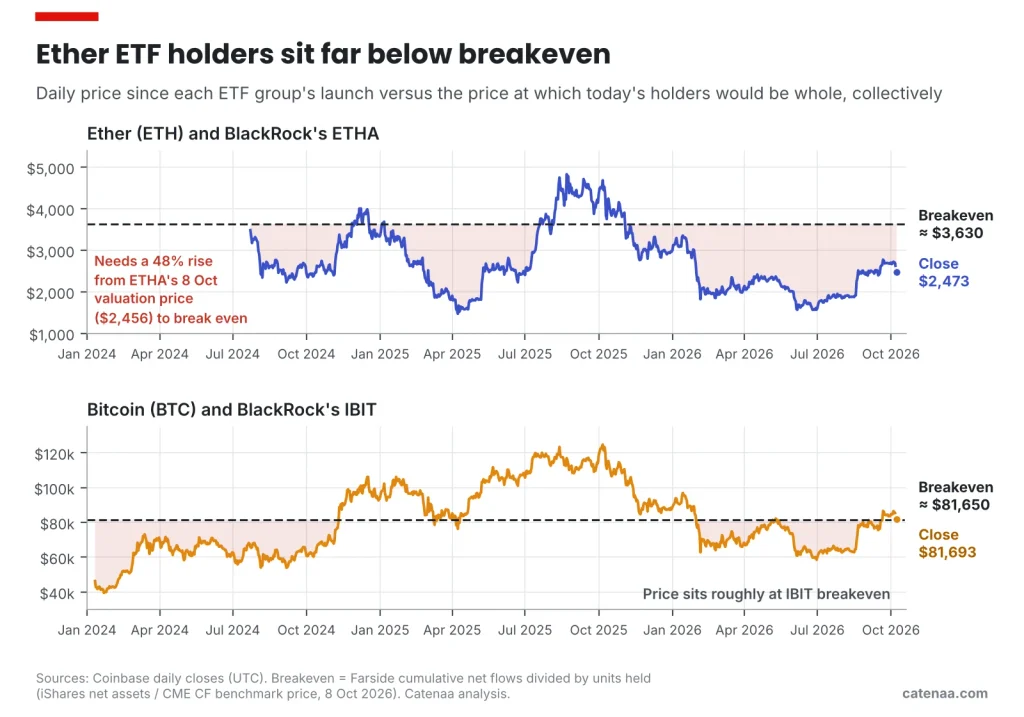
ETHA’s breakeven price is about $3,630 per ether. Ether needs to rise roughly 48% for ETHA holders to recover, and ETHA earns no staking yield while they wait.

Ethereum ETF losses vs Bitcoin ETFs: the scorecard
The cleanest way to measure Ethereum ETF losses is to compare two funds from one issuer. ETHA and IBIT are BlackRock’s flagship crypto ETFs. They have also gathered far more net new money than any rival in their groups, as Farside’s ether table and bitcoin table show.
The method is simple. First, add every dollar that flowed in and subtract every dollar that flowed out. Then compare the result with what the fund holds today. The difference is the collective gain or loss of everyone who has ever owned the fund.
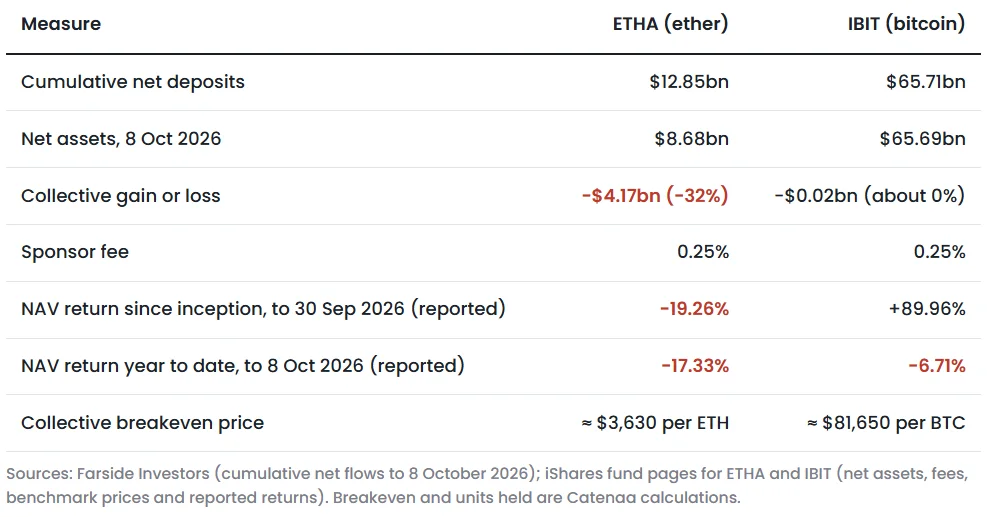
The table also hides a twist. Chaining iShares’ reported returns to 8 October, IBIT’s net asset value has gained about 85% since its January 2024 inception. Yet its investors, as a group, are flat. Meanwhile, ETHA’s net asset value is down about 26% since its June 2024 inception, but its investors have lost about 32%.
Why the difference? A fund’s return tracks the price from day one. By contrast, investors’ results depend on when their money arrived. IBIT’s collective breakeven, about $81,650 per bitcoin, sits far above the roughly $46,000 bitcoin fetched when the fund began trading. That points to heavy buying after bitcoin had already rallied. Bitcoin’s price has simply held up near that level. Ether’s has not.
A simple example shows the effect. Suppose a fund starts at $100 a share and doubles to $200. Most investors then pile in near $200, and the price slips to $150. The fund reports a 50% gain, yet most of its money is down 25%. That pattern, in milder or harsher form, shaped both BlackRock funds.
Ether ETF breakeven price: how far ether must rise
Dividing a fund’s net deposits by the coins it holds gives a collective breakeven price. ETHA’s net assets imply about 3.54 million ether, valued at $2,455.91 each by its benchmark on 8 October. That puts breakeven near $3,630 per ether. Ether would need to climb about 48% to get there.
Bitcoin’s math looks very different. IBIT’s net assets imply about 805,000 bitcoin, valued at $81,622.11 each. Its breakeven works out near $81,650. In other words, bitcoin ETF investors are roughly level. Ether ETF investors need a major rally just to recover.
Are outflows driving Ethereum ETF losses?
Not mainly. Outflows have picked up lately, but most of the money never left. Ethereum ETF losses reflect falling prices, not money walking out the door.
Cumulative net inflows into US spot ether ETFs peaked at $15.1 billion on 8 October 2025, according to Farside’s daily flow history. A year later, the running total stands at $13.3 billion. That means investors pulled out a net $1.8 billion, or about 12% of the peak. The rest stayed invested and rode ether lower.
Recent weeks have been rougher, though. Ether funds posted eight straight sessions of net outflows from 29 September to 8 October, totaling $641 million. ETHA alone saw $450 million of net outflows, about 5% of its assets. Over the same sessions, IBIT took in a net $374 million. Bitcoin funds as a whole saw $490 million of net outflows, driven by two heavy days on 7 and 8 October.
Size magnifies every move. A $200 million redemption is routine for a $65 billion fund. For an $8.7 billion fund, it is a far larger share of assets. Relative to size, ether ETF outflows bite much harder.
Why ether ETF money arrived at the worst time
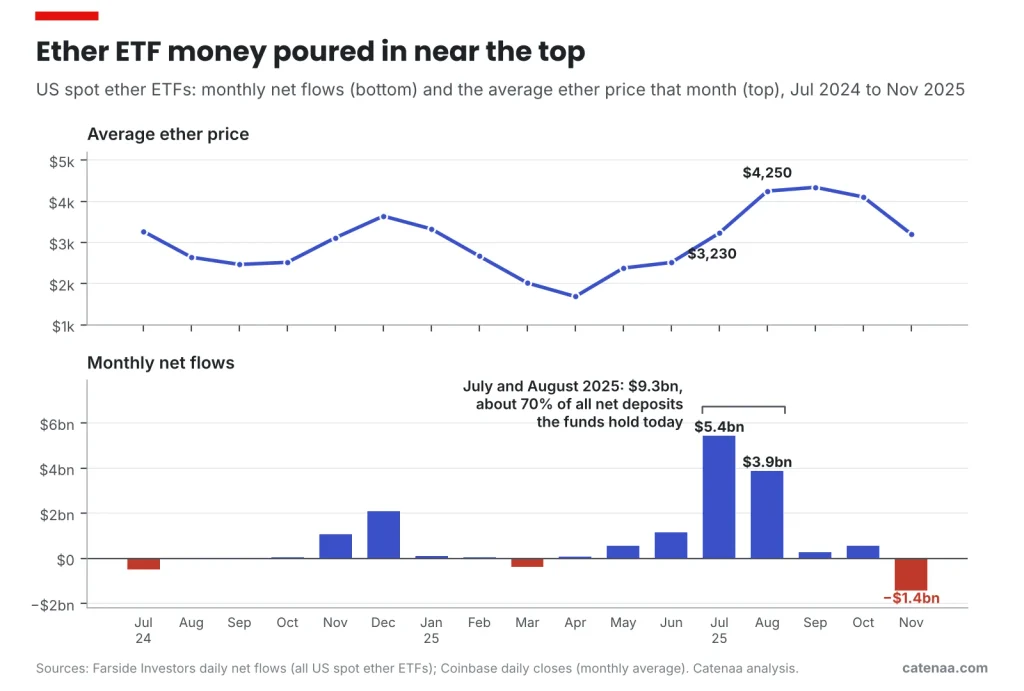
Timing explains a large share of Ethereum ETF losses. US spot ether ETFs took in a net $5.4 billion in July 2025 and another $3.9 billion in August, based on Farside’s daily data. Those two months alone equal about 70% of all net deposits the funds hold today.
The buying chased a rally. Ether’s average price rose from about $3,230 in July to about $4,250 in August, on Coinbase daily closes. Ether then set a record close of $4,831 on 22 August 2025. Weighted by the size of each inflow day, the July and August money bought ether at about $3,920 on average.
Later money tells the other half of the story. BlackRock’s staked ether fund, ETHB, launched in March 2026, when ether traded near $2,070. It now holds $1.08 billion against $885 million of net deposits. Same asset and same issuer, but better timing.
Why ether keeps losing ground to bitcoin
Timing alone does not explain the gap with bitcoin, since IBIT investors also bought late. Ether has also lagged bitcoin badly. One ether bought 0.0528 bitcoin on 23 July 2024, the day spot ether ETFs began trading. By 8 October 2026, it bought just 0.0303, a 43% slide on Coinbase’s ETH-BTC market. Over the same span, ether fell 29% in dollars while bitcoin rose 24%. This relative slide sits at the heart of Ethereum ETF losses.
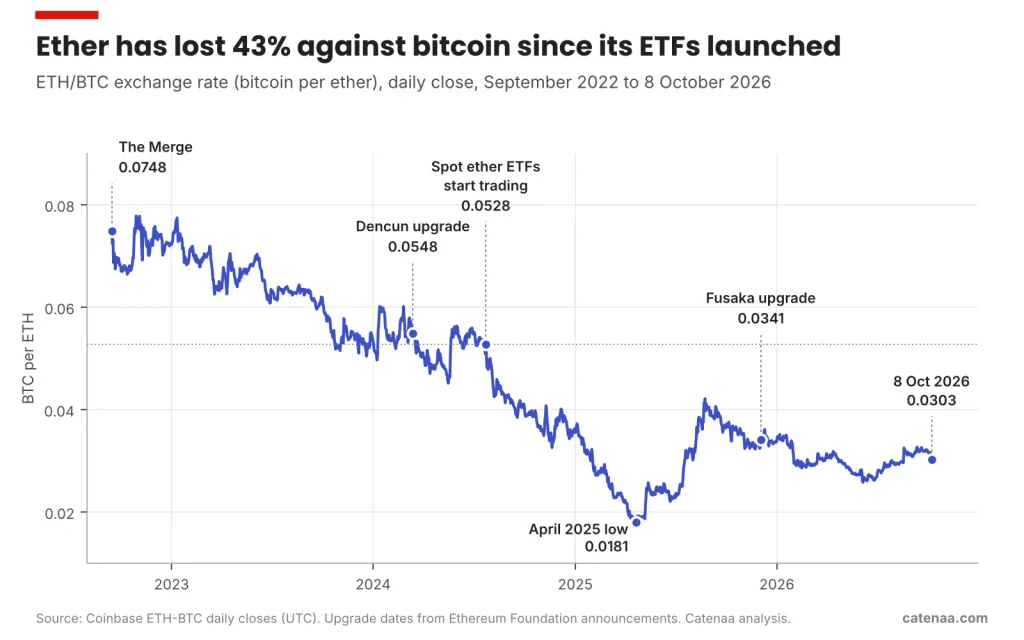
Three forces stand out behind this slide.
1. Ethereum’s fee engine has gone quiet
Users pay fees whenever they use Ethereum’s main chain. The network burns part of each fee, which removes Ether from circulation. After the 2022 Merge cut new issuance, the burn often outpaced it, and supply shrank until early 2024. Fans called this “ultrasound money.”
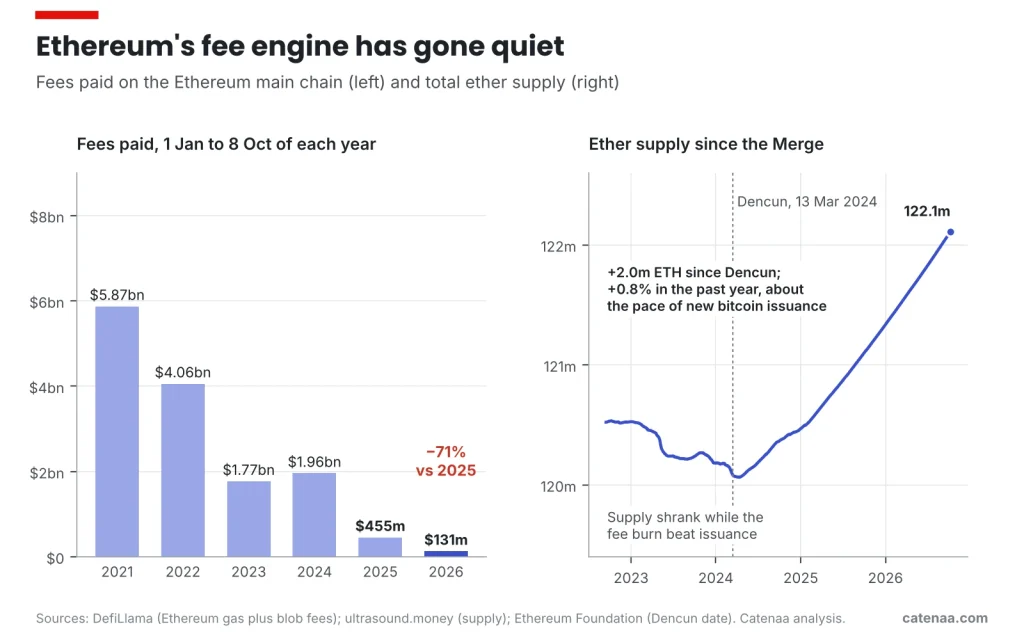
That engine has slowed sharply. Main-chain fees totaled $131 million from 1 January to 8 October 2026, according to DefiLlama. The same span brought $455 million in 2025 and $1.96 billion in 2024. That is a 71% drop in one year and 93% in two.
Network upgrades played a big part, by design. Dencun, activated in March 2024, gave layer-2 networks a cheap new data lane called “blobs.” Fusaka, which followed in December 2025, raised the default gas limit to 60 million and opened the way to more blob capacity. As a result, users pay far less. That helps adoption, yet it also shrinks the burn.
Supply is growing again. Over the past 30 days, the network burned about 2,500 ether while total supply rose by about 86,000, per ultrasound.money. Supply grew 0.8% over the past year to 122.1 million. Bitcoin’s new issuance runs at almost the same pace. Its block reward halves every 210,000 blocks and now stands at 3.125 BTC. That adds about 164,000 coins a year, or 0.8% of the roughly 20.1 million in circulation. Ether’s scarcity edge has faded.
2. Ether swings harder, so dips cut deeper
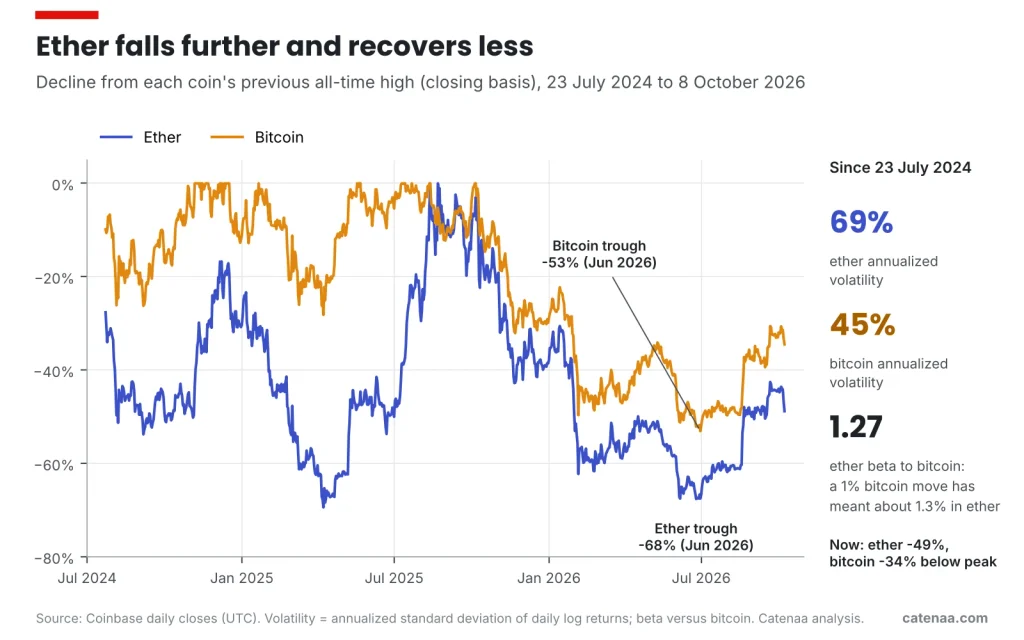
Ether is the more volatile asset. Since 23 July 2024, its annualized volatility has been 69%, versus 45% for bitcoin, based on Coinbase daily closes. Its beta to bitcoin is 1.27. Put simply, a 1% move in bitcoin has come with about a 1.3% move in ether, on average.
That leverage cuts both ways. In the second quarter of 2026, ether fell 25% while bitcoin fell 14%. From its August 2025 record, ether dropped 68% to its June 2026 low. By comparison, bitcoin’s deepest fall from its October 2025 peak was 53%. Even after the rebound, ether sits 49% below its peak, against 34% for bitcoin.
Rates add pressure. The Federal Reserve raised its policy range to 3.75% to 4.00% on 16 September 2026. Higher rates raise the return investors demand from risky assets, and ether sits higher on that risk ladder than bitcoin.
3. A plain ETF is a second-best way to hold Ether
Bitcoin pays its holders nothing, so a passive ETF gives up little by simply holding it. Ether is different. Holders can stake it to help secure the network and earn rewards.
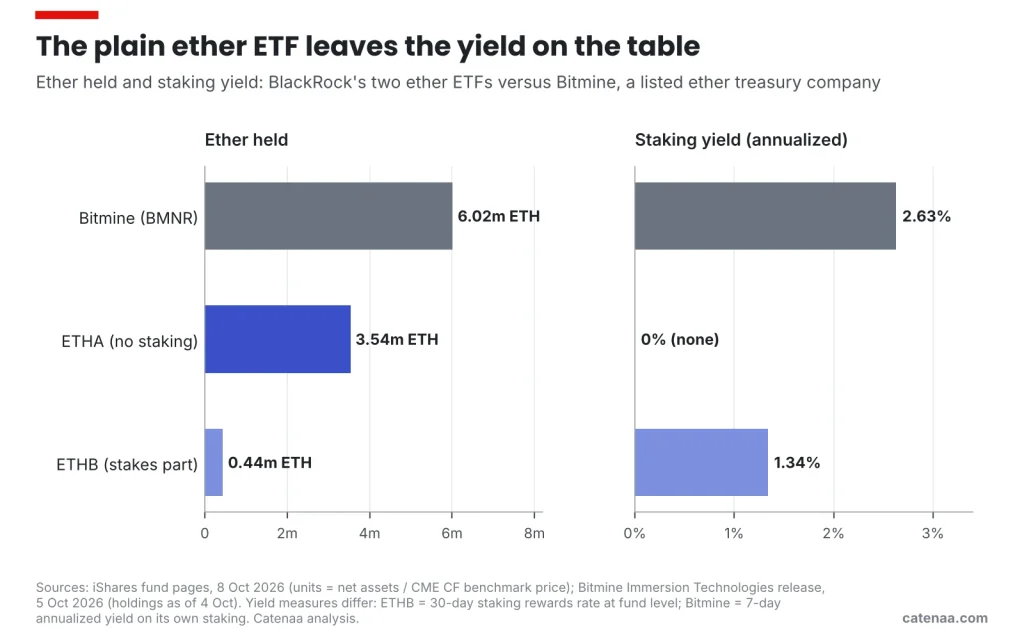
When the SEC cleared spot ether ETFs for listing in May 2024, the approval did not cover staking. ETHA still does not stake. BlackRock launched a separate staked fund, ETHB, in March 2026. Its 30-day staking rewards rate was 1.34% on 8 October.
Treasury companies go further. Bitmine Immersion Technologies held 6.02 million ether on 4 October, about 1.7 times ETHA’s holdings, according to the company’s 5 October release. It had staked 84% of that ether and reported a 2.63% seven-day annualized yield on its staking. Such firms give investors another listed route into ether. For a long-term ether investor, an unstaked fund gives up that yield every year, and the gap compounds.
What could change the outlook for ether ETF investors?
None of this guarantees further Ethereum ETF losses. Several factors could narrow the gap.
First, staking is spreading. If more Ether ETF money moves into staked products, holders will earn yield while they wait for a recovery.
Second, the protocol keeps evolving. The Glamsterdam upgrade was scheduled to activate on the Sepolia test network on 6 October 2026. However, the Ethereum Foundation says mainnet timing has not been decided. Upgrades also take time to show up in fees, if they do at all.
Third, ether’s high beta works in reverse. From 30 June to 8 October 2026, ether rose 58% while bitcoin rose 40%. If that pattern holds, a broad crypto rally would help ETHA holders more than IBIT holders, in percentage terms.
Still, the hurdle is steep. ETHA holders need a 48% rise just to get their money back. Meanwhile, outflows could resume if prices slide, and further rate rises remain possible.
What Ethereum ETF losses teach investors
The story behind Ethereum ETF losses offers lessons that reach beyond crypto.
First, a fund’s headline return is not your return. A reported return assumes you bought at the start of the period and held throughout. Your result depends on when you bought and how much. When money floods in after a rally, the average dollar invested tends to earn less than the fund.
Second, volatility calls for smaller positions. An asset with 69% annualized volatility can nearly halve in six months, as ether did in the first half of 2026. For this reason, many investors spread purchases over time. That habit lowers the risk of buying everything at a peak.
Third, the wrapper matters for assets that pay a yield. Staked ether funds pass on part of the staking rewards. However, iShares warns that staked ether cannot be sold while it moves through activation or withdrawal queues. Staking also adds risks such as validator or custodian failure. Investors should weigh that trade-off.
Finally, anyone can check a fund’s collective breakeven. Issuers such as iShares publish net assets and benchmark prices daily, and flow trackers publish cumulative flows. Comparing the two shows how far a fund’s investors stand from even.
The bottom line on Ethereum ETF losses
Ethereum ETF losses are real, large, and concentrated. They did not come from a rush for the exits. Instead, they came from buying a more volatile asset near its peak, just as its fee engine slowed and its value against bitcoin slid. A plain wrapper without staking widened the gap.
Bitcoin ETF investors were not immune to poor timing either. IBIT’s fund return far exceeds its investors’ collective result. Even so, bitcoin has held up well enough to keep them near breakeven. For ether ETF holders, the road back is longer.
This article is for educational purposes only and is not investment advice. Figures are as of 8 October 2026 unless stated otherwise. Collective gains and losses are Catenaa calculations from published flow and fund data and may differ slightly from issuer figures because of reporting timing.