


In Summary
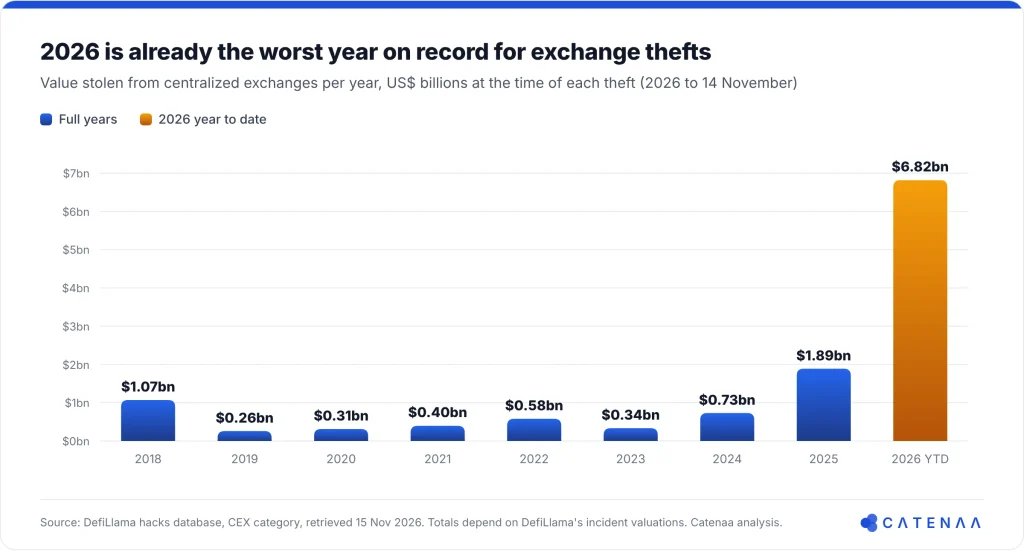
In 2026, the biggest crypto exchange failure risk has been cyber theft. Thefts from centralized exchanges reached $6.82bn in 2026 to 14 November, the most in DefiLlama’s database.
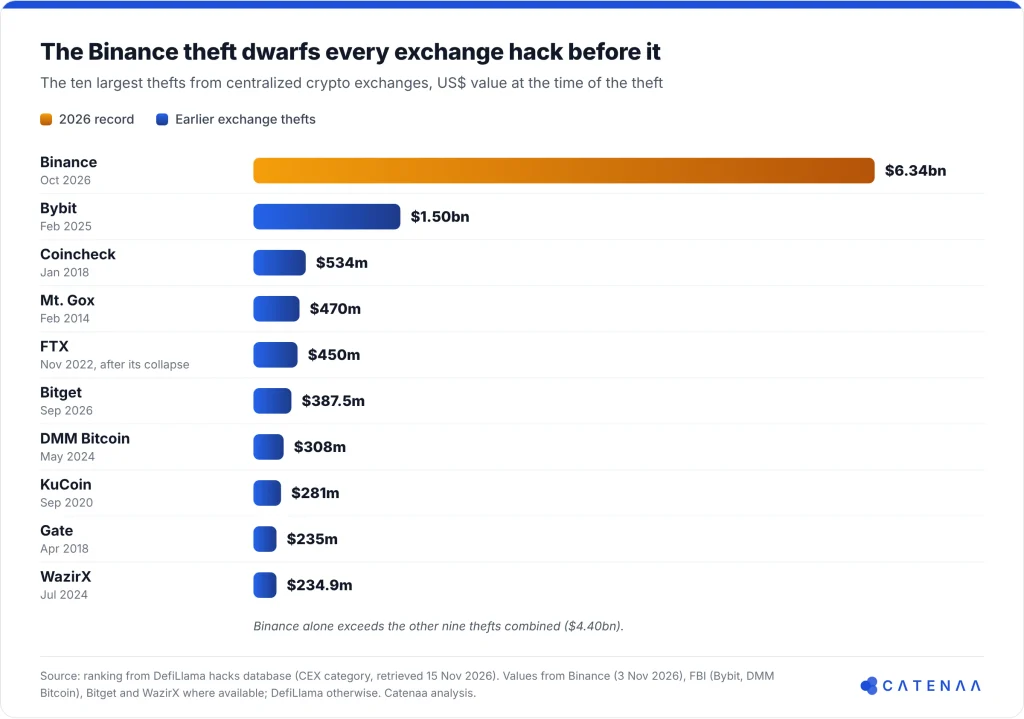
Binance lost $6.34bn on 29 October, about 4.4% of its tracked reserves, and covered it from its own funds.
WazirX lost 46.6% of its reserves in 2024, and its users absorbed part of the loss.
Binance’s dedicated user fund was worth about 18% of the loss. Its corporate treasury and insurance fund paid the rest.
Proof of reserves is a snapshot of assets. It does not prove solvency, legal ownership or the absence of hidden debts.
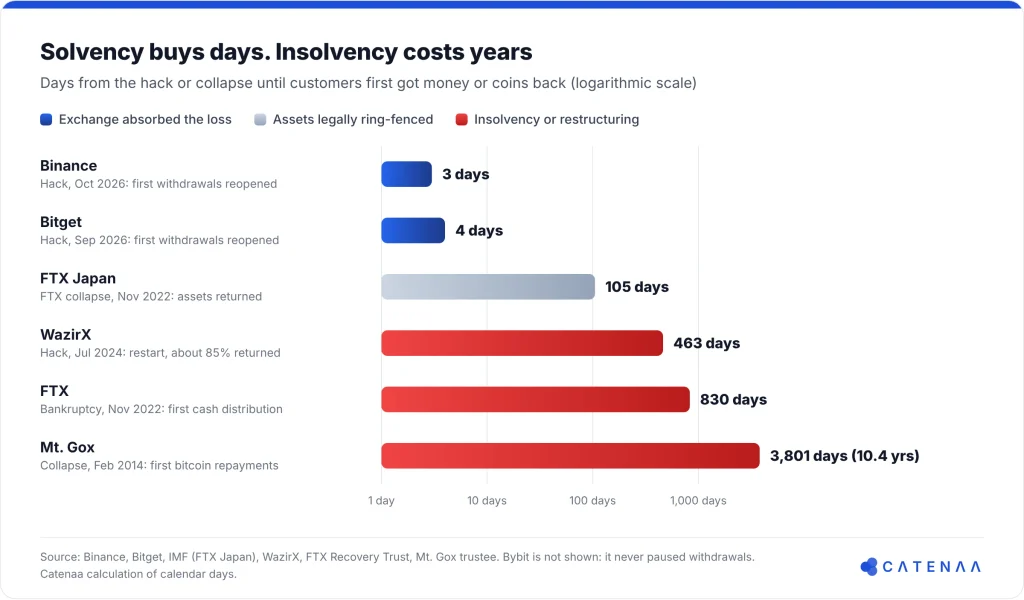
Asset segregation decides what happens in bankruptcy. FTX Japan clients got assets back in 105 days; other FTX customers waited 830 days for a first payment.
In the US, coins held on an exchange generally sit outside SIPC and FDIC protection. The CLARITY Act also stalled in the Senate in September 2026.

A crypto exchange failure no longer needs fraud or a bank run to begin. It can start with a fake job interview. On 29 October 2026, attackers drained about $6.3bn from Binance, the world’s largest crypto exchange. It was the biggest theft the industry has recorded. Binance survived. It paid the loss from its own money and said every customer balance was covered.
That outcome is reassuring. It also exposes the problem. One company’s choice and balance sheet protected customers, not a legal right. This analysis uses the 2026 thefts at Binance and Bitget to test what really protects money left on an exchange. It also draws on the older failures of FTX, WazirX and Mt. Gox.
Crypto exchange hack 2026: how $6.3bn left Binance in minutes
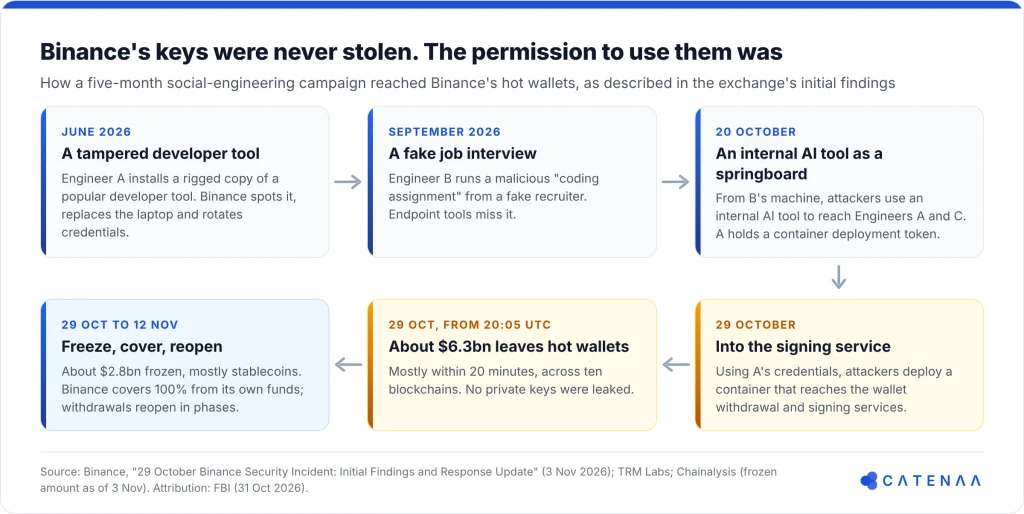
The theft itself was fast. Binance says attackers compromised its hot wallets at about 20:05 UTC on 29 October. The loss was about $6.3bn. TRM Labs counted about $6.36bn leaving Binance wallets on ten blockchains, most of it within roughly 20 minutes. On 31 October, the FBI attributed the attack to TraderTraitor, a North Korean hacking operation.
The preparation, however, was slow. Binance’s initial findings describe a five-month campaign. In June, a wallet engineer installed a tampered developer tool; Binance caught it, replaced the laptop and rotated credentials. In September, a second engineer ran malicious code from a fake job interview. On 20 October, attackers used an internal AI tool to seize two wallet engineers’ machines, including the first one’s. That engineer held a container deployment token. On 29 October, that token opened a path to the withdrawal and signing services.
Notably, Binance said it found no evidence that wallet private keys leaked. The attackers did not need them. Instead, they gained the power to make Binance’s own systems sign. That is the hidden fragility in one line. Cold storage protects keys. But a hot wallet is only as safe as every person and tool allowed to instruct it.
Why exchange hacks now drive crypto exchange failure risk
Binance is not an outlier. It is the peak of a trend. DefiLlama’s hacks database records $6.82bn stolen from centralized exchanges in 2026 to 14 November. That is about 78% of all value stolen in the database this year. It is also more than any previous full year in the database.
The list keeps growing. Bitget lost $387.5m on 24 September, and Mercado Bitcoin in Brazil lost more than $40m on 2 November. For 2025, Chainalysis counted more than $3.4bn of crypto theft, with North Korean groups taking at least $2.02bn. Bybit’s $1.5bn loss alone was about 44% of that total.
The pattern matters for investors. Attackers now favor a few very large targets. Chainalysis linked a record 76% of 2025’s service compromises, by value, to North Korea. Moreover, it says funds stolen from Binance mixed on-chain with funds from the Bitget theft. One state-backed group keeps returning to the same industry, and it is patient.
Exchange solvency after a hack: why Binance survived and WazirX did not
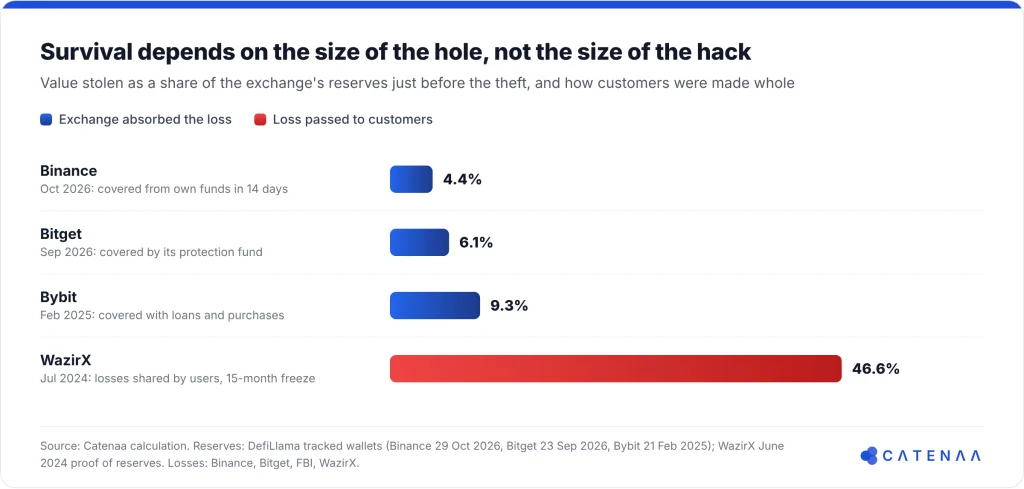
A hack becomes a crypto exchange failure only when the hole is bigger than the cushion. So the size of the theft matters less than its size relative to reserves.
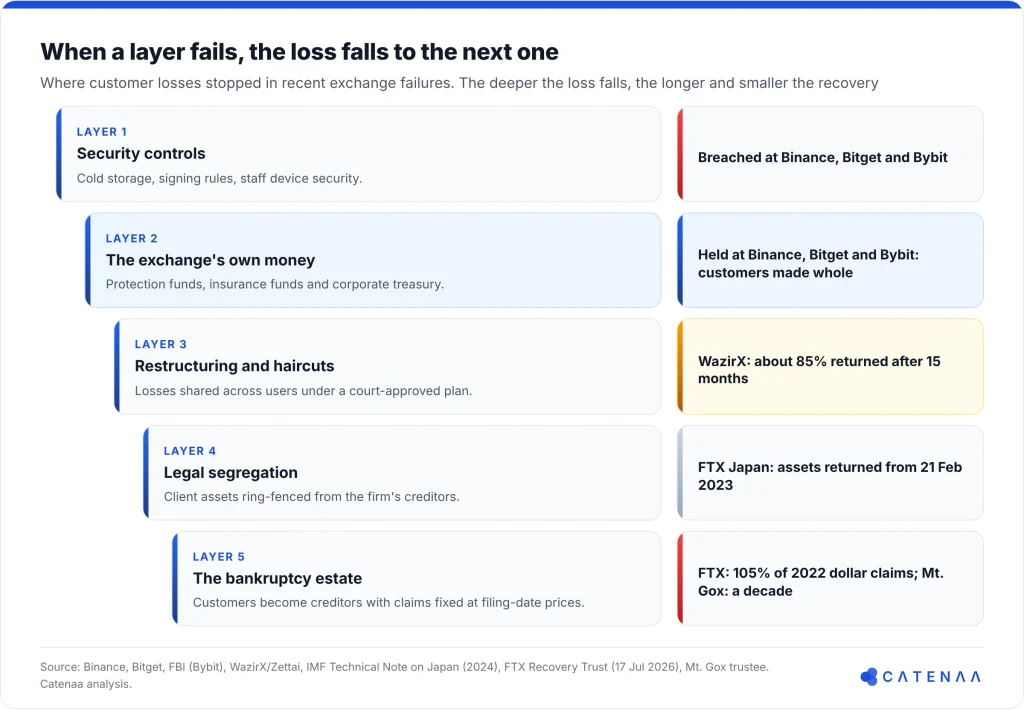
Binance’s loss equaled about 4.4% of the $144.9bn held in its publicly tracked wallets at the start of that day. Bitget’s loss equaled about 6.1% of its tracked reserves, and Bybit’s 2025 loss about 9.3%. Each exchange made customers whole. By contrast, WazirX lost $234.9m in July 2024. Its June 2024 proof of reserves showed holdings of about $503.6m, so the theft took 46.6%. WazirX froze withdrawals and restructured under a Singapore court scheme. It restarted in October 2025 and returned about 85% of eligible balances in a first distribution.
The buffers deserve a closer look. Binance turned its Secure Asset Fund for Users (SAFU) into 15,000 BTC in February 2026. At bitcoin’s close on 29 October, that fund was worth about $1.17bn, roughly 18% of the loss. As a result, Binance also drew on its futures insurance fund and its corporate treasury, according to its recovery updates. Bitget’s protection fund held more than $464m, so its loss used about 84% of the fund’s stated size.
In short, two profitable private companies chose to pay, and could afford to. Binance said on 12 November that coverage was complete, 14 days after the theft. A smaller exchange facing the same attack would almost certainly not have had the money.
The silent run that follows a hack
Even a solvent exchange faces a test of confidence. Bybit’s tracked reserves fell from $16.2bn to $10.2bn within two days of its 2025 hack. The theft explains only about $1.5bn of that drop; withdrawals and price moves explain the rest.
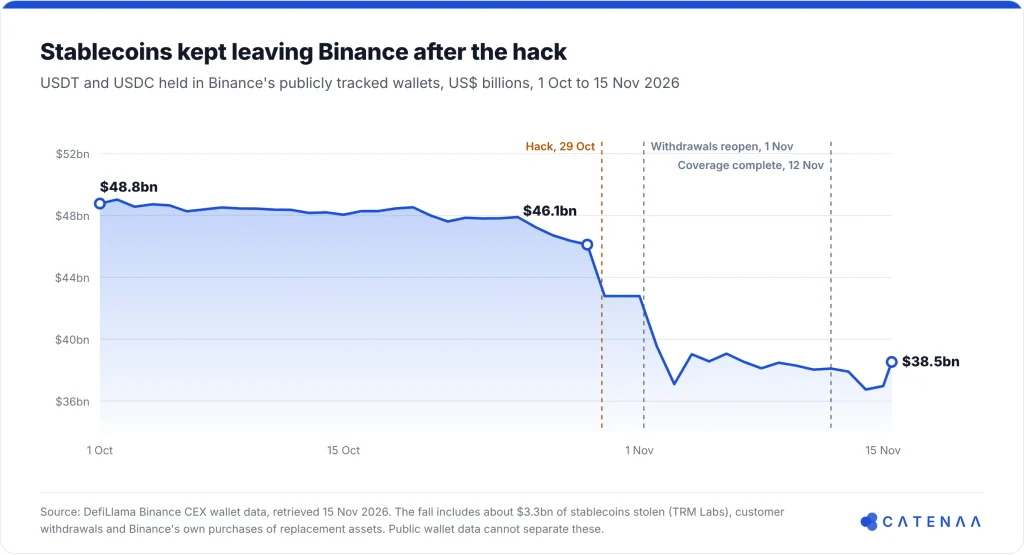
Binance shows a similar pattern. USDT and USDC in its tracked wallets fell from $46.1bn at the start of the hack day to $38.5bn on 15 November. Attackers stole about $3.3bn of stablecoins, according to TRM Labs. The remainder reflects customer withdrawals and Binance’s own purchases of replacement coins, which public data cannot separate. Still, the direction is clear. Trust leaves faster than it returns.
Is proof of reserves reliable? What the snapshot shows and hides
Proof of reserves (PoR) became the industry’s answer to FTX, the crypto exchange failure that shook the market in 2022. It shows that wallets an exchange controls hold at least as much of each covered token as customers are owed. Binance adds a zero-knowledge proof, so each user can check that their own balance is counted.
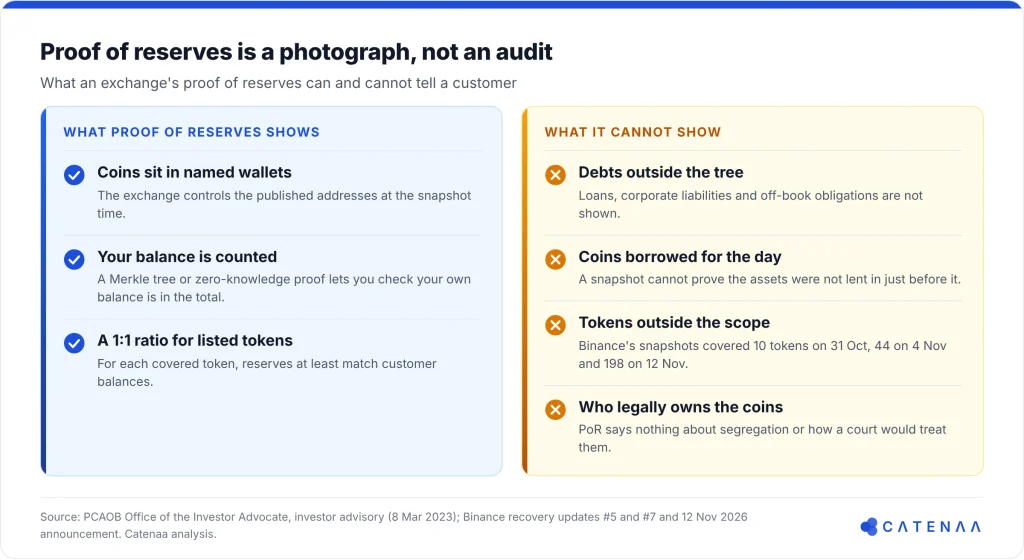
However, PoR is a photograph, not an audit. The US audit regulator’s investor advocate warned in 2023 that PoR reports are “inherently limited.” Each one reflects a single point in time. They do not show loans, corporate debts or coins borrowed for the day of the snapshot.
The Binance episode exposed a second limit: scope. Its 31 October snapshot covered ten tokens. The 4 November snapshot covered 44, and the 12 November snapshot 198. When Binance announced the last one, it had not yet finished generating the full zero-knowledge proof. Meanwhile, WazirX published a reassuring PoR in June 2024, about five weeks before it lost almost half its reserves. A clean snapshot says nothing about the next attack.
What happens if a crypto exchange goes bankrupt? Segregation decides
If the cushion fails, a hack turns into a crypto exchange failure, and a legal question takes over. Are the coins still yours? The answer depends on contracts and local law, not on blockchain records.
Celsius showed the downside. In January 2023, a US bankruptcy judge ruled on its Earn accounts. Under the terms of use, the crypto in them belonged to the company’s estate. Those customers became unsecured creditors. FTX customers fared better than many expected. By July 2026, the FTX Recovery Trust had paid 105% of allowed main customer claims. Yet the plan fixed those claims in dollars as of the November 2022 filing, when bitcoin traded near $17,000. The first cash payment came 830 days after that filing.
Japan offers the contrast. Its rules require exchanges to keep customer assets separate and mostly offline. Less than 5% may sit in hot wallets. The exchange must also hold the same amount of its own coins in cold storage. When FTX collapsed, FTX Japan held enough to repay all users. It began returning assets on 21 February 2023, according to the IMF.
Europe’s MiCA rules aim for a similar result. Article 75 requires custodied crypto to be legally segregated, so a provider’s creditors have no recourse to it in insolvency. It also makes providers liable for losses they cause, capped at market value. Mt. Gox remains the worst case. It halted withdrawals in February 2014 and began repaying bitcoin only in July 2024. Its trustee has now moved the final deadline to 31 October 2027.
Are crypto exchange funds insured? The investor protection gap
In the US, the short answer is usually no. SIPC says crypto assets that do not qualify as registered securities fall outside its protection, even at a member broker. The FDIC states that deposit insurance does not protect against the failure of any non-bank, including crypto exchanges.
Congress has acted on stablecoins but not on exchanges. The GENIUS Act gives holders of payment stablecoins priority over other creditors if an issuer fails. However, the CLARITY Act, a bill to set rules for spot crypto markets, has stalled. It failed a Senate procedural vote, 49 to 50, on 15 September 2026. Consequently, a US customer of an offshore exchange relies mostly on that exchange’s own promises.
Ironically, the fastest protection during the Binance theft came from centralized stablecoin issuers. Tether, Circle and others froze about $2.7bn within hours, according to TRM Labs. No issuer can freeze bitcoin or ether that way, which is why the attacker rushed to swap stablecoins into ether.
What a major crypto exchange failure would mean for markets
Concentration turns one exchange’s problem into everyone’s problem. Binance handled 38.7% of spot volume among the ten largest centralized exchanges in the second quarter of 2026, CoinGecko reports. On the day of the theft, bitcoin’s daily close on Coinbase fell 4.3%, from $81,249 to $77,780.
A true failure, rather than a covered hack, would hit three channels at once. First, customer assets could freeze for months or years. Second, a large slice of market liquidity would disappear. Third, fear could trigger withdrawals at rival venues. After its own hack, Bybit’s tracked reserves fell by about $6bn in two days. For that reason, exchange resilience is now a market-wide risk, not a private one.
How to protect crypto on exchanges: a practical checklist
No single step removes the risk of a crypto exchange failure. Together, however, these habits limit the damage.
- Keep only trading balances on an exchange. Long-term holdings left there carry the exchange’s security and insolvency risks, usually for no extra return.
- Know which legal entity holds your coins. Rules that require segregation, such as MiCA or Japan’s regime, change what happens in bankruptcy.
- Read the terms of yield products. As Celsius showed, some terms transfer ownership of your coins to the platform.
- Treat proof of reserves as a minimum. Check which tokens it covers, how often it updates and whether liabilities are verified.
- Spread exposure across venues. Concentration in one exchange concentrates the risk of a single breach.
- Remember that self-custody has risks too. DefiLlama records $116m stolen in 2026 through a Coldcard firmware flaw and $93m through tampered Ledger devices sold by resellers.
Outlook: the fragility is structural, not accidental
The 2026 thefts show the industry’s defenses working and failing at the same time. Freezes, protection funds and fast replenishment kept Binance and Bitget customers whole. Yet both breaches came through people and internal systems, not through broken cryptography. Binance says its security team detected and blocked 57 suspected North Korea-linked threat cases during 2026.
Therefore, the key question for investors is not whether attackers will target an exchange. It is whether the exchange, and the law around it, can absorb the loss. Until segregation and loss-absorbing capital become legal duties everywhere, the cost of a crypto exchange failure stays with customers. An exchange balance remains a claim on a company’s promise.
Frequently asked questions
What happens to my crypto if an exchange is hacked?
If the exchange has enough capital, it can replace the stolen coins, as Binance did in 2026 using its user fund, insurance fund and treasury. If the loss is too large, customers may face frozen withdrawals and a haircut, as WazirX users did after its 2024 hack.
Is crypto on an exchange insured?
In the US, generally not. SIPC does not protect crypto that is not a registered security, and FDIC insurance does not cover the failure of a crypto exchange. Exchange protection funds are company commitments, not insurance.
Does proof of reserves prove an exchange is solvent?
No. Proof of reserves shows assets in specific wallets at one moment. It does not show all liabilities, borrowed assets or legal ownership, and the PCAOB investor advocate has called such reports inherently limited.
Who owns crypto held by a bankrupt exchange?
It depends on the terms of use and local law. Under segregation rules such as MiCA Article 75 or Japan’s regime, client assets are ring-fenced from creditors. Where terms transfer title, as with Celsius Earn accounts, customers become unsecured creditors.

Methodology: figures labelled as Catenaa calculations are derived from the cited sources. Reserve shares compare stolen value with DefiLlama’s tracked exchange wallets on the day of each theft, or with WazirX’s own June 2024 proof of reserves. Wallet tracking covers only addresses an exchange has published. Day counts use calendar days. This article is for information and education only and is not investment, legal or financial advice.