

Speed has costs. We review Solana’s outage record, map where its validators run, track the US rulebook and list the milestones that will show whether the fixes work.
Solana risks deserve as much attention as its speed. The first four parts of this series described what the network does well. This final part asks the harder question: what could go wrong?
We look at four kinds of risk: technical, infrastructure, regulatory and market. None of these risks is unique to Solana, but each takes a particular shape here. For each, we rely on the network’s own data or on official records. Then we list the milestones that will show whether Solana’s fixes are working. As always, the live figures date from 25 September 2026.
In Summary
Official post-mortems cover four major halts or slowdowns, in 2021, 2022, 2023 and 2024. Each needed a coordinated validator restart.
On 12 August 2026, a hosting failure knocked 28.83% of stake offline, close to the 33.34% line at which finality stops.
Catenaa’s 25 September mapping found about 29.5% of stake on one hosting network and about 55% in Germany and the Netherlands.
US guidance now lists SOL as a digital commodity, but the Clarity Act stalled in the Senate on 15 September 2026.
Watch Alpenglow’s mainnet launch, 200 millisecond slots, Firedancer adoption and hosting diversity.
A record of stoppages
Solana has halted or badly slowed several times since its launch. After major incidents, the Solana Foundation publishes a post-mortem, and four such reports stand out.
On 14 September 2021, a flood of bot transactions during a token sale took the network offline for 17 hours. A year later, in September 2022, a bug in consensus code halted the chain for about eight hours.
In February 2023, an abnormally large block slowed finality for almost 20 hours until validators restarted the network. Most recently, in February 2024, a software bug stopped block finalization for about five hours.
Outages hurt more than convenience. During a halt, traders cannot adjust positions and apps cannot settle payments, which can magnify losses when markets move.
The causes differ, yet a pattern emerges. Each time, validators had to coordinate a manual restart. That shows the network can recover. Restarts are hard work, though. In 2021, engineers coordinated an upgrade and restart among more than 1,000 validators, the post-mortem notes. The episode also showed that, in a crisis, Solana still relies on fast human coordination.
In fairness, the record has improved. Solana’s official status page lists no incident after February 2024. Since then, a second client has joined the network and major upgrades have shipped, as Parts 1 and 2 showed. The status page also logs shorter outages in April and June 2022, which the chart below leaves out.
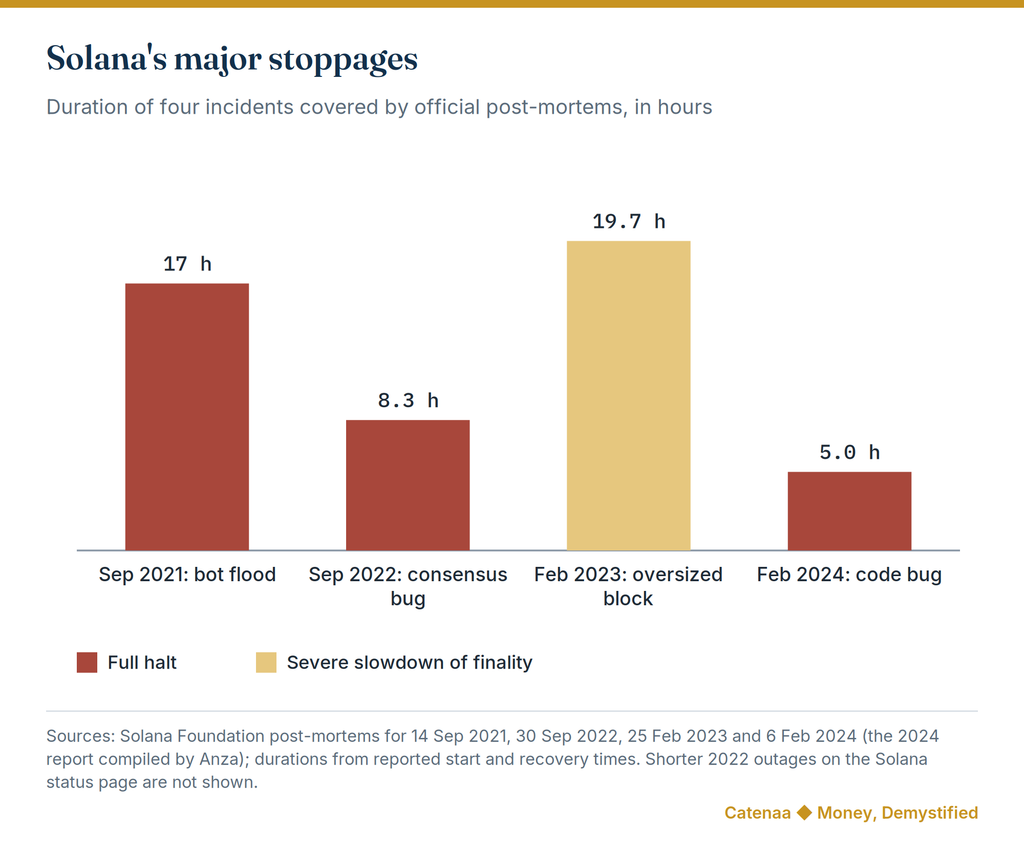
The 2023 incident slowed finality rather than halting blocks; the others were full stops.
The August 2026 near miss
On 12 August 2026, the network came close to another stall. A routing failure at hosting firm TeraSwitch cut off a large group of validators at the same moment.
Staking provider Marinade Finance calculated that validators holding 28.83% of staked SOL went offline. Solana stops finalizing blocks once more than 33.34% is out. Blocks kept coming, and service returned within about 33 minutes.
Why did the network survive? Finality needs votes from more than two thirds of stake, as Part 2 explained. With 28.83% offline, the remaining 71.17% could still reach that bar, though only just. Affected validators lost about 333 SOL in rewards, Marinade estimated.
This time, the cause was not a Solana bug. Instead, too much stake sat with one provider. Marinade found that TeraSwitch’s network hosted 27.34% of all stake that day, and most of it dropped at once. Because blocks kept flowing, Solana’s status page recorded no incident.
The August scare came from a data centre, not from Solana’s code.
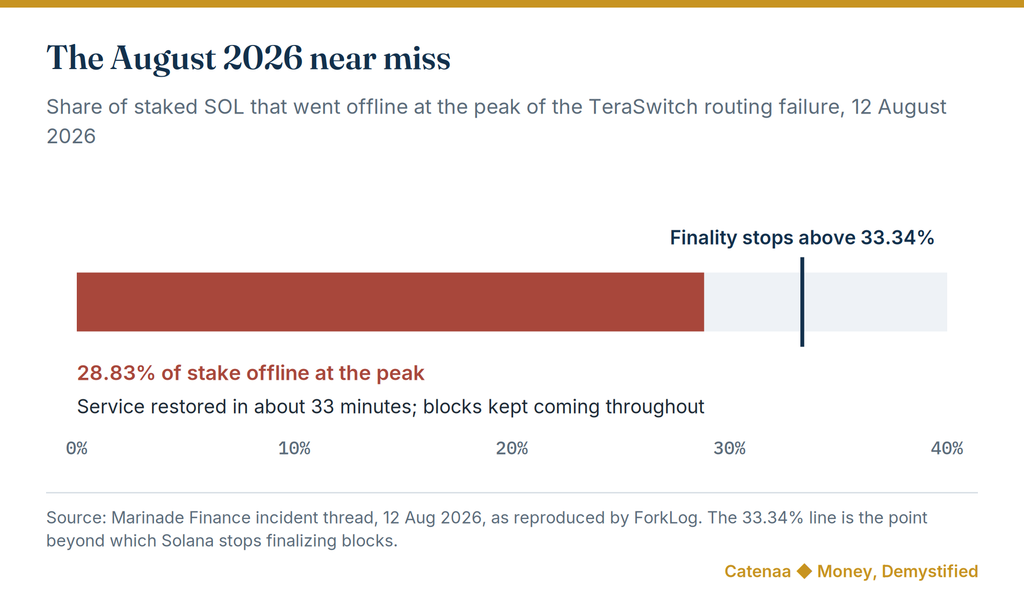
The network stayed 4.51 percentage points short of losing finality.
Where the validators live
We checked whether that concentration has eased since August. For each validator, we took the internet address it advertises on the network. We then matched those addresses to networks and countries using a public lookup service.
The result was striking. On 25 September 2026, TeraSwitch’s network carried about 29.5% of stake, even more than in August. Latitude.sh came next at about 10.1%, followed by Allnodes at 7.1%.
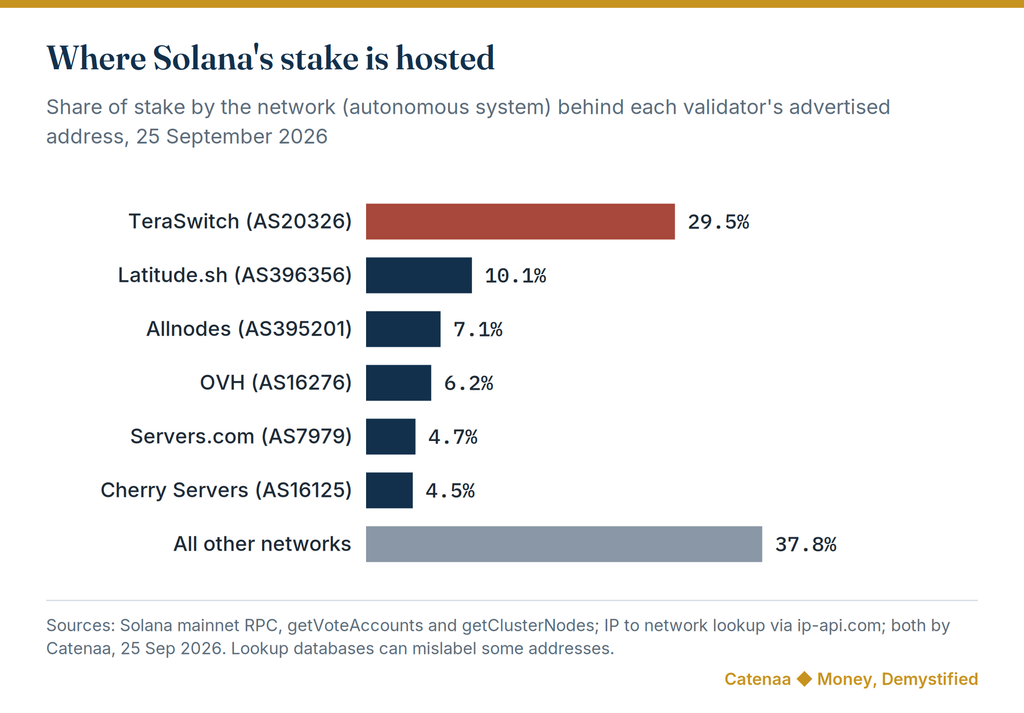
One hosting network carried almost 30% of stake, near the level that nearly stalled the network in August.
Geography tells a similar story. By our count, Germany hosted about 35% of stake and the Netherlands about 20%. So more than half of the network’s voting power sat in two European countries.
Two caveats apply. Address databases can mislabel some networks, and a validator may run backup machines elsewhere. Still, the pattern matches Marinade’s August findings closely.
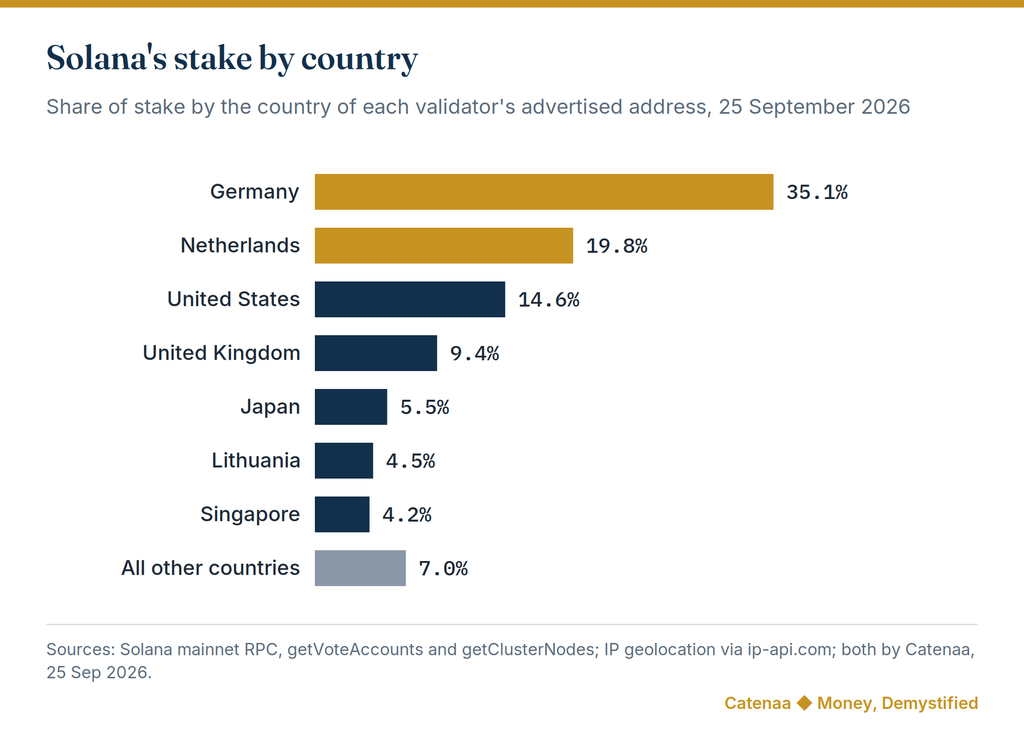
Germany and the Netherlands together hosted more than half of all stake.
Why hosting concentration matters
Concentration creates shared points of failure. A single data centre fire, power cut or routing error can silence many validators together. Similarly, one country’s laws could, in theory, pressure a large share of operators at once.
Nobody forces validators into these facilities. Instead, the choice reflects cost and performance. Validators need fast, reliable links to keep up with 250 millisecond slots, and a few providers offer exactly that.
Fixing this needs better incentives rather than rules alone. After the August scare, Marinade said it would review its own limits. Those limits govern how much stake it places with each provider. Other large delegators face the same question. Solana’s fast slots make low-latency links especially valuable, which pulls validators toward a few well-connected facilities.
One dominant codebase
Software is a second single point of failure. As Part 2 showed, Agave-based clients secured about 87% of stake in our snapshot. A serious Agave bug could therefore still stall most of the network.
Firedancer offers a genuine alternative, yet its share is still modest. Even so, 13% marks real progress for a network that long relied on one main codebase. Moreover, Anza’s feature tracker showed that Firedancer builds did not yet support Alpenglow. Until they do, the upgrade itself leans on one codebase.
Client diversity also brings its own risk. Two clients must agree on every rule, down to the last detail. A mismatch between them could, in rare cases, split the network. That is why new clients tend to grow slowly.
Threats beyond the protocol
Not every risk lives in the core software. Apps, bridges and wallets add their own weak points. Users can therefore lose funds even when the network runs perfectly.
For users, the practical lessons are simple. Check token addresses against the issuer’s own list, as Part 4 showed. Fake tokens remain a common trap, because anyone can copy a well-known name. Treat unexpected tokens and links with suspicion, and never share a recovery phrase.
Apps built on Solana carry their own risks too. A lending app, trading pool or liquid staking token can fail even while the network runs perfectly. So judging Solana and judging an app on Solana are two separate tasks.
From lawsuits to a rulebook
Regulation has shifted fast in the United States. In September 2025, the SEC approved generic listing standards that let exchanges list qualifying crypto products more easily.
Weeks later, on 28 October 2025, Bitwise’s BSOL fund began trading on the New York Stock Exchange. It holds SOL and aims to stake it. For many investors, that opened a familiar route into the asset. It also ties SOL more closely to mainstream markets, for better and for worse.
Then, in March 2026, the SEC issued an interpretation, which the CFTC joined. It sorts crypto assets into five groups. The release itself names Solana (SOL) among 16 examples of digital commodities, a category separate from digital securities.
Congress has not finished the job, though. The House passed the Digital Asset Market Clarity Act in July 2025, by 294 votes to 134. However, on 15 September 2026, the Senate failed to advance it by 49 votes to 50.
So the current US framework rests mainly on agency guidance rather than law. A future SEC could revisit that guidance. The SEC itself says its interpretation complements Congress’s efforts to write a full market structure framework into law. Outside the US, rules differ by country, and a product allowed in one market may face limits in another. Meanwhile, in August 2026, the SEC also proposed new rules for crypto assets, which were still at the proposal stage.
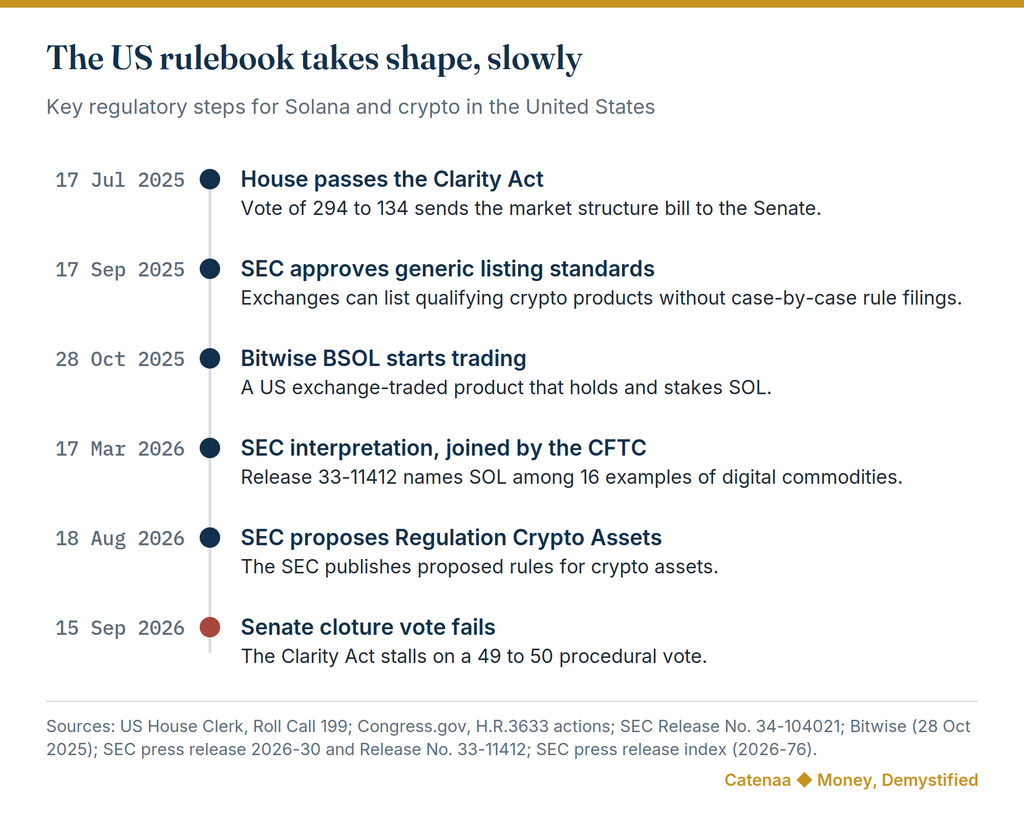
Agency guidance has moved faster than legislation.
Market risk has not gone away
Better rules do not guarantee better prices. SOL peaked near $235 on 3 October 2025, according to CoinGecko data. It then fell to about $62 on 7 June 2026. That was a drop of roughly 74%.
By 25 September 2026, it had recovered to $120.02. Swings of this size have been common for SOL, and they can still wipe out savings. Anyone holding SOL should expect more of them. In 14 of the past 52 weeks, SOL fell by more than 5%, by our count of CoinGecko data. That is roughly a year of staking income lost in a single week.
Network activity can fall as well as rise, and fees and validator income move with it. As a result, headline usage figures from a busy month can mislead.
What has improved
A fair review must also note the progress. Target slot times fell from 400 to 250 milliseconds in about a month. A second, independent client now secures about 13% of stake.
Large firms have also committed real products to the network, as Part 4 showed. Meanwhile, the February 2024 halt remains the latest covered by an official post-mortem. Each of these steps reduces some risk, even if none removes it. Engineers have also published detailed reports after major failures, which lets outsiders check the fixes.
In short, Solana today is faster, more diverse and better understood by regulators than it was two years ago. Its weak spots have shifted from code toward infrastructure and law.
What to watch next
Several milestones will test Solana’s next chapter. First, watch whether Alpenglow reaches mainnet and how it performs under real traffic. Its on-chain switch was still off on mainnet when we checked.
Second, watch the final step to 200 millisecond slots, which had not activated on mainnet. The Solana Foundation says it will pause if validators skip too many blocks.
Third, track whether stake spreads beyond a handful of hosting firms. Fourth, follow Firedancer’s share of stake. Finally, watch Congress, because a law would give the industry firmer ground than guidance. The economic proposals from Part 3 also deserve attention, since they would affect every staker.
Some upgrades have already landed. For example, a new transaction format, Transaction V1, switched on in mid-September 2026. According to SIMD-0385, its designers built it to allow larger transactions and faster processing.
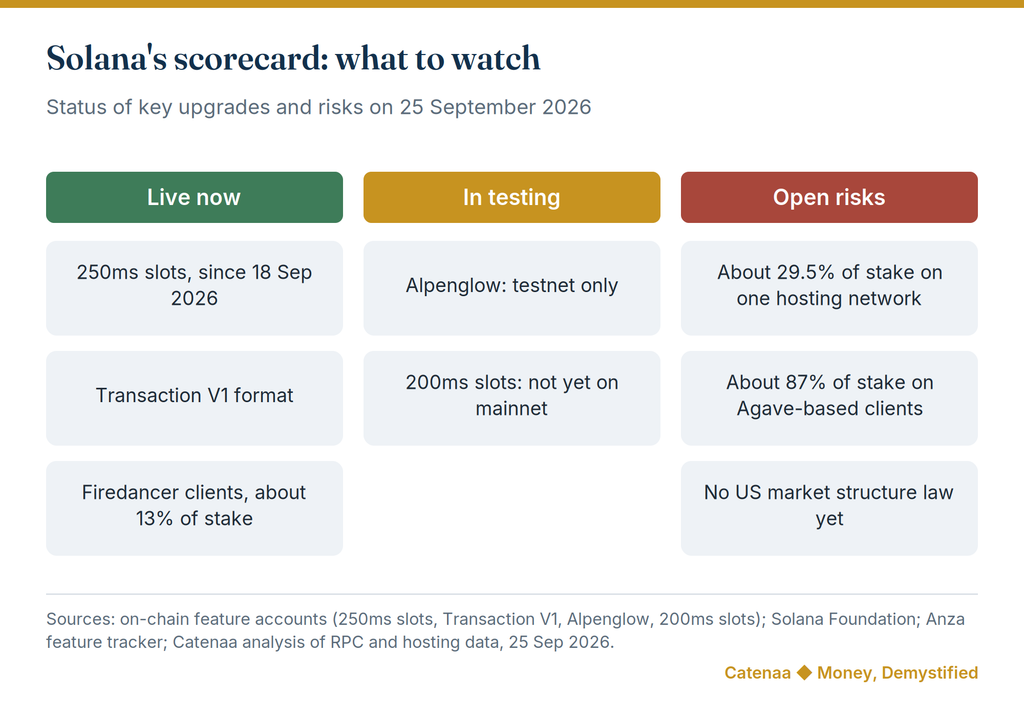
Several upgrades are live, while the biggest structural risks remain open.
Solana has shown it can grow fast and recover from failure. The open question is whether it can spread out its infrastructure as quickly as it speeds up its blocks. That, more than any single upgrade, will decide how much trust it earns.
Disclaimer. This article is for education only. It is not investment, legal or tax advice. Crypto assets are volatile and can lose value quickly. On-chain figures are taken on 25 September 2026 and will change.
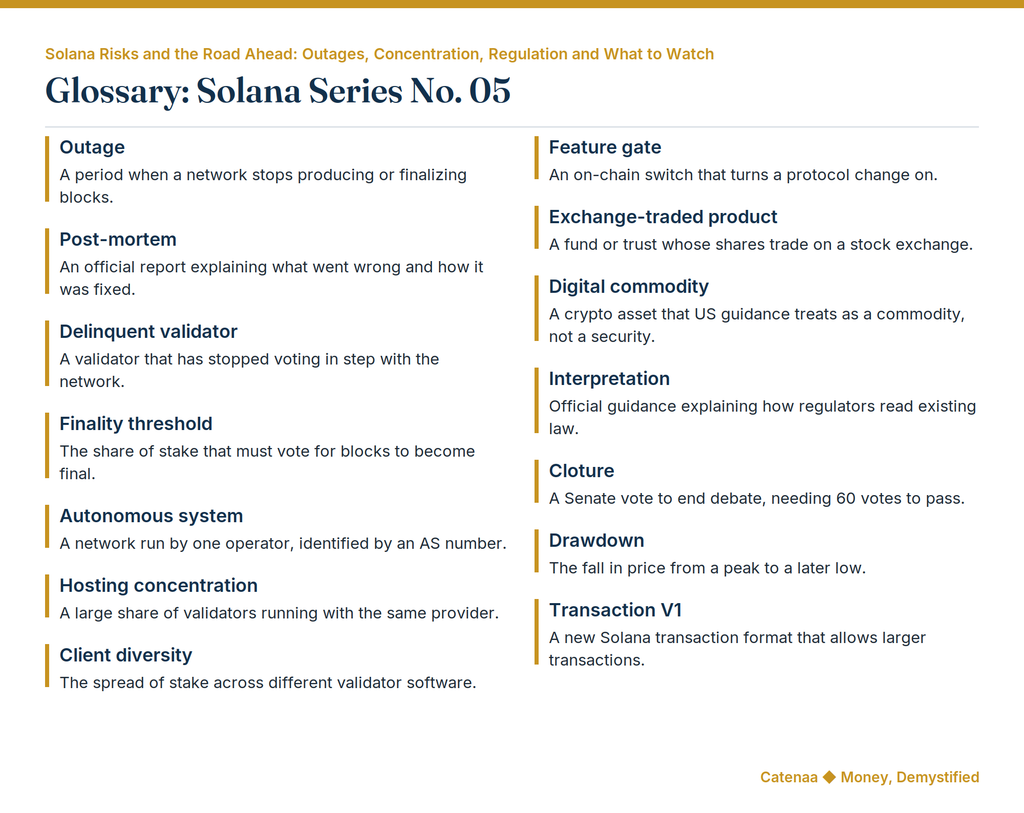
Glossary
Sources and references
- Solana Foundation. 9-14 Network Outage Initial Overview. Sep 2021. https://solana.com/news/9-14-network-outage-initial-overview
- Solana Foundation. 09-30-22 Solana Mainnet Beta Outage Report. 6 Oct 2022. https://solana.com/news/09-30-22-solana-mainnet-beta-outage-report
- Solana Foundation. 02-25-23 Solana Mainnet Beta Outage Report. 2023. https://solana.com/news/02-25-23-solana-mainnet-beta-outage-report
- Solana Foundation, compiled by Anza. 02-06-24 Solana Mainnet Beta Outage Report. Feb 2024. https://solana.com/news/02-06-24-solana-mainnet-beta-outage-report
- Marinade Finance incident thread on X (@MarinadeFinance), quoted verbatim by ForkLog. Solana Nears Transaction Finalization Halt Due to TeraSwitch Outage. 12 Aug 2026. https://forklog.com/en/solana-nears-transaction-finalization-halt-due-to-teraswitch-outage/
- Congress.gov. H.R.3633, Digital Asset Market Clarity Act: all actions. Accessed 25 Sep 2026. https://www.congress.gov/bill/119th-congress/house-bill/3633/all-actions
- Solana Foundation. Solana status page, incident history (checked via status API). Checked 26 Sep 2026. https://status.solana.com/history
- ip-api.com. Batch IP to network (ASN) and country lookup, used by Catenaa. 25 Sep 2026. https://ip-api.com/docs/api:batch
- Solana mainnet RPC. getVoteAccounts, queried by Catenaa, 25 Sep 2026. 25 Sep 2026. https://solana.com/docs/rpc/http/getvoteaccounts
- Solana mainnet RPC. getClusterNodes, queried by Catenaa, 25 Sep 2026. 25 Sep 2026. https://solana.com/docs/rpc/http/getclusternodes
- Anza. Feature Gate Tracker Schedule, Agave wiki. Accessed 25 Sep 2026. https://github.com/anza-xyz/agave/wiki/feature-gate-tracker-schedule
- US Securities and Exchange Commission. Release No. 34-104021, citing the 17 Sep 2025 approval of generic listing standards. Sep 2025. https://www.sec.gov/files/rules/sro/nysearca/2025/34-104021.pdf
- Bitwise. The Bitwise Solana Staking ETF (BSOL) Begins Trading. 28 Oct 2025. https://bitwiseinvestments.com/newsroom/the-bitwise-solana-staking-etf-bsol-begins-trading
- US Securities and Exchange Commission. SEC Clarifies the Application of Federal Securities Laws to Crypto Assets, press release 2026-30. 17 Mar 2026. https://www.sec.gov/newsroom/press-releases/2026-30-sec-clarifies-application-federal-securities-laws-crypto-assets
- US Securities and Exchange Commission. Release No. 33-11412, Commission Interpretation on the Application of the Federal Securities Laws to Crypto Assets. 17 Mar 2026. https://www.sec.gov/files/rules/interp/2026/33-11412.pdf
- Office of the Clerk, US House of Representatives. Roll Call 199: On Passage, H.R. 3633, CLARITY Act (294 yeas, 134 nays). 17 Jul 2025. https://clerk.house.gov/Votes/2025199
- US Securities and Exchange Commission. Press release index, incl. 2026-76 SEC Proposes New Regulation Crypto Assets (18 Aug 2026). Accessed 25 Sep 2026. https://www.sec.gov/newsroom/press-releases?combine=crypto&year=All&month=All
- CoinGecko. Solana (SOL) price, market cap and 365-day history via public API. Snapshot 25 Sep 2026. https://www.coingecko.com/en/coins/solana
- Solana Explorer. Feature gate A1pengvu: Alpenglow, SIMD-0326 (on-chain account). Checked 25 Sep 2026. https://explorer.solana.com/address/A1pengvuM6JEcyNuTnMqepBKhwHE3N6PmUrdATGawhJS
- Solana Explorer. Feature gate iBRLjhJn: reduce slot time to 200ms (on-chain account). Checked 25 Sep 2026. https://explorer.solana.com/address/iBRLjhJnkmDZgNoZRDMW11d8ZV7HvsL3vAyRjZB5npW
- Solana Foundation. Reduced Slot Times, upgrade status page. Jun 2026, updated Sep 2026. https://solana.com/upgrades/reduced-slot-times
- Solana Explorer. Feature gate txv1aq4p: Transaction V1 (on-chain account, activated at slot 447,120,000). Checked 25 Sep 2026. https://explorer.solana.com/address/txv1aq4pp281K9um3tnPgkfX8UqtFT6wcVW3hNezGLL
- Solana Improvement Documents. SIMD-0385: Transaction V1 Format. 2025. https://github.com/solana-foundation/solana-improvement-documents/blob/main/proposals/0385-transaction-v1.md
- Solana Explorer. Feature gate iBRLMc81: reduce slot time to 250ms (on-chain account). Checked 25 Sep 2026. https://explorer.solana.com/address/iBRLMc81UjRa8fn8A6eE8bJTnRbgQoPTynM51akENCV
Editorial note: Figures in this series reflect data as of 25 September 2026