

What Wall Street’s biggest buzzword really means, and why it matters right now.
SpaceX is on the verge of the biggest public market debut in history. OpenAI and Anthropic are right behind. The word “IPO” fills every financial headline right now. But what does it actually mean, and why should you care?
Table of Contents
- Table of contents will be generated automatically when the page loads.
In Summary
An IPO is when a private company sells shares to the public for the first time and lists on a stock exchange.
Companies go public primarily to raise capital, give early investors a way to exit, and gain market credibility.
The process takes 6 to 12 months and involves underwriters, the SEC, an S-1 filing, and a roadshow.
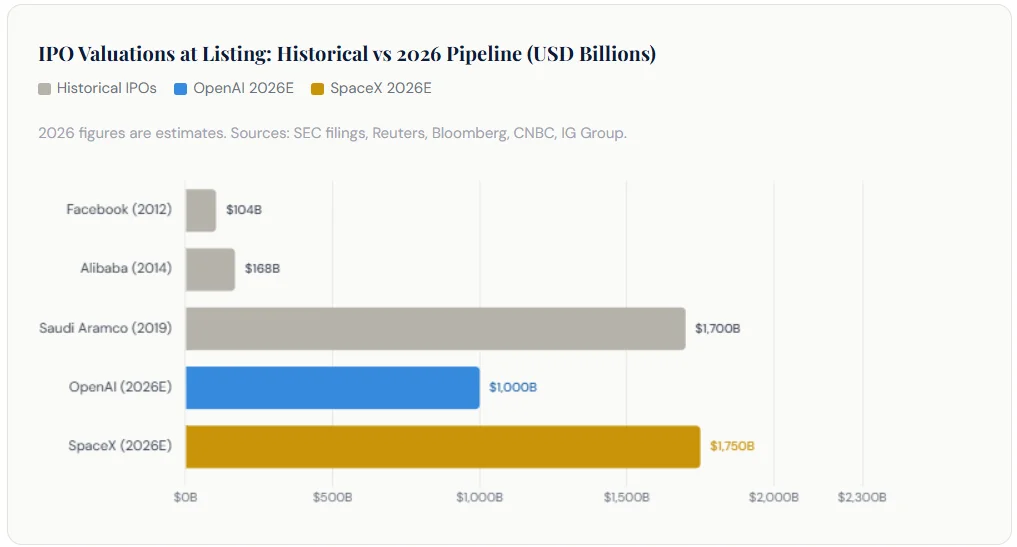
SpaceX targets a $1.75 trillion valuation. That could make it the largest IPO in financial history.
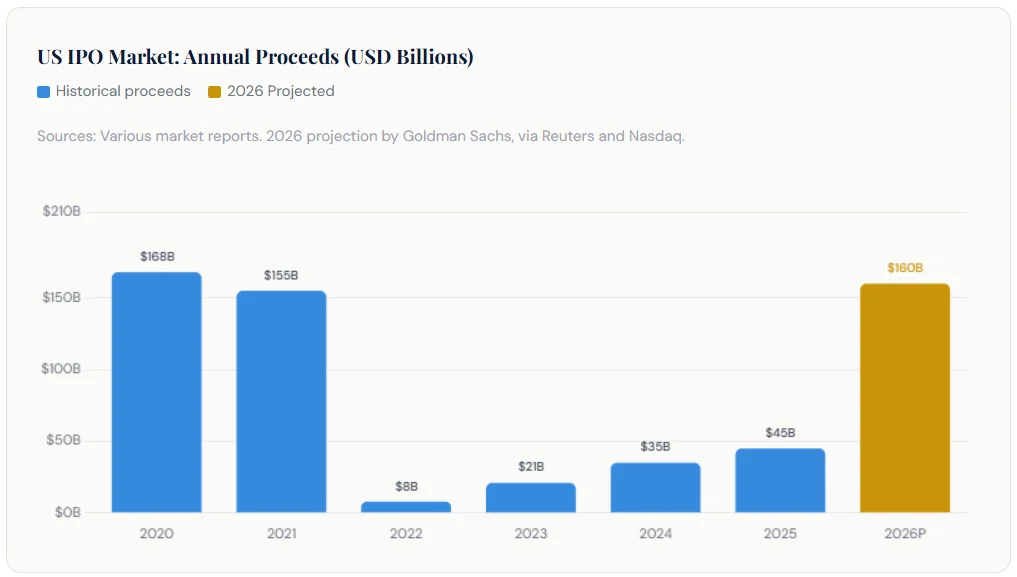
Goldman Sachs projects US IPO proceeds could reach $160 billion in 2026, up from just $45 billion in 2025.
IPO investing carries real risks. Lock-up expiry pressure, high valuations, and heavy operating losses demand careful scrutiny.
What Is an IPO?
IPO stands for Initial Public Offering. It is the process by which a private company sells shares to the public for the very first time. Think of it as a company opening its ownership to anyone with a brokerage account.
Before an IPO, a company is privately held. Founders, employees, and venture capital (VC) firms own most of its equity. These shares are not freely tradeable. There is no open market where someone can simply buy or sell them. This state is called being “illiquid.”
An IPO changes everything. The company lists its shares on a major exchange, such as the New York Stock Exchange (NYSE) or the Nasdaq. From that day forward, anyone can trade those shares freely. The company raises fresh capital. Early investors gain liquidity. Furthermore, the public gets a real-time price on the business every second of every trading day.
The word “initial” is crucial. This is the one and only time shares are issued this way. After listing, a company can raise more capital through follow-on offerings. However, the IPO marks the original and defining public transaction.
According to Wall Street Prep, the process typically begins with hiring investment banks, filing regulatory documents, and then conducting investor presentations. Each step builds toward the first day of public trading.
Why Do Companies Go Public?
The most obvious driver is capital. Public markets offer access to far more capital than private rounds. SpaceX is targeting a $50 to $75 billion raise from its upcoming IPO. It plans to use that capital to fund AI infrastructure and continued space exploration.
However, fundraising is just one motivator. Companies pursue IPOs for several powerful and interconnected reasons.
Capital at Scale
Private funding rounds have hard limits. Public markets simultaneously unlock billions from global institutional investors. Anthropic’s annualised revenue hit $44 billion by May 2026. Yet the company still needs massive capital to build an AI computing infrastructure. A public listing delivers that at a scale no venture round can match.
Liquidity for Early Investors
Venture capital funds have finite lifespans. Their investors expect returns on a schedule. An IPO gives early backers a legitimate, liquid exit. Employees with stock options can finally convert them to real, spendable cash. This creates powerful incentives for everyone involved from the start.
Credibility and Accountability
A listed company signals commitment to transparency. As Cornell finance professor Minmo Gahng noted, going public means companies can no longer cherry-pick their disclosures. Quarterly earnings reports, audited financials, and public filings hold management accountable in ways private companies never face.
Acquisition Currency and Talent Retention
Public companies can use their own shares to acquire other businesses. This powerful tool avoids depleting cash reserves. Additionally, publicly traded stock options are far more attractive to top talent than private-company paper that may never be redeemed.
How Does the IPO Process Work?
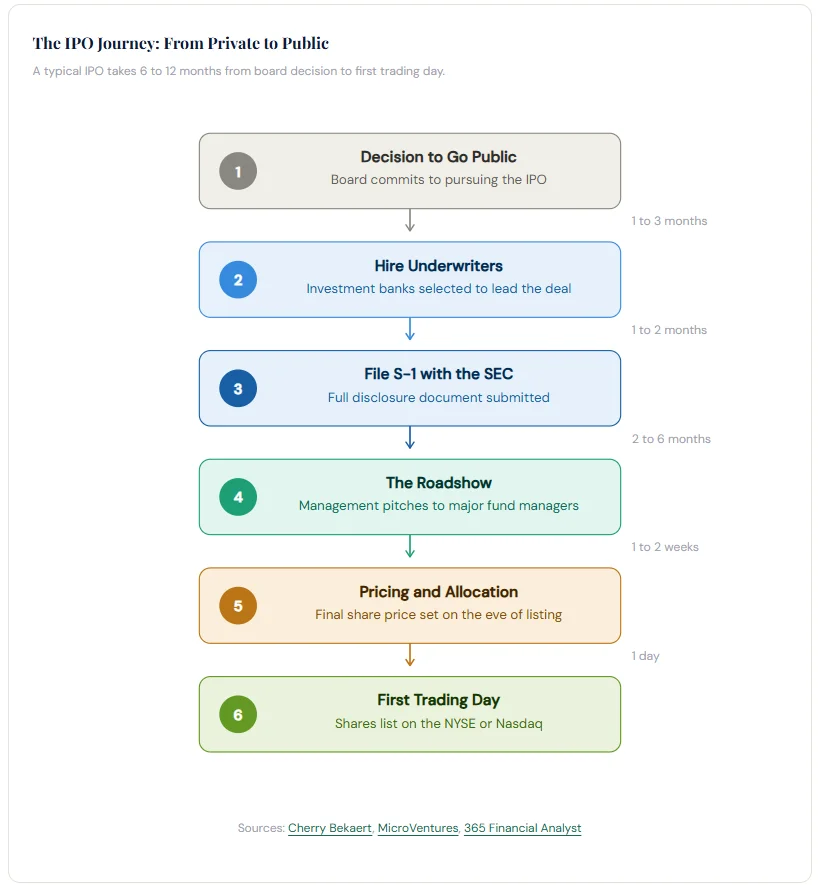
The IPO is not a single event. It is a structured, multi-stage journey. According to MicroVentures, the full timeline from initial decision to first trading day spans 6 to 12 months. Each stage has specific regulatory, legal, and financial requirements.
Step 1: The Decision to Go Public
The board and senior leadership vote to pursue an IPO. This is a major strategic commitment. It means accepting new obligations: quarterly financial disclosures, regulatory oversight, and ongoing public scrutiny of every business decision.
Step 2: Hire Underwriters
The company selects investment banks to manage the process. These banks are called “underwriters.” The lead bank, known as the “bookrunner,” coordinates the entire deal. For SpaceX, Goldman Sachs is leading a 21-bank syndicate. Underwriters typically earn fees of 3 to 7% of total proceeds. Therefore, large IPOs are enormously profitable for Wall Street.
Step 3: File the S-1 Registration Statement
In the US a company files a Form S-1 with the US Securities and Exchange Commission (SEC). This is the most important document in the process. It discloses the company’s financial history, business risks, plans for the use of funds raised, and management details. The SEC then reviews the filing, a process that typically takes 2 to 6 months.
Step 4: The Roadshow
Once the SEC approves the filing, executives and bankers conduct ab awareness program called “roadshow”. They travel to major financial centers: New York, Boston, San Francisco, and London. They present to institutional investors such as mutual funds, pension funds, and sovereign wealth funds. The roadshow typically lasts 1 to 2 weeks. It directly influences final pricing and investor demand.
Step 5: Pricing and Allocation
The night before trading begins, the underwriter sets the final IPO price. This price reflects the demand gathered during the roadshow. Shares are then allocated to investors, with institutional buyers typically receiving priority.
Step 6: First Trading Day
Once the company is listed on the exchange, shares begin trading publicly. Retail investors can buy shares for the first time. Media attention peaks. The market assigns a live, real-time price to the business every second.
The 2026 IPO Wave: An Unprecedented Scale
The current IPO pipeline has no modern parallel. Three of the world’s most valuable private companies are targeting public debuts within months of each other. The scale is staggering.
Goldman Sachs analysts project total US IPO proceeds could reach $160 billion in 2026. That is a fourfold increase from the $45 billion raised in all of 2025. This forecast was made before the full scale of the current wave even became apparent.
SpaceX is the furthest along. It has filed its S-1 with the SEC, with Goldman Sachs leading its 21-bank syndicate. Its roadshow began last week on June 4. The company targets a valuation of $1.75 trillion. That would surpass Saudi Aramco’s record, making SpaceX the largest IPO in financial history.
OpenAI aims for a public debut as early as Q4 2026 at a valuation approaching $1 trillion. Its annualised revenue exceeded $20 billion by the end of 2025.
That figure grew from just $2 billion in 2023. Anthropic, meanwhile, targets a listing as early as October 2026. Its annualised revenue hit $30 billion in April 2026, up from $9 billion at the end of 2025.
This wave matters for investors worldwide. It represents the first opportunity to own pure-play AI companies at scale. Historically, investors accessed AI indirectly: buying Microsoft for its OpenAI stake or Nvidia for its chip exposure. That era is ending.
“These are companies that could realistically attract investors who have spent years waiting for pure-play AI exposure in public markets.”
-Daniel Newman, Analyst, Futurum Group, via Marketplace (May 2026)
What Risks Should Investors Know?
IPO investing is exciting. However, the excitement surrounding a high-profile listing can cloud judgment. Understanding the key risks is essential before committing any capital.
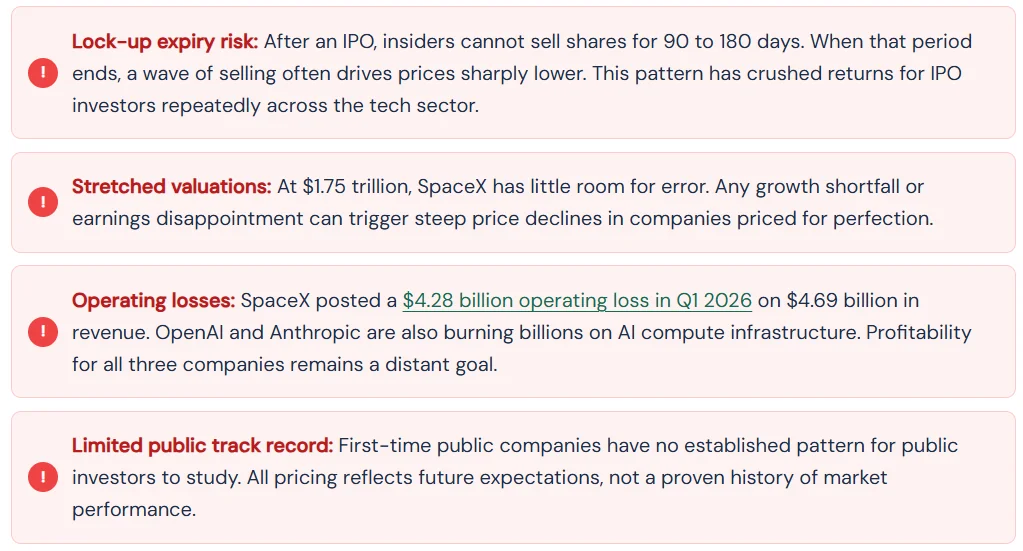
Therefore, the best protection is thorough research. Read the S-1 carefully. Study the financials. Understand the risks the company itself discloses. Only then should you make any investment decision.