

Billions of digital dollars now sit on Solana. We counted them on-chain, traced how a single transfer works and looked at why large payment firms have moved in.
Solana stablecoins may end up touching far more people than SOL itself. Most people will never buy a volatile crypto token. Yet many may still use Solana one day, perhaps without even noticing. The reason is the stablecoin, a digital token that tracks a currency such as the US dollar.
This fourth part of our series explains how those tokens work on Solana. We counted how many exist using the network’s own data. Then we followed a single transfer step by step, and looked at the companies building on top.
In Summary
Five issuer-verified dollar stablecoins totalled about $14.8 billion on Solana on 25 September 2026, led by USDC at $8.14 billion.
A token transfer updates two token accounts through the token program. The base fee was about $0.0006 at that day’s SOL price.
PYUSD and USDG run on the newer Token-2022 program, which supports built-in features such as transfer hooks.
Visa (2023), PayPal (2024), BlackRock’s BUIDL via Securitize (2025) and Western Union (2026) have all used Solana.
A stablecoin is only as sound as its issuer. Cash-out routes and network reliability still limit everyday use.
What a stablecoin is
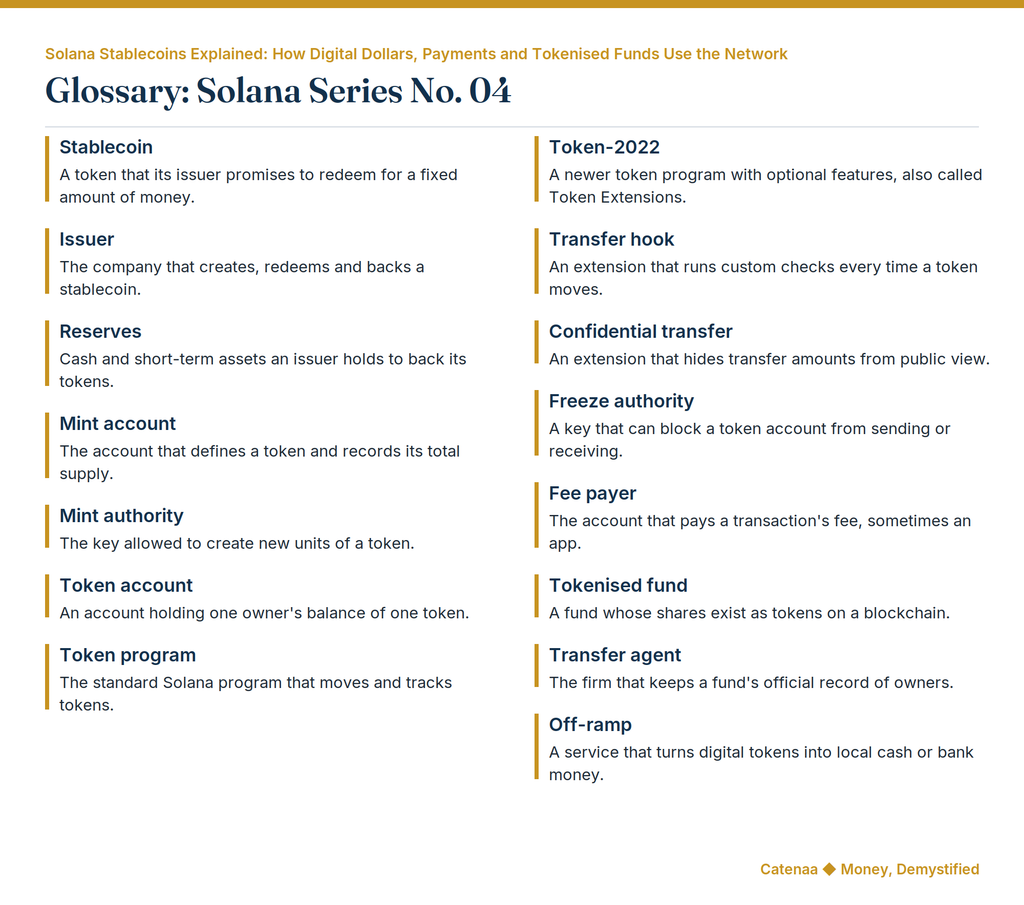
A stablecoin is a token that an issuer promises to redeem for a fixed amount of money. For a dollar stablecoin, that amount is one dollar. To back the promise, the issuer holds reserves, typically cash and short-term government debt.
On Solana, each stablecoin has a mint account. It records the total supply and names the authority allowed to create new tokens. When a customer deposits dollars, the issuer mints fresh tokens. Redemptions work the other way, as the issuer destroys tokens and pays out dollars.
Crucially, the blockchain tracks only the tokens. The dollars themselves sit with banks and custodians, off the chain. So when you hold a stablecoin, you rely on the issuer to keep its reserves safe and to honour redemptions.
That makes stablecoins very different from SOL. SOL has no issuer and no promise of a fixed value. A stablecoin, by contrast, is a claim on a company, carried by a public network. Reserve reports differ by issuer, so check each issuer’s own disclosures.
Why put dollars on a blockchain?
Why would anyone want dollars on a blockchain rather than in a bank? Three reasons come up again and again. First, stablecoins move at any hour, including weekends and holidays. Second, anyone with an internet connection and a wallet can hold them.
Third, software can move them automatically. For example, a program could pay a supplier the moment goods arrive, without a clerk pressing a button.
These features appeal most where banking is slow, costly or hard to reach. Cross-border payments are a clear example. Yet the same openness also attracts fraud, so issuers and exchanges spend heavily on identity and transaction checks.
Counting the dollars on Solana
How much money lives on Solana? We asked the network directly. Using each issuer’s published mint address, we read the on-chain token supply on 25 September 2026.
Circle’s USDC led with about $8.14 billion. Tether’s USDT followed at $3.84 billion. World Liberty Financial’s USD1 stood at $1.38 billion. PayPal’s PYUSD, issued by Paxos, and Paxos’s own USDG each held around $0.7 billion.
Together, those five tokens came to about $14.8 billion. That is a floor rather than a total, because we left out smaller stablecoins. We also counted only tokens whose addresses the issuers themselves publish.
Why insist on issuer addresses? Anyone can create a token called USDC on a public blockchain. Only the address that Circle publishes is the real one. Checking the address is the first defence against fakes. Supplies also change daily as issuers mint and redeem, so treat these totals as a snapshot.
The ranking also reveals concentration. With USDC holding more than half the total, much of Solana’s dollar economy depends on a single issuer.
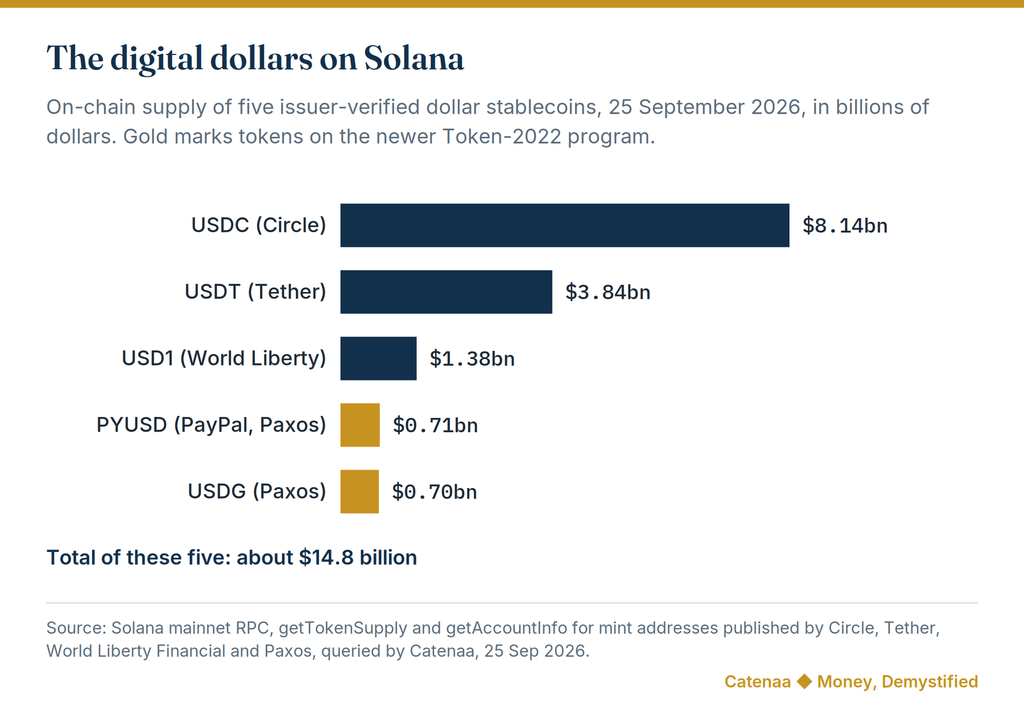
The five tokens totalled about $14.8 billion; USDC alone was over half.
Following one transfer
Suppose Amara in Nairobi sends 50 USDC to her brother Kofi in London. Her wallet does not move coins from one pocket to another. Instead, it asks the token program to update two token accounts. One balance falls by 50, and the other rises by 50.
If Kofi has never held USDC, his wallet may first need a new token account. That account needs a small SOL deposit, which he gets back if he ever closes it.
The transfer itself pays Solana’s base fee of about $0.0006 at the day’s price. Normally, the sender pays it in SOL. However, apps can cover fees for their users, as the Solana payments guide explains. Amara may therefore never touch SOL at all.
Speed matters for everyday money. A shop cannot wait an hour to learn that the money has arrived. On Solana, that answer usually arrives before a customer puts the phone away.
Kofi’s wallet shows the funds once the network confirms the block, a step that Anza describes as sub-second. Moving the money takes seconds and costs a fraction of a cent. Turning it back into local cash is the harder part. That step still depends on exchanges, agents and banks, and their fees can dwarf the network fee.
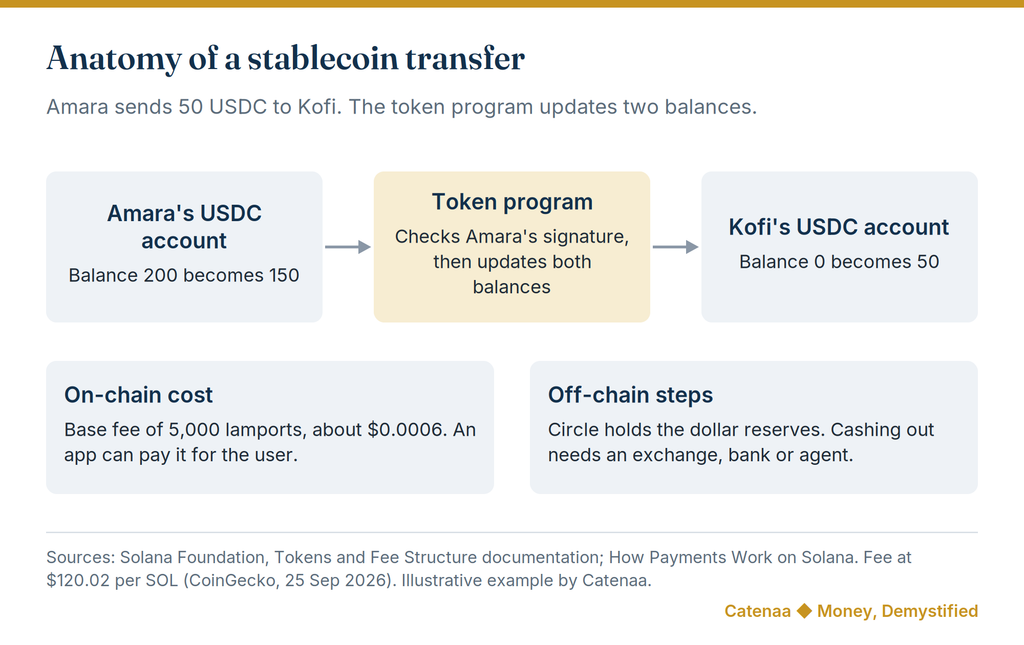
On-chain, a transfer is two balance updates plus a tiny fee.
Who can freeze your dollars?
Every stablecoin comes with a set of master keys. Our on-chain check found that all five tokens we counted keep an active mint authority. Each also keeps a freeze authority, which can block a specific account from moving its tokens.
Such powers can block stolen funds or enforce legal orders. Yet they also mean a stablecoin is not censorship resistant in the way SOL is.
For most users, this trade-off is acceptable, and even reassuring. Still, it is worth knowing. A digital dollar on Solana is fast and cheap to move, but its issuer keeps the final say.
Two token programs
Solana now runs two standard token programs. The original one powers USDC, USDT and USD1. A newer version, called Token Extensions or Token-2022, adds optional features that an issuer can switch on.
Our on-chain check shows that PYUSD and USDG both use the newer program. According to a Solana Foundation deep dive, PYUSD uses extensions such as on-chain metadata. Other extensions can add transfer hooks, which run custom checks on every transfer, or confidential transfers, which hide amounts.
We checked the live settings. On 25 September 2026, both PYUSD and USDG had switched on several extensions, including transfer hooks and confidential transfers. Both also enabled a permanent delegate. Solana’s documentation describes this as an authority that can move or burn tokens from any account of that token.
These tools matter for regulated firms. They let an issuer build compliance rules into the token itself, rather than bolting them on later. However, the same power can restrict or freeze funds. So users should understand what a token allows before they rely on it.
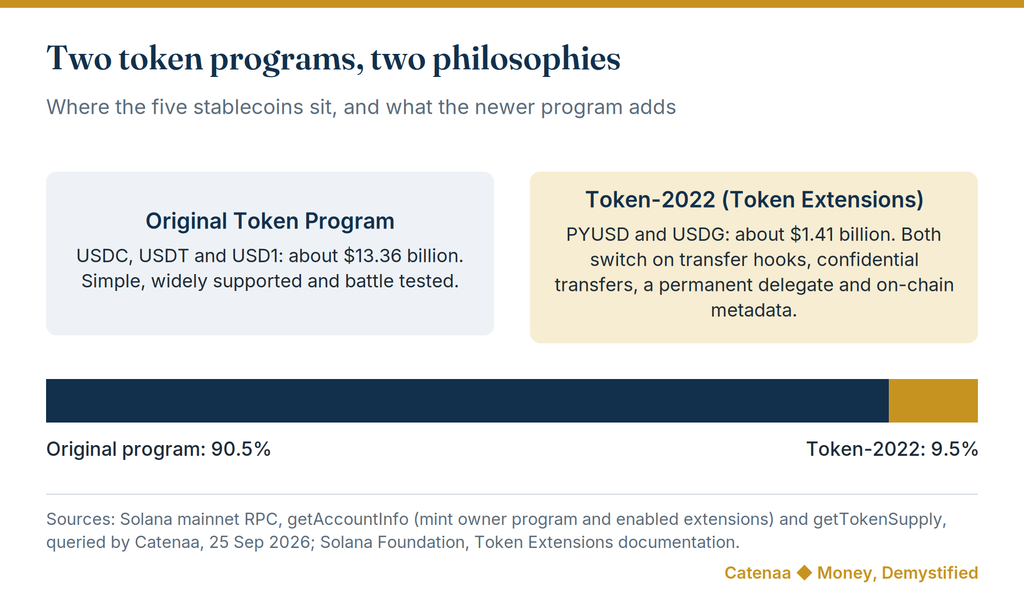
Most stablecoin value still sits on the original token program.
Do stablecoins help SOL?
A fair question follows. If billions of dollars move on Solana, does SOL benefit? The answer is less direct than many assume.
Each transfer pays a fee in SOL, and new token accounts need small SOL deposits. That creates steady demand. However, the fees are tiny, and apps can pay them on behalf of users. So a stablecoin boom does not automatically translate into large SOL purchases.
The bigger link runs through validators and staking. More activity can lift fee income for validators. Over time, that may make running and securing the network more attractive. The effect on SOL’s price, though, depends on many other forces.
Payment giants move in
Large payment companies have tested Solana for years. Visa moved first. In September 2023, it said it had expanded its stablecoin settlement work to Solana. It worked with the merchant acquirers Worldpay and Nuvei.
In May 2024, PayPal brought PYUSD to Solana, pitching faster and cheaper transactions for its users. Then, in May 2026, Western Union launched USDPT, a dollar stablecoin on Solana. Its original announcement named Anchorage Digital Bank as the issuer and promised cash off-ramps through Western Union’s own network.
Each move follows a similar logic. Stablecoins settle around the clock, including weekends, while traditional transfers often wait for banks to open. Meanwhile, Solana keeps the cost per transfer tiny. For firms that move money across borders, both features cut delays and costs.
Western Union’s move stands out, because cross-border transfers are its core business.
That does not mean these firms have abandoned banks. Most run stablecoins alongside existing rails, testing where they help. The shift is gradual rather than sudden.
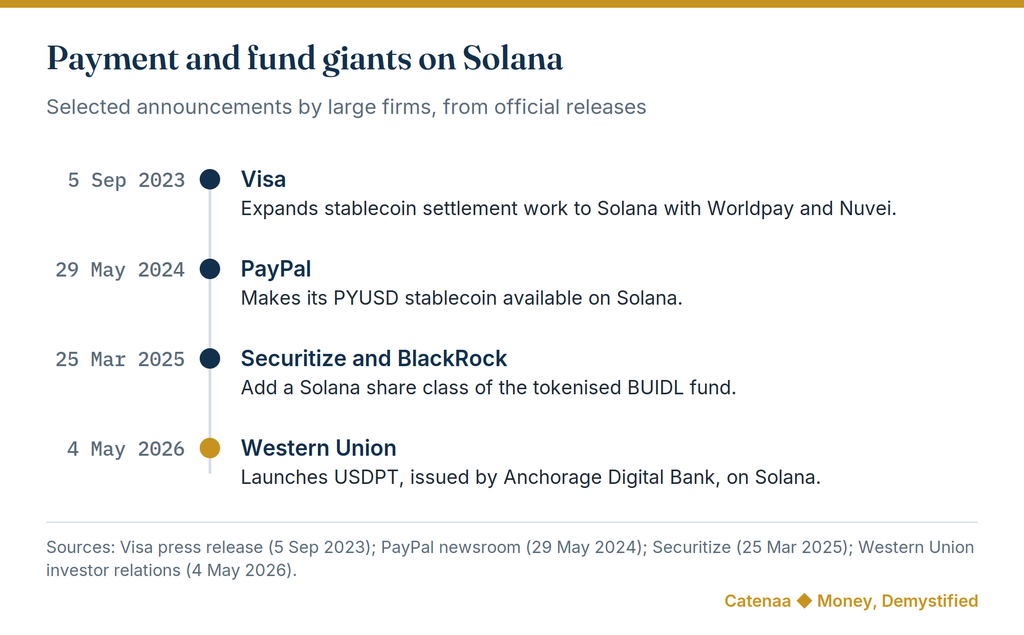
Large firms have added Solana step by step since 2023.
Funds and shares as tokens
Investment funds have followed the payment firms. In March 2025, Securitize announced a new Solana share class of BUIDL. That is a tokenised BlackRock fund that invests in cash-like assets.
A tokenised fund works like a normal fund with a digital share register. Many such funds restrict who can hold them. Investors typically pass identity checks, and a transfer agent or tokenisation platform keeps the official record.
Tokenisation changes the plumbing, not the legal nature of an asset.
US regulators have drawn a clear line here. The SEC’s March 2026 interpretation treats tokenised securities as securities, whatever technology carries them. In other words, putting a fund on a blockchain changes the plumbing, not the legal rules.
For investors, tokenised funds promise faster settlement and easier use as collateral. Cash and fund shares can even change hands in the same transaction. That cuts the risk that one side fails to deliver. So far, though, they mainly serve large institutions rather than households.
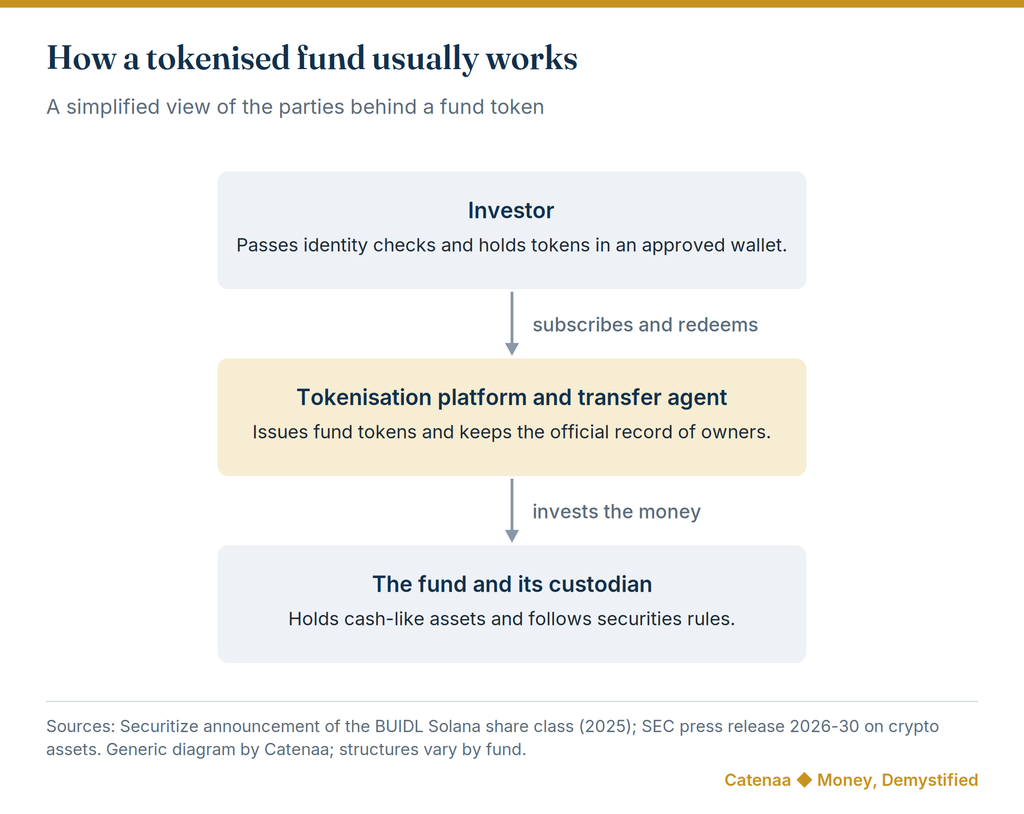
The token is a digital share register; the legal fund and its assets stay the same.
What could slow adoption
The case for digital dollars on Solana looks strong on paper, yet real hurdles remain. First, users depend entirely on issuers and their reserves. If an issuer stumbles, the blockchain cannot fix it.
Second, cash-out routes vary widely by country. Third, the network itself must stay online, a topic Part 5 examines closely.
Competition matters as well. Stablecoins run on many blockchains, so Solana competes with other networks for issuers and users. It must keep earning that business.
Finally, the network prices fees in SOL, so their dollar cost moves with the SOL price. We checked what the base fee cost across the past year’s price range. Even at SOL’s peak, near $235, it stayed around a tenth of a cent.
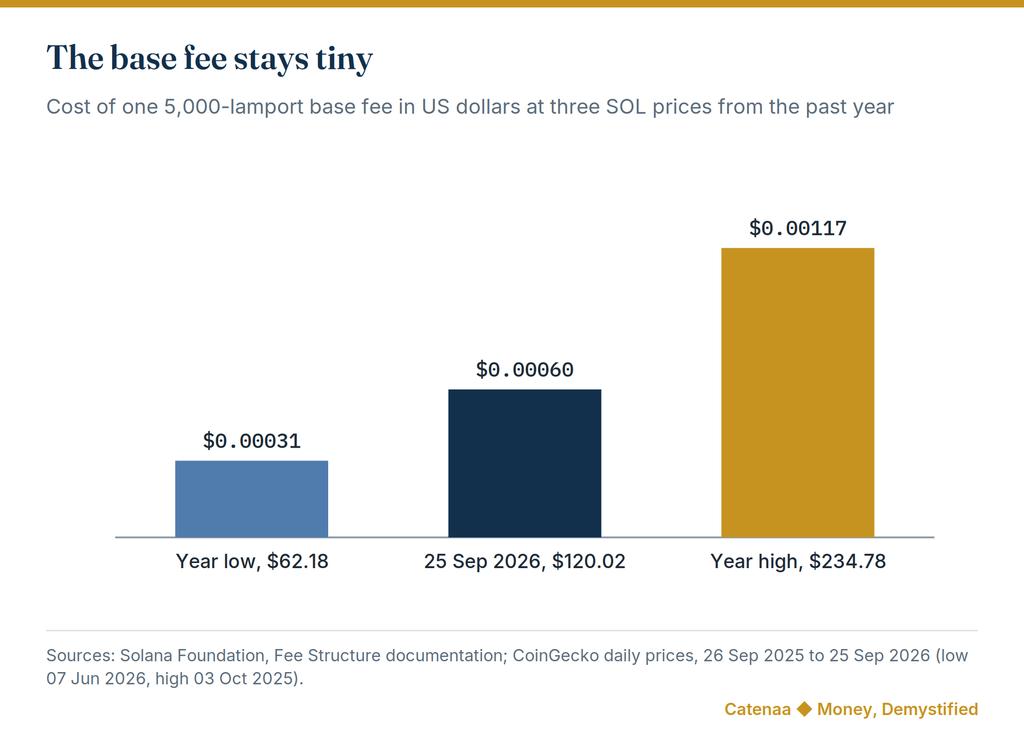
Even at the year’s high, a basic fee cost around a tenth of a cent.
Stablecoins may yet become Solana’s most practical use, because they strip away much of crypto’s volatility. In the final part, we weigh the risks that could still hold the network back.
Disclaimer. This article is for education only. It is not investment, legal or tax advice. Crypto assets are volatile and can lose value quickly. On-chain figures are taken on 25 September 2026 and will change.
Glossary
Sources and references
- Visa. Visa Expands Stablecoin Settlement Capabilities to Merchant Acquirers. 5 Sep 2023. https://usa.visa.com/about-visa/newsroom/press-releases.releaseId.19881.html
- PayPal. PayPal USD Stablecoin Now Available on Solana Blockchain. 29 May 2024. https://newsroom.paypal-corp.com/2024-05-29-PayPal-USD-Stablecoin-Now-Available-on-Solana-Blockchain,-Providing-Faster,-Cheaper-Transactions-for-Consumers
- Securitize. BUIDL is now on Solana (company post on X). 25 Mar 2025. https://x.com/Securitize/status/1904519397420749028
- Western Union. Western Union Launches USDPT on Solana. 4 May 2026. https://ir.westernunion.com/news/archived-press-releases/press-release-details/2026/Western-Union-Launches-USDPT-on-Solana-Advancing-Regulated-Digital-Infrastructure-for-Global-Payments/default.aspx
- Solana Foundation. Tokens on Solana, Solana documentation. Accessed 25 Sep 2026. https://solana.com/docs/core/tokens
- Solana mainnet RPC. getTokenSupply and getAccountInfo for stablecoin mints, queried by Catenaa, 25 Sep 2026. 25 Sep 2026. https://solana.com/docs/rpc/http/gettokensupply
- Circle. USDC contract addresses. Accessed 25 Sep 2026. https://developers.circle.com/stablecoins/usdc-contract-addresses
- Tether. Supported Protocols and Integration Guidelines. Accessed 25 Sep 2026. https://tether.to/en/supported-protocols/
- World Liberty Financial. USD1 contract addresses. Accessed 25 Sep 2026. https://docs.worldlibertyfinancial.com/usd1-token/contract-addresses
- Paxos. PYUSD on Main Networks. Accessed 25 Sep 2026. https://docs.paxos.com/guides/stablecoin/pyusd/mainnet
- Paxos. USDG on Main Networks. Accessed 25 Sep 2026. https://docs.paxos.com/guides/stablecoin/usdg/mainnet
- Solana Foundation. Account Structure, Solana documentation. Accessed 26 Sep 2026. https://solana.com/docs/core/accounts/account-structure
- Solana Foundation. How Payments Work on Solana, Solana documentation. Accessed 25 Sep 2026. https://solana.com/docs/payments/how-payments-work
- Anza. Alpenglow: A New Consensus for Solana. 19 May 2025. https://www.anza.xyz/blog/alpenglow-a-new-consensus-for-solana
- Solana Foundation. Fee Structure, Solana documentation. Accessed 25 Sep 2026. https://solana.com/docs/core/fees/fee-structure
- CoinGecko. Solana (SOL) price, market cap and 365-day history via public API. Snapshot 25 Sep 2026. https://www.coingecko.com/en/coins/solana
- Solana Foundation. Token Extensions, Solana documentation. Accessed 25 Sep 2026. https://solana.com/docs/tokens/extensions
- Solana Foundation. A Technical Deep Dive into PYUSD on Solana. 2024. https://solana.com/news/pyusd-paypal-solana-developer
- Western Union. Western Union Announces USDPT Stablecoin on Solana and Digital Asset Network. 28 Oct 2025. https://ir.westernunion.com/news/archived-press-releases/press-release-details/2025/Western-Union-Announces-USDPT-Stablecoin-on-Solana-and-Digital-Asset-Network/default.aspx
- US Securities and Exchange Commission. SEC Clarifies the Application of Federal Securities Laws to Crypto Assets, press release 2026-30. 17 Mar 2026. https://www.sec.gov/newsroom/press-releases/2026-30-sec-clarifies-application-federal-securities-laws-crypto-assets
Editorial note: Figures in this series reflect data as of 25 September 2026