

Solana creates new SOL every epoch and destroys a slice of every fee. Here is who gains, who gets diluted and what the numbers looked like on 25 September 2026.
Solana inflation sounds like bad news, yet it is how the network pays for its own security. Every blockchain must reward the people who keep it running. Bitcoin pays miners with new coins and fees. Solana pays validators and stakers in a similar way, with its own twists.
This third part of our series follows the money. Along the way, we measure how much new SOL the network creates, who receives it and where fees end up. The piece also shows why holding SOL without staking it quietly shrinks your share of the network. As before, the live figures come straight from Solana’s public servers on 25 September 2026.
In Summary
Solana inflation started at 8%, falls by 15% of its value each year and stops at 1.5%. The live rate was 3.63% on 25 September 2026.
About 69.4% of all SOL was staked, which implies a gross staking return near 5.2% before commission.
At today’s rate, a holder who never stakes sees their share of total supply shrink by about 3.5% a year.
Half of each base fee is burned. Yet the daily burn, estimated at about 648 SOL, is tiny next to roughly 63,000 new SOL issued each day.
Two open proposals, SIMD-0411 and SIMD-0553, could speed up disinflation or raise the burn.
Why a network pays for its own security
Validators run costly servers around the clock. As Part 2 showed, they also pay fees to cast their votes. If they go offline, they simply miss rewards. So the protocol needs a steady income stream to keep them honest, online and well equipped.
Solana funds that stream from two sources. The first is new SOL, created through inflation. Transaction fees provide the second, which users pay whenever they send a transaction.
Inflation here means only the growth of the token supply. It has nothing to do with consumer prices. Still, the effect on holders can feel similar, because new tokens dilute existing ones unless you take part.
Why issuance starts high and falls
Why not simply rely on fees from day one? The usual logic is that a young network earns few fees. So new tokens carry most of the security budget in the early years.
The reasoning then runs in reverse. As usage grows, fees should rise and take over more of the job. Issuance can therefore fall gradually without leaving the network unprotected.
Whether that handover actually happens is an open question for Solana, as the fee figures below show. Other networks face the same test, each with its own schedule and trade-offs. This version, at least, is easy to audit, because anyone can read its settings from the network.
The inflation schedule in three numbers
Solana’s inflation schedule rests on three settings. It started at 8% a year. From there, it falls by 15% of its current value each year, a process called disinflation. Finally, it stops falling at a floor of 1.5%. Because each cut is a percentage of the last rate, the yearly declines get smaller as the rate falls.
You can read those same three settings from the live network. On 25 September 2026, the current annual rate stood at 3.63%. If nothing changes, the rate would reach its 1.5% floor in roughly five and a half years.
Faster slots do not change this picture. The SIMD-0525 proposal adjusts the maths so that inflation stays the same in calendar time, even as slots shrink.
Still, the rule is not set in stone. In late 2025, a proposal called SIMD-0411 suggested doubling the pace of decline to 30% a year. However, when we checked, the network still reported the original 15% setting.
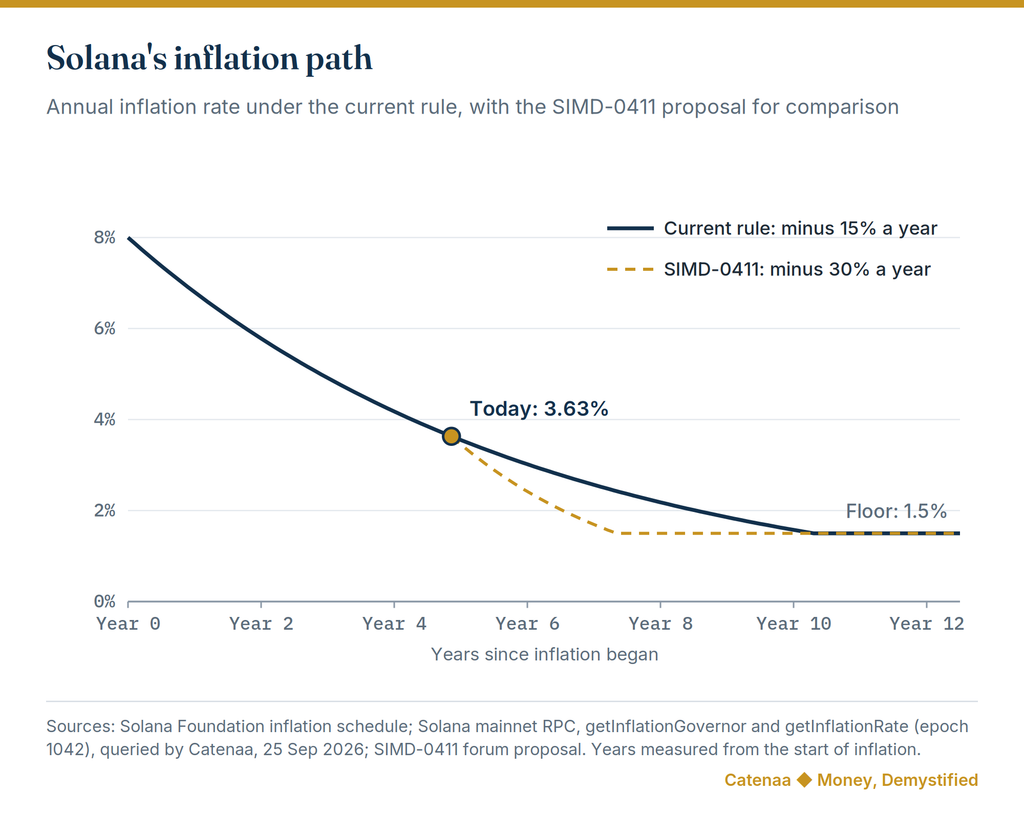
The live rate of 3.63% sits on the original 15% disinflation path.
A worked example with 100 SOL
Numbers become clearer with a simple example. Imagine two friends, Maya and Leo, who each hold 100 SOL at the start of a year. Maya stakes hers with a validator that charges 5%. Leo leaves his in a wallet.
After a year at today’s rates, Maya holds about 105 SOL. Leo still holds exactly 100 SOL. Meanwhile, the whole network has grown by about 3.6%.
So who is better off? Maya’s slice of the network has grown slightly. Leo’s slice has shrunk, even though his balance never moved. That is dilution in action.
The example ignores price changes, which usually dwarf these effects. It also ignores taxes, which vary by country and can apply to staking rewards. Still, it shows why the choice to stake matters.
Who receives the new SOL
New SOL goes to stakers and their validators at the end of each epoch. People who hold SOL without staking it receive nothing. Their share of the total supply therefore shrinks over time.
Our snapshot makes this concrete. Holders had staked about 440.6 million SOL, or 69.4% of supply. Spread 3.63% of new supply across that staked share, and stakers collect roughly 5.2% a year before commission.
Put another way, staking mostly protects your slice of the pie rather than creating new wealth. At today’s rates, a non-staker’s share shrinks by about 3.5% a year. A staker’s share grows slightly, by about 1.3% after a typical 5% commission.
The network credits rewards epoch by epoch. They therefore add up in small, frequent steps rather than one annual payment.
These figures leave out fees, tips and price moves. Even so, they explain why holders stake most of their SOL. Sitting still costs you a slow, steady dilution.
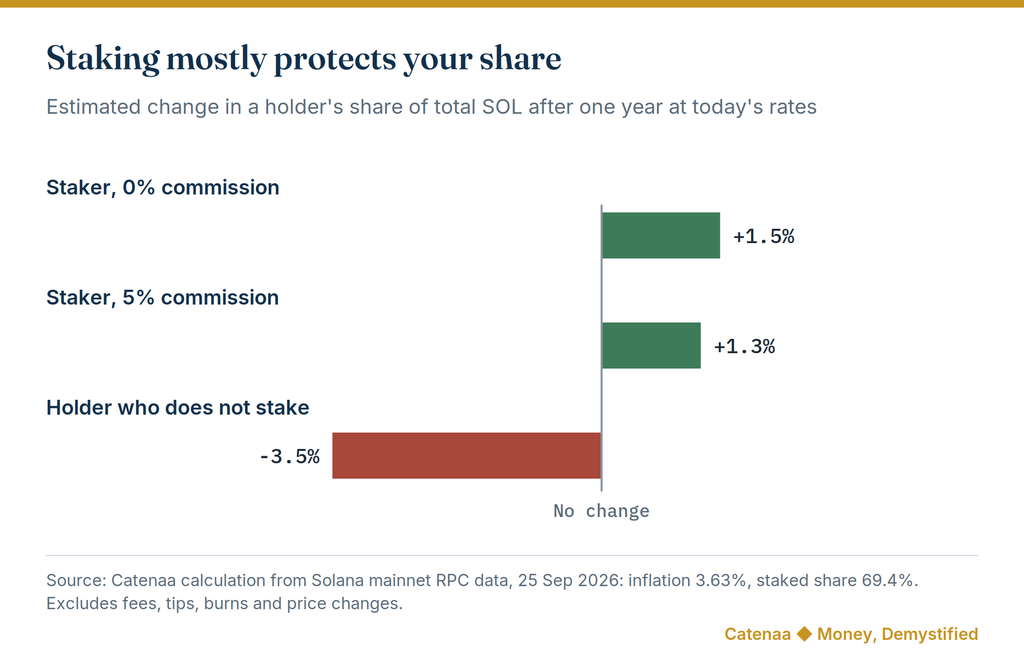
Stakers roughly keep pace with new supply, while non-stakers are diluted.
Commission: the validator’s cut
Validators keep a share of their stakers’ rewards, known as commission. The rate is a public setting on each validator’s vote account, so anyone can check it.
Rates vary widely. In our snapshot of 675 active validators, 271 charged 5% and 230 charged nothing at all. Another 65 set commission at 100%, which leaves nothing for outside stakers.
Zero is not always a bargain. A validator can raise its rate later, so today’s zero may not last. Performance matters too, because a validator that misses votes earns less for everyone. Staking dashboards track these numbers, but the raw data sits on-chain for anyone to check.
So a careful staker compares uptime, commission history and size, not just today’s rate. Spreading stake across smaller, well-run validators also helps the network, as Part 2 explained.
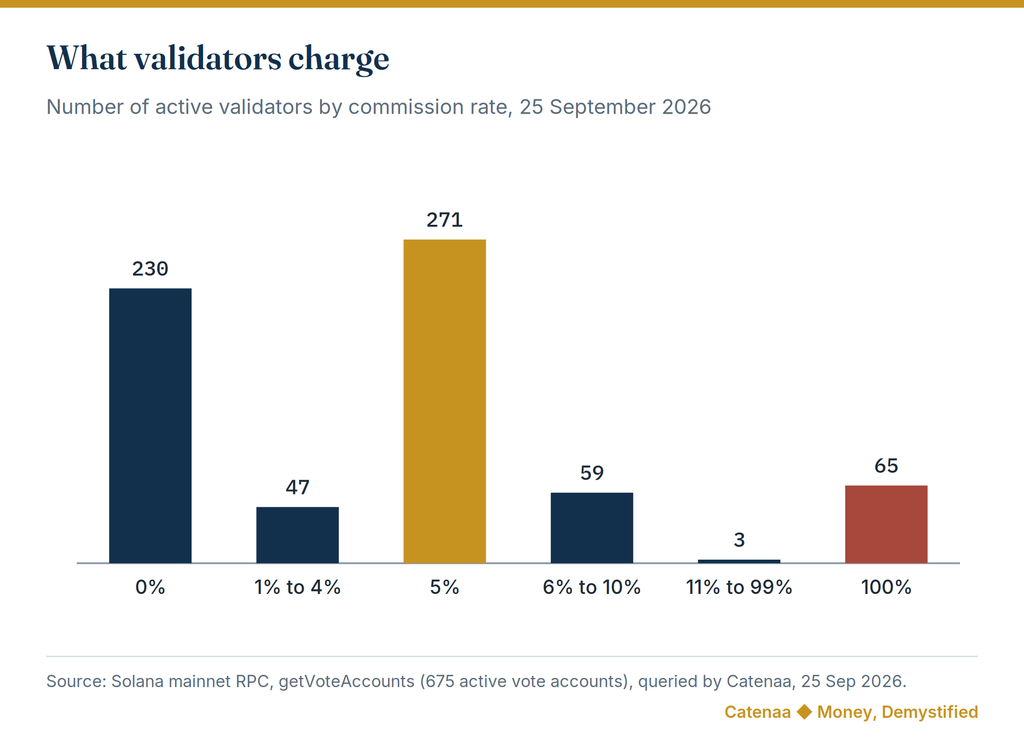
Five percent is the most common rate, and zero is close behind.
How staking works in practice
To stake, you move SOL into a stake account and delegate it to a validator. The validator gains voting weight from your stake. You keep the withdraw authority, the key that can move the SOL out, as Solana’s staking documentation explains.
Changes happen at epoch boundaries. New stake warms up before it earns, and unstaked SOL cools down before you can withdraw it. Only part of the network’s stake can change state in any one epoch. The exact timing therefore depends on how much stake is moving.
With 250 millisecond slots, an epoch now lasts about 30 hours. That means rewards arrive a little more often than the old two-day rhythm.
Many holders now use liquid staking tokens instead. These tokens represent staked SOL and can trade or serve as collateral elsewhere. They add convenience, yet they also add smart contract and market risks on top of staking itself.
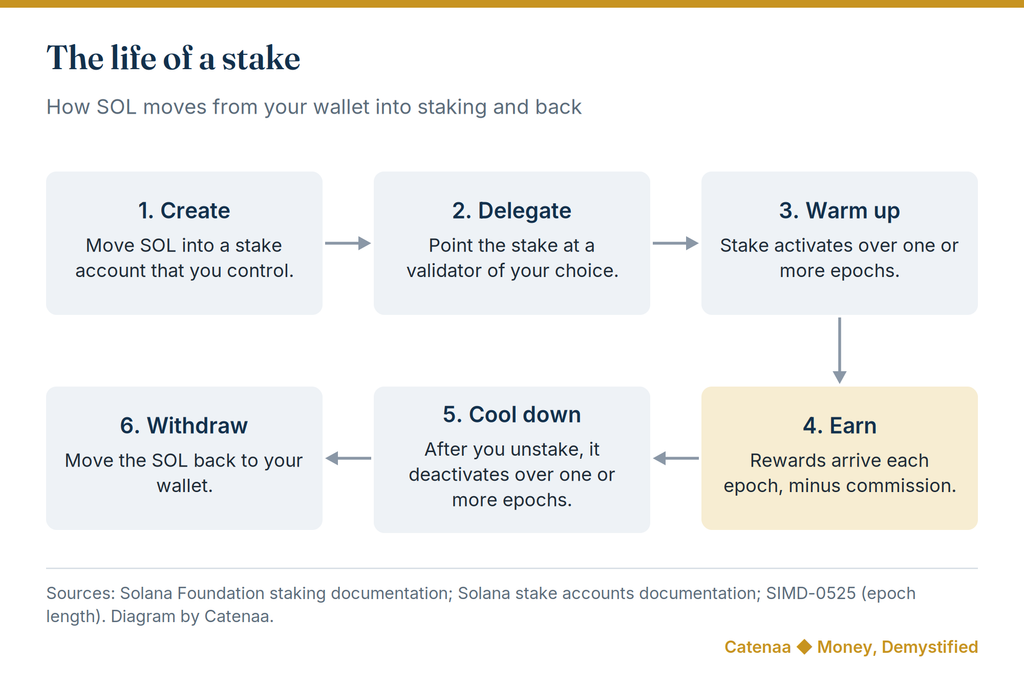
Most steps happen at epoch boundaries, about every 30 hours.
Where the fees go
Fees form the other half of the reward story. As Part 1 explained, the network burns half of each base fee, and the validator keeps the other half. Priority fees go entirely to the validator.
Burning removes SOL from supply for good, and every burned lamport is visible on-chain. However, at current fee levels, the burn is small. The author of SIMD-0553 estimates today’s burn at about 648 SOL a day. By comparison, today’s inflation rate implies roughly 63,000 new SOL a day.
That gap has sparked a lively debate. SIMD-0553 is an open proposal from June 2026. It would tie the burned portion of fees to how much computing a transaction requests. Its author estimates it could lift the daily burn to between 7,500 and 9,000 SOL. For now, it remains a proposal, not a rule.
Priority fees rise and fall with demand, because users bid them up only when blocks fill. That makes validator income uneven and hard to forecast.
Some traders also pay tips to third-party block builders for faster inclusion. Those payments sit outside the protocol’s fee rules, so the network does not burn them.
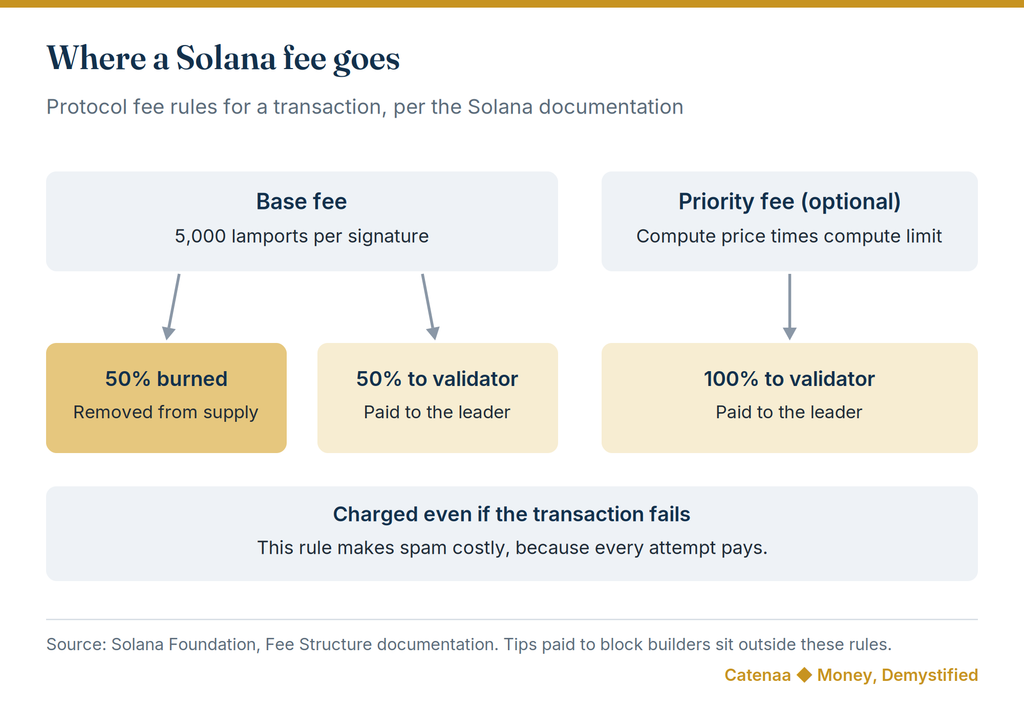
Half of the base fee is burned. Priority fees go to the validator.
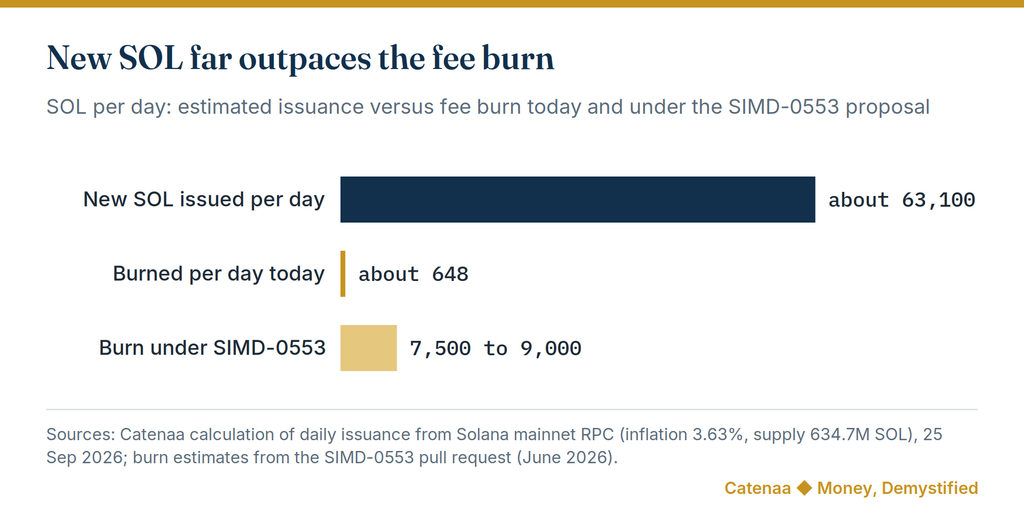
Burning would need to rise many times over to offset issuance.
Busy days reward validators
Fees do not stay flat. When many traders want the same block space, they compete by raising their priority fees. Those fees scale with the computing a transaction requests.
Such spikes flow straight to validators. The protocol burns only half of the small base fee, never the priority fee. So busy periods lift validator income far more than they shrink supply.
This design has a logic. It rewards the validators who do the extra work during rushes. Critics argue, however, that it does little for holders who hope fees will offset inflation. That tension sits at the heart of the SIMD-0553 debate.
Who sets the rules
Solana’s economic rules can change, but not overnight or in secret. Changes start as Solana Improvement Documents, or SIMDs, which anyone can read on GitHub. Developers and validators then debate them in public forums.
If a proposal wins support, core teams write the code. Validators must upgrade their software, and a feature switch must then activate on-chain. Part 1 showed this process at work with the slot time cuts.
For holders, this openness is a double-edged sword. You can watch changes coming months ahead. On the other hand, the rules you rely on today may not hold forever.
What it means for holders
Three lessons stand out. First, SOL’s supply keeps growing, though more slowly each year. Second, staking mainly shields you from dilution rather than paying a free yield. Third, fee burns will matter only if activity or the burn rule changes sharply.
Staking mostly protects your slice of the pie.
Staking carries risks of its own. A poorly run validator can miss rewards. Liquid staking tokens, for their part, can trade below the value of the SOL behind them. Diversifying across validators reduces, but does not remove, those risks.
None of this predicts the price. Demand, regulation and competition matter far more over short periods. Yet the schedule is public and anyone can check it, which is more than many assets offer.
Keep an eye on governance, too. Validators vote on proposals like SIMD-0411 and SIMD-0553, weighted by stake. Their choices could reshape the economics described here. In Part 4, we turn from SOL itself to the digital dollars that move across Solana every day.
Disclaimer. This article is for education only. It is not investment, legal or tax advice. Crypto assets are volatile and can lose value quickly. On-chain figures are taken on 25 September 2026 and will change.
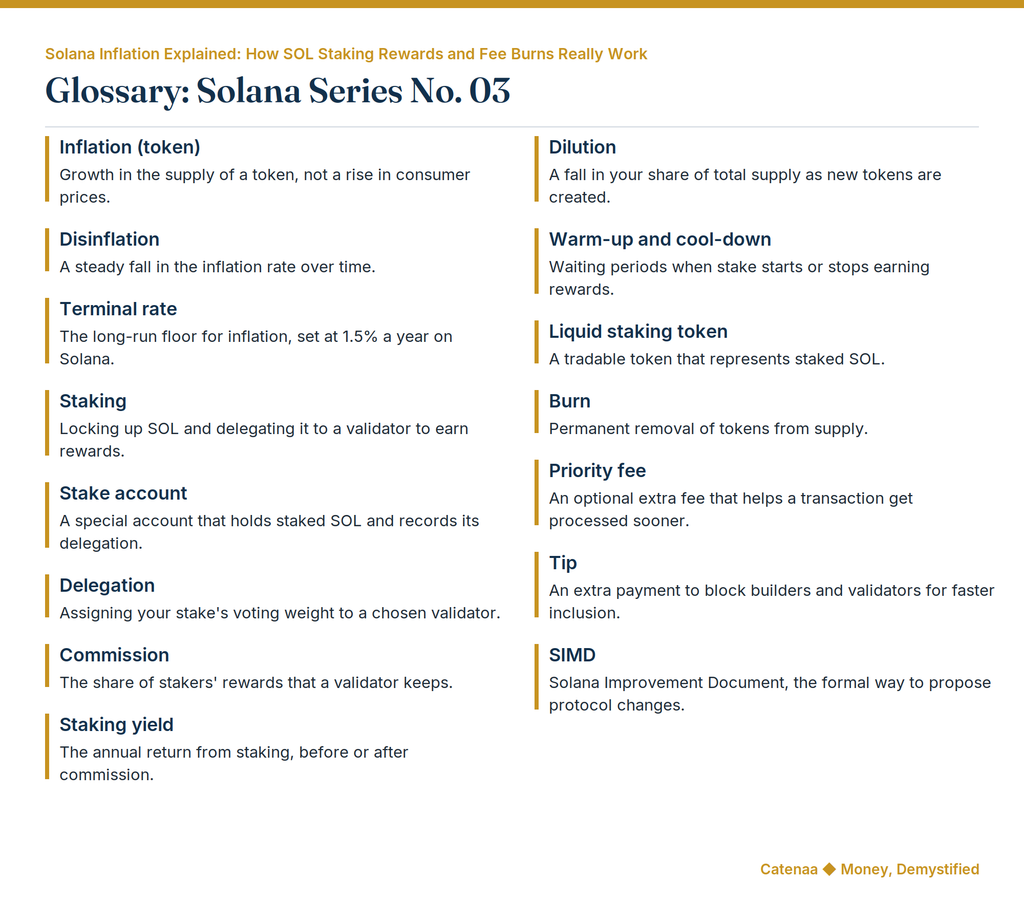
Glossary
Sources and references
- Solana mainnet RPC. getInflationRate, queried by Catenaa, 25 Sep 2026. 25 Sep 2026. https://solana.com/docs/rpc/http/getinflationrate
- Solana Developer Forums. SIMD-0411: Proposal for Doubling the Disinflation Rate. Nov 2025. https://forum.solana.com/t/simd-0411-proposal-for-doubling-the-disinflation-rate/4515
- Solana Improvement Documents. SIMD-0553: Resource and Inclusion Fee (open pull request). 4 Jun 2026. https://github.com/solana-foundation/solana-improvement-documents/pull/553
- Solana Foundation. Proposed Inflation Schedule, developer documentation. Undated. https://github.com/solana-foundation/developer-content/blob/main/docs/economics/inflation/inflation-schedule.md
- Solana mainnet RPC. getInflationGovernor, queried by Catenaa, 25 Sep 2026. 25 Sep 2026. https://solana.com/docs/rpc/http/getinflationgovernor
- Solana Improvement Documents. SIMD-0525: Reduce Slot Times. 2026. https://github.com/solana-foundation/solana-improvement-documents/blob/main/proposals/0525-reduce-slot-times.md
- Solana mainnet RPC. getVoteAccounts, queried by Catenaa, 25 Sep 2026. 25 Sep 2026. https://solana.com/docs/rpc/http/getvoteaccounts
- Solana Foundation. getInflationReward RPC method, Solana documentation. Accessed 26 Sep 2026. https://solana.com/docs/rpc/http/getinflationreward
- Solana mainnet RPC. getSupply, queried by Catenaa, 25 Sep 2026. 25 Sep 2026. https://solana.com/docs/rpc/http/getsupply
- Solana Foundation. Staking on Solana, Solana documentation. Accessed 25 Sep 2026. https://solana.com/docs/references/staking
- Solana Foundation. Stake Accounts, Solana documentation. Accessed 26 Sep 2026. https://solana.com/docs/references/staking/stake-accounts
- Solana Foundation. Fee Structure, Solana documentation. Accessed 25 Sep 2026. https://solana.com/docs/core/fees/fee-structure
- Jito Labs. Low Latency Transaction Send: tips, Jito documentation. Accessed 26 Sep 2026. https://docs.jito.wtf/lowlatencytxnsend/
Editorial note: Figures in this series reflect data as of 25 September 2026