

Corporate treasury runs enormous balances with very small teams. That makes it the most tempting place to hand decisions to software, and the most dangerous place to get the limits wrong.
In Summary
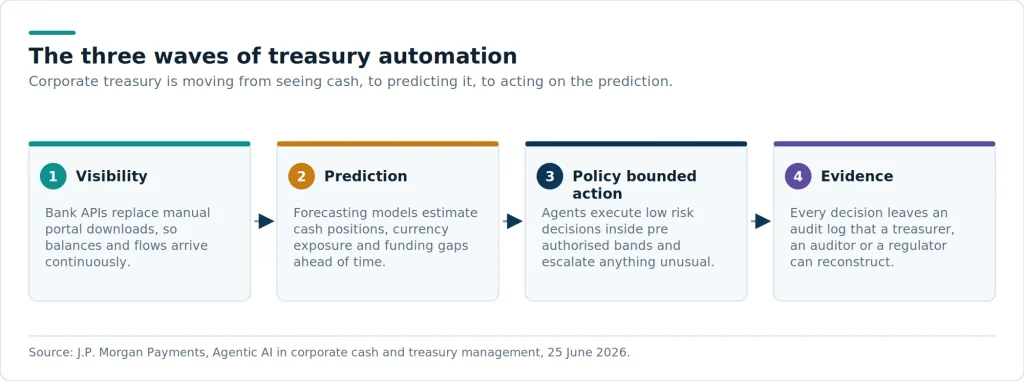
Treasury automation is arriving in three waves: visibility, prediction, then policy bounded autonomy.
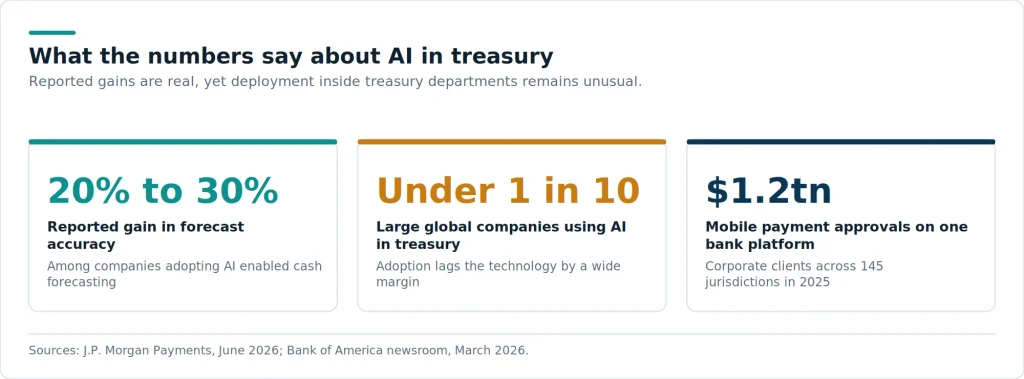
Companies adopting AI-enabled forecasting report 20% to 30% improvements in accuracy, which flows straight into working capital.
Adoption is still thin. Fewer than one in ten large global companies have deployed AI inside the treasury function.
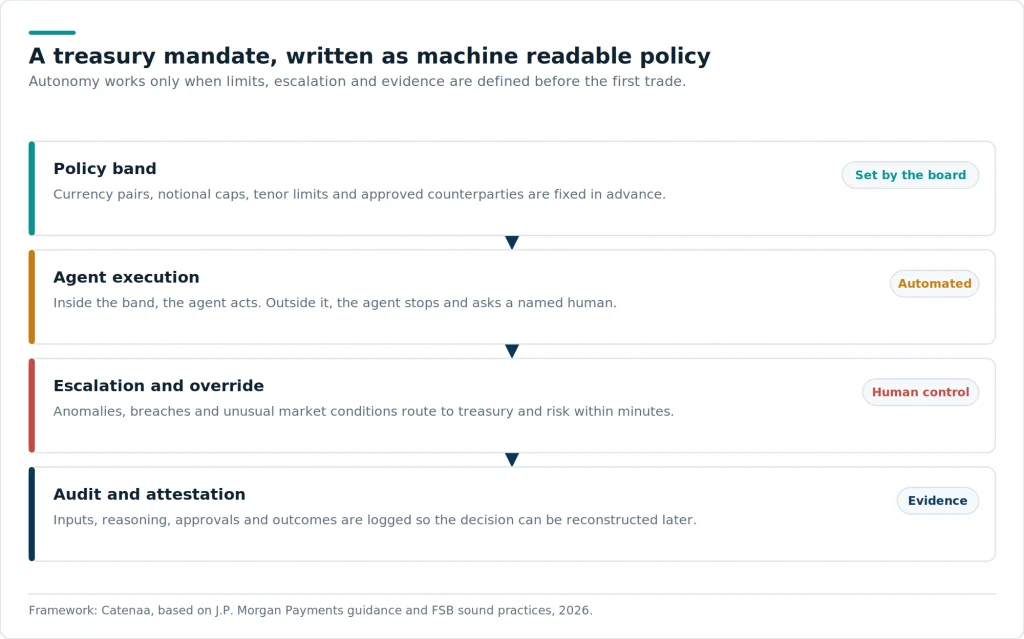
Autonomy needs a written band. Currency pairs, notional caps, and approved counterparties must be defined before an agent executes anything.
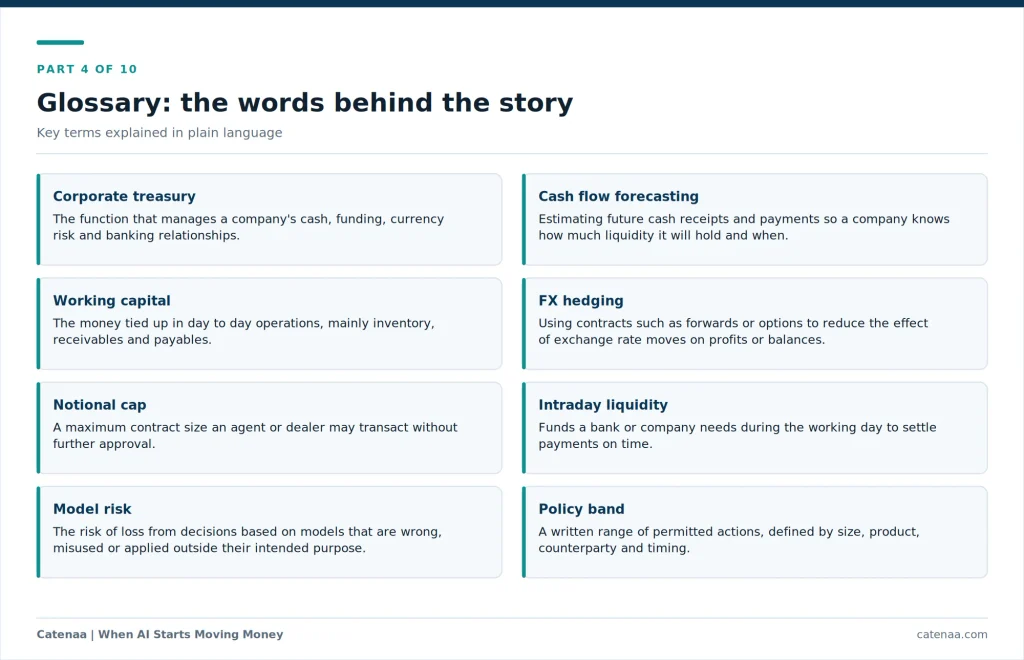
Supervisors worry about correlated behaviour. The IMF flags algorithmic herding and intraday liquidity strain when many agents act together.
A corporate treasurer holds an unusual job. The team is small, often fewer than ten people. The balances are enormous. A single missed currency exposure can erase a quarter of operating profit.
Treasury also runs on deadlines. Cash positions must be known each morning. Hedges must be placed before markets move. Therefore, speed and accuracy compete for the same limited attention.
Most of the day disappears into assembly work. Downloading statements, reconciling positions, chasing subsidiaries and rebuilding the same spreadsheet each morning. Very little of it requires judgement.
Why treasury attracts agents first
Three features make the treasury unusually suitable. The data is structured. The decisions repeat. The rules already exist in written policy. Consequently, much of the work looks like a machine problem wearing a spreadsheet.
J.P. Morgan Payments described the shift in June 2026 as three waves. First comes visibility through APIs. Second comes prediction through forecasting models. Third comes autonomy, where agents execute inside policy bands.
Adoption also has a cultural advantage here. Treasurers already trust automated execution in areas such as sweeping and netting. Extending that trust to a model feels less alien than it does in advisory functions.
The forecasting prize
Cash forecasting sounds dull. It is not. A better forecast releases trapped liquidity, reduces precautionary borrowing, and lowers hedging costs. J.P. Morgan reports that companies using AI-enabled forecasting see 20% to 30% accuracy improvements.
Apply that to a company holding two billion in cash. Even a modest reduction in idle balances funds real projects. The gain arrives quietly, through interest and avoided drawdowns, rather than through a headline.
Yet uptake remains low. According to the same analysis, fewer than one in ten large global companies have deployed AI in treasury. Legacy systems, fragmented bank connectivity, and audit concerns all slow the work.
Bank connectivity remains the biggest practical obstacle. A group with fifteen banks in twenty countries rarely has one clean data feed. Until that is fixed, an agent inherits the same blind spots as the treasurer.
Where the agent is allowed to act
Autonomy in treasury is not binary. It is banded. A hedge that falls inside an approved notional cap, currency pair, and tenor can execute automatically. Anything outside the band should stop and wait.
J.P. Morgan describes exactly this design. Low-risk decisions are executed inside a pre-authorised policy, while anomalies are routed to humans with full audit trails and evidence panels. Scenario work stays advisory because judgement about strategy belongs to the CFO.
Notice what this really is. It is delegated authority, the same concept treasurers already use with dealers and subsidiaries. The novelty lies in the counterparty being software.
Speed is the visible benefit. A hedge that once waited for an approval email can execute within seconds of the exposure appearing. Nevertheless, speed is only safe when the band around it is deliberately narrow.
The bank side is moving too
Corporate banks are building the counterpart infrastructure. Bank of America processed 1.2 trillion US dollars of mobile payment approvals on its corporate platform during 2025, across more than 145 jurisdictions. Citi launched an internal agent platform in April 2026.
Settlement infrastructure is being tested as well. The BIS reports that its Project Agorá completed real value testing in July 2026 with 28 financial institutions and central banks. Faster, programmable settlement would make agent-driven liquidity management far more useful.
Together, these efforts point in one direction. Corporate cash management is becoming a continuous process rather than a daily routine. Agents suit continuous processes far better than people do.
The risks a CFO should raise first
Three risks deserve early attention. Model risk comes first. An agent trained on stale seasonality will misjudge a working capital cycle, and it will do so confidently.
Concentration comes second. If most large treasuries adopt similar models from similar vendors, behaviour converges. The IMF warns that correlated agent behaviour could synchronise payment flows and strain intraday liquidity.
Governance comes third. Banking supervisors already expect documented model management. The Federal Reserve replaced its long-standing guidance with SR 26-2 in April 2026, and the FSB set out twelve sound practices for AI governance. Corporates will be judged against similar expectations by their auditors and lenders.
Fraud belongs on the same list. An agent with payment initiation rights is an attractive target, and payment fraud already exploits urgency and authority. Controls must therefore assume the agent itself may be manipulated.
How far can this go?
The realistic answer is further than most treasurers expect, but not everywhere. Routine sweeps, intercompany netting, short-dated hedging, and payment scheduling can be automated with confidence. Capital structure cannot.
Market stress marks the natural boundary. The Bank of England has warned about correlated positions amplifying volatility. A treasury agent should therefore be designed to slow down when markets speed up.
Corporate cash is one pool of capital. Investment portfolios are another, and far larger. In the next part, we ask whether AI can manage them.