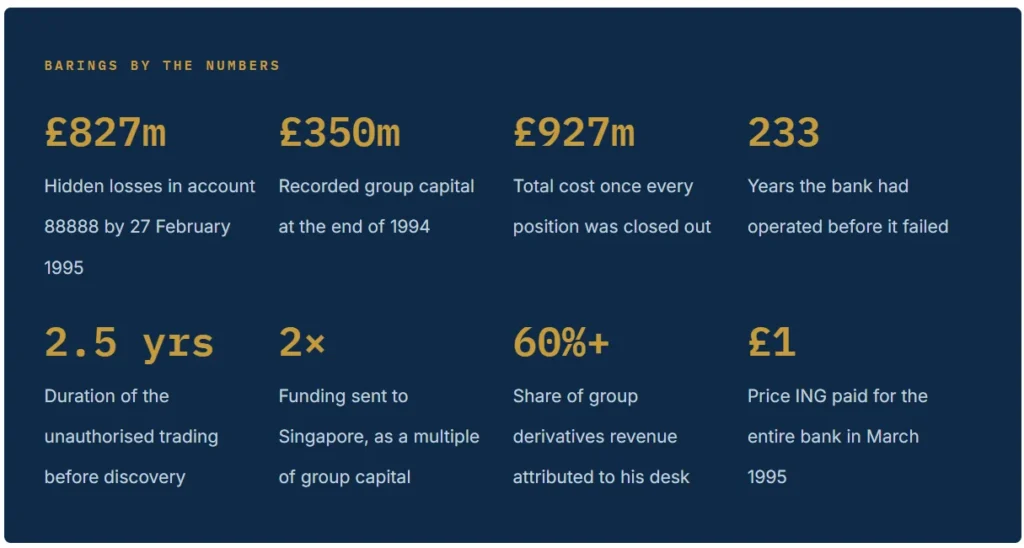


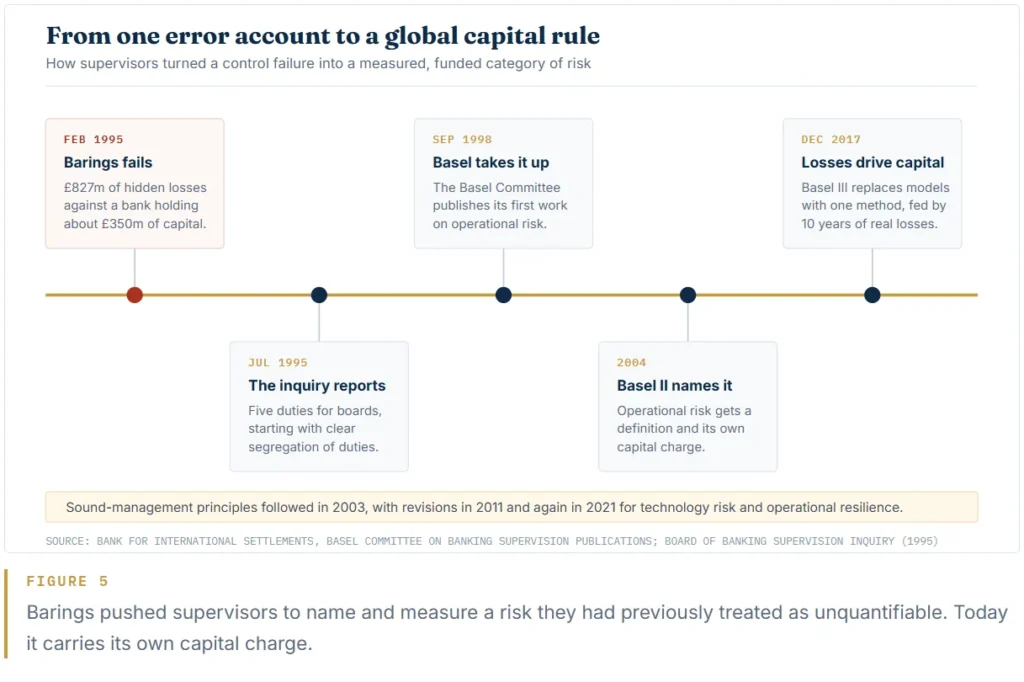
One trader in Singapore buried £827 million of losses inside an error account. His employer held roughly £350 million of capital. Here is how the arithmetic ended and what it permanently changed about the way banks watch themselves.
In Summary
One person controlled both the trading and the record-keeping. That single gap made every other failure possible, and internal audit had flagged it six months before the collapse.
Margin calls turn losses into cash demands within hours. Barings funded those calls without asking why a low-risk arbitrage desk needed twice the group’s capital.
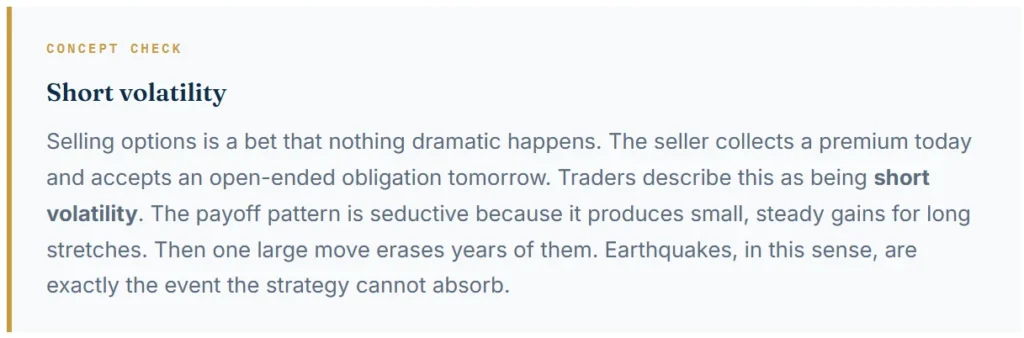
Selling options generates cash today and open-ended risk tomorrow. Short volatility positions look profitable until one shock arrives, as Kobe demonstrated.
Suspiciously good numbers are a control signal. Supervisors now treat outsized returns from low-margin activity as a reason to investigate rather than celebrate.
Time, not size, killed the bank. The December 1994 loss was survivable. Eight weeks of concealment made it fatal.
Barings created the modern discipline of operational risk. Its lessons run directly into Basel II capital charges and today’s standardised approach.
On the evening of 23 February 1995, Nick Leeson walked out of his office in Singapore and boarded a flight to Kuala Lumpur. He left behind a short note that said sorry. In addition, he left a hole in his employer’s balance sheet worth £827 million.
Three days later, administrators took control of Barings. For context, the bank had opened for business in 1762. It had helped fund the Louisiana Purchase. It had also survived one near-death crisis in 1890, when the Bank of England stepped in. This time no rescue arrived. On 5 March 1995, Dutch financial group ING agreed to acquire substantially all of Barings’ operating businesses for a nominal £1. The transaction received court approval on 6 March, with ING assuming substantial liabilities and providing additional funding.
Most retellings cast this as the story of one reckless young man. By contrast, the official inquiries tell a wider story. They describe a bank that never looked closely at its most profitable desk.
The job that was never split
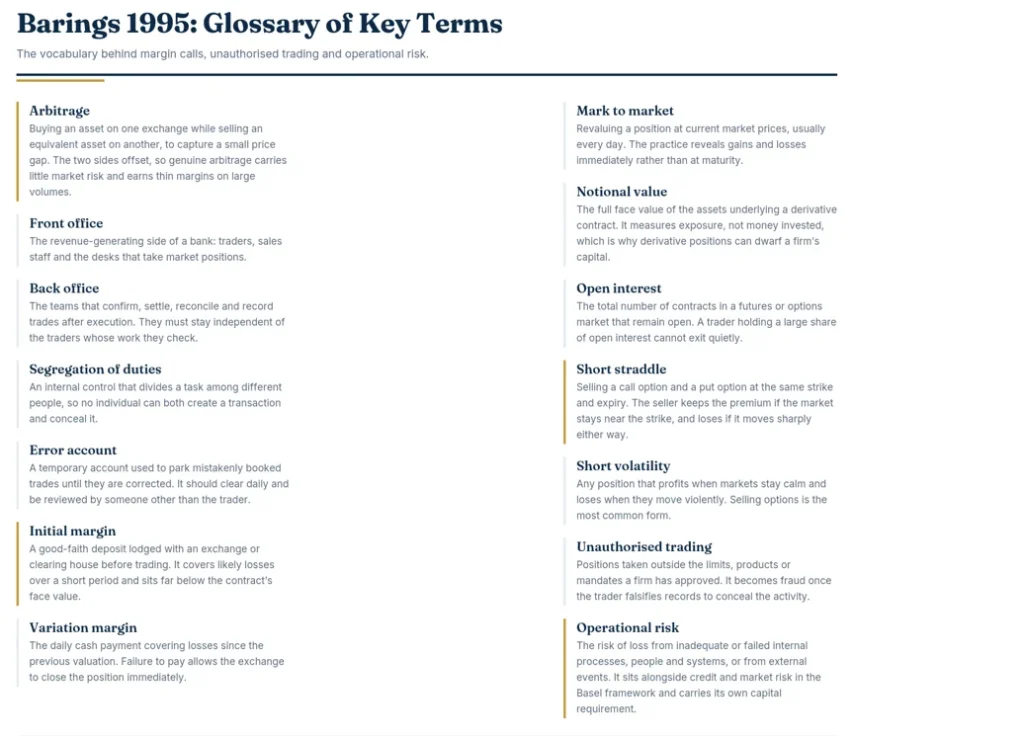
Barings sent Leeson to Singapore in 1992. At first, his work looked dull on paper. He was hired to run arbitrage, known internally as switching, between the Singapore International Monetary Exchange and Japan’s Osaka exchange. Arbitrage exploits tiny price gaps between two venues. In practice, each purchase on one exchange offsets a sale on the other. The strategy therefore carries very little market risk.
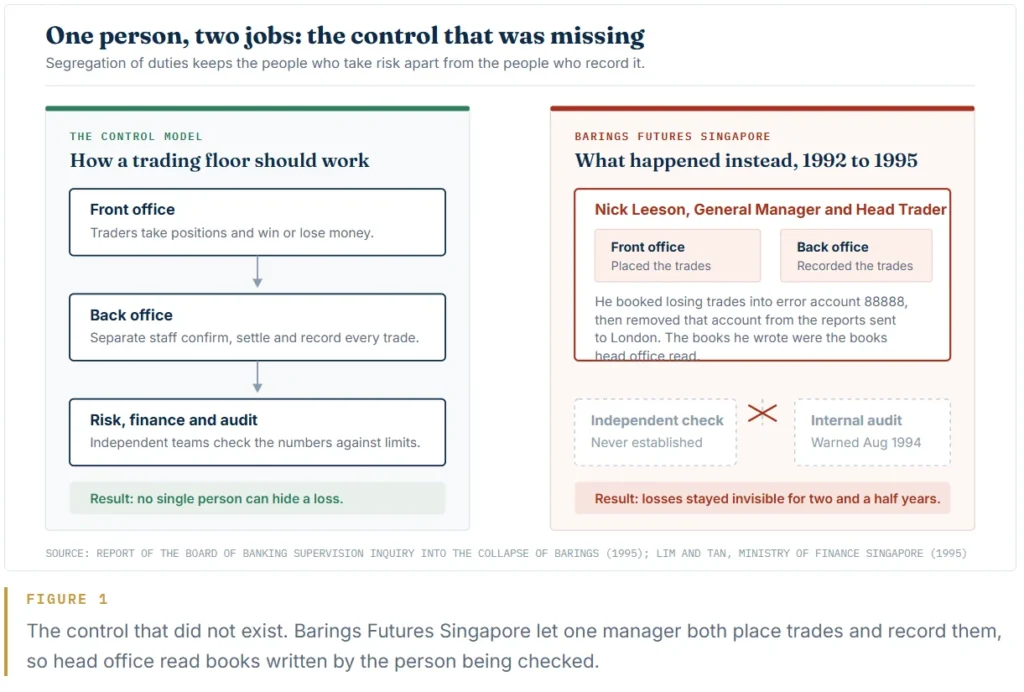
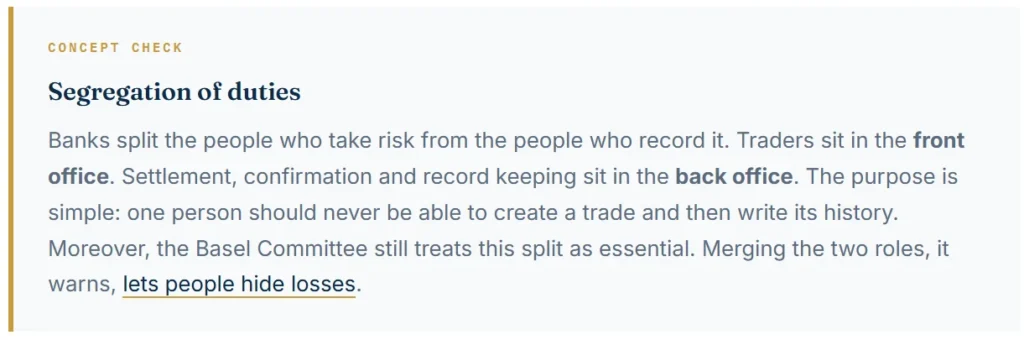
However, Leeson also ran settlement and accounting for the Singapore office. He placed the trades, and he wrote the records of those trades. Nobody separated the two roles. As a result, the numbers that reached London were simply the numbers he chose to send.
Reporting lines made things worse. Leeson answered to different managers for different parts of his job. Oversight therefore became ambiguous and, in practice, ineffective. Nobody owned the task of watching him.
Internal audit did spot the problem. For example, a review in August 1994 recommended splitting the two functions. Nevertheless, management left the arrangement in place. Leeson was, after all, the group’s star performer.
The drawer marked 88888
Leeson opened error account 88888 on 3 July 1992, two days after Barings joined the Singapore exchange. Error accounts are ordinary tools. Typically, traders use them to park mistakes for a few hours, and they should clear each day.
This account behaved differently from the start. Within a week, Leeson had the office software changed so that 88888 disappeared from the market activity reports sent to London. From then on, losing trades went into the drawer. Invented profits went into the accounts head office actually read.
So how did the profits appear? He created them through cross-trades. Leeson executed transactions between account 88888 and the ordinary trading accounts at prices he set himself. Profits landed in the visible accounts. Meanwhile, the damage stayed hidden.
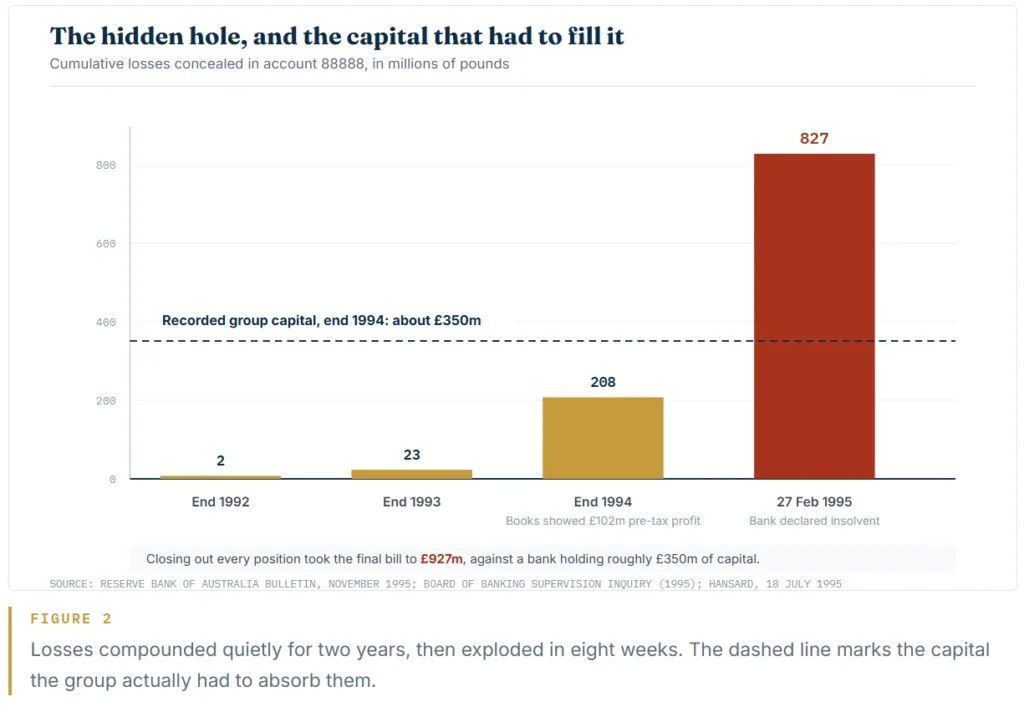
The gap widened year after year. By the end of 1992 the account sat about £2 million underwater. A year later the figure reached £23 million. By December 1994 it stood at roughly £208 million.
Meanwhile, Barings believed the opposite. Its draft 1994 accounts showed a pre-tax profit of £102 million, struck after setting aside an equal sum for bonuses. Leeson alone had booked £28.5 million of fictitious profit that year. Managers even acknowledged that his supposedly risk-free desk produced more than 60 per cent of group derivatives revenue. Nobody asked how a riskless activity could pay so well.

The cash machine nobody switched off
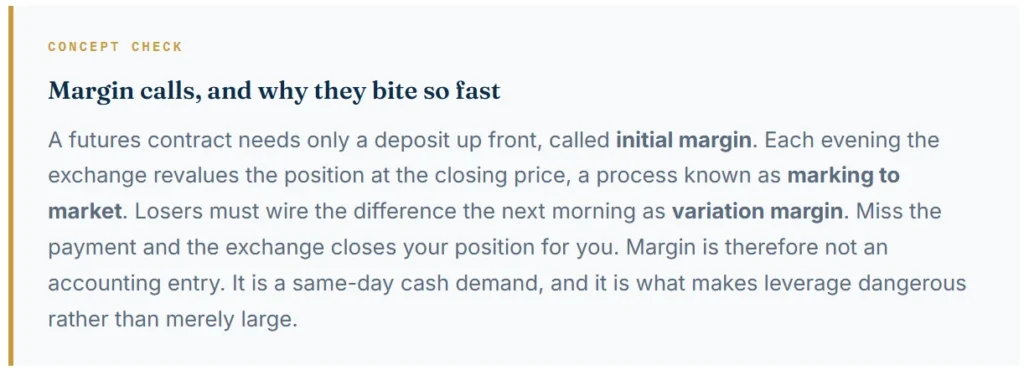
Futures exchanges do not extend credit. Instead, they collect cash every day from anyone whose position has lost money. That demand is a margin call, and it converted Leeson’s paper losses into a group-wide funding problem.
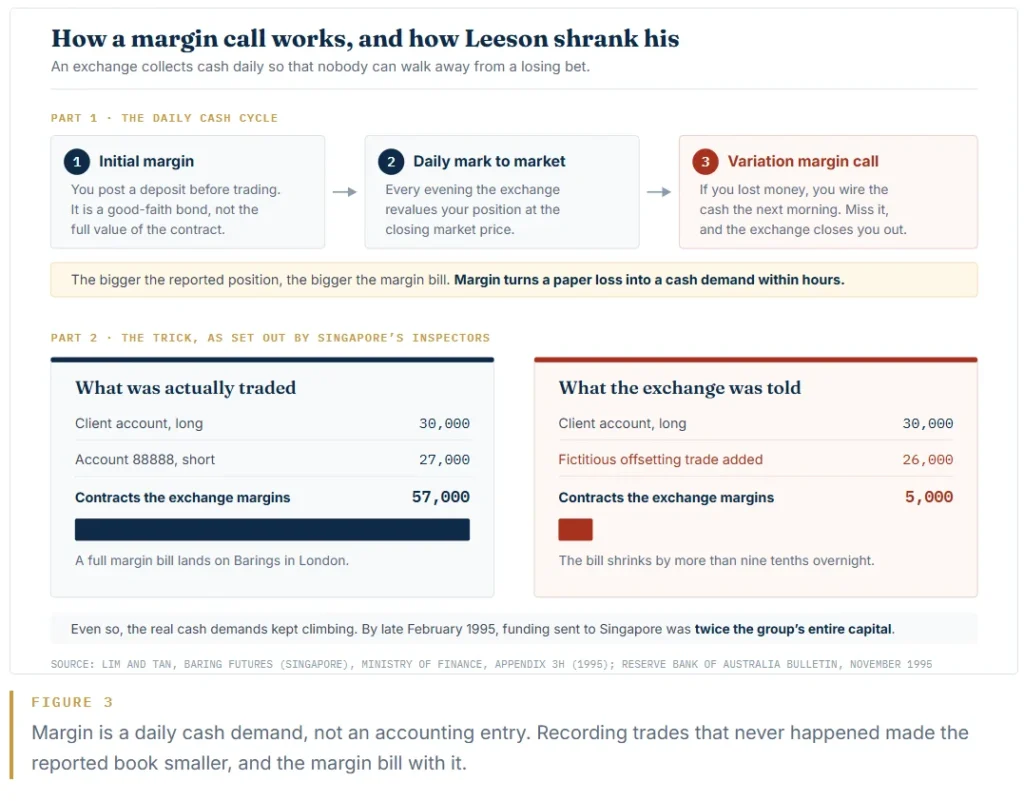
Consequently, Singapore needed money constantly. Leeson described the flow as client funding and as intra-day calls from the exchange. Even so, London kept paying. By late February 1995, money sent to the Singapore subsidiary equalled twice the entire capital of the Barings group. No limit constrained it, and the credit implications went unassessed.
He also worked to shrink the bill. Singapore’s inspectors set out the method plainly. Leeson instructed staff to record trades that had never taken place, then reversed them when the market reopened. On paper, the fictitious entries cancelled real positions, so the exchange calculated margin on a far smaller book.
The exchange itself grew uneasy. In particular, SIMEX wrote to the Singapore office on 11 January and again on 27 January 1995, querying margin information and referring to account 88888. Neither letter was passed to London at the time.
Selling calm to buy time
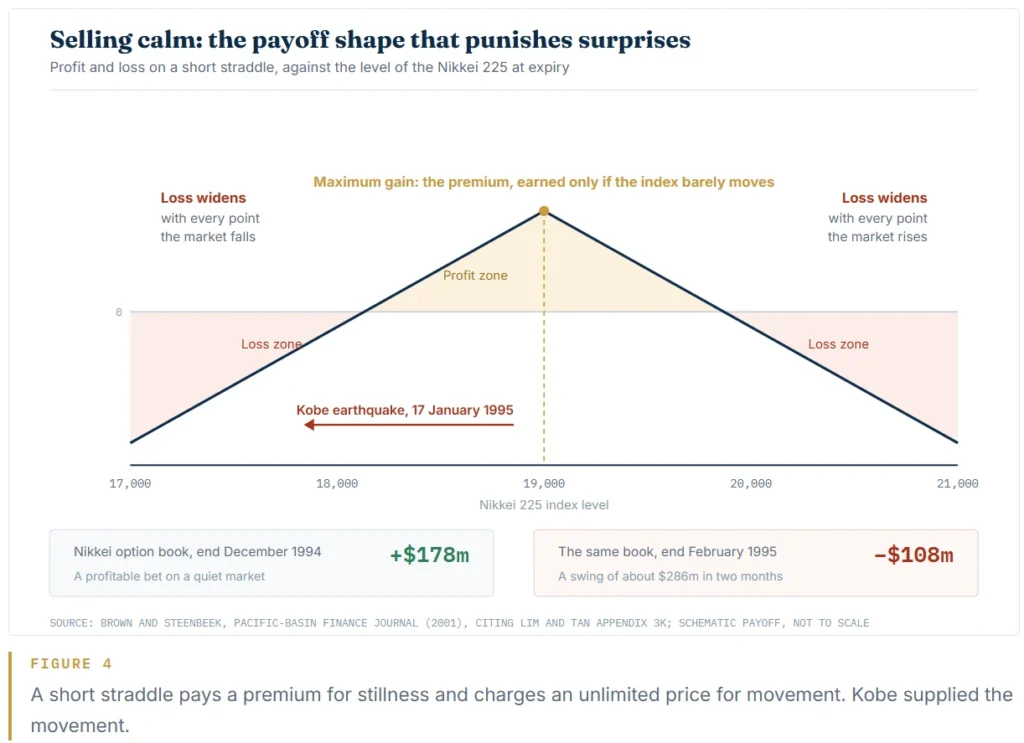
Futures were only part of the position. Besides them, from 1993 Leeson also sold options on the Nikkei index, mostly as short straddles. A short straddle earns a fixed premium if the market stays still. It loses money in either direction once the market moves far enough.
In the short term, those premiums were useful. They produced cash, and that cash helped meet margin calls. Yet they also exposed the bank to losses with no natural ceiling. At the end of December 1994, the option book was worth about $178 million. Two months later it showed a loss of roughly $108 million.
Twelve days in February
The Kobe earthquake struck on 17 January 1995. Japanese shares fell sharply, and as a result Leeson’s three bets began to fail together. He was long Nikkei futures, short Japanese government bond futures and short volatility. Falling shares hurt the first position. Falling interest rates hurt the second. Rising turbulence hurt the third.
Instead of cutting the position, he enlarged it. Researchers who later studied his trading records call this a doubling strategy. In short, you raise the bet whenever it loses, then pray for a bounce. By February he held close to half the open interest in the March Nikkei futures contract. His short bond position exceeded 28,000 contracts. Barings Futures Singapore had become the largest single trader on the exchange.
Markets moved the other way. During the final two weeks of February, however, every relevant market turned against him at once. Roughly a quarter of the eventual gross losses arrived on a single day. On 23 February, Barings could no longer meet its margin obligations in Singapore, and Leeson left the country.
Above all, timing decided everything. Had the losses surfaced in December 1994, Barings would probably have survived. Eight weeks later, the sums no longer worked.
What the collapse changed
The Bank of England’s Board of Banking Supervision reported on 18 July 1995. It found no exotic instrument and no ingenious fraud. Rather, it found a failure to do ordinary things.
In response, the board set out five duties. Teams must understand the businesses they run. Responsibility for each activity must be clear. Duties must be segregated. Independent risk management must cover every business line. Finally, boards and audit committees must fix known weaknesses quickly.
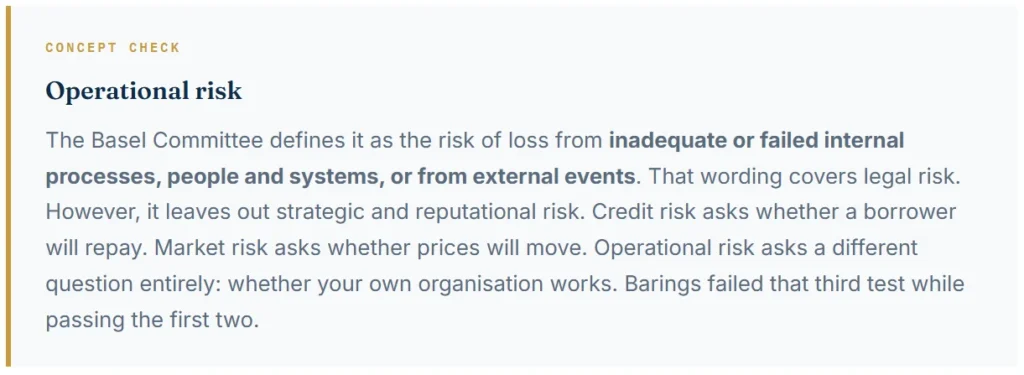
Supervisors then widened the lens. Three years later, in September 1998, the Basel Committee published its first survey of operational risk management across major banks. Later, Basel II gave the category a formal definition and a capital charge of its own. Then, in December 2017, the Basel III package went further. It scrapped internal models for one shared method. That method feeds a bank’s own ten years of losses straight into its capital bill.
The way forward for banking and treasury
Above all, Barings changed the questions treasurers ask. Three of them still matter today.
Follow the cash before you follow the profit
Leeson’s fraud showed up in funding requests long before it reached any profit figure. For two years, treasury saw the symptom but missed the disease. Modern teams therefore track intraday liquidity and margin flows as risk signals, not merely as payments. A subsidiary that keeps needing more cash than its business could require is telling you something.
Treat unexplained profit as a control alert
The Basel Committee now says this explicitly. Low-risk, low-margin activity that generates high returns may indicate an internal control breach rather than exceptional skill. Indeed, Barings had that exact signal on its desk, yet it read the signal as genius.
Assume the pattern will repeat
It has, repeatedly. For instance, Société Générale lost €4.9 billion on unauthorised positions in 2008. UBS lost $2.3 billion in 2011, and the UK regulator fined it £29.7 million for systems and controls that had proved seriously defective. Credit Suisse lost about $5.5 billion when Archegos collapsed in March 2021, and its own board committee blamed a fundamental failure of management.
Each of these firms had a rulebook, and each had a risk department. What fails is rarely the design of controls. Instead, firms lose the will to enforce them against a profitable person. Barings, in the end, is not a story about derivatives. It is a story about what happens when someone marks their own homework, and everyone else likes the grade.