

Fast and cheap is only half the story. Here is what the data say about control, crime, courts and regulation on TRON.
In Summary
The top 27 Super Representatives hold 97% of TRON’s votes, and the top nine hold more than half.
TRON carried 58% of illicit crypto volume in 2024, TRM Labs found, though that volume fell by $6 billion that year.
A joint unit of Tether, TRON and TRM Labs had frozen more than $450 million of illicit funds by May 2026.
The SEC’s 2023 case ended in March 2026: Rainberry paid a $10 million penalty, and claims against Justin Sun were dismissed.
New stablecoin laws in the US and EU matter for TRON, because most of its traffic is one issuer’s token.
The first four parts of this series showed what TRON does well. It is fast, cheap and busy. Its stablecoin traffic dwarfs most rivals.
Now for the harder part. Every financial system rests on trust, and trust needs scrutiny. So this final part asks four questions. Who controls TRON? How much crime flows through it? What happened in court? And how are regulators responding?
The aim is balance. We present the data, note the counter-arguments, and leave the verdict to you.
Question 1: How decentralised is TRON?
Recall the basics from Part 2. Holders vote, and the top 27 candidates produce blocks. On paper, anyone can compete for a seat.
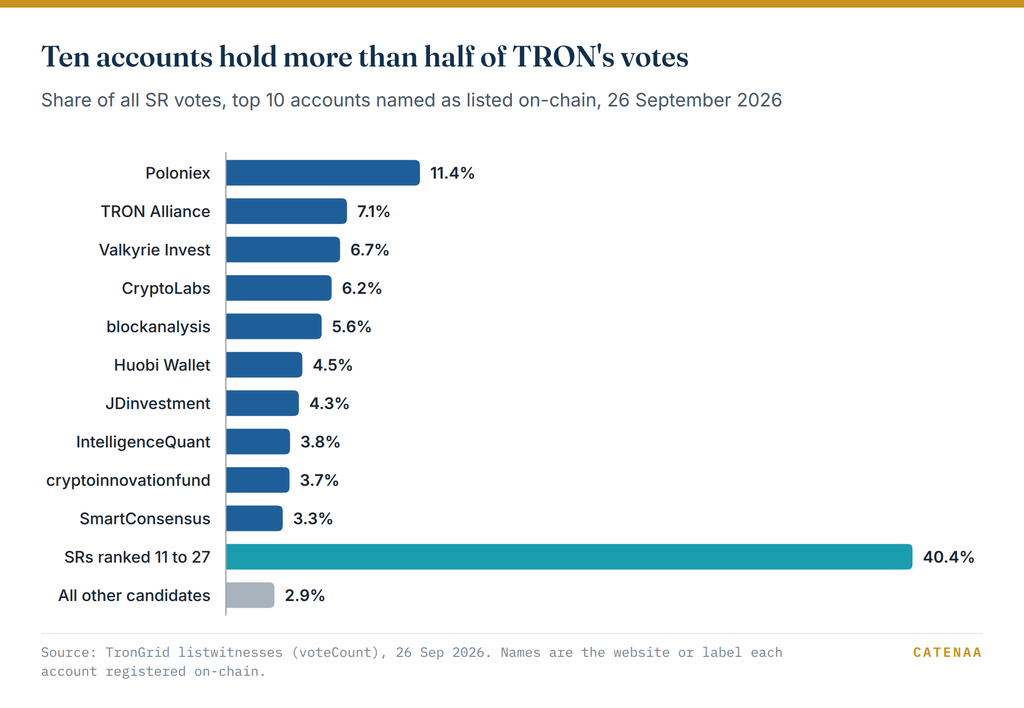
In practice, votes cluster heavily. On 26 September 2026, the top 27 held about 97.1% of all votes, TronGrid data show. The top five held about 37%. The single largest, listed under Poloniex’s website, held about 11.4%.
Several top SRs belong to exchanges and staking firms. The list includes accounts linked to Binance, OKX and Kraken, among others. Some of these accounts list the exchange’s staking page as their website. That suggests they vote with TRX that customers stake through them. As a result, a few platforms can carry a lot of weight.
The reward system can reinforce this pattern. Only the top 127 candidates share the voter pool, so voters have a reason to back established names. In turn, those names can attract even more votes. Consequently, newcomers may find it hard to break into the top 27.
Two thresholds that matter
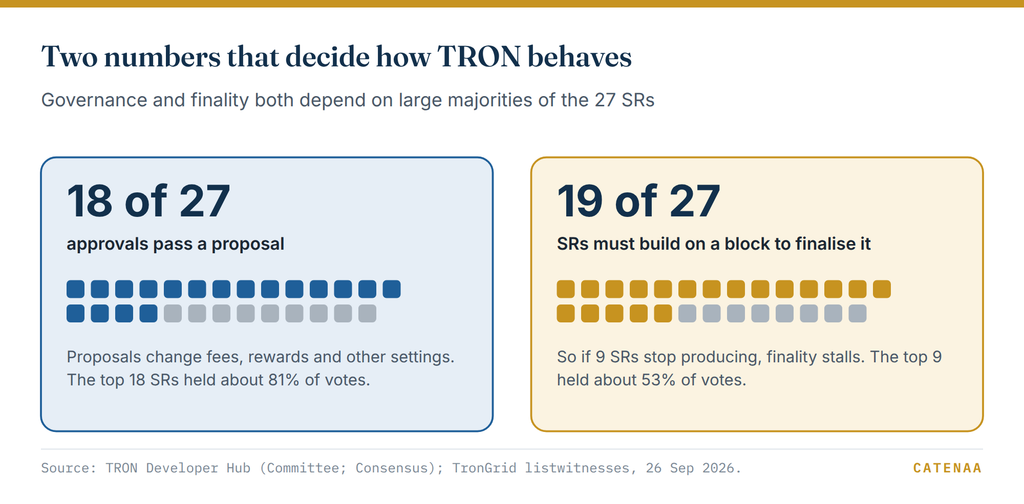
Two thresholds show why concentration matters. A governance proposal passes with 18 of 27 SR approvals, the docs say. Meanwhile, a block is final only once 19 of 27 SRs produce blocks at or above it, the rules state.
Put those together, and the picture sharpens. If nine SRs stopped producing, blocks could not reach finality. And the top nine held about 53% of votes on our snapshot date. That does not mean they would act together. It does mean the system relies on a small group behaving well.
Supporters offer a fair reply. The 27 seats are contested every six hours, and voters can switch their votes. In December 2021, the Foundation’s own nodes also left the SR ranks. Critics answer that a handful of large players now hold most of the voting power. Both points can be true at once.
Question 2: How much crime flows through TRON?
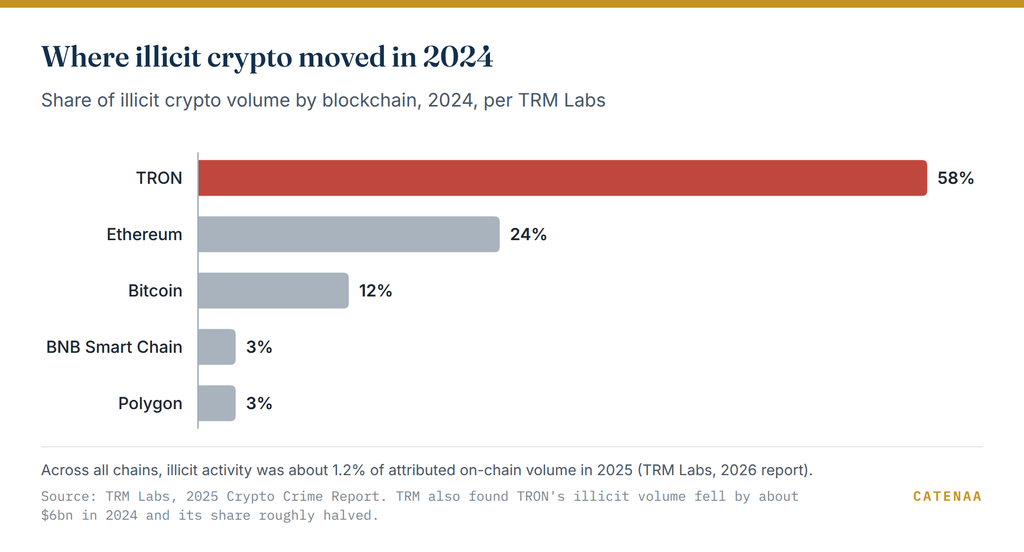
This is the most sensitive question, so precision matters. In 2024, TRON carried 58% of all illicit crypto volume that TRM Labs tracked, its 2025 report found. Ethereum followed with 24% and Bitcoin with 12%.
The same report adds important context. TRON saw the biggest drop of any chain that year. Its illicit volume fell by about $6 billion, and its share roughly halved. Moreover, 49% of TRON’s illicit volume was linked to sanctioned entities. Another 32% involved blocklisted funds that had already been frozen.
Why does TRON attract so much? Largely for the same reasons honest users do. A 2024 UN report found USDT on TRON had become a preferred choice of launderers in East and Southeast Asia. It cited the token’s stability and the ease, anonymity and low fees of transfers.
Crime follows the dollar tokens
The pattern goes beyond TRON. Nearly 95% of inflows to sanctioned entities and jurisdictions in 2025 went through stablecoins, TRM Labs reports. In addition, stablecoins made up about 84% of fraud inflows that year. Put simply, criminals follow the dollar tokens wherever they travel.
Scale matters too. Across all chains, illicit activity was 1.2% of attributed on-chain volume in 2025, TRM’s 2026 report estimates. So crime is a real problem, yet most activity is lawful.
The freeze button: a double-edged tool
TRON’s heavy USDT use creates an unusual defence. Tether can freeze USDT at an address. In September 2024, Tether, TRON and TRM Labs set up the T3 Financial Crime Unit. It works with police to trace and freeze funds.
The results have grown steadily. The unit froze about $12 million in its first weeks. By January 2025, the total passed $100 million. It crossed $300 million by October 2025 and $450 million by May 2026, across 23 jurisdictions.
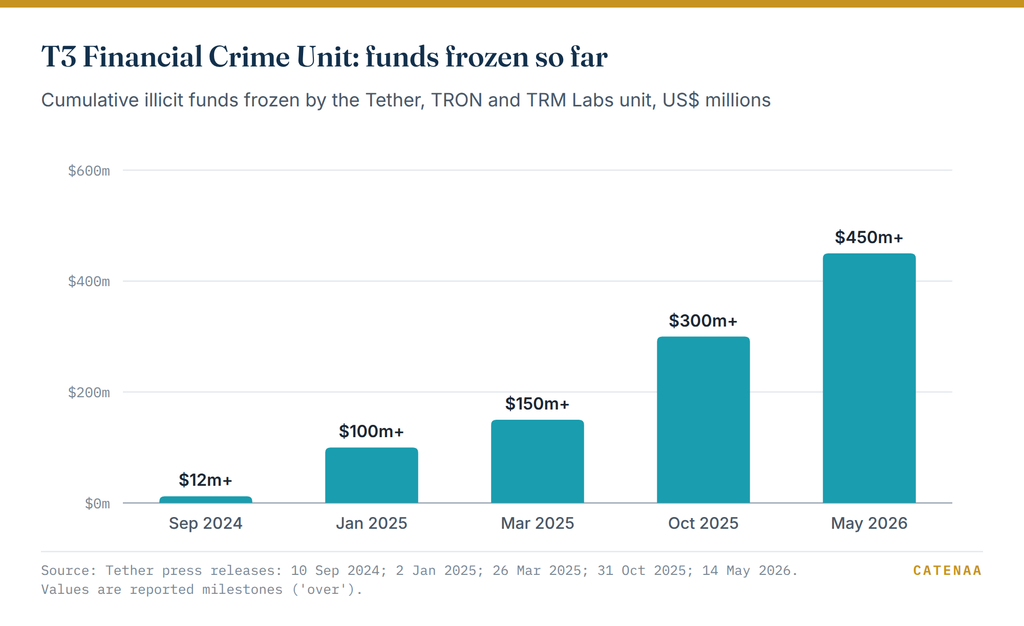
That power cuts both ways, however. It helps victims and police. Yet it also shows that USDT on TRON is not beyond central control. Users who value censorship resistance should weigh that trade-off carefully.
The same power that stops criminals can also freeze anyone.
Question 3: What happened with the SEC?
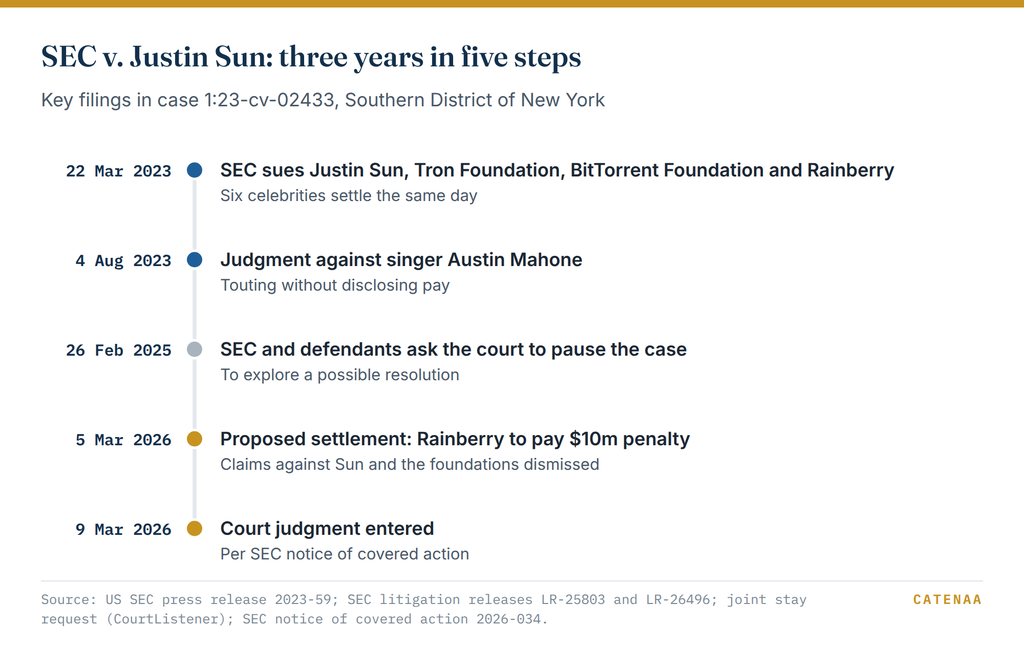
For three years, a US lawsuit hung over TRON. On 22 March 2023, the SEC charged Justin Sun, the Tron Foundation, the BitTorrent Foundation and Rainberry. The regulator alleged unregistered offers of TRX and BTT. It also alleged more than 600,000 wash trades between April 2018 and February 2019.
Celebrities were caught up too. The SEC charged eight for promoting the tokens without disclosing payment. Six settled when the case was filed, and singer Austin Mahone followed in August 2023.
Then the case paused. In February 2025, the SEC and the defendants asked the court to stay the case while they explored a resolution. On 5 March 2026, the SEC filed a proposed settlement. Rainberry agreed to a $10 million penalty over wash trading, without admitting or denying the allegations.
Under the same filing, all claims against Justin Sun, the Tron Foundation and the BitTorrent Foundation were dismissed. The court’s judgment followed on 9 March 2026, an SEC notice shows. Allegations in a complaint are not findings of fact, so the dismissed claims were never proven.
Question 4: How are regulators responding?
The bigger regulatory story concerns stablecoins, not TRX. That matters, because stablecoins drive most of TRON’s traffic.
In the United States, the GENIUS Act became law on 18 July 2025. It provides for the regulation of payment stablecoins at the federal level. In January 2026, Tether launched USA₮, a separate US-regulated token. The global USDT that dominates TRON remains a different product.
The details are still being written. In August 2026, the Treasury proposed rules to put the law into practice. Under the proposal, US crypto platforms could not offer a stablecoin after 18 July 2028 without a permitted issuer. The draft also sets out a route for qualifying foreign issuers. Comments close on 19 October 2026.
In the European Union, rules arrived earlier. In January 2025, ESMA told crypto platforms to stop offering stablecoins that lack authorisation under MiCA, the EU’s crypto law. The statement set a deadline of the end of the first quarter of 2025.
Why does this matter for TRON? Because rules for issuers and platforms shape where stablecoins circulate. If USDT’s access to a major market narrows, some traffic could move elsewhere. If it widens, TRON could benefit. Either way, TRON’s fortunes are tied to decisions it does not make.
TRON meets Wall Street
Meanwhile, TRON has moved closer to traditional markets. In July 2025, Tron Inc. began trading on Nasdaq under the ticker TRON, its filing shows. It said it held more than 365 million TRX.
That link brings both benefits and risks. On one hand, public companies face disclosure rules, which can add transparency. On the other hand, TRX demand may now swing with equity market moods. Investors in such firms should read the filings, not the headlines.
The everyday risks users face
Big-picture questions aside, most losses happen at a personal level. Like any blockchain, TRON is unforgiving. A payment sent to the wrong address cannot be recalled on the chain. Likewise, anyone who loses a private key loses the funds it controls.
Scams are another hazard. As noted above, stablecoins made up about 84% of fraud inflows in 2025. USDT on TRON is among the most widely used. Therefore, careful habits matter: check addresses, start with small test payments, and distrust promises of guaranteed returns.
Smart contracts add their own risk. DeFi apps can contain bugs, and staking or lending through third parties adds counterparty risk. None of this is unique to TRON, but it applies here as much as anywhere.
Where control really sits
Pulling this together, power on TRON sits in several places at once. Users hold their own keys and votes. SRs produce blocks and set fees. Tether controls USDT. Exchanges hold customer funds and many votes. Regulators shape what issuers and exchanges may do.
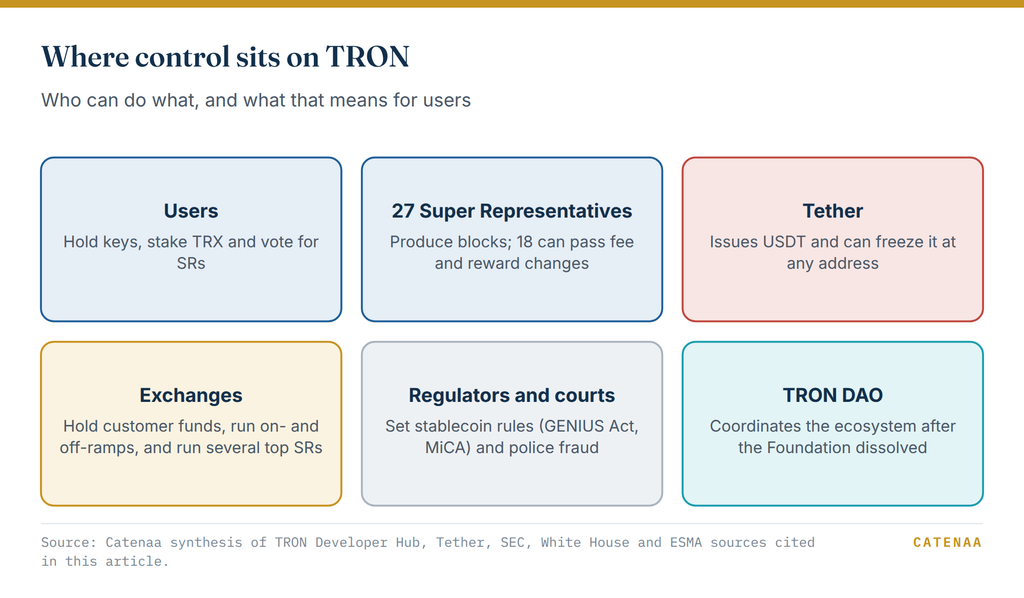
No single actor controls everything. Still, several hold real leverage. For readers, the practical lesson is simple: know which of these players your money depends on.
A reader’s checklist
- Custody: do you hold your own keys, or does an exchange hold them for you?
- Issuer: are you comfortable trusting Tether’s reserves and its freeze power?
- Fees: have you checked the current energy price and whether you need staked energy?
- Rules: do local laws allow you to buy, hold and cash out stablecoins?
- Scams: are you sure the address and the counterparty are genuine?
The series in one paragraph
TRON began as a 2017 token sale and became the largest home for digital dollars. It runs on 27 elected producers, prices activity in energy and bandwidth, and changes its rules by SR vote. Its coin, TRX, shrank in supply for years, then began to grow again after a fee cut. Its greatest strength is cheap USDT transfers. Yet that strength also brings its greatest risks: dependence on one issuer, heavy criminal use and concentrated control. Understanding both sides is the best protection any reader can have.
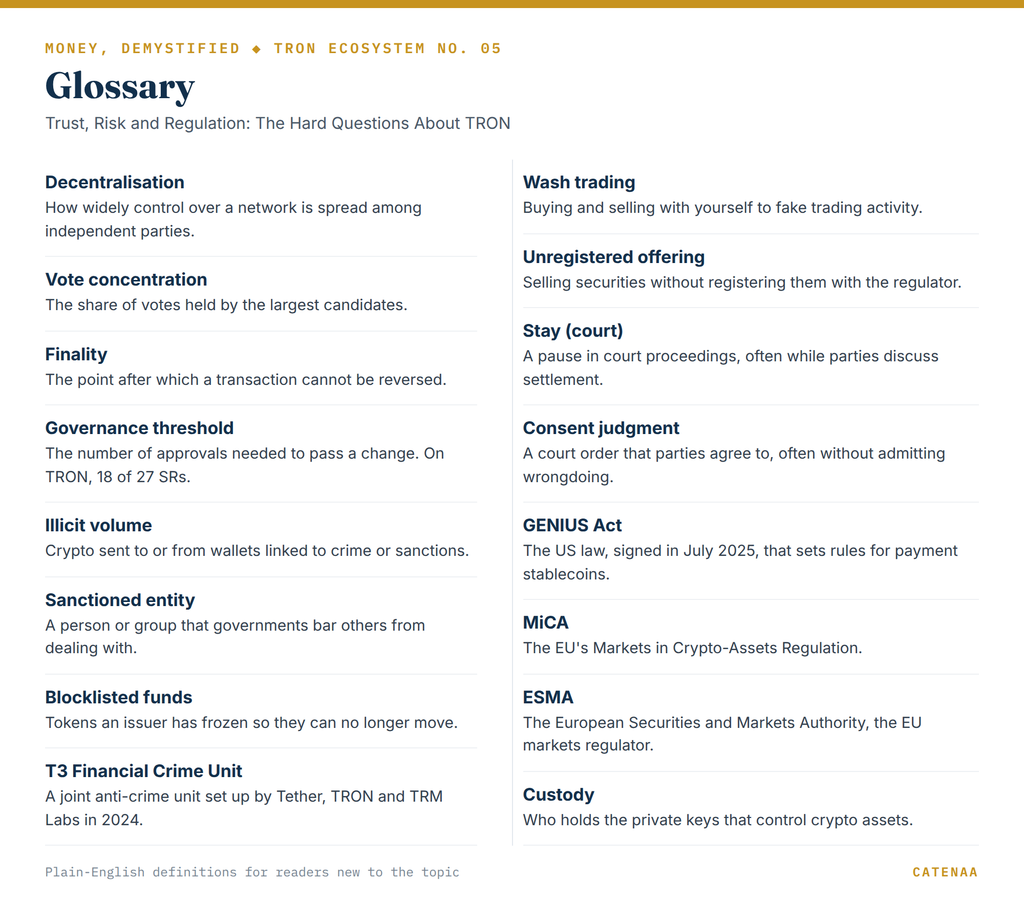
Glossary
Disclaimer: This article is for education only and is not legal or investment advice. It summarises public court and regulatory records; allegations in a complaint are not findings of fact. Check current rules in your jurisdiction.
Sources and references
- TronGrid API, listwitnesses (SR vote counts), 26 September 2026. https://api.trongrid.io/wallet/listwitnesses
- TRON Developer Hub, Consensus. https://developers.tron.network/docs/concensus
- TRON Developer Hub, Committee and proposals. https://developers.tron.network/docs/committee
- TRM Labs, 2025 Crypto Crime Report (data for 2024). https://www.trmlabs.com/reports-and-whitepapers/2025-crypto-crime-report
- TRM Labs, 2026 Crypto Crime Report (data for 2025). https://www.trmlabs.com/reports-and-whitepapers/2026-crypto-crime-report
- UNODC, Casinos, Money Laundering, Underground Banking and Transnational Organized Crime in East and Southeast Asia, January 2024. https://www.unodc.org/roseap/uploads/documents/Publications/2024/Casino_Underground_Banking_Report_2024.pdf
- Tether, T3 Financial Crime Unit established, 10 September 2024. https://tether.io/news/tether-tron-and-trm-labs-establish-first-ever-private-sector-financial-crime-unit-to-combat-crypto-crime/
- Tether, T3 FCU marks $100 million frozen, 2 January 2025. https://tether.io/news/t3-financial-crime-unit-marks-enforcement-victory-100-million-in-criminal-assets-frozen-across-five-continents/
- Tether, T3 FCU freezes Bybit-linked funds; total over $150 million, 26 March 2025. https://tether.io/news/t3-fcu-freezes-nearly-9-million-linked-to-record-breaking-bybit-hack-bringing-crime-units-total-to-over-150-million/
- Tether, T3 FCU surpasses $300 million frozen, 31 October 2025. https://tether.io/news/t3-financial-crime-unit-surpasses-300-million-in-frozen-assets-strengthening-global-efforts-against-crypto-related-crime/
- Tether, $450 million frozen and counting, 14 May 2026. https://tether.io/news/450-million-frozen-and-counting-t3-financial-crime-unit-continues-global-crackdown-on-illicit-crypto-flows/
- US SEC, Press release 2023-59, 22 March 2023. https://www.sec.gov/newsroom/press-releases/2023-59
- US SEC, Litigation release on Austin Mahone judgment, 7 August 2023. https://www.sec.gov/enforcement-litigation/litigation-releases/lr-25803
- SEC v. Sun, joint request for a stay, S.D.N.Y. docket, 26 February 2025 (via CourtListener). https://storage.courtlistener.com/recap/gov.uscourts.nysd.596044/gov.uscourts.nysd.596044.83.0_2.pdf
- US SEC, Litigation release on proposed Rainberry settlement, 5 March 2026. https://www.sec.gov/enforcement-litigation/litigation-releases/lr-26496
- US SEC, Notice of covered action 2026-034 (judgment date 9 March 2026). https://www.sec.gov/enforcement-litigation/whistleblower-program/notice-covered-actions/award-claim-2026-034
- Tron Inc., press release filed with the SEC (Exhibit 99.1), 16 July 2025. https://www.sec.gov/Archives/edgar/data/1956744/000164117225019830/ex99-1.htm
- The White House, The President signed into law S. 1582 (GENIUS Act), 18 July 2025. https://www.whitehouse.gov/briefings-statements/2025/07/the-president-signed-into-law-s-1582
- US Treasury, GENIUS Act Regulations on Payment Stablecoin Issuance, Offer, and Sale, proposed rule, Federal Register, 18 August 2026. https://www.federalregister.gov/documents/2026/08/18/2026-16796/genius-act-regulations-on-payment-stablecoin-issuance-offer-and-sale
- ESMA, Statement on non-MiCA-compliant ARTs and EMTs, 17 January 2025. https://www.esma.europa.eu/sites/default/files/2025-01/ESMA75-223375936-6099_Statement_on_stablecoins.pdf
- Tether, Tether announces the launch of USA₮, 27 January 2026. https://tether.io/news/tether-announces-the-launch-of-usat-the-federally-regulated-dollar-backed-stablecoin-made-in-america/
- TRON DAO, Announcement on TRON Foundation restructured as TRON DAO, January 2022. https://trondao.medium.com/announcement-on-tron-foundation-restructured-as-tron-dao-3b18aec7699e