

More digital dollars sit on TRON than on any other blockchain. Here is how that happened, what it costs to use, and what can go wrong.
In Summary
Tether brought USDT to TRON in March 2019. By April 2021, TRON hosted more USDT than any other network.
On 25 September 2026, TRON carried about $92.7 billion of USDT, 50.4% of all USDT in circulation.
The USDT on TRON is worth nearly three times the market value of TRX itself.
A basic USDT transfer burns about 6.8 TRX, or roughly $2.28, if the sender has no staked energy.
The network fee is only part of the cost.
Buying and cashing out USDT can add exchange fees and spreads.
Imagine a toll road that carries more trucks of cash than any other road in the world. Now imagine that most drivers never think about who built it. That, in short, is TRON’s relationship with the stablecoin USDT.
On 25 September 2026, TRON carried about $92.7 billion of USDT, Tether’s transparency page shows. That was 50.4% of all USDT in circulation, more than on Ethereum or any other chain.
This part explains how that happened. It also shows what a transfer really costs and which risks come with the convenience.
Stablecoins in one minute
A stablecoin is a crypto token designed to hold a steady value, usually one US dollar. Tether, the company behind USDT, says its tokens are “backed 100% by Tether’s Reserves”, according to its transparency page.
Why would anyone want a crypto dollar? It combines two things. It keeps the familiar value of the US dollar, and it moves like crypto, at any hour and across borders. For people outside the US banking system, that mix can be hard to find elsewhere.
Crucially, TRON does not issue USDT. Tether does. On TRON, USDT is a smart contract that follows the TRC-20 token standard, the local version of Ethereum’s ERC-20. The contract keeps a list of balances and moves them when users send tokens.
Because Tether controls the contract, it can also freeze tokens at specific addresses. Keep that point in mind. It returns later in this story and again in Part 5.
How USDT came to TRON
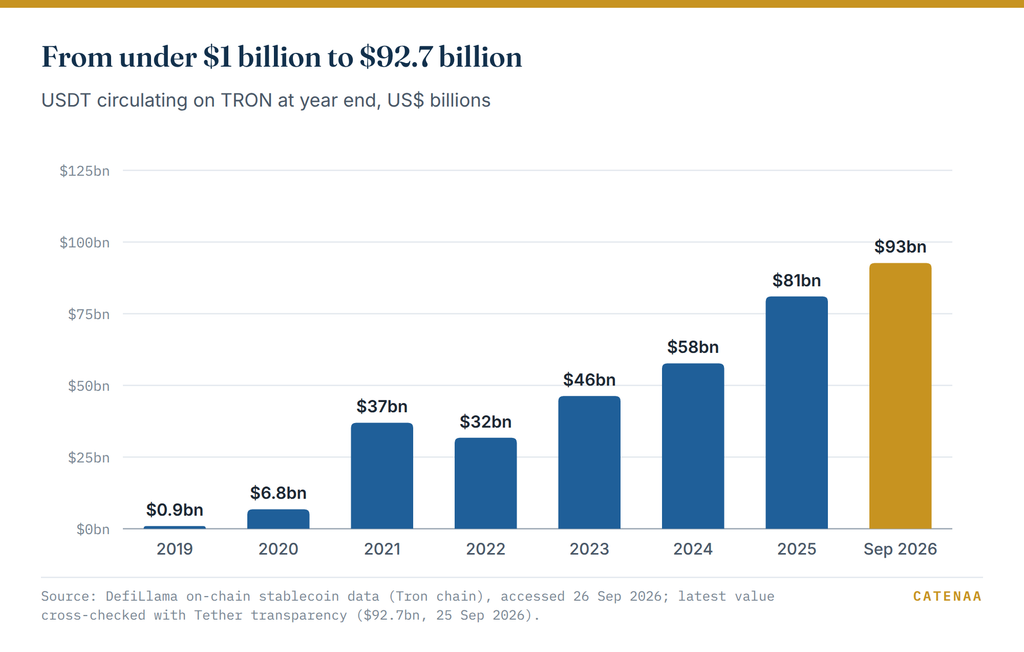
The partnership began on 4 March 2019, when Tether announced that USDT would launch on TRON. At first, growth was slow. Around $0.9 billion of USDT sat on TRON at the end of 2019, on-chain data compiled by DefiLlama show.
Then growth took off. The total reached about $6.8 billion by the end of 2020 and roughly $37 billion a year later. By April 2021, TRON hosted the largest supply of USDT of any network, a 2024 UN report notes.
The climb has continued since, with one dip during the 2022 crypto slump. By September 2026, the total stood near $92.7 billion. The latest DefiLlama figure matches Tether’s own data.
Worth more than the road itself
One comparison shows how central USDT has become. The USDT on TRON is worth about $92.7 billion. By contrast, all TRX in circulation was worth about $32 billion on 26 September 2026, CoinGecko data show.
In other words, the traffic is worth nearly three times the road’s own token. That makes TRON unusual. Much of its value to users comes from an asset it does not issue or control.
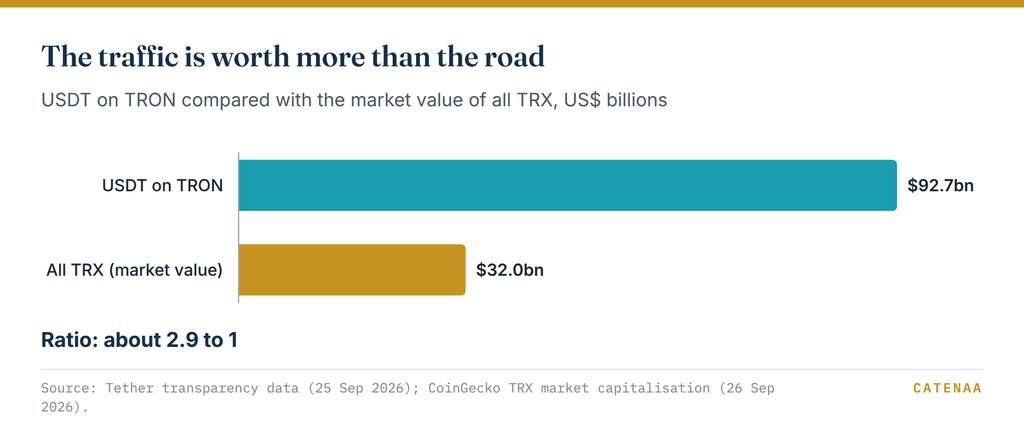
The traffic is worth nearly three times the road.
What happens when you send USDT
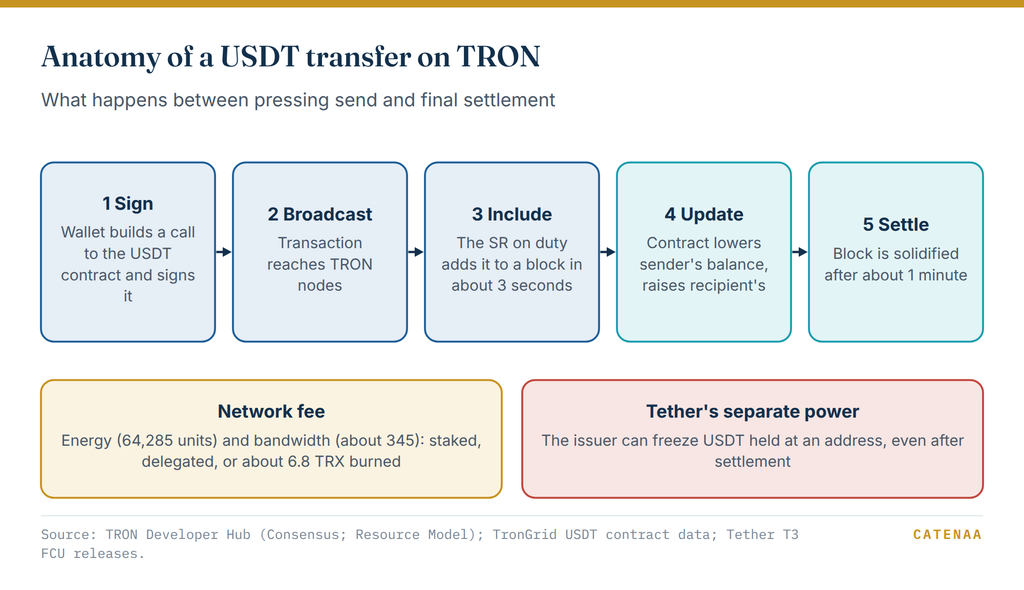
Sending USDT on TRON takes seconds, but several things happen behind the scenes. First, your wallet builds a transaction that calls the USDT contract. Then it signs the transaction with your private key and broadcasts it.
Next, a Super Representative includes it in a block, usually within three seconds. The contract lowers your balance and raises the recipient’s. Meanwhile, the network charges energy and bandwidth, as Part 2 explained.
About a minute later, the block becomes final on the chain. However, Tether keeps a separate power. It can freeze USDT held at an address, for example at the request of law enforcement.
Who uses USDT on TRON
The user base is large. Tronscan counted about 76.9 million addresses holding USDT on TRON in late September 2026. As always, addresses are not people, and exchanges hold many of them.
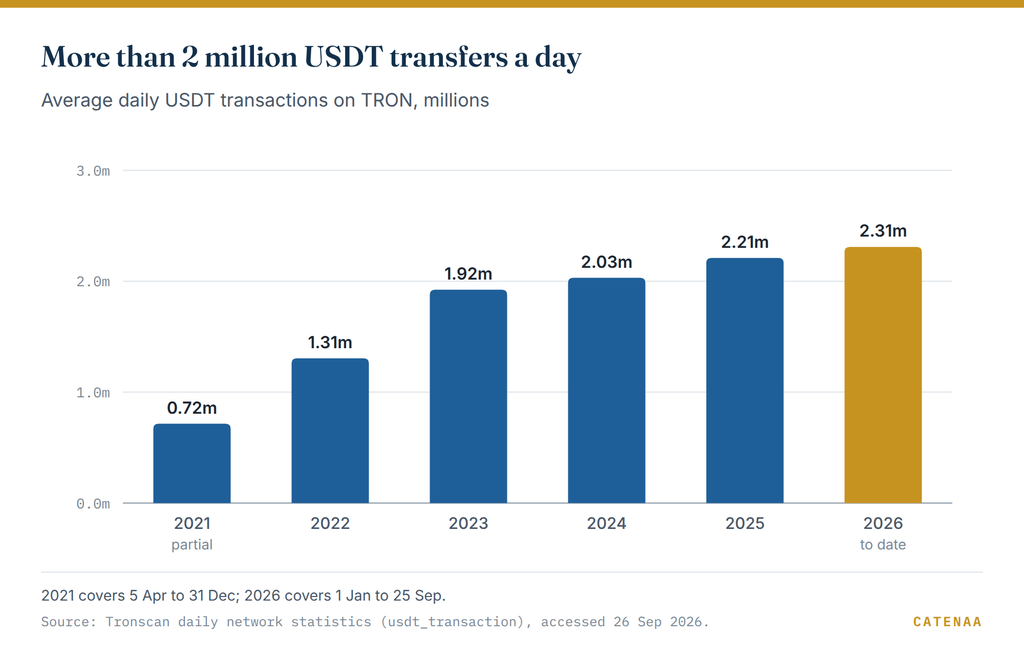
Activity is steady too. USDT transfers averaged about 2.3 million a day in 2026 so far, Tronscan’s daily statistics show. That is up from about 0.7 million a day in 2021.
Typical uses include moving money between exchanges, holding dollars outside a weak local currency, and paying across borders. Traders, freelancers and small firms all fit that picture. Still, public data rarely reveal who sends what, so exact shares by use remain unknown.
Three everyday scenarios
Numbers become clearer with people attached. The three cases below are illustrations, not real individuals, but they reflect common patterns.
The freelancer. A designer in Lagos bills a client in London. The client pays in USDT on TRON, and the money arrives in seconds. However, the designer still needs a local exchange or broker to turn it into naira for rent and groceries.
The small importer. A trader in Buenos Aires pays a supplier abroad. Paying in USDT avoids waiting days for a bank wire. Still, the trader must follow local currency and tax rules, which vary by country.
The saver. A family worried about a weak local currency keeps part of its savings in USDT. That can protect against local inflation. Yet it swaps one risk for others: trust in Tether and exposure to account freezes or scams.
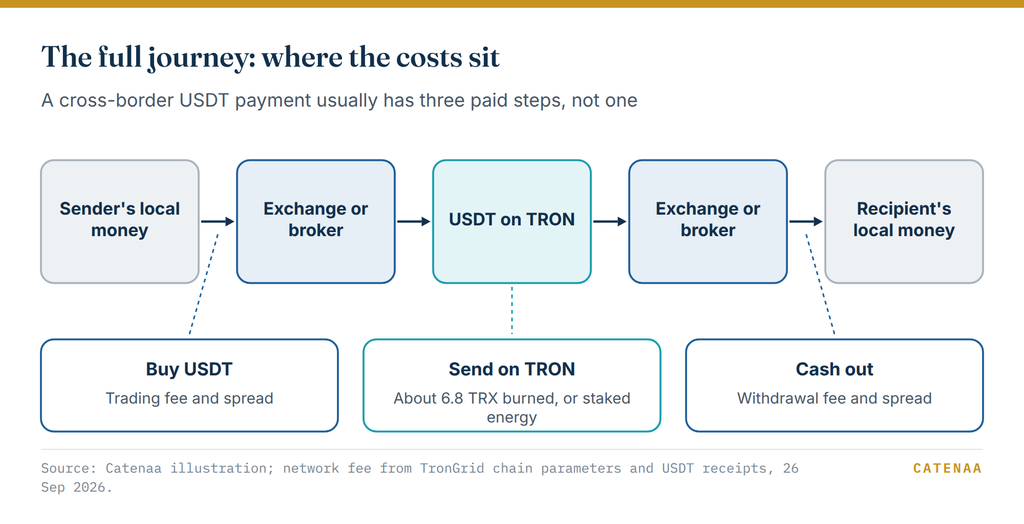
Each case shows the same pattern. TRON makes the middle step fast and cheap. The first and last steps, where money enters and leaves, still carry most of the friction.
The cost argument
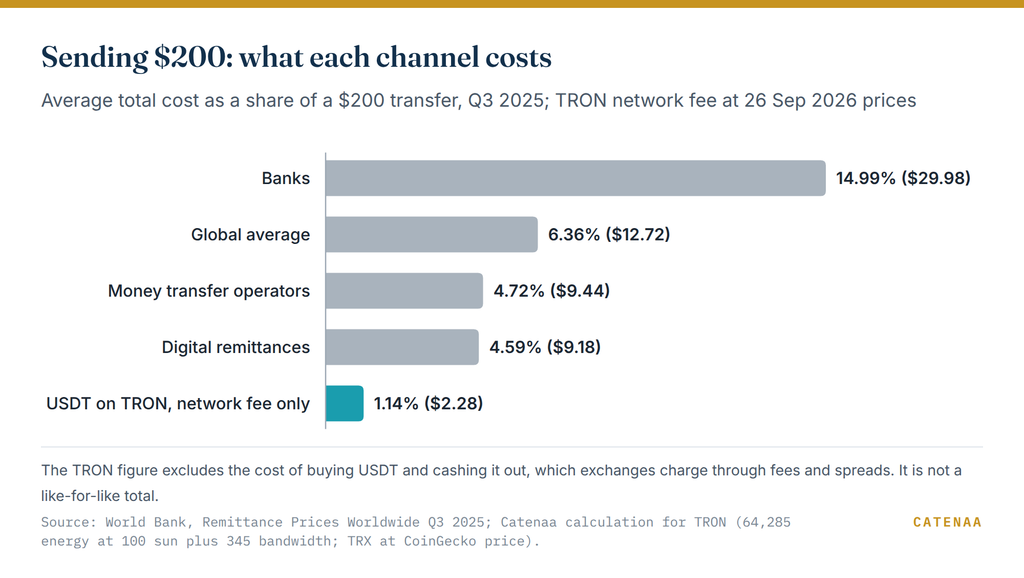
Why use TRON rather than a bank? Cost is a big part of the answer. Sending $200 abroad through traditional channels cost 6.36% on average in the third quarter of 2025, the World Bank reports. Banks were the priciest, at 14.99%.
Compare that with a USDT transfer on TRON. At today’s prices, a basic transfer burns about 6.8 TRX when the sender has no staked energy. That is roughly $2.28, or about 1.1% of $200.
However, that comparison flatters crypto. The on-chain fee is only one step. Most users must first buy USDT and later sell it for local money. Exchanges and brokers charge fees and spreads at both ends, and those costs vary widely.
Fees on TRON have also fallen fast. Between September 2024 and August 2025, SRs cut the energy price from 420 to 100 sun, the proposal record shows. As a result, the TRX burned for each unit of energy fell by about three-quarters.
Why TRON won the stablecoin race
Several forces worked together. First, TRON offered low fees set by posted prices rather than bidding wars. Second, transfers settled in seconds. Third, as usage grew, exchanges and wallets added support for USDT on TRON.
Then network effects took over. Once many users held USDT on TRON, new users picked it so they could trade with them. In turn, more services added support. Each step made the next one more likely.
Timing mattered as well. TRON moved early, in 2019, before several of today’s rival chains had launched. By the time competitors arrived, TRON already had the users and the liquidity.
TRON versus Ethereum for USDT
Ethereum remains TRON’s closest rival for USDT. It carried about $86.4 billion on 25 September 2026, or 47% of the total, Tether’s data show. So the two chains hold almost all USDT between them.
They tend to serve different jobs, however. Ethereum hosts far more DeFi. Its locked value was about $53.6 billion in late September 2026, against about $5.7 billion on TRON, DefiLlama reports. TRON, by contrast, leans towards simple transfers.
That split reflects each chain’s design. Ethereum offers deep liquidity for complex finance. TRON offers cheap, fast payments. Many users hold USDT on both and pick the road that suits the trip.
Dollars that do more: DeFi on TRON
Stablecoins also feed TRON’s decentralised finance, or DeFi, apps. JustLend DAO, for example, describes itself as the first official lending platform on TRON. Users can deposit assets to earn interest or borrow against them.
By DeFi value locked, TRON ranked fifth among blockchains in late September 2026, at about $5.7 billion, DefiLlama data show. That is small next to the $92.7 billion of USDT on the network. So most USDT on TRON moves as payments rather than sitting in DeFi.
The risks behind the convenience
Convenience comes with trade-offs. Issuer risk comes first. USDT is only as sound as Tether’s reserves and operations. On 25 September 2026, Tether reported about $189.3 billion of assets and $183.8 billion of liabilities, its data show. Even so, users must trust a private company’s reporting.
Freeze risk follows from the same fact. Tether can freeze USDT at an address. That power helps stop crime, as the T3 Financial Crime Unit shows. Yet it also means USDT is not censorship-proof. A frozen balance stays visible on the chain, but its owner cannot move it until Tether lifts the freeze.
Concentration risk cuts both ways. TRON depends heavily on one token from one issuer. Meanwhile, rules are changing. In January 2026, Tether launched USA₮, a separate US-regulated stablecoin, while global USDT continues. How that shapes TRON’s traffic is still unclear.
What to watch next
Three numbers will tell you where this story goes. Watch TRON’s share of USDT supply, the daily count of USDT transfers, and the energy price. If all three hold steady, TRON’s role as a stablecoin highway looks secure. If they slip, competition is biting. Watch regulation too. New stablecoin rules in the US and Europe could shift where issuers and users go.
Part 5 closes the series with the hard questions. Who really controls TRON? How does it handle crime? And what have regulators said?
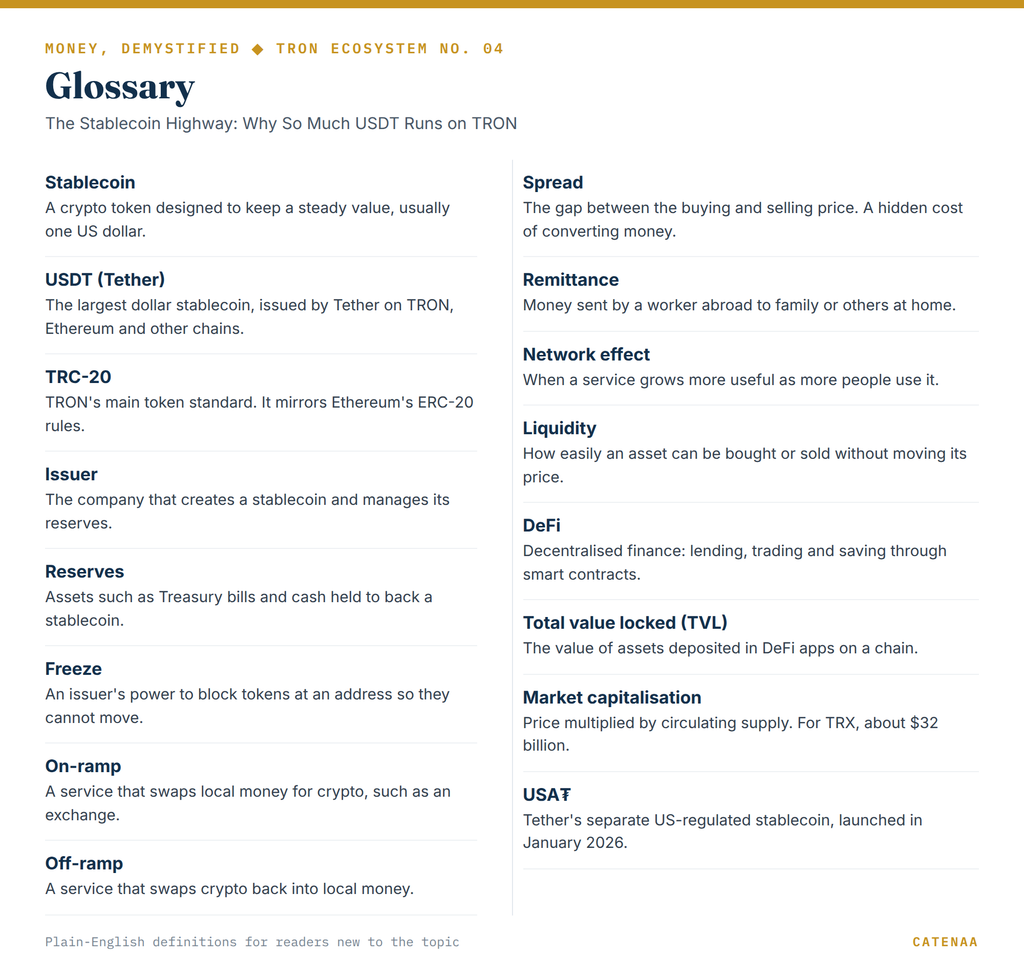
Glossary
Disclaimer: This article is for education only and is not financial, legal or investment advice. Stablecoins carry issuer, operational and regulatory risks. Check fees and rules in your own country before sending money.
Sources and references
- Tether, Transparency page (USDT by network; reserves), snapshot 25 September 2026. https://tether.to/en/transparency/
- Tether, USDT introduced to TRON blockchain, 4 March 2019. https://tether.io/news/usdt-introduced-to-tron-blockchain/
- UNODC, Casinos, Money Laundering, Underground Banking and Transnational Organized Crime in East and Southeast Asia, January 2024 (footnote 26). https://www.unodc.org/roseap/uploads/documents/Publications/2024/Casino_Underground_Banking_Report_2024.pdf
- DefiLlama, USDT circulating supply by chain (on-chain data), accessed 26 September 2026. https://stablecoins.llama.fi/stablecoin/1
- Tronscan API, daily network statistics (USDT transfers), accessed 26 September 2026. https://apilist.tronscanapi.com/api/stats/overview?days=2000
- Tronscan API, USDT holders and stablecoin data (homepage bundle), accessed 26 September 2026. https://apilist.tronscanapi.com/api/system/homepage-bundle
- CoinGecko, TRON (TRX) market data, 26 September 2026. https://www.coingecko.com/en/coins/tron
- World Bank, Remittance Prices Worldwide, Q3 2025 report. https://remittanceprices.worldbank.org/sites/default/files/2026-04/RPW_main_report_and_annex_Q325.pdf
- TronGrid API, listproposals (energy price proposals #95 and #104), 26 September 2026. https://api.trongrid.io/wallet/listproposals
- USDT contract on Tronscan; energy data queried via the TronGrid getcontractinfo API, 26 September 2026. https://tronscan.org/#/contract/TR7NHqjeKQxGTCi8q8ZY4pL8otSzgjLj6t
- Tether, $450 million frozen and counting: T3 Financial Crime Unit, 14 May 2026. https://tether.io/news/450-million-frozen-and-counting-t3-financial-crime-unit-continues-global-crackdown-on-illicit-crypto-flows/
- JustLend DAO, official site. https://justlend.org/
- DefiLlama, DeFi TVL by chain, accessed 26 September 2026. https://defillama.com/chains
- Tether, Tether announces the launch of USA₮, 27 January 2026. https://tether.io/news/tether-announces-the-launch-of-usat-the-federally-regulated-dollar-backed-stablecoin-made-in-america/
- Tronscan, Tether USD (USDT) TRC-20 contract page. https://tronscan.org/#/token20/TR7NHqjeKQxGTCi8q8ZY4pL8otSzgjLj6t