

For almost four years, TRON destroyed more TRX than it created. Then a fee cut flipped the balance. The data tell the story.
In Summary
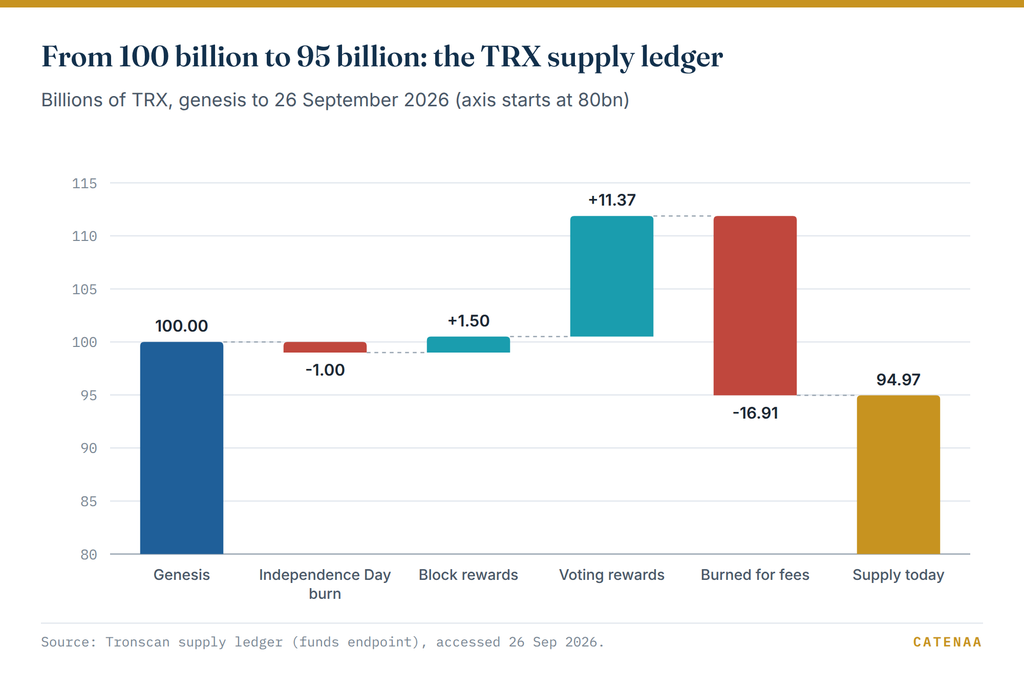
TRON began with 100 billion TRX. One billion were burned on Independence Day in June 2018.
New TRX comes from block rewards: 8 TRX to the block producer and 128 TRX to a voter pool, per block.
TRX is destroyed when users pay fees by burning it. Tronscan counts about 16.9 billion TRX burned this way since launch.
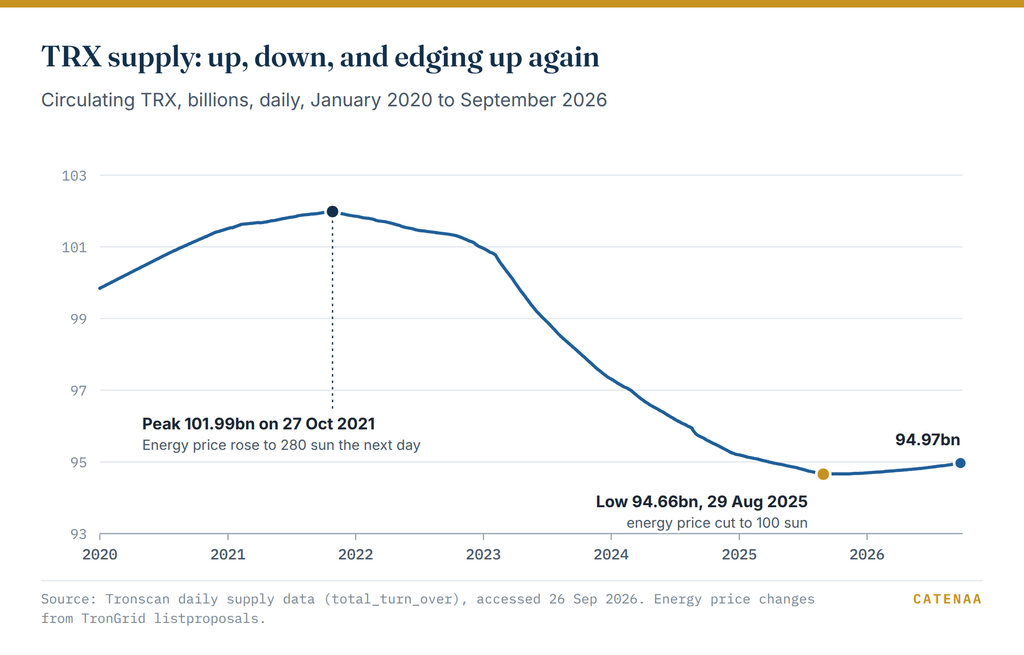
Supply peaked near 102 billion in October 2021, then fell to about 94.7 billion by August 2025.
After SRs cut the energy price in August 2025, issuance overtook burning. Supply has edged up since, to about 95.0 billion.
Every currency has a supply story. Central banks print money, and governments tax some of it back. TRX works in a similar way, but the rules sit in code, and every change shows up on-chain.
Here is the headline. For almost four years, TRON destroyed more TRX than it created. Then, in August 2025, a fee cut flipped the balance. Since then, supply has crept up again.
This part walks through where TRX comes from, where it goes, and what the numbers show. All figures come from Tronscan’s supply ledger and the network’s own records.
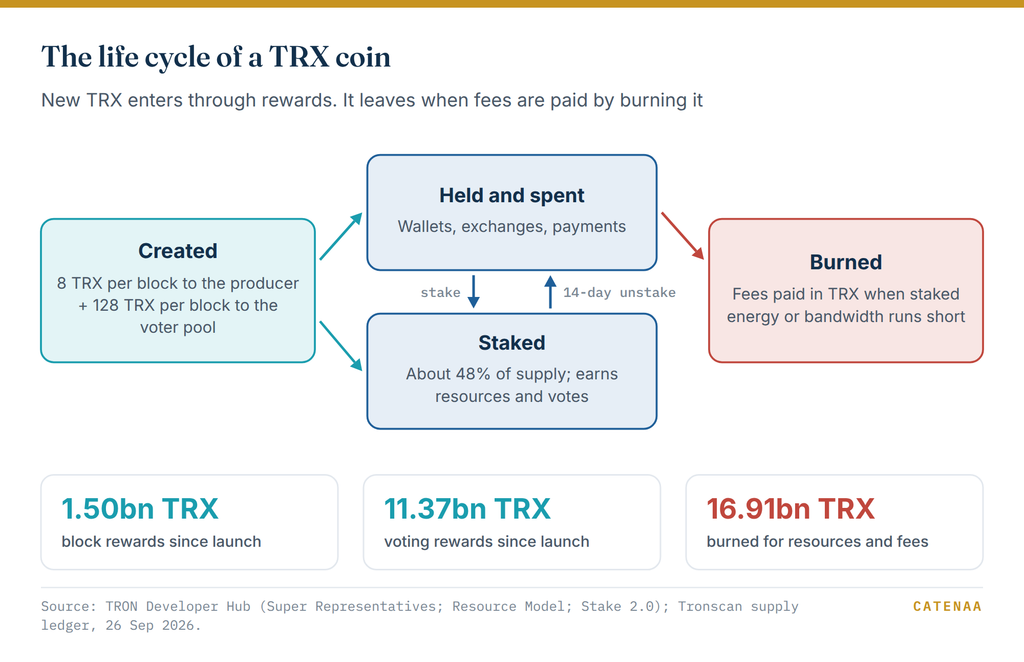
A simple picture helps. Think of TRX supply as water in a bathtub. Block rewards are the tap, pouring in new coins every three seconds. Fees paid by burning TRX are the drain. The water level rises or falls depending on which flow is stronger.
Crucially, TRON’s SRs can adjust both. They set the reward per block, which controls the tap. They also set the price of energy and bandwidth, which controls how fast the drain runs.
Where it started: 100 billion coins
TRON’s genesis block created 100 billion TRX, Tronscan records. Then, to mark Independence Day on 25 June 2018, one billion TRX were burned.
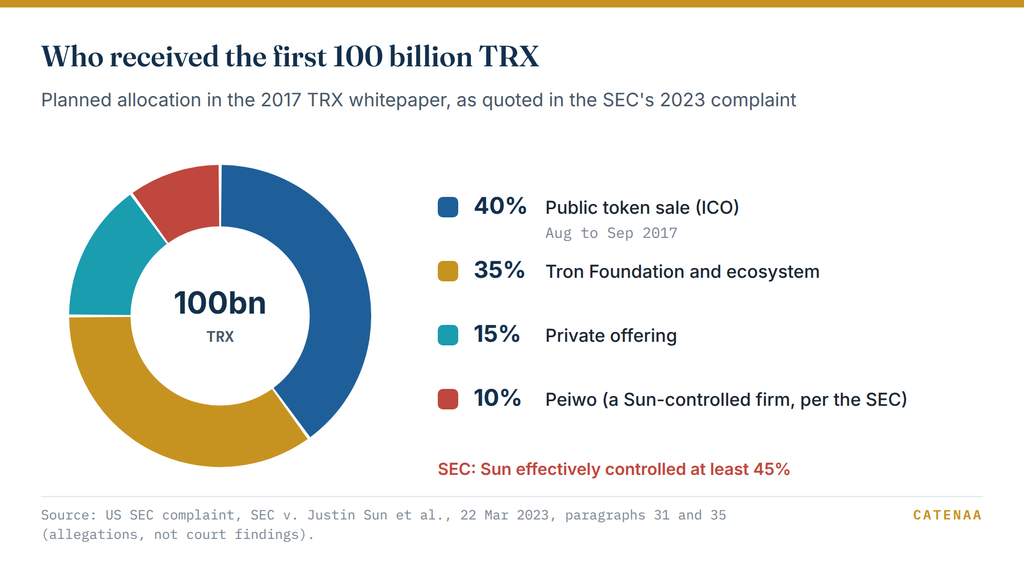
Who got the starting coins? The answer comes from the 2017 whitepaper, as quoted in a 2023 SEC complaint. Forty per cent went to buyers in the 2017 token sale. The Tron Foundation and ecosystem were allocated 35%. A private sale took 15%, and a company called Peiwo was allocated 10%.
Those details come from the SEC’s allegations, so read them in that light. Still, the split matters. The SEC alleged that Sun effectively controlled at least 45% of TRX through the Foundation and Peiwo.
One unit note before we go on. TRX divides into one million smaller units called sun. Network fees are usually quoted in sun, so the term will keep appearing.
How new TRX is created
TRON has no miners, so it pays its block producers instead. Every block creates new TRX in two parts, TRON’s docs explain.
First, the Super Representative that makes the block earns 8 TRX. Second, 128 TRX per block flows into a pool for the top 127 candidates, shared by votes. By default, candidates pass 80% of their share on to voters.
Now do the maths. With a block every three seconds, the network produces about 28,800 blocks a day. At 136 TRX per block, that works out to roughly 3.9 million new TRX daily. Over a year, it comes to about 1.43 billion TRX.
That rate is lower than it used to be. From November 2019 until June 2025, rewards totalled 176 TRX per block. Then SRs approved a cut to today’s level, the proposal record shows. Since launch, Tronscan counts 1.50 billion TRX paid as block rewards and 11.37 billion as voting rewards.
Who actually earns the rewards?
The voter pool is far bigger than the block reward. Each block pays 128 TRX to the pool but only 8 TRX to the producer. So most new TRX ends up with voters, not block producers.
The pool is shared among the top 127 candidates in proportion to their votes. Each candidate keeps a slice, called brokerage, and passes the rest to its voters. The default brokerage is 20%, TRON’s docs state, though candidates can set their own.
In practice, this rewards scale. Large exchanges and staking firms run many of the top SRs, and they attract big pools of votes. As a result, a large share of new TRX passes through those platforms before it reaches their customers. Part 5 returns to that concentration.
How TRX is destroyed
Supply also shrinks. Whenever someone pays a network fee by burning TRX, those coins disappear for good. That happens when a sender lacks enough staked energy or bandwidth, as Part 2 explained.
Other actions remove TRX too. For instance, registering as an SR candidate costs 9,999 TRX, which the network burns. Creating a new account also carries a small fee, the chain parameters show.
Added up, the total is large. Since launch, Tronscan counts about 16.9 billion TRX burned for resources and fees. That is more than all the block and voting rewards combined.
Cheaper fees helped users, but they also slowed the burn.
The deflation years
The turning point came in late 2021. Circulating supply peaked at about 101.99 billion TRX on 27 October 2021, Tronscan’s daily data show. The next day, SRs raised the energy price to 280 sun.
Higher prices meant more TRX burned per transaction. Meanwhile, stablecoin traffic kept growing. As a result, burning outpaced issuance in every calendar year from 2022 to 2025.
The effect peaked in 2023. That year, Tronscan recorded about 1.85 billion TRX created and 5.49 billion burned. Supply therefore fell by roughly 3.6 billion TRX in a single year.
What drove the burn? Stablecoin traffic played a big part. USDT transfers on TRON averaged about 1.3 million a day in 2022 and 1.9 million in 2023, Tronscan shows. Each one needed energy, and energy had just hit 420 sun. Busy roads and high tolls meant a fast-running drain.
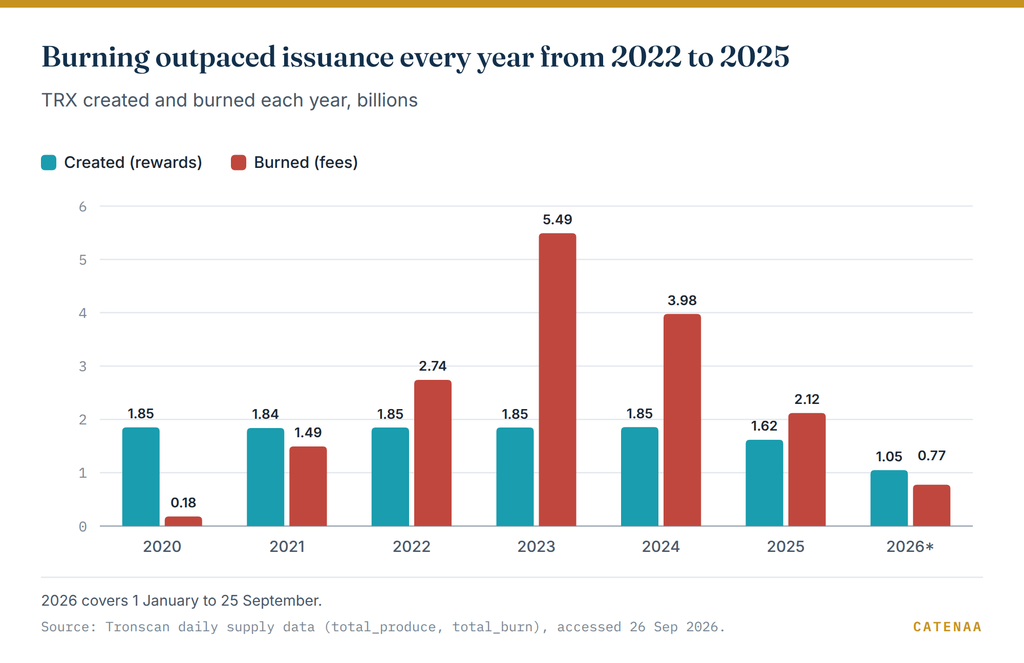
By 29 August 2025, supply had dropped to about 94.66 billion TRX. That was roughly 7.3 billion below the 2021 peak, a fall of about 7%.
The turn of 2025
That date is no coincidence. On 29 August 2025, proposal 104 cut the energy price from 210 to 100 sun. Two months earlier, in June 2025, SRs had also trimmed block rewards.
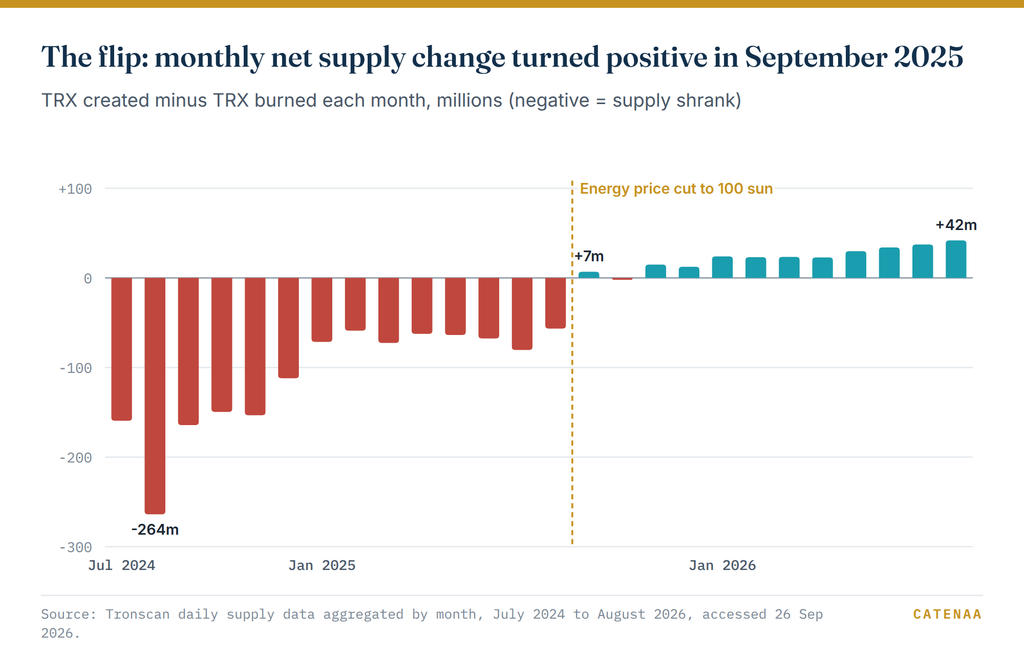
The two changes pulled in opposite directions. Lower rewards reduced issuance. However, the energy price cut reduced burning even more. From September 2025, issuance exceeded burning in every month but one.
The gap has widened since. In August 2026, the network created about 121 million TRX and burned about 80 million, Tronscan data show. By 25 September 2026, supply stood near 94.97 billion, about 0.3 billion above the August 2025 low.
Put another way, net additions averaged about 30 million TRX a month in the first eight months of 2026. That is a gentle slope, but it points up rather than down.
Is that a problem? It depends on your view. Lower fees make TRON cheaper for the people who use it every day. On the other hand, holders lose a force that had been shrinking supply. At current rates, net supply growth is modest, well under 1% a year.
Staking: the other half of the picture
Supply is only part of the story. What matters too is how much TRX is locked away. On 25 September 2026, about 45.6 billion TRX was staked, Tronscan reported. That is roughly 48% of the circulating supply.
That staked total sits in two pots. About 27.5 billion TRX uses Stake 2.0, the current system. Another 18.1 billion still sits in the older Stake 1.0 system, which TRON replaced in April 2023.
Staked TRX cannot be spent right away. Under Stake 2.0, unstaking comes with a 14-day wait. So a large staked share reduces the TRX that can hit the market quickly.
Why stake at all? There are two reasons. First, staking earns energy or bandwidth, which cuts fees. Second, it grants votes that earn a share of the reward pool.
Here is a rough guide to that reward. The voter pool pays about 1.35 billion TRX a year. Across roughly 44 billion votes, that is about 3% a year before commissions. After the default 20% SR cut, it falls to about 2.4%. This is our own estimate, and actual returns vary by SR.
Corporate treasuries enter the picture
A newer source of demand has appeared on Wall Street. In July 2025, a Nasdaq-listed firm renamed itself Tron Inc. and adopted the ticker TRON. It said it held more than 365 million TRX, its filing states.
That stake is small next to total supply, at well under 1%. Still, it marks a shift. TRX now sits on the balance sheet of a public company, so equity markets can shape demand for it. Part 5 looks at what that link means.
Three common misreadings
A burn does not guarantee a higher price. Supply is only one side of the market. Demand, liquidity and wider crypto sentiment often matter more.
Staking is not risk-free. Staked TRX still moves with the market. Moreover, the 14-day unstaking wait means you cannot sell instantly if prices fall.
Supply growth is not always bad. Cheaper fees can attract more users and more traffic. Over time, that traffic could lift burning again. Nobody can promise that outcome, though.
What it all means for readers
TRX supply is not fixed. Instead, it moves with two dials: reward levels and fee prices. SRs control both through on-chain votes.
That makes TRX different from coins with a hard cap. Its supply path depends on decisions by a small group of elected producers. Governance, in other words, shapes the supply outlook.
For users, the recent direction has been welcome, since fees fell sharply. For holders, the picture is mixed. The burn that once shrank supply has faded, while staking still locks up nearly half of it.
Before drawing conclusions, watch three signals. Track the energy price, the monthly burn and the staking share. Together, they tell you far more than any headline price move. Part 4 turns to the traffic that drives the burn: stablecoins.
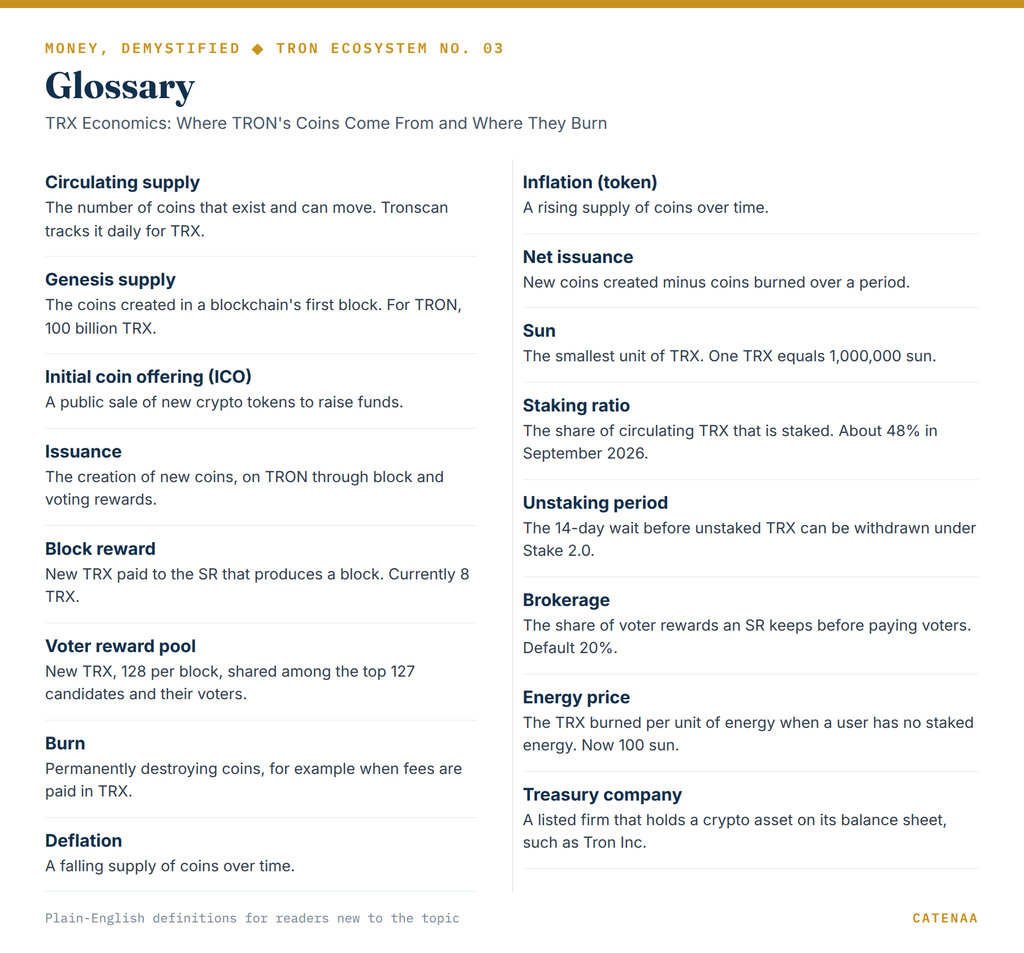
Glossary
Disclaimer: This article is for education only and is not investment advice. Crypto assets are volatile and can lose value. Figures reflect on-chain and official data at the time of writing and will change.
Sources and references
- Tronscan API, TRX supply ledger (funds), accessed 26 September 2026. https://apilist.tronscanapi.com/api/funds
- Tronscan API, daily TRX supply, issuance and burn (turnover), accessed 26 September 2026. https://apilist.tronscanapi.com/api/turnover?size=5000&start=1529856000000&end=1790000000000&type=0
- Tronscan API, staking and resource statistics, accessed 26 September 2026. https://apilist.tronscanapi.com/api/system/homepage-bundle
- US SEC, Complaint in SEC v. Justin Sun et al., filed 22 March 2023 (allegations; paragraphs 31 and 35). https://www.sec.gov/files/litigation/complaints/2023/comp-pr2023-59.pdf
- TRON, Advanced Decentralized Blockchain Platform Whitepaper v2.0. https://tron.network/static/doc/white_paper_v_2_0.pdf
- TRON Developer Hub, Super Representatives (reward rules). https://developers.tron.network/docs/super-representatives
- TRON Developer Hub, Consensus. https://developers.tron.network/docs/concensus
- TRON Developer Hub, Staking on TRON (Stake 2.0). https://developers.tron.network/docs/staking-on-tron-network
- TRON Developer Hub, Resource Model. https://developers.tron.network/docs/resource-model
- TronGrid API, getchainparameters, 26 September 2026. https://api.trongrid.io/wallet/getchainparameters
- TronGrid API, listproposals (proposals #27, #71, #102, #104), 26 September 2026. https://api.trongrid.io/wallet/listproposals
- TronGrid API, listwitnesses (total votes), 26 September 2026. https://api.trongrid.io/wallet/listwitnesses
- Tronscan API, daily network statistics (USDT transfers), accessed 26 September 2026. https://apilist.tronscanapi.com/api/stats/overview?days=2000
- Tron Inc., press release filed with the SEC (Exhibit 99.1), 16 July 2025. https://www.sec.gov/Archives/edgar/data/1956744/000164117225019830/ex99-1.htm
- Tronscan Support Center, What are token migration and Independence Day. https://support.tronscan.org/hc/en-us/articles/360042161631-What-are-token-migration-and-Independence-Day