

Twenty-seven elected block producers, a block every three seconds and a fee system built on energy and bandwidth. Here is how the machine runs.
In Summary
TRON uses delegated proof of stake: TRX holders stake, vote, and elect 27 Super Representatives every six hours.
SRs take turns producing a block every three seconds. A block becomes final once 19 of the 27 have built on it, usually within about a minute.
Instead of a single gas fee, TRON meters two resources: bandwidth for transaction size and energy for smart contract work.
A standard USDT transfer uses 64,285 energy, or 130,285 if the recipient holds no USDT yet.
SRs set resource prices by vote. They cut the energy price from 420 to 100 sun in two steps in 2024 and 2025.
Every blockchain must answer two questions. Who writes the next page of the ledger? And who pays for the ink?
Bitcoin answers with miners and fees. Ethereum answers with validators and gas. TRON gives its own answers: elected block producers and a fee system based on two resources, energy and bandwidth.
Part 1 explained what TRON is. This part opens the hood. By the end, you will know why a TRON payment settles in seconds. You will also see why its cost can change after a vote.
The problem every blockchain must solve
A blockchain has no boss. Thousands of computers hold copies of the ledger, and they must agree on one version of it. The method they use is called a consensus mechanism.
Bitcoin uses proof of work. Miners burn electricity to solve puzzles, and the winner adds the next block. Ethereum uses proof of stake. There, anyone who deposits 32 ETH can run a validator, ethereum.org explains.
TRON uses a variant called delegated proof of stake, or DPoS. Holders do not produce blocks themselves. Instead, they elect a small group to do it for them, much like voters electing a council.
Delegated proof of stake, step by step
The process runs in a loop. First, a holder stakes TRX. Since April 2023, TRON has used a system called Stake 2.0. Each staked TRX earns one unit of TRON Power, which counts as one vote.
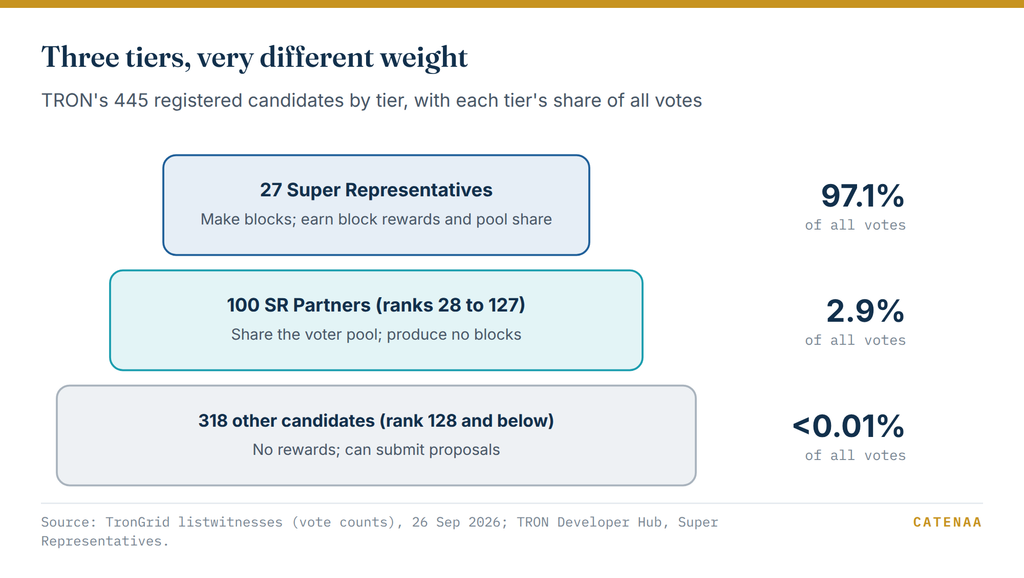
Next, the holder votes for candidates. Any account can stand by paying a 9,999 TRX fee, which the network burns, TRON’s docs state. On 26 September 2026, 445 accounts had registered, TronGrid data show.
Then comes the count. Every six hours, the network tallies votes during a short maintenance period. The top 27 become active Super Representatives, or SRs. Ranks 28 to 127 become SR Partners. They share voting rewards but do not produce blocks.
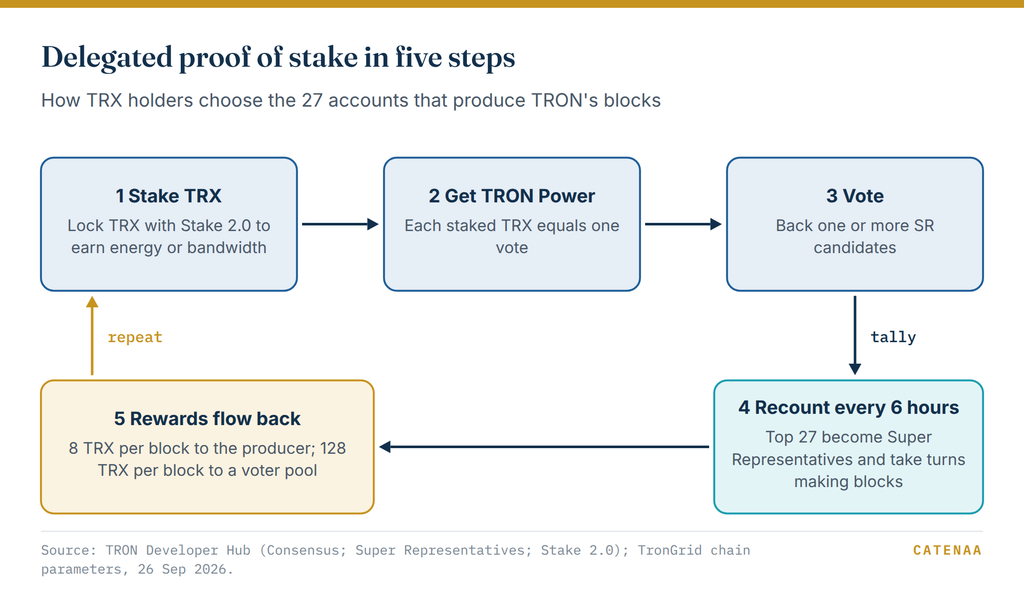
Finally, rewards flow back. Each block pays 8 TRX to the SR that produced it. On top of that, 128 TRX per block goes into a voter reward pool for the top 127. By default, an SR keeps 20% of its share and passes 80% to its voters.
Three seconds per block, one minute to finality
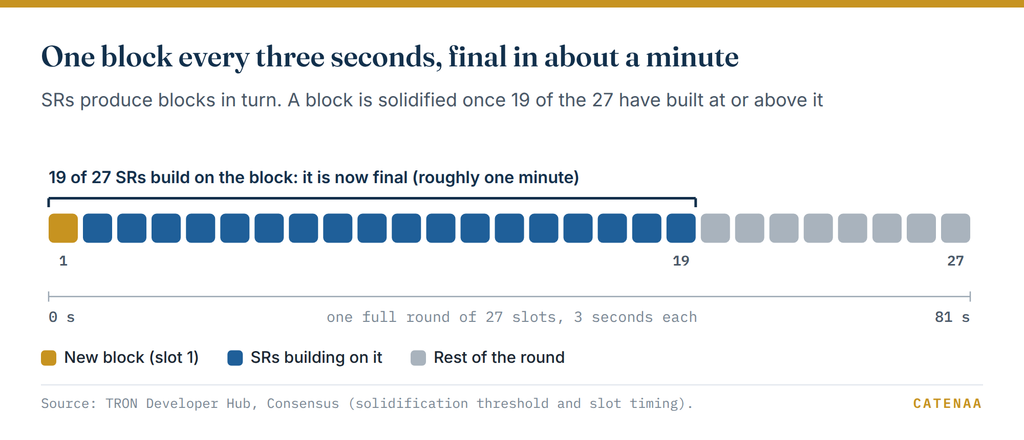
SRs do not race each other. Instead, they take turns in a fixed order, the consensus docs explain. The top-voted SR gets the first slot, the second gets the next, and so on.
Each slot lasts three seconds. So a full round of 27 producers takes about 81 seconds. If an SR misses its slot, the slot is simply left empty, and that SR forfeits the block’s rewards.
A new block is not yet final, though. It becomes irreversible, or solidified, once 19 of the 27 SRs have produced blocks at or above its height. In a healthy network, that takes about a minute.
Why 19? It is the smallest number above two-thirds of 27. As a result, a minority of faulty or dishonest producers cannot rewrite settled history on their own.
On TRON, the price of computing power is set by vote.
The TRON Virtual Machine
Smart contracts need an engine. On TRON, that engine is the TRON Virtual Machine, or TVM. It runs contract code on every node and must reach the same result each time.
The TVM tracks Ethereum’s upgrades step by step, TRON’s docs note. As a result, developers can write contracts in Solidity, a language widely used on Ethereum. That helps explain why many tokens and apps exist on both chains.
There are differences, however. TRON caps how long one transaction can compute. The limit is currently 80 milliseconds, the chain parameters show. TRON also meters computation in energy rather than Ethereum’s gas. That brings us to the fee model.
Bandwidth and energy: TRON’s fee model
TRON splits the cost of a transaction into two resources, the resource model explains. Bandwidth pays for size, measured in bytes. Every transaction uses some. Energy, by contrast, pays for computation. Only smart contract calls use it.
Here is the key twist. Each account gets 600 free bandwidth points every 24 hours. Energy, on the other hand, has no free quota. Users get it in one of three ways.
- Stake TRX. Staking for energy earns a share of the network’s daily energy supply. It refills over 24 hours.
- Receive delegated energy. Another account can lend its staked energy, which lets one account cover another’s costs.
- Burn TRX. If neither applies, the network burns TRX from the sender at the current price.
An analogy helps. Staking is like buying a monthly transit pass, while burning TRX is like paying for a single ticket. Frequent riders buy the pass. Occasional riders simply pay per trip.
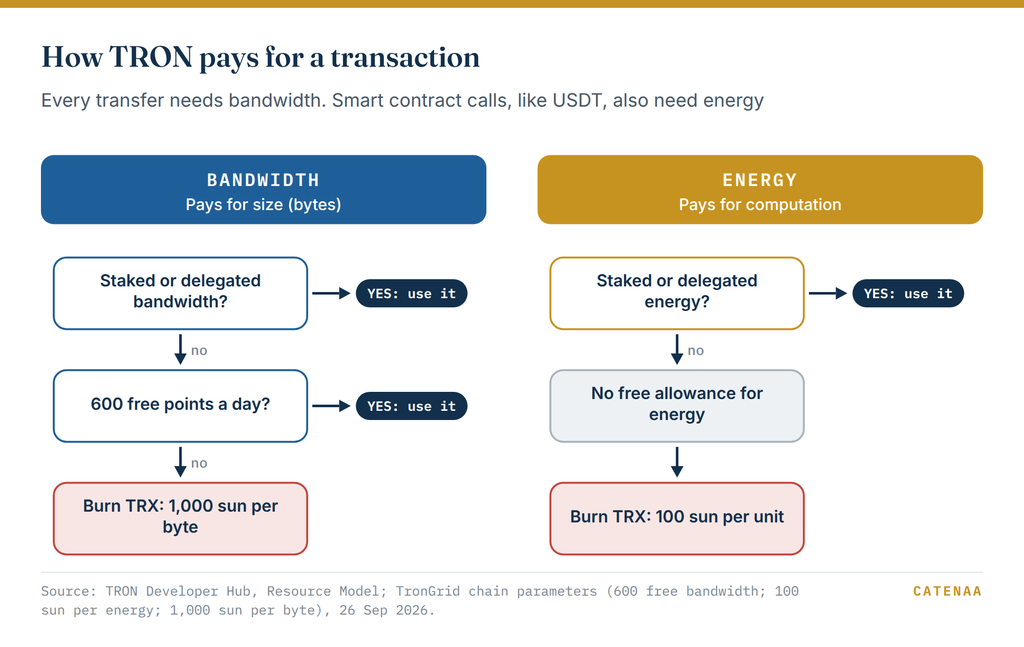
The same logic applies to bandwidth once the free allowance runs out. Stake for it, or burn TRX at 1,000 sun per byte, the current chain parameters show. Remember, one TRX equals one million sun.
What a USDT transfer really uses
USDT on TRON is a smart contract, so sending it needs energy. To see how much, we pulled receipts for recent USDT transfers from the network.
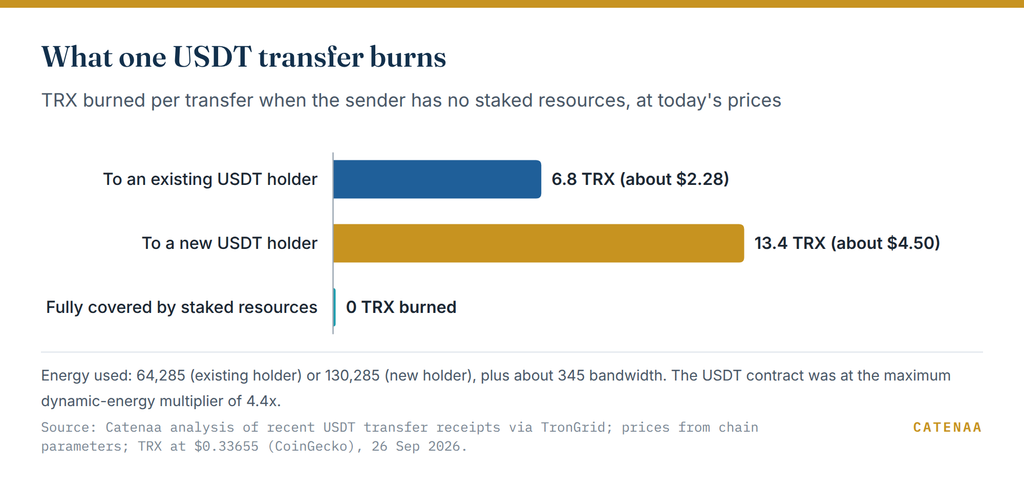
The pattern was clear. A transfer to an address that already holds USDT used 64,285 energy. A transfer to an address holding none used 130,285 energy, because the contract must create a new balance record. Each also used about 345 bandwidth.
Why so much energy? A dynamic energy rule charges busy contracts more. If a contract’s use passes a set threshold in six hours, its energy cost rises. The cap is 4.4 times the base. On 26 September 2026, the USDT contract sat at that maximum, network data show.
Now apply today’s prices. At 100 sun per unit of energy, the first case costs about 6.43 TRX in energy. Add 0.345 TRX for bandwidth, and the total is about 6.8 TRX. At the CoinGecko price on 26 September 2026, that is roughly $2.28.
Sending to a brand-new holder costs about 13.4 TRX, or roughly $4.50. However, senders who stake TRX or receive delegated energy burn far less. So heavy users have a strong reason to stake.
A worked example: one payment, start to finish
Picture Maya, a freelancer in Manila. A client in Dubai wants to pay her 100 USDT on TRON. Here is what happens, step by step.
First, the client’s wallet builds a transaction that calls the USDT contract. The wallet signs it with the client’s private key and broadcasts it to the network.
Next, the SR whose slot is due picks up the transaction and includes it in a block. That usually happens within a few seconds. At this point, Maya’s wallet can already see the payment.
Then the other SRs keep building. About a minute later, 19 of them have added blocks on top, and the payment is solidified. From then on, nobody can reverse it on the chain.
Meanwhile, the network charges for resources. If the client staked TRX for energy, the fee comes from that allowance. Otherwise, the network burns about 6.8 TRX from the client’s balance.
One caveat matters here. The chain cannot reverse the payment, but Tether can freeze USDT at an address. Part 4 explains how that power works and why it exists.
Governance in action: the price of energy
Who sets those prices? The SRs do, through on-chain proposals. A proposal passes if at least 18 of the 27 active SRs approve it within three days, the docs state. By August 2026, the chain had logged 107 proposals, and 50 had passed, TronGrid records show.
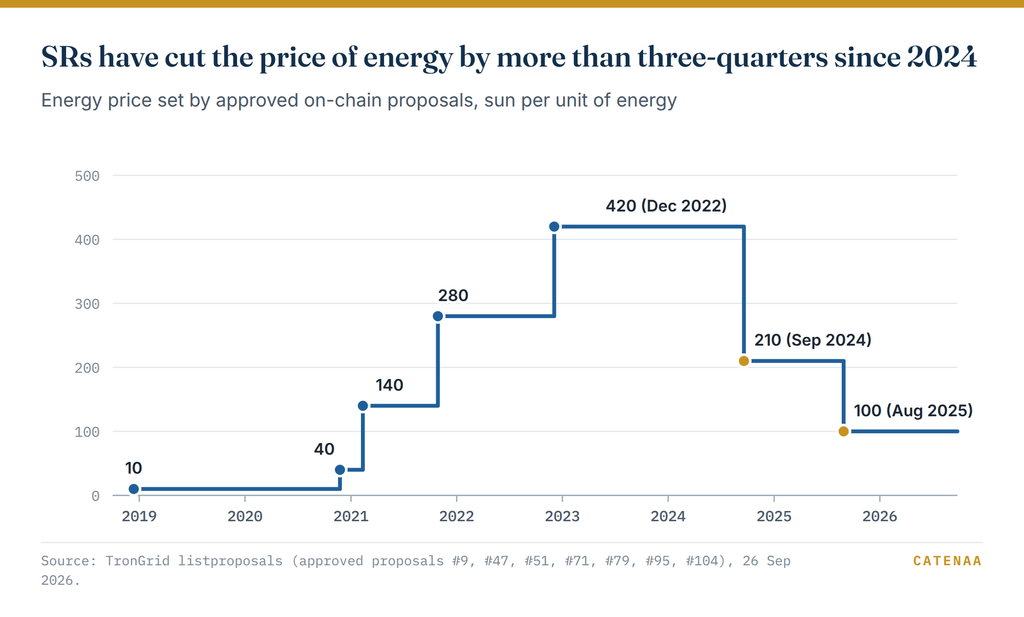
Energy pricing tells the story well. The price rose in steps from 10 sun in late 2018 to 420 sun in December 2022. Then the direction flipped. In September 2024, SRs halved it to 210 sun. In August 2025, they cut it again to 100 sun.
Those cuts matter for users. At 420 sun, today’s 64,285-energy transfer would have burned about 27.3 TRX. At 100 sun, it burns about 6.8 TRX. Lower prices, however, also mean less TRX is burned. Part 3 explores what that means for supply.
What changed since the whitepaper
The rules today differ from those in the original design. For example, the whitepaper promised 5,000 free bandwidth points a day. SRs cut that to 1,500 in September 2021 and to 600 in July 2023.
Rewards changed too. The whitepaper described 32 TRX per block for producers. From November 2019, the split became 16 TRX per block plus a 160 TRX voter pool. Then, in June 2025, SRs cut both, to 8 TRX and 128 TRX.
In other words, TRON’s settings are not fixed in stone. They move when the 27 SRs vote, which makes the governance record worth watching.
Strengths and trade-offs
TRON’s design has clear strengths. Blocks arrive every three seconds. Fees follow posted prices rather than bidding wars, although busy contracts use more energy. Moreover, anyone who stakes TRX can vote.
The trade-offs are just as real. Only 27 producers secure the chain, and voting power is concentrated. In addition, a small group of SRs controls fee settings. Part 5 looks at those questions in depth.
For now, remember the core idea. TRON trades some decentralisation for speed and cheap, predictable costs. That trade explains both its popularity and its critics. For a payments network, the bargain often makes sense. For users who value maximum resistance to censorship, it may not.
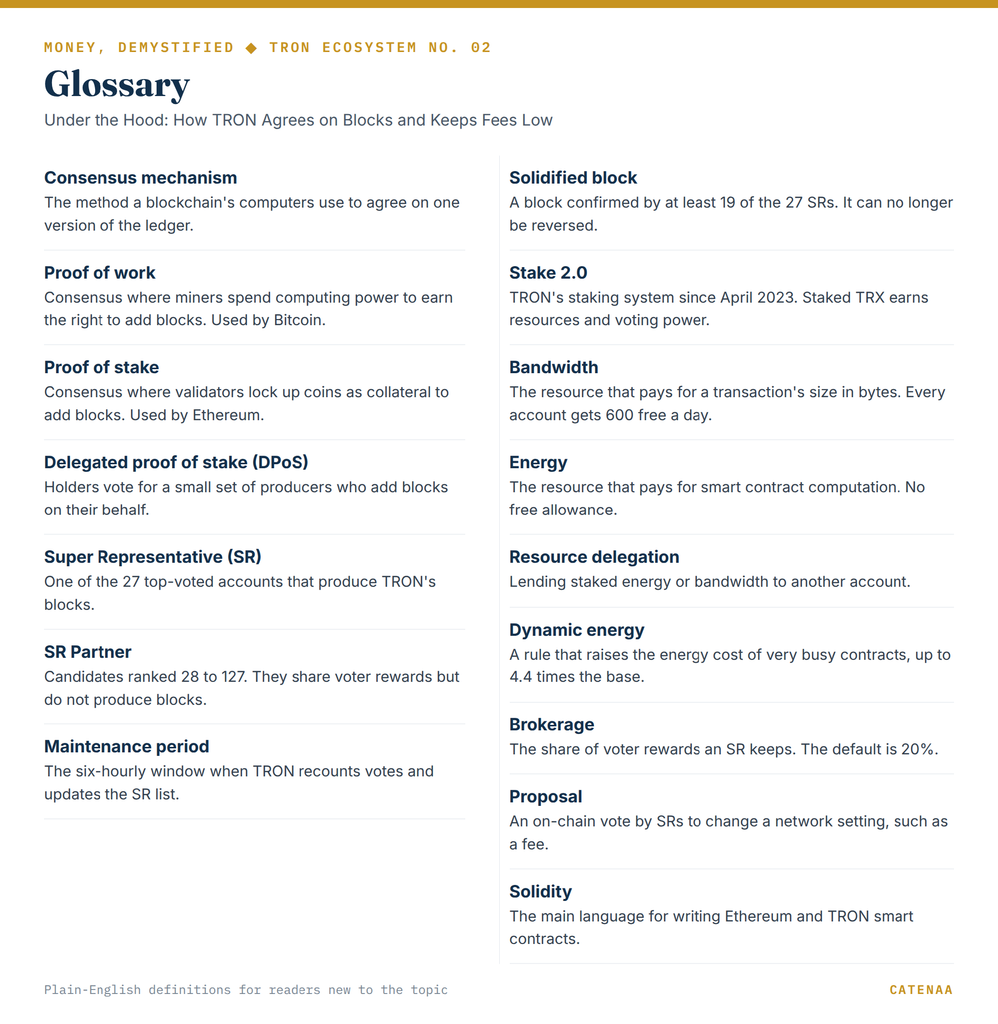
Glossary
Sources and references
- TRON Developer Hub, Consensus. https://developers.tron.network/docs/concensus
- TRON Developer Hub, Super Representatives. https://developers.tron.network/docs/super-representatives
- TRON Developer Hub, Staking on TRON (Stake 2.0). https://developers.tron.network/docs/staking-on-tron-network
- TRON Developer Hub, Resource Model. https://developers.tron.network/docs/resource-model
- TRON Developer Hub, TRON Virtual Machine. https://developers.tron.network/docs/tvm
- TronGrid API, getchainparameters (live network settings), 26 September 2026. https://api.trongrid.io/wallet/getchainparameters
- TronGrid API, listproposals (governance record), 26 September 2026. https://api.trongrid.io/wallet/listproposals
- TronGrid API, listwitnesses (SR vote counts), 26 September 2026. https://api.trongrid.io/wallet/listwitnesses
- TRON, Advanced Decentralized Blockchain Platform Whitepaper v2.0. https://tron.network/static/doc/white_paper_v_2_0.pdf
- Tronscan, Tether USD (USDT) TRC-20 contract page. https://tronscan.org/#/token20/TR7NHqjeKQxGTCi8q8ZY4pL8otSzgjLj6t
- CoinGecko, TRON (TRX) price, 26 September 2026. https://www.coingecko.com/en/coins/tron
- ethereum.org, Proof-of-stake (PoS). https://ethereum.org/en/developers/docs/consensus-mechanisms/pos/
- java-tron documentation, Resource Model (dynamic energy model). https://tronprotocol.github.io/documentation-en/mechanism-algorithm/resource/
- USDT contract on Tronscan; energy_factor queried via the TronGrid getcontractinfo API (developers.tron.network/reference/getcontractinfo), 26 September 2026. https://tronscan.org/#/contract/TR7NHqjeKQxGTCi8q8ZY4pL8otSzgjLj6t
- TRON Developer Hub, Committee and proposals. https://developers.tron.network/docs/committee