

It started as a token on Ethereum in 2017. Today it carries more USDT than any other network. Here is TRON from the ground up.
KEY TAKEAWAYS
In Summary
TRON is a public blockchain that runs smart contracts and has its own coin, TRX.
TRX began as an Ethereum token in 2017. TRON launched its own chain in 2018.
Holders stake TRX to vote. The top 27 vote-getters, called Super Representatives, produce every block.
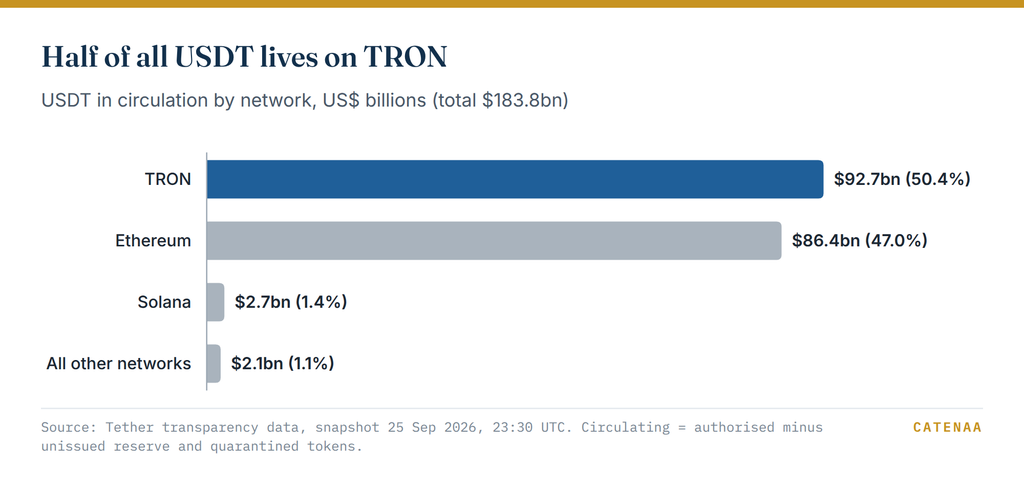
As of 25 September 2026, TRON carried about $92.7 billion of USDT, just over half of the total supply.
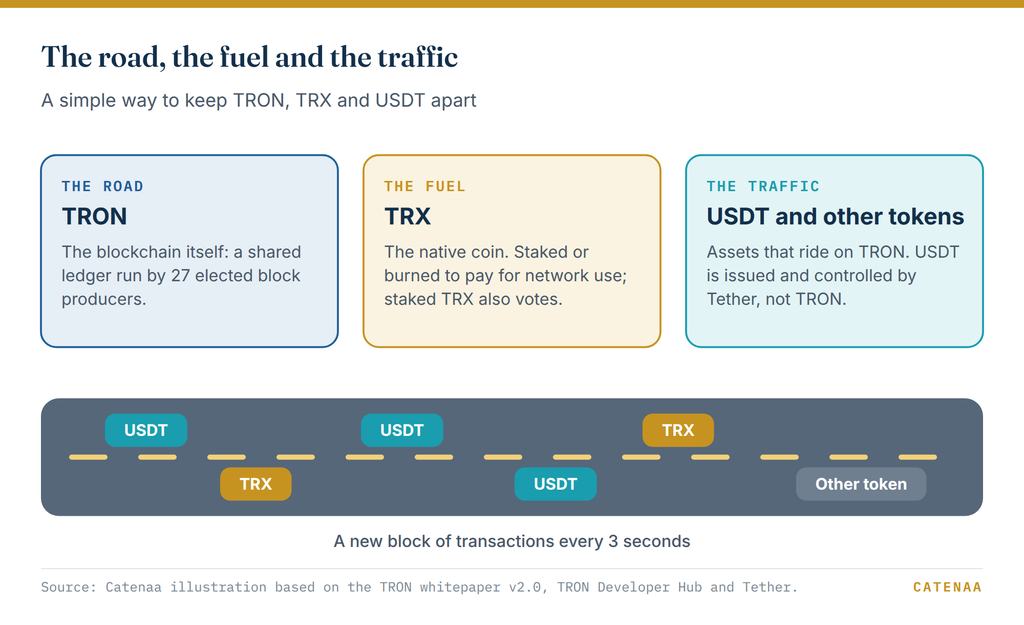
TRON works best seen as a payments highway. TRX is the fuel, and stablecoins are most of the traffic.
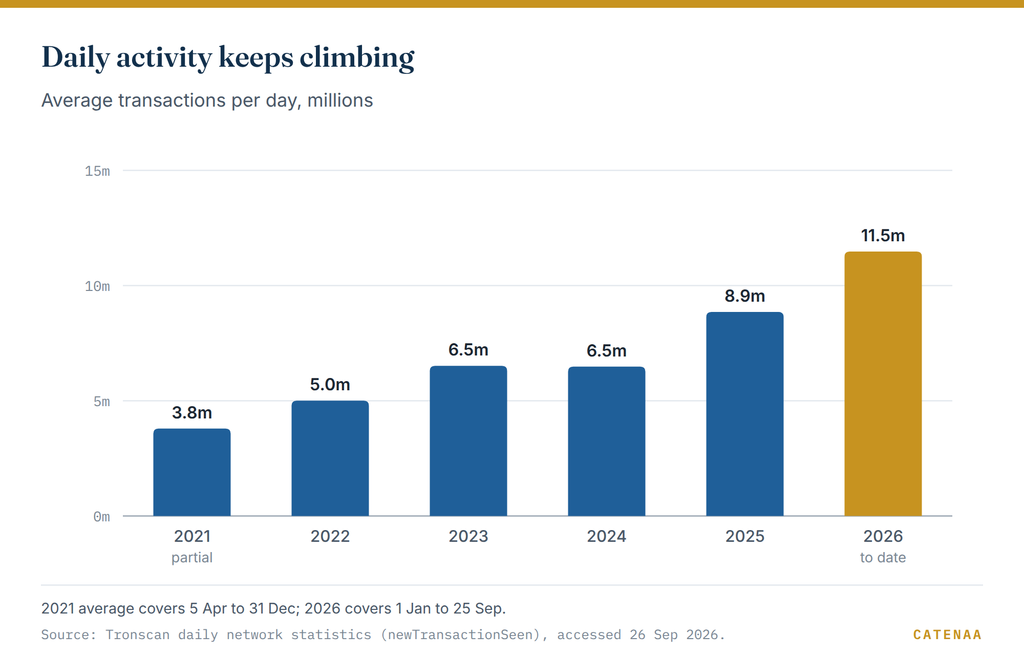
Every day, TRON carries more than two million transfers of digital dollars, Tronscan data show. Many of the people sending them never think about the network underneath. Yet TRON is doing the work.
Here is a striking fact. As of 25 September 2026, TRON held about $92.7 billion of Tether’s USDT stablecoin, according to Tether’s transparency page. That is just over half of all USDT in circulation.
So what is TRON, and how did a 2017 start-up become a backbone for digital cash? This five-part series answers that question from the ground up. Part 1 covers the basics: where TRON came from, what it is made of, and who runs it.
What is TRON, in one paragraph?
TRON is a public blockchain. In plain terms, it is a shared record of transactions that thousands of computers keep in sync. Anyone can read it, and anyone can send a payment on it without asking permission.
Like Ethereum, TRON can run smart contracts. These are small programs that execute automatically when set conditions are met. Developers use them to build tokens, lending apps, and trading venues.
TRON also has its own coin, TRX, short for Tronix, as the whitepaper explains. You need TRX, or resources earned by locking it up, to use the network. Think of TRX as both the fuel and the voting card of the system.
From an Ethereum token to its own chain
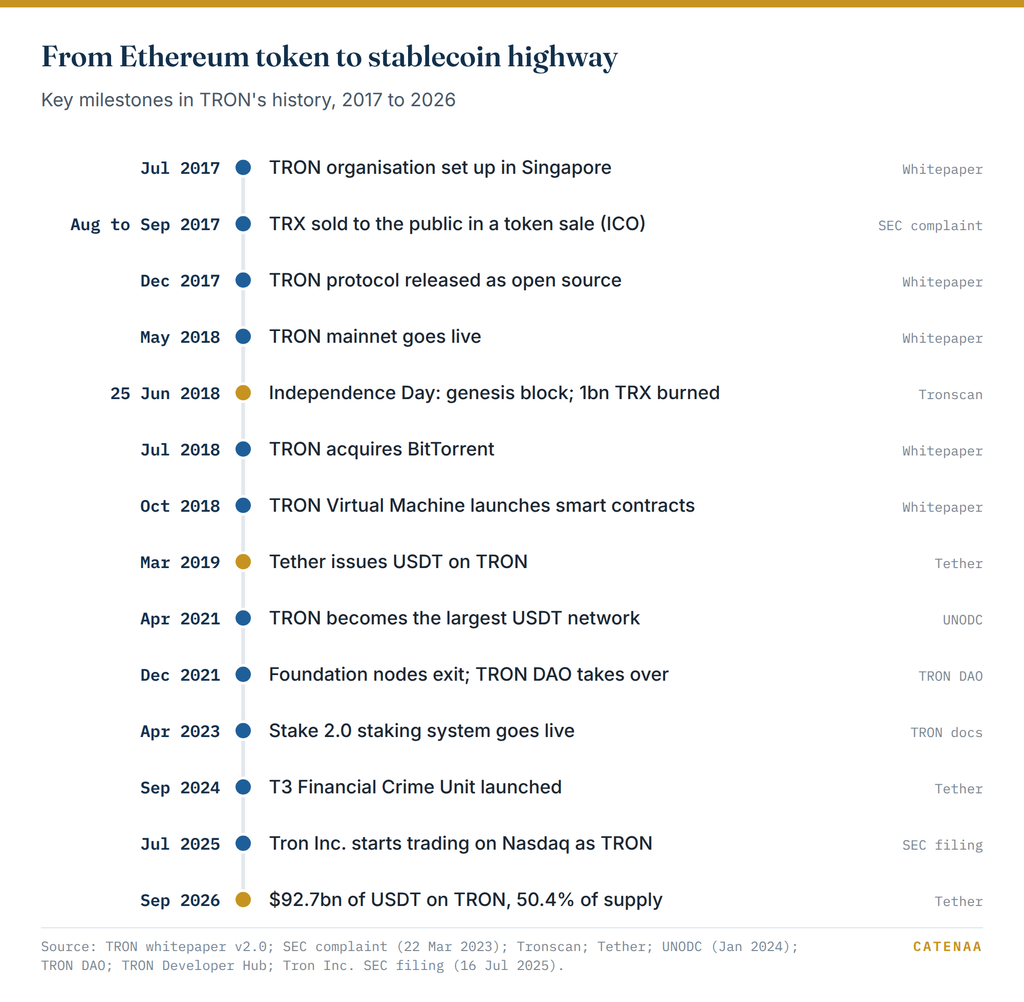
TRON’s story starts in 2017. According to the TRON whitepaper, the organisation behind it was set up in Singapore in July 2017. Justin Sun founded the Tron Foundation that year, a 2023 SEC complaint states.
From August to September 2017, the Foundation sold TRX in an initial coin offering, or ICO, the complaint adds. Then, in December that year, TRON released its code as open source.
At first, TRX did not live on its own blockchain. Instead, it existed as an ERC-20 token on Ethereum, a bit like a tenant renting a room. Meanwhile, the team built a home of its own. The TRON mainnet went live in May 2018.
Next came the move. TRON calls 25 June 2018 its Independence Day, the day it broke away from Ethereum. The whitepaper links that month to the creation of the genesis block, the chain’s first block. Holders swapped their Ethereum-based tokens for native TRX, helped by around 50 exchanges.
To mark the day, one billion TRX were burnt, which means permanently destroyed. Tronscan’s supply ledger still records that burn today.
After that, TRON moved fast. In July 2018, it acquired BitTorrent, the file-sharing company. By October 2018, it had launched the TRON Virtual Machine, the engine that runs smart contracts. Then, in March 2019, Tether brought USDT to TRON. That last step would later shape the network’s whole identity.
How TRON is built: three layers
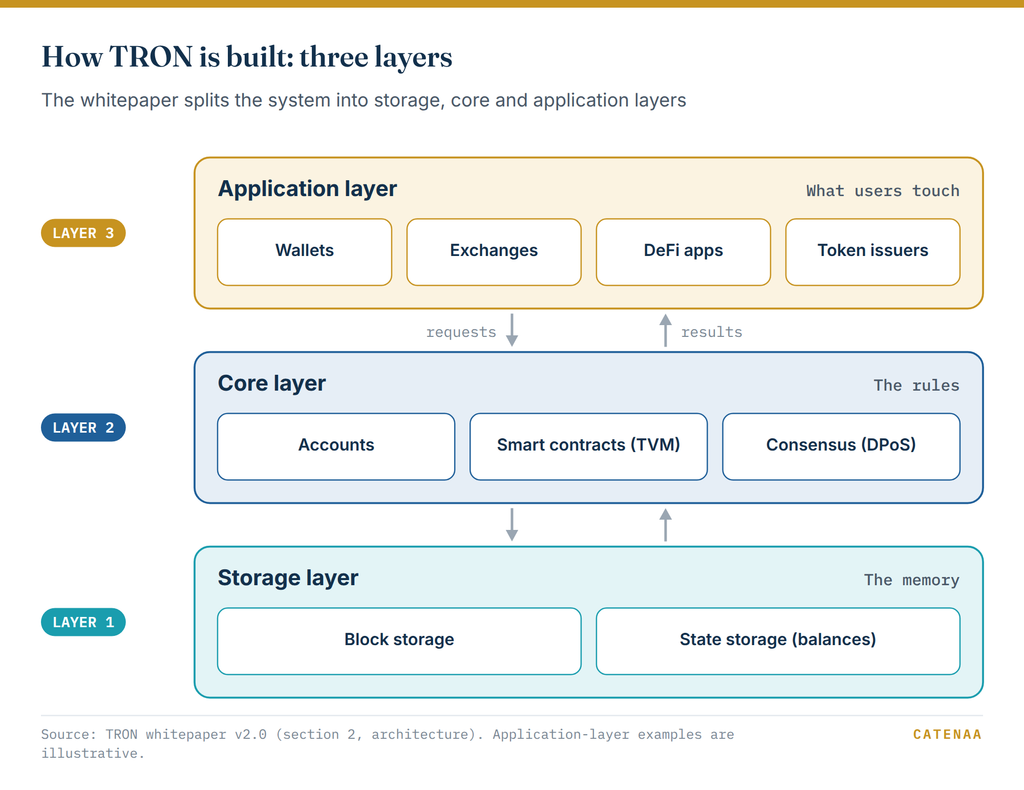
The whitepaper describes three layers, stacked like floors in a building. At the bottom, the storage layer keeps the data. It holds every block and the current state of every account, such as balances.
In the middle, the core layer holds the rules. It manages accounts, smart contracts and consensus, which is how computers agree on the next block. On top sits the application layer. Wallets, exchanges and apps all live here.
This design is common across blockchains. Still, one detail matters in practice. TRON’s smart contract engine closely follows Ethereum’s and accepts code written in Solidity, TRON’s developer docs note. As a result, moving an app from Ethereum is usually easier than starting from scratch.
Who keeps the network running?
Bitcoin relies on miners. TRON, by contrast, relies on elected block producers called Super Representatives, or SRs.
The process works like a rolling election. First, TRX holders lock up, or stake, their coins. Each staked TRX gives one vote, known as TRON Power. Holders then vote for candidates. Every six hours, the network recounts, and the top 27 become active SRs.
These 27 take turns producing blocks, one every three seconds. In return, they earn newly created TRX. Voters also receive a share of rewards, which gives them a reason to take part.
On 26 September 2026, 445 accounts were registered as candidates, TronGrid data show. Even so, the top 27 held about 97% of all votes. Several belong to large exchanges and staking firms. Part 5 returns to what that concentration means.
Governance follows a similar path. SRs vote on proposals that change network settings, such as fees and rewards. By August 2026, the chain had recorded 107 such proposals.
What can you actually do on TRON?
For most users, TRON does five everyday jobs. First, it moves TRX from one wallet to another. Second, it moves tokens, above all USDT. In fact, Tronscan counts about 76.9 million addresses holding USDT on TRON.
Third, anyone can create a token. TRON’s main token standard is called TRC-20, and it matches Ethereum’s ERC-20 at the interface level, TRON’s docs say. By late September 2026, Tronscan listed roughly 187,000 TRC-20 tokens. That count shows how easy issuing a token is, not how many matter.
Fourth, users can lend, borrow and swap through decentralised finance, or DeFi, apps. JustLend DAO, for example, describes itself as the first official lending platform on TRON. Finally, holders can stake TRX, vote for SRs and earn a share of rewards.
How TRON compares with Bitcoin and Ethereum
Each big blockchain makes different trade-offs. Bitcoin’s rules aim for 2,016 blocks every two weeks, about one every ten minutes, bitcoin.org explains. Ethereum groups time into 12-second slots, ethereum.org notes. TRON, by contrast, produces a block every three seconds.
Speed has a price, though. On Bitcoin, anyone with the right hardware can mine. On Ethereum, anyone who stakes 32 ETH can run a validator. TRON instead hands block production to 27 elected producers. That makes it fast and cheap, but it also concentrates power. Neither model is simply better. Each suits a different job.
TRON is less a social platform than a payments highway.
From foundation to DAO
In the early years, the TRON Foundation steered development. That changed in 2021. According to TRON DAO, the Foundation dissolved, and its three own nodes left the SR ranks in December 2021. In January 2022, the project said TRON DAO had taken over.
A DAO, or decentralised autonomous organisation, is a group that coordinates through votes rather than one board. Supporters say 27 separate block producers make TRON hard to control. Critics reply that influence still clusters around a few large players. Both views deserve a hearing, and Part 5 weighs them with data.
TRON by the numbers
Numbers help cut through the noise. The figures below come from on-chain data and official dashboards, as of late September 2026.
- Addresses: Tronscan counts 405.9 million. For comparison, TRON DAO reported about 70 million accounts in January 2022.
- Activity: the network averaged about 11.5 million transactions a day in 2026 so far. Its lifetime total has passed 15.6 billion.
- Stablecoins: TRON carried $92.7 billion of USDT, or 50.4% of the supply, Tether reports.
- Staking: about 45.6 billion TRX, roughly 48% of the supply, sat in staking contracts, Tronscan data show.
- Market value: TRX ranked eighth among crypto assets, worth about $32 billion, per CoinGecko.
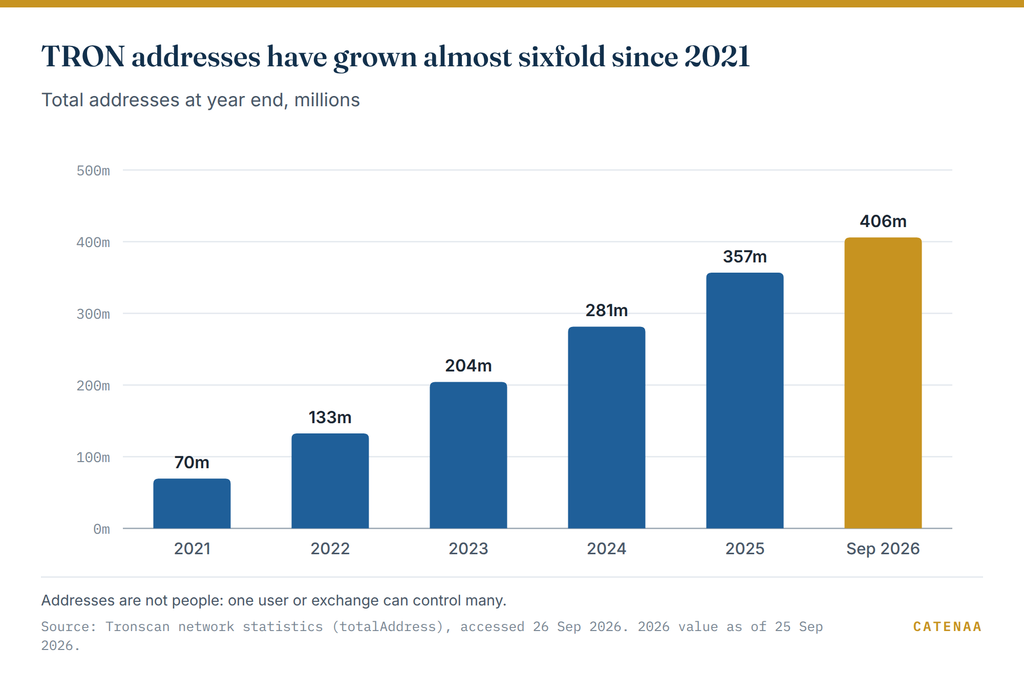
Keep one caveat in mind. Addresses are not people. One person can hold many wallets, and a single exchange may control millions. So treat address counts as a sign of activity rather than a headcount.
Why so many people use TRON
TRON’s main draw has been cheap and predictable transfers. A USDT payment settles in seconds, and the fee is usually small. For a trader moving money between exchanges, that matters. For a family sending money home, it matters even more.
Fees are also set in the open. The 27 SRs vote on the price of network resources. Energy is the resource that smart contracts consume. In August 2025, SRs cut its price from 210 to 100 sun per unit, the on-chain proposal record shows.
Network effects then did the rest. Exchanges added TRON deposits and withdrawals, and users followed the liquidity. By April 2021, TRON hosted the largest supply of USDT of any network, a 2024 UN report notes. Today it still carries more USDT than any other chain, Tether’s data show.
However, cheap rails attract everyone, including criminals. The same UN report found USDT on TRON had become a favourite tool of money launderers in parts of Asia. In response, TRON, Tether and TRM Labs launched a joint unit to freeze criminal funds in 2024. Part 5 covers that trade-off in detail.
Four common misconceptions
TRON is not Tether. Tether issues USDT and can freeze it. TRON is the road the token travels on. In fact, USDT also runs on Ethereum, Solana and other chains.
Cheap is not free. Every transfer uses network resources. Users either stake TRX to earn them or pay by burning TRX. Part 2 explains how that works.
TRON is not a listed company. In July 2025, a Nasdaq-listed firm renamed itself Tron Inc. It holds TRX as a treasury asset. However, owning its shares is not the same as owning TRX.
Popular is not risk-free. Heavy use shows demand, not safety. For that reason, readers should weigh governance, legal and issuer risks before relying on any network.
What comes next
Part 2 opens the hood. It explains delegated proof of stake and why TRON prices activity in energy and bandwidth. It also shows how that design keeps stablecoin transfers cheap.
For now, the key idea is simple. TRON is less a social platform than a payments highway. Once you see it that way, the rest of the story becomes much easier to follow.
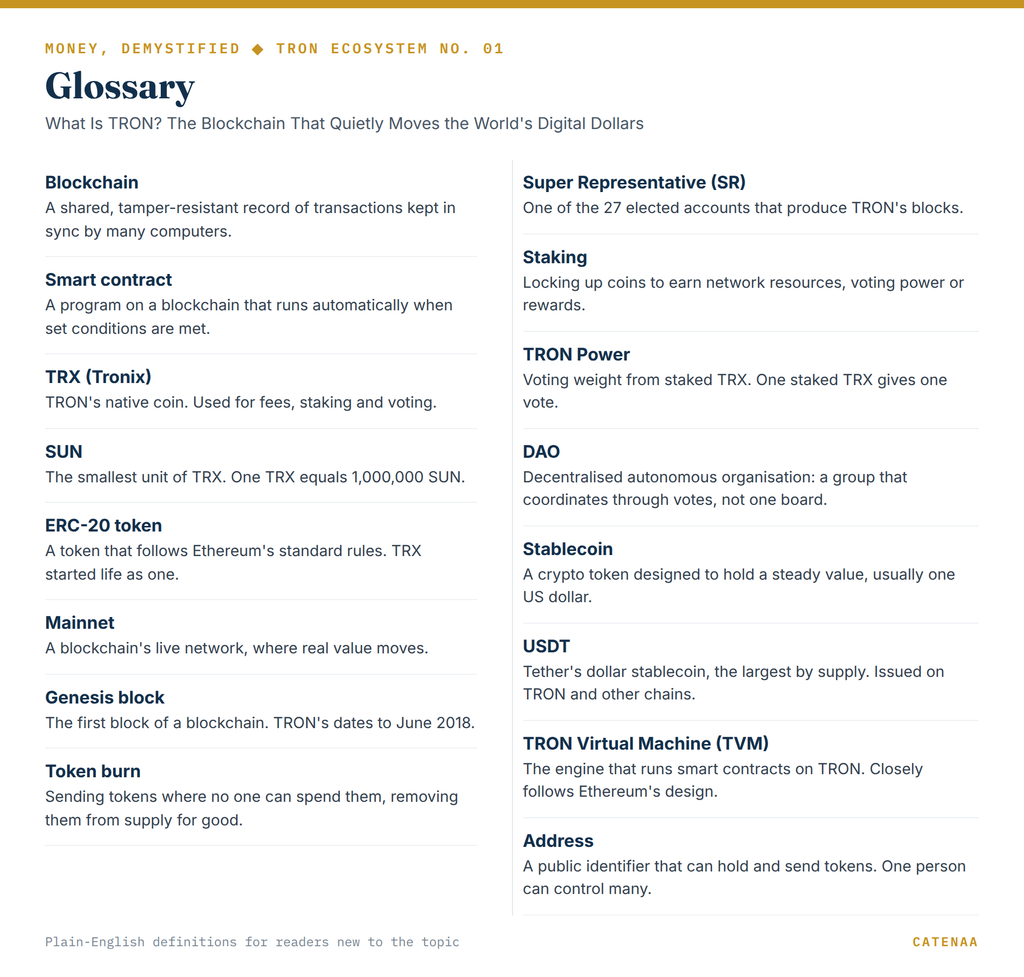
Glossary
Sources and references
- Tether, Transparency page (USDT supply by network), accessed 26 September 2026. https://tether.to/en/transparency/
- TRON, Advanced Decentralized Blockchain Platform Whitepaper v2.0. https://tron.network/static/doc/white_paper_v_2_0.pdf
- Tronscan Support Center, What are token migration and Independence Day. https://support.tronscan.org/hc/en-us/articles/360042161631-What-are-token-migration-and-Independence-Day
- Tronscan API, TRX supply ledger (funds), accessed 26 September 2026. https://apilist.tronscanapi.com/api/funds
- Tronscan API, daily network statistics, accessed 26 September 2026. https://apilist.tronscanapi.com/api/stats/overview?days=2000
- Tether, USDT introduced to TRON blockchain, 4 March 2019. https://tether.io/news/usdt-introduced-to-tron-blockchain/