

Solana is a public blockchain built to move value quickly and cheaply. This guide explains how it works, what SOL is for and what the network looks like today, using data pulled straight from the chain.
What is Solana? Start by imagining a ledger that hundreds of strangers keep at the same time. Nobody owns it, yet anyone can check it. That is the basic idea of a blockchain. Solana is one of the busiest examples, and its designers built it around one goal: speed.
This is the first of five stories on the Solana ecosystem. We start with the basics. Later parts explain how the network agrees, how its token economy works, where money moves and what can go wrong. Wherever possible, we let the blockchain speak for itself. On 25 September 2026, Catenaa queried Solana’s public servers directly for the figures in this series.
In Summary
Solana is a public blockchain designed for speed and low fees. Its mainnet beta went live on 16 March 2020.
SOL pays for fees and secures the network through staking. Total supply stood at 634.7 million SOL on 25 September 2026.
A simple transfer pays 5,000 lamports per signature, about $0.0006 at $120.02 per SOL. Half of that base fee is burned.
On-chain records show target slot times fell from 400 to 250 milliseconds between August and September 2026.
\Validator votes made up about 57% of transactions in our sample, so headline speed figures overstate user activity.
A shared ledger anyone can check
A blockchain is a record of transactions that many computers store and update together. Each new batch of entries forms a block. However, no bank or company sits in the middle to approve changes. Instead, independent operators run the software and check one another’s work. Solana calls these operators validators.
Validators follow shared rules. For example, they accept a transfer only if it carries a valid digital signature from the account owner. That signature works like a tamper-proof autograph. As a result, nobody can spend your money without your private key. Of course, the same design means nobody can reverse your mistakes either.
Public blockchains differ mainly in how they balance speed, cost and openness. Solana leans hard toward speed. It aims to handle trading, payments and apps at internet speed, while fees stay tiny.
Wallets, keys and addresses
To use Solana, you need a wallet. A wallet is software that stores your private key and shows your balances. The key never needs to leave your device. Instead, the wallet uses it to sign each transaction you approve.
Your public address comes from that key. You can share it freely, much like an email address. By contrast, anyone who learns your private key controls your funds. Most wallets therefore let you back it up as a recovery phrase, a short list of words.
Wallets talk to the network through servers that offer a remote procedure call, or RPC, interface. These servers pass your transactions on and read balances for you. Catenaa used the same public interface to gather the data in this series.
Where Solana came from
Solana began with a whitepaper by Anatoly Yakovenko. It proposed a new way for computers to agree on the order of events, which he called Proof of History. Part 2 of this series explains that idea in detail. For now, think of it as a shared clock that anyone can verify.
The network opened to the public as a mainnet beta on 16 March 2020. By then, 92 validators in 23 countries had helped the founding team test it. The beta label has stuck ever since, even as usage grew. Early on, a company called Solana Labs built the software, while the Solana Foundation backed the wider project.
Several groups now maintain the core software. In January 2024, former Solana Labs engineers formed Anza to run the main validator client, called Agave. Meanwhile, a second, independently written client named Firedancer also runs on the network, as its gossip data shows. Having two codebases matters for resilience, and Part 2 explains why.
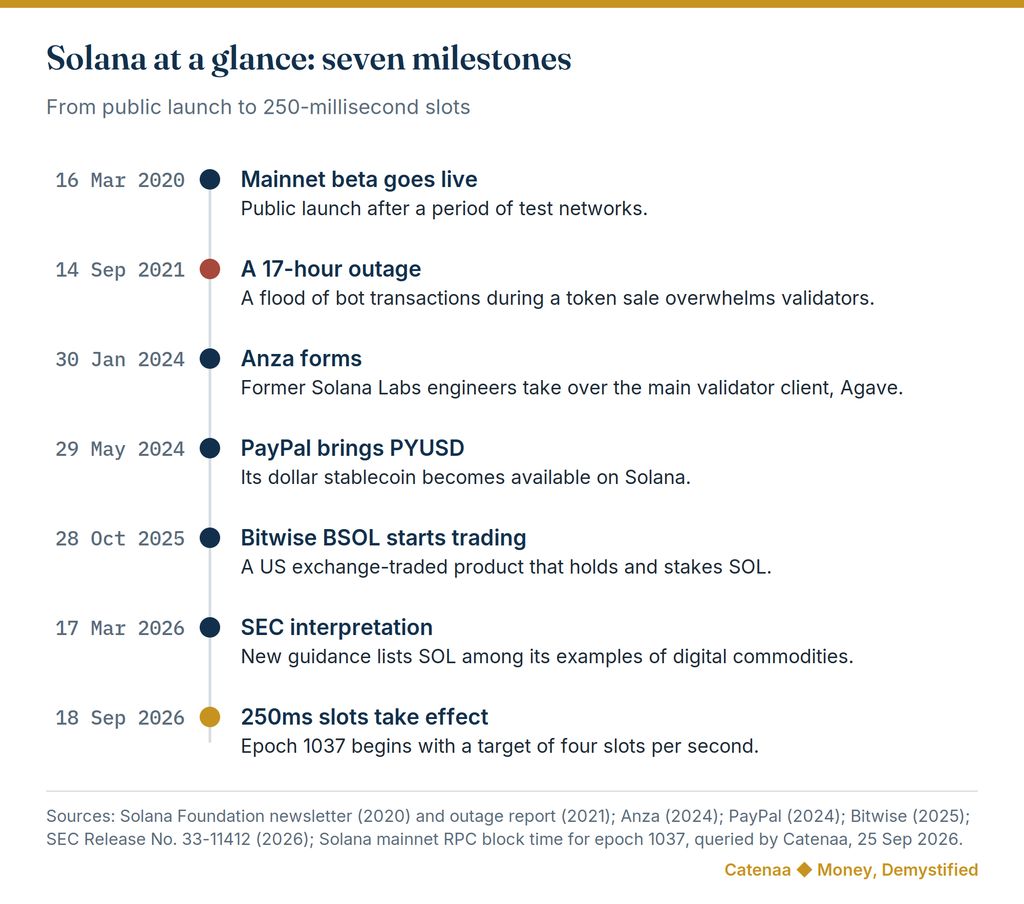
Key dates in Solana’s history, drawn from official releases, filings and on-chain records.
SOL and the lamport
SOL is Solana’s native token. You need it to pay transaction fees, and you can stake it to help secure the network. Its smallest unit is the lamport. According to Solana’s official terminology, one lamport is a billionth of a SOL.
How much SOL exists? On 25 September 2026, the network reported a total supply of 634.7 million SOL. Of that, 587.6 million counted as circulating. The network flagged the remaining 47.0 million as non-circulating.
Most of that SOL is working. Holders had staked about 69% of it on the day of our check, delegating it to validators. Part 3 explains why so many holders choose to stake.
Supply also grows over time, because the protocol issues new SOL as staking rewards. Part 3 covers that schedule in depth. At the same time, part of every fee disappears for good, which slightly offsets new issuance.
In market terms, SOL traded at $120.02 on 25 September 2026, according to CoinGecko. That implied a market value of roughly $70.5 billion. Still, prices move fast. Over the prior year, SOL swung between about $235 and $62.
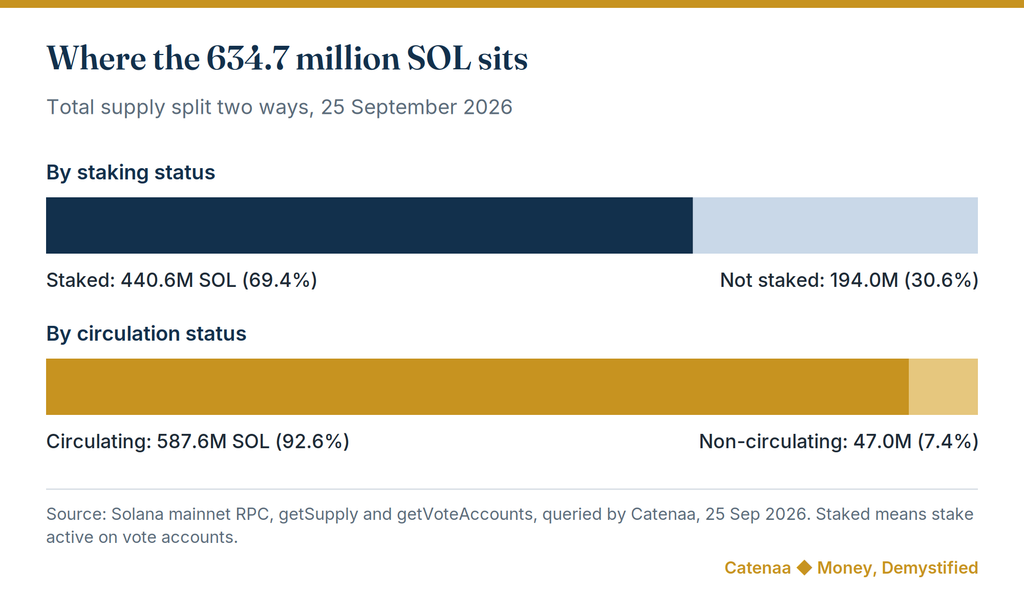
About 69% of all SOL was staked, and about 93% counted as circulating.
Accounts: how Solana stores everything
Solana keeps all of its data in accounts. An account is a small record with an address, a balance in lamports and some stored data. Your wallet is an account. So is every token balance you hold. Even programs, Solana’s name for smart contracts, live in accounts.
Here is the key design choice. Programs hold code but keep no data of their own. Instead, they read and write separate data accounts. For instance, your USDC balance sits in its own token account, which the token program updates. That split sounds technical, yet it has a real payoff.
Every Solana transaction must list the accounts it will read or write, as the Sealevel design notes explain. Validators can therefore spot transactions that do not overlap. They can then process those transactions side by side instead of in a single queue.
Accounts also carry a small cost. Each one must hold a minimum SOL balance, a refundable storage deposit that you get back when you close it. That rule stops people from filling the ledger with junk data for free.
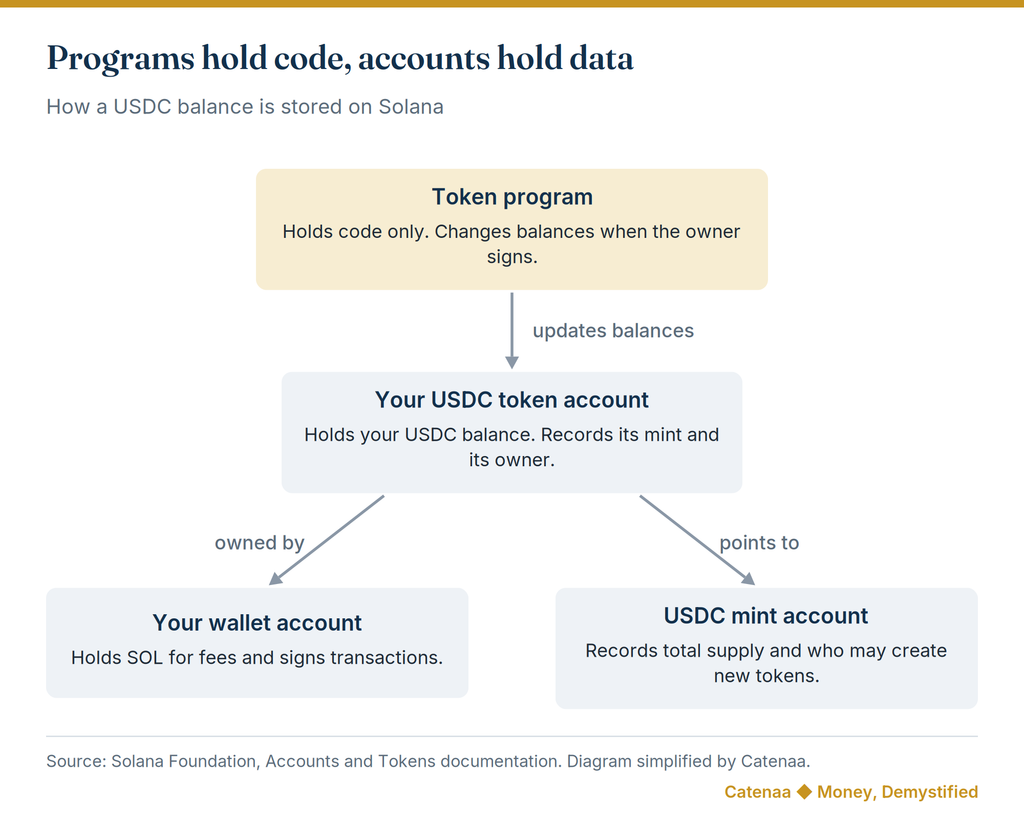
A USDC balance lives in a token account that the token program updates.
What a transaction costs
Every transaction pays a base fee of 5,000 lamports per signature. Most simple transfers carry one signature. At $120.02 per SOL, that works out to about $0.0006. The network burns half of the base fee, which removes it from the supply for good. Validators receive the other half as payment for processing it.
Users can also add an optional priority fee. It works like a tip that helps a transaction jump the queue when the network is busy. The validator keeps all of it. Its size depends on how much computing power a transaction requests. So a complex trade usually pays more than a basic transfer.
Low costs matter for everyday use. They let apps send many small transactions, such as game moves or price updates, without charging users much.
Note one catch in the rules. The network charges the fee even if the transaction fails. That design discourages spam, because every failed attempt still costs something. The fee comes from the transaction’s fee payer, which can be an app rather than the user.
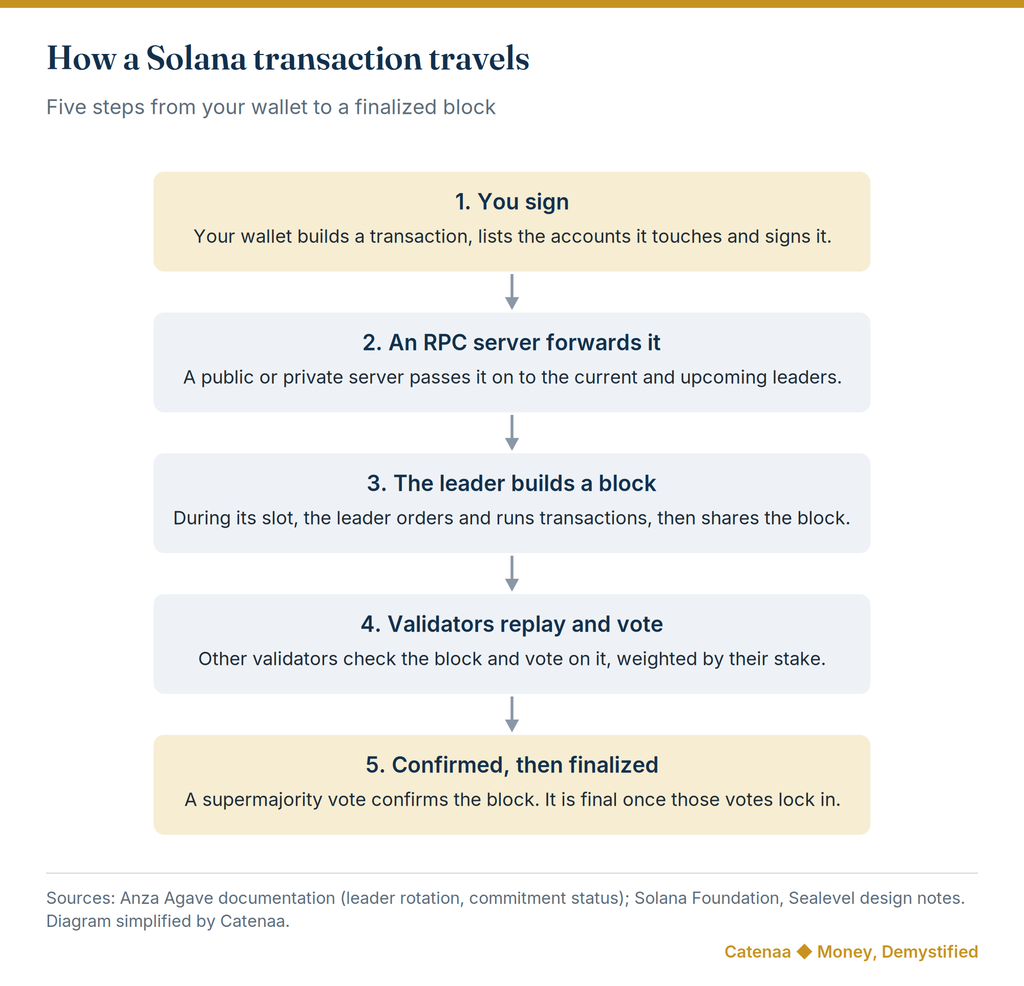
A simplified path of a transaction from signing to finality.
How fast is fast?
Solana divides time into slots. In each slot, one validator, called the leader, may produce a block. For most of Solana’s history, each slot targeted 400 milliseconds.
That changed in August 2026. Under a proposal called SIMD-0525, validators began cutting the target in steps of 50 milliseconds. On-chain records show the 250-millisecond step switched on at the start of epoch 1036. It then took effect from epoch 1037, which began on 18 September 2026.
So today, the network aims for four blocks every second. An epoch of 432,000 slots now lasts about 30 hours instead of two days. Interestingly, the Solana Foundation’s own status page still listed 300 milliseconds when we checked. The on-chain record is newer. Meanwhile, the final 200-millisecond step has not activated on mainnet.
Faster slots do not mean more total capacity. The proposal shrinks each block’s limits in step with the slot, so work per second stays roughly the same. Instead, the gain is shorter waiting time for users and traders. Prices on a blockchain update only when a new block lands. So quicker blocks mean fresher prices, as Foundation research on shorter slots notes.
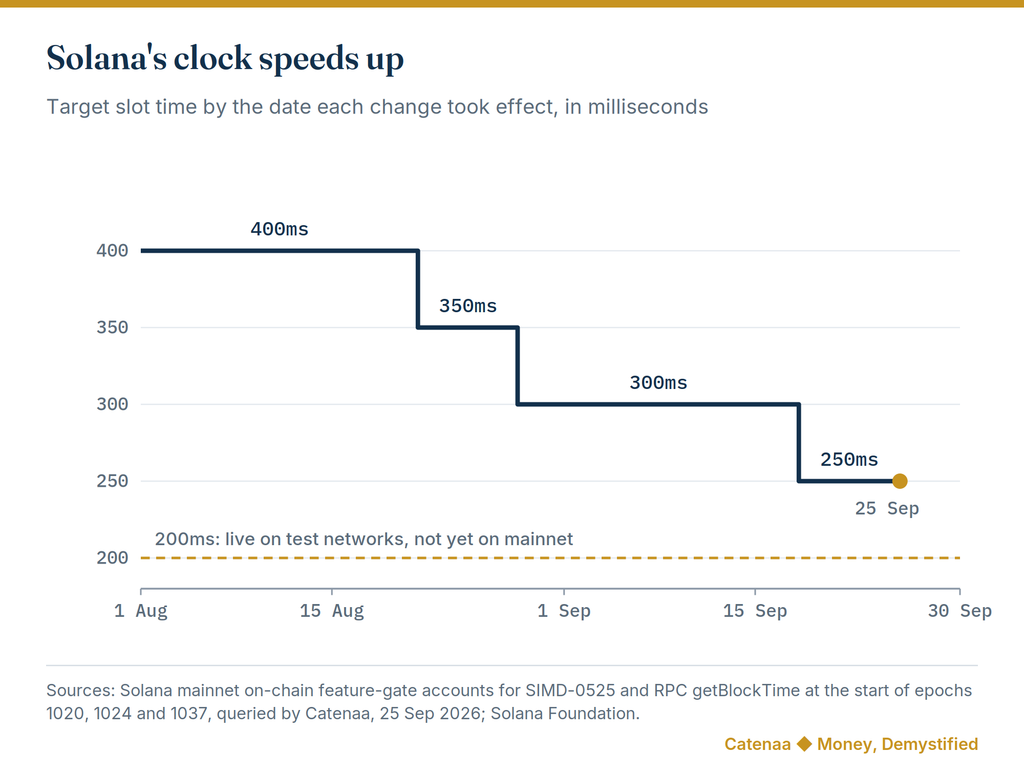
Each 50ms cut took effect one epoch after its on-chain switch activated.
Votes, not just payments
How busy is the network? Over about 4.6 hours on 25 September, Solana handled roughly 4,440 transactions per second. However, only about 1,926 of those were ordinary user transactions. The rest were votes.
Validators vote on blocks by sending transactions of their own. Those votes keep everyone in agreement, but they also take up space. In our sample, votes made up about 57% of all transactions. Headline speed figures can therefore overstate real user activity.
Why so many votes? Solana Foundation research models each validator sending about one vote per slot. Vote traffic therefore grows with the number of validators, not with user demand.
Always ask whether a speed figure includes validator votes.
Part 2 explains Alpenglow, a planned upgrade that would change how validators vote.
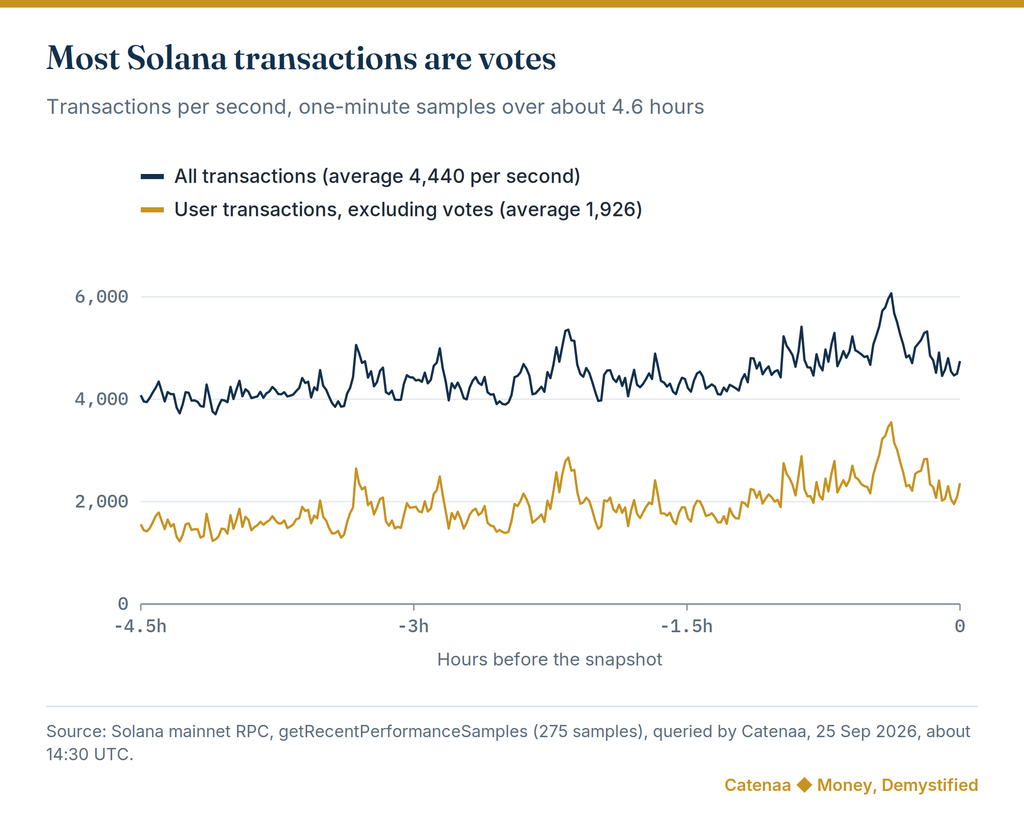
User transactions averaged about 1,926 per second, against roughly 4,440 in total.
Who keeps it running
On 25 September 2026, the network listed 685 vote accounts, the accounts validators use to vote. Ten of them had fallen behind, a state Solana calls delinquent. Together, all of them held about 440.6 million staked SOL.
Anyone can run a validator, but it takes serious effort. Operators need fast servers, strong internet links and SOL to pay for their votes. As a result, many validators sit in professional data centres. Part 5 shows how concentrated that hosting has become.
Why the basics matter
Solana’s design makes clear trade-offs. It favours speed and low cost. In return, it depends on validators keeping pace with a very fast clock.
That approach has attracted large companies. Visa, PayPal and Western Union have all announced payment projects on the network, which Part 4 examines. Yet the same design has also caused trouble. Solana suffered several multi-hour outages, including a 17-hour stoppage in 2021, and Part 5 reviews that record.
Supporters argue that cheap, fast settlement opens finance to more people. Sceptics reply that speed means little if the network halts or a few firms control it. Both views have evidence behind them, and this series tries to show both.
Understanding these basics helps you judge claims about speed, cost and safety. Next, we open the engine room and look at how hundreds of validators agree on a single version of history.
Disclaimer. This article is for education only. It is not investment, legal or tax advice. Crypto assets are volatile and can lose value quickly. On-chain figures are a snapshot taken on 25 September 2026 and will change.
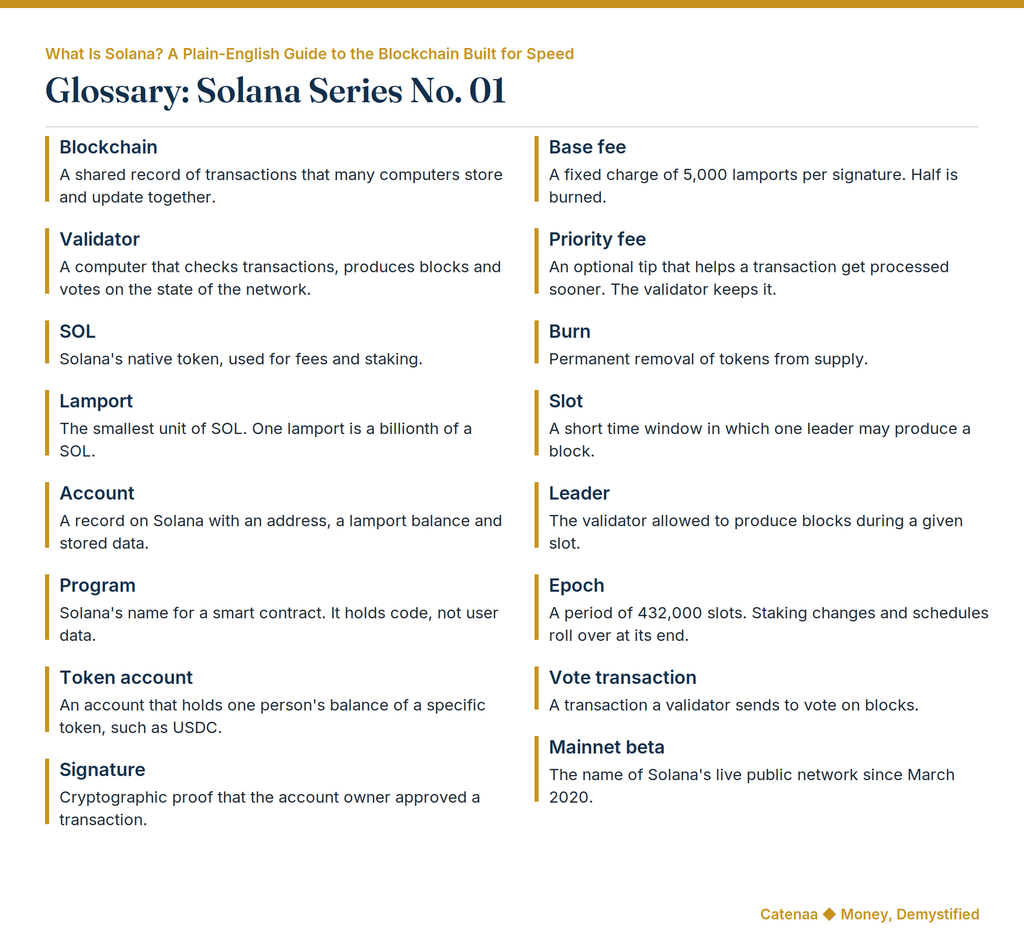
Glossary
Sources and references
- Solana Foundation. May Newsletter (Mainnet Beta launch, 16 March 2020). 2020. https://solana.com/news/may-newsletter
- Solana mainnet RPC. getSupply, queried by Catenaa, 25 Sep 2026. 25 Sep 2026. https://solana.com/docs/rpc/http/getsupply
- Solana Foundation. Fee Structure, Solana documentation. Accessed 25 Sep 2026. https://solana.com/docs/core/fees/fee-structure
- Anatoly Yakovenko. Solana: A new architecture for a high performance blockchain, whitepaper v0.8.13. Undated. https://solana.com/solana-whitepaper.pdf
- Anza. Meet Anza, a New Solana-Focused Dev Shop. 30 Jan 2024. https://www.anza.xyz/blog/meet-anza-a-new-solana-focused-dev-shop
- Solana mainnet RPC. getClusterNodes, queried by Catenaa, 25 Sep 2026. 25 Sep 2026. https://solana.com/docs/rpc/http/getclusternodes
- Solana Foundation. 9-14 Network Outage Initial Overview. Sep 2021. https://solana.com/news/9-14-network-outage-initial-overview
- PayPal. PayPal USD Stablecoin Now Available on Solana Blockchain. 29 May 2024. https://newsroom.paypal-corp.com/2024-05-29-PayPal-USD-Stablecoin-Now-Available-on-Solana-Blockchain,-Providing-Faster,-Cheaper-Transactions-for-Consumers
- Bitwise. The Bitwise Solana Staking ETF (BSOL) Begins Trading. 28 Oct 2025. https://bitwiseinvestments.com/newsroom/the-bitwise-solana-staking-etf-bsol-begins-trading
- US Securities and Exchange Commission. SEC Clarifies the Application of Federal Securities Laws to Crypto Assets, press release 2026-30. 17 Mar 2026. https://www.sec.gov/newsroom/press-releases/2026-30-sec-clarifies-application-federal-securities-laws-crypto-assets
- US Securities and Exchange Commission. Release No. 33-11412, Commission Interpretation on the Application of the Federal Securities Laws to Crypto Assets. 17 Mar 2026. https://www.sec.gov/files/rules/interp/2026/33-11412.pdf
- Solana mainnet RPC. getBlockTime for epoch start slots, queried by Catenaa, 25 Sep 2026. 25 Sep 2026. https://solana.com/docs/rpc/http/getblocktime
- Solana Foundation. Terminology, Solana documentation. Accessed 25 Sep 2026. https://solana.com/docs/references/terminology
- Solana mainnet RPC. getVoteAccounts, queried by Catenaa, 25 Sep 2026. 25 Sep 2026. https://solana.com/docs/rpc/http/getvoteaccounts
- CoinGecko. Solana (SOL) price, market cap and 365-day history via public API. Snapshot 25 Sep 2026. https://www.coingecko.com/en/coins/solana
- Solana Foundation. Accounts, Solana documentation. Accessed 25 Sep 2026. https://solana.com/docs/core/accounts
- Solana Foundation. Sealevel: Parallel Processing Thousands of Smart Contracts. Undated. https://solana.com/news/sealevel—parallel-processing-thousands-of-smart-contracts
- Solana Foundation. Account Structure, Solana documentation. Accessed 26 Sep 2026. https://solana.com/docs/core/accounts/account-structure
- Solana Foundation. Tokens on Solana, Solana documentation. Accessed 25 Sep 2026. https://solana.com/docs/core/tokens
- Solana Foundation. How Payments Work on Solana, Solana documentation. Accessed 25 Sep 2026. https://solana.com/docs/payments/how-payments-work
- Anza. Leader Rotation, Agave validator documentation. Accessed 25 Sep 2026. https://docs.anza.xyz/consensus/leader-rotation
- Anza. Commitment Status, Agave validator documentation. Accessed 25 Sep 2026. https://docs.anza.xyz/consensus/commitments
- Solana Foundation. Reduced Slot Times, upgrade status page. Jun 2026, updated Sep 2026. https://solana.com/upgrades/reduced-slot-times
- Solana Improvement Documents. SIMD-0525: Reduce Slot Times. 2026. https://github.com/solana-foundation/solana-improvement-documents/blob/main/proposals/0525-reduce-slot-times.md
- Solana Explorer. Feature gate iBRLMc81: reduce slot time to 250ms (on-chain account). Checked 25 Sep 2026. https://explorer.solana.com/address/iBRLMc81UjRa8fn8A6eE8bJTnRbgQoPTynM51akENCV
- Solana Explorer. Feature gate iBRLjhJn: reduce slot time to 200ms (on-chain account). Checked 25 Sep 2026. https://explorer.solana.com/address/iBRLjhJnkmDZgNoZRDMW11d8ZV7HvsL3vAyRjZB5npW
- Solana Foundation. Lowering Slot Time and Validator Economics. 19 Aug 2026. https://solana.com/news/lowering-slot-time-and-validators-economic
- Solana mainnet RPC. getRecentPerformanceSamples, queried by Catenaa, 25 Sep 2026. 25 Sep 2026. https://solana.com/docs/rpc/http/getrecentperformancesamples
- Anza. Validator Requirements, Agave validator documentation. Accessed 25 Sep 2026. https://docs.anza.xyz/operations/requirements
- Visa. Visa Expands Stablecoin Settlement Capabilities to Merchant Acquirers. 5 Sep 2023. https://usa.visa.com/about-visa/newsroom/press-releases.releaseId.19881.html
- Western Union. Western Union Launches USDPT on Solana. 4 May 2026. https://ir.westernunion.com/news/archived-press-releases/press-release-details/2026/Western-Union-Launches-USDPT-on-Solana-Advancing-Regulated-Digital-Infrastructure-for-Global-Payments/default.aspx
Editorial note: Figures in this series reflect data as of 25 September 2026