

A blockchain is only useful if everyone agrees on the same record. Here is how Solana’s validators do it, where the stake sits today and what the Alpenglow upgrade would change.
How Solana works starts with a puzzle, because nobody is in charge. Picture 685 bookkeepers spread across several continents. None of them fully trusts the others, and a few may even cheat. Still, they must agree on the same list of payments, several times every second.
That is the job Solana’s validators do every day. On 25 September 2026, the network listed 685 vote accounts holding 440.6 million staked SOL. This second part of our series explains how Solana works under the hood. It shows how validators agree, where their voting power sits and why that process is about to change.
In Summary
Validators vote with stake, not per head. A block is finalized once a supermajority of stake has voted for it and locked in, per Anza’s documentation.
Proof of History works as a verifiable clock. Leaders take turns of four slots each, set by a stake-weighted schedule.
Solana runs transactions in parallel when they touch different accounts, a design called Sealevel.
On 25 September 2026, Agave-based clients secured about 87% of stake and Firedancer-based clients about 13%.
The largest 18 validators held more than a third of stake. Alpenglow targets about 150 millisecond finality, but its switch was active only on testnet.
The problem every blockchain must solve
In a normal bank, one central database decides the order of payments. A public blockchain has no such referee. Instead, its validators must agree even if some of them lie, crash or go offline. Computer scientists call this Byzantine fault tolerance, after an old puzzle about generals and traitors.
Solana, like many modern networks, uses proof of stake. Validators lock up SOL, known as stake, as a kind of bond. Holders can also delegate their SOL to a validator they trust. Votes then count in proportion to stake, not per head. As a result, a validator with twice the stake carries twice the weight.
Anza’s documentation describes the final step. A block counts as finalized once a supermajority of stake has voted for it and locked in. In practice, that means validators holding more than two thirds of stake must agree. The rule has a flip side. If more than a third of stake goes silent, new blocks can no longer become final.
Proof of History: a clock anyone can check
Agreeing on time is surprisingly hard for computers that sit far apart. Clocks drift, and messages arrive late. Solana’s answer is Proof of History, the idea at the heart of Yakovenko’s whitepaper.
The idea is simple. A leader runs a hash function over and over, feeding each output into the next step. Such a function scrambles data into a short, fixed-size fingerprint. Because each step needs the previous result, nobody can skip ahead. The sequence therefore proves that real time has passed.
When a transaction arrives, the leader mixes it into the sequence. That stamps the transaction with a position in time. Other validators can later replay the sequence to check the order. In the original whitepaper, Yakovenko argued that this cuts the number of messages validators must exchange. His paper even predicted sub-second finality, a goal that Alpenglow now aims to reach.
Proof of History is not consensus by itself, though. Rather, it is a shared clock that makes consensus cheaper. Solana’s voting system, Tower BFT, still decides which blocks the network accepts.
A transaction mixed into the hash chain gets a provable place in time.
How votes lock in
Tower BFT adds a clever twist to voting. Each vote for a block comes with a lockout. That is a number of slots during which the validator cannot back a rival version of history.
Every new vote stacked on top doubles the lockouts beneath it. After a few votes, switching sides costs a validator a long wait. Once 32 votes pile up, the oldest one reaches maximum lockout, and the validator earns a reward for it.
This design turns patience into security. A validator that flip-flops between rival forks gets stuck and misses rewards. Honest validators, by contrast, pile their votes onto one chain, which is why that chain hardens into final history.
Votes also cost money. Each validator pays fees to send them, so voting is a real business expense. That cost, in turn, shapes who can afford to run a validator.
Leaders take turns
At any moment, one validator acts as leader and produces blocks. The network publishes a leader schedule in advance, and validators with more stake appear in it more often. Each leader gets four consecutive slots before the next one takes over.
Because the schedule is public, everyone knows who will produce the next blocks. That predictability helps transactions reach the right machine quickly.
With 250 millisecond slots, a leader’s turn now lasts about one second. It used to last 1.6 seconds. Solana Foundation research argues that shorter turns limit how long any one leader controls the order of transactions.
Transactions do not wait in a shared public queue, as they do on some chains. Instead, they travel straight to the current and upcoming leaders. Solana calls this forwarding system Gulf Stream, as its upgrade notes describe.
Schedules roll over each epoch, which lasts 432,000 slots under SIMD-0525. At today’s speed, an epoch runs for about 30 hours. That rhythm also drives staking rewards, which Part 3 explores.
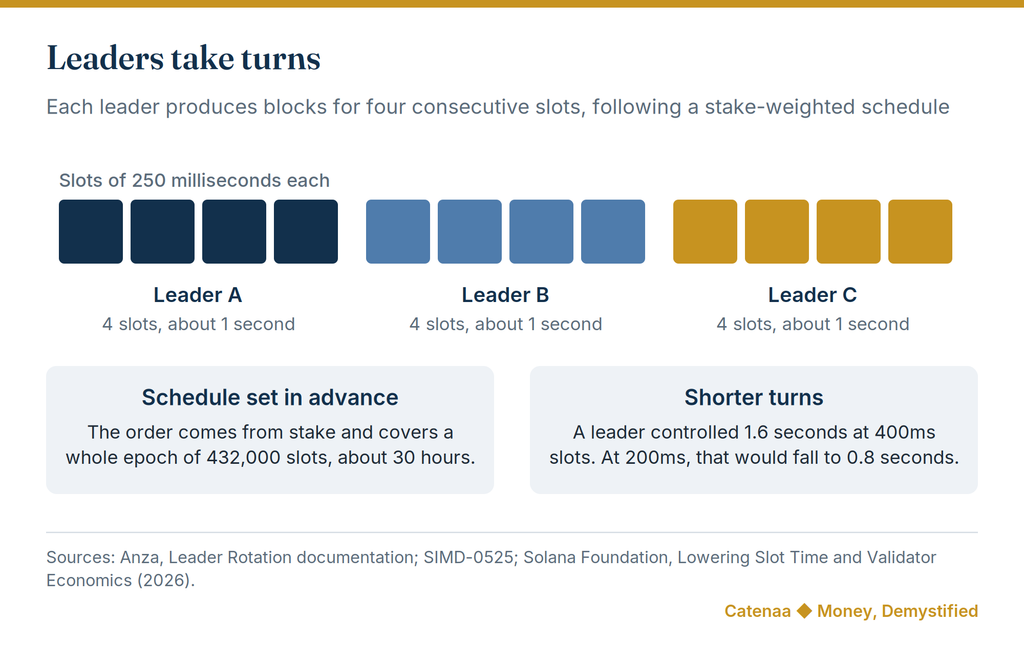
At 250 milliseconds per slot, each leader turn lasts about one second.
Turbine: sharing blocks at speed
A leader must also share each block with hundreds of validators, fast. Sending the full block to everyone directly would swamp its internet link. Instead, Solana uses a system called Turbine.
Turbine breaks each block into small pieces called shreds. The leader sends the pieces to a first layer of validators. Those validators pass them on to the next layer, like branches of a tree. Extra recovery data travels with the pieces, so validators can rebuild a block even when some pieces go missing.
The tree changes for every shred, based on a random seed. That makes it harder for an attacker to target one path. Alpenglow, discussed below, would hand this job to a new component called Rotor.
Running many transactions at once
Many early blockchains ran smart contracts one at a time, in a single line. Solana took another path, a runtime it calls Sealevel.
Every Solana transaction must list the accounts it will read or write. So a validator can spot transactions that touch different accounts. It then runs those in parallel across many processor cores. However, transactions that write to the same account must still wait their turn.
An analogy helps. Think of a supermarket with many tills. Shoppers buying different items can all pay at once. Yet two shoppers fighting over the last carton of milk must queue. On Solana, a popular trading pool is that carton of milk.
This is why Solana fees can differ for similar transactions. A trade on a crowded pool competes with many others for the same account. By contrast, a transfer between two quiet wallets rarely waits at all.
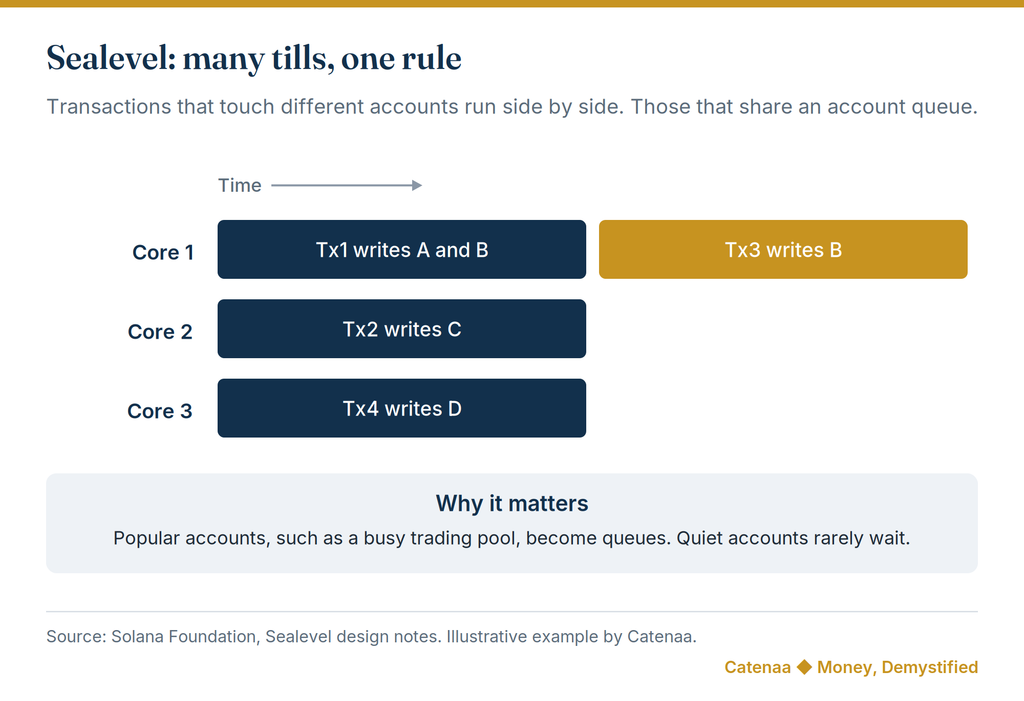
Tx3 waits for Tx1 because both write to account B.
The price of speed
Speed comes with a hardware bill. Anza’s validator guide recommends at least 12 processor cores and 256 gigabytes of memory. It also suggests separate fast drives of a terabyte or more for accounts and the ledger.
That is far beyond a home laptop. Our hosting data in Part 5 shows most stake running with commercial hosting firms. That helps explain the concentration we examine there.
The trade-off cuts both ways. Faster machines let the network serve more users. Yet higher costs narrow the pool of people who can check the chain independently.
Two codebases, one network
Validators run software called a client. If every validator runs the same client, a single bug can stop everyone at once. Client diversity therefore works like a second engine on an aircraft.
Our snapshot of the network’s gossip data shows how stake splits today. Clients built on Agave, the codebase Anza maintains, secured about 86.8% of stake. Firedancer-based clients, built on a rewrite from the ground up, secured about 13.0%.
Several Agave-based builds carry other teams’ names, such as Jito Labs and Harmonic. They share Agave’s core code, so a deep Agave bug could still hit most of them together. Solana now has real client diversity, then, but the split remains lopsided.
Why has change been slow? Writing a validator from scratch means matching every rule of the protocol exactly. Even a tiny difference could split the network in two. New clients therefore tend to join gradually, one small share of stake at a time.
Agave-based clients secured 86.8% of stake and Firedancer-based clients 13.0%.
How concentrated is the stake?
Stake decides voting power, so its spread matters as much as the number of validators. In our snapshot, the largest 18 validators held more than a third of all stake. Researchers often call this count the Nakamoto coefficient.
Meanwhile, 80 validators together held more than two thirds. The top ten alone controlled 24.4%. Put simply, a few dozen operators could stall finality if they all went offline together.
Delegation choices shape these numbers, because stake follows the decisions of the holders who delegate it. A few large delegations can therefore shift the picture quickly.
These figures shift every epoch as holders move stake around. They also say nothing about where those validators run. Part 5 shows that hosting providers add a second, less visible layer of concentration.
The top 18 validators held over a third of stake; the top 80 held over two thirds.
Alpenglow: a new way to agree
Today, Solana takes about 12.8 seconds to reach full finality under Tower BFT, according to Anza. For quicker answers, Solana also offers optimistic confirmation, which Anza describes as reaching into the sub-second range.
Anza calls its proposed replacement Alpenglow. It retires both Tower BFT and Proof of History. A new component, Votor, handles voting and finality, while another, Rotor, spreads block data. Anza expects median finality of about 150 milliseconds.
Where does it stand? Anza’s feature tracker lists Alpenglow as proposal SIMD-0326. On 25 September 2026, its on-chain switch was active on Solana’s testnet but not on mainnet. The same tracker listed Firedancer builds as not yet supporting it.
Anza’s release plan marks 28 September 2026 to resume mainnet feature activations. However, that date covers switching on features in general. It is not a confirmed launch date for Alpenglow.
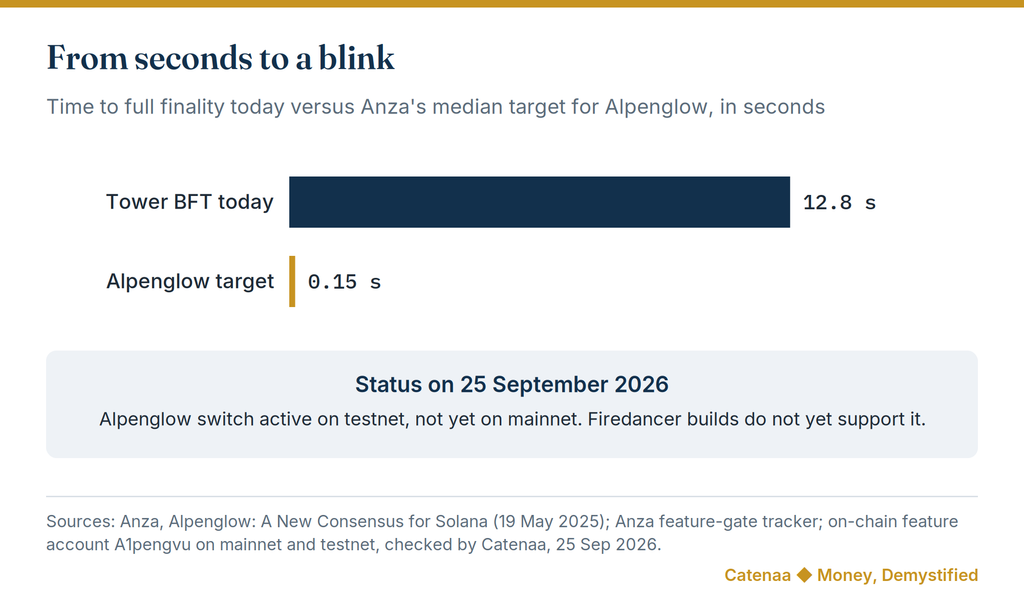
Alpenglow’s switch was active on testnet only when we checked.
Alpenglow would shrink the wait for finality from seconds to a blink.
Faster finality would matter beyond raw speed. Exchanges could credit deposits sooner, and payment apps could treat a transfer as settled almost at once.
If Alpenglow works as designed, payments and trades would settle almost as fast as a web page loads. Next, in Part 3, we follow the money that pays for all this security.
Disclaimer. This article is for education only. It is not investment, legal or tax advice. Crypto assets are volatile and can lose value quickly. On-chain figures are taken on 25 September 2026 and will change.
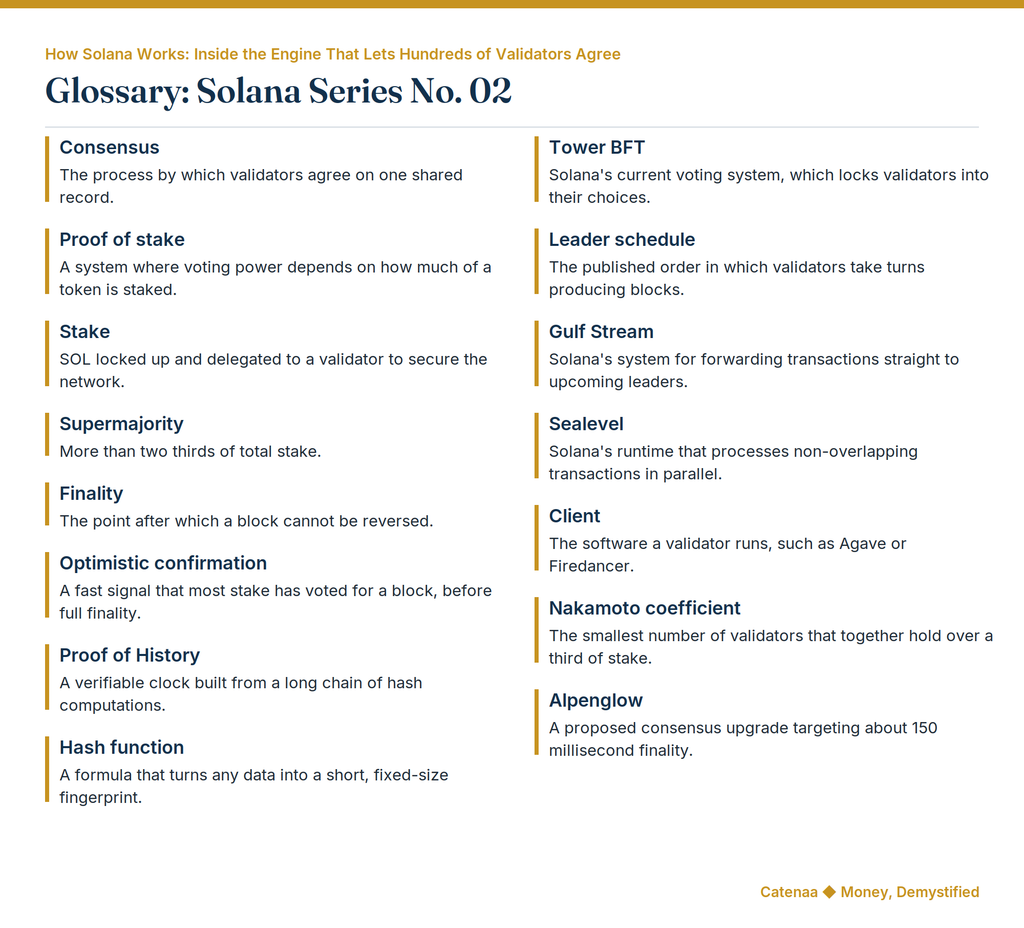
Glossary
Sources and references
- Solana mainnet RPC. getVoteAccounts, queried by Catenaa, 25 Sep 2026. 25 Sep 2026. https://solana.com/docs/rpc/http/getvoteaccounts
- Anza. Commitment Status, Agave validator documentation. Accessed 25 Sep 2026. https://docs.anza.xyz/consensus/commitments
- Solana Foundation. Sealevel: Parallel Processing Thousands of Smart Contracts. Undated. https://solana.com/news/sealevel—parallel-processing-thousands-of-smart-contracts
- Solana Foundation. Staking on Solana, Solana documentation. Accessed 25 Sep 2026. https://solana.com/docs/references/staking
- Solana Foundation. Proof of History: A Clock for Blockchain. Undated. https://solana.com/news/proof-of-history
- Anatoly Yakovenko. Solana: A new architecture for a high performance blockchain, whitepaper v0.8.13. Undated. https://solana.com/solana-whitepaper.pdf
- Anza. Tower BFT, Agave validator documentation. Accessed 25 Sep 2026. https://docs.anza.xyz/implemented-proposals/tower-bft
- Solana Foundation. Lowering Slot Time and Validator Economics. 19 Aug 2026. https://solana.com/news/lowering-slot-time-and-validators-economic
- Anza. Leader Rotation, Agave validator documentation. Accessed 25 Sep 2026. https://docs.anza.xyz/consensus/leader-rotation
- Solana Foundation. Reduced Slot Times, upgrade status page. Jun 2026, updated Sep 2026. https://solana.com/upgrades/reduced-slot-times
- Solana Improvement Documents. SIMD-0525: Reduce Slot Times. 2026. https://github.com/solana-foundation/solana-improvement-documents/blob/main/proposals/0525-reduce-slot-times.md
- Anza. Turbine Block Propagation, Agave validator documentation. Accessed 25 Sep 2026. https://docs.anza.xyz/consensus/turbine-block-propagation
- Anza. Validator Requirements, Agave validator documentation. Accessed 25 Sep 2026. https://docs.anza.xyz/operations/requirements
- Solana mainnet RPC. getClusterNodes, queried by Catenaa, 25 Sep 2026. 25 Sep 2026. https://solana.com/docs/rpc/http/getclusternodes
- Firedancer. Firedancer documentation: a new Solana validator client, built from the ground up. Accessed 26 Sep 2026. https://docs.firedancer.io/
- Anza. Alpenglow: A New Consensus for Solana. 19 May 2025. https://www.anza.xyz/blog/alpenglow-a-new-consensus-for-solana
- Anza. Feature Gate Tracker Schedule, Agave wiki. Accessed 25 Sep 2026. https://github.com/anza-xyz/agave/wiki/feature-gate-tracker-schedule
- Solana Improvement Documents. SIMD-0326: Alpenglow. 2025. https://github.com/solana-foundation/solana-improvement-documents/blob/main/proposals/0326-alpenglow.md
- Solana Explorer. Feature gate A1pengvu: Alpenglow, SIMD-0326 (on-chain account). Checked 25 Sep 2026. https://explorer.solana.com/address/A1pengvuM6JEcyNuTnMqepBKhwHE3N6PmUrdATGawhJS
- Anza. v4.3 Release Schedule, Agave wiki. Accessed 25 Sep 2026. https://github.com/anza-xyz/agave/wiki/v4.3-Release-Schedule
Editorial note: Figures in this series reflect data as of 25 September 2026