


Washington has started the clock on a rulebook for token offerings. Traders, however, are watching the Federal Reserve and the Strait of Hormuz instead.
In Summary
SEC crypto regulation reached the Federal Register on 21 August 2026, and the comment window closes on 20 October.
The framework offers two funding exemptions, capped at $5 million over four years and $75 million a year.
A conditional safe harbour would let a mature token exit the definition of a security altogether.
Bitcoin traded near $78,800 on 9 September, roughly 38% below its record high of $126,198.
Spot bitcoin funds drew $3.8 billion over three weeks, yet 2026 flows remain slightly negative overall.
The Senate holds a procedural vote on separate market-structure legislation on 15 September.
SEC crypto regulation now has a formal deadline attached to it. On 18 August 2026, the US Securities and Exchange Commission proposed Regulation Crypto Assets. The framework is built for offerings that involve digital tokens. Three days later, it appeared in the Federal Register, which started a 60-day comment period ending on 20 October.
Prices, meanwhile, have gone almost nowhere. Bitcoin rallied hard in late August, then gave most of it back. That gap between policy progress and price action deserves a closer look.
What the SEC crypto regulation proposal actually says
The Commission built three doors out of the legal grey zone. Each one suits a different stage of a project’s life.
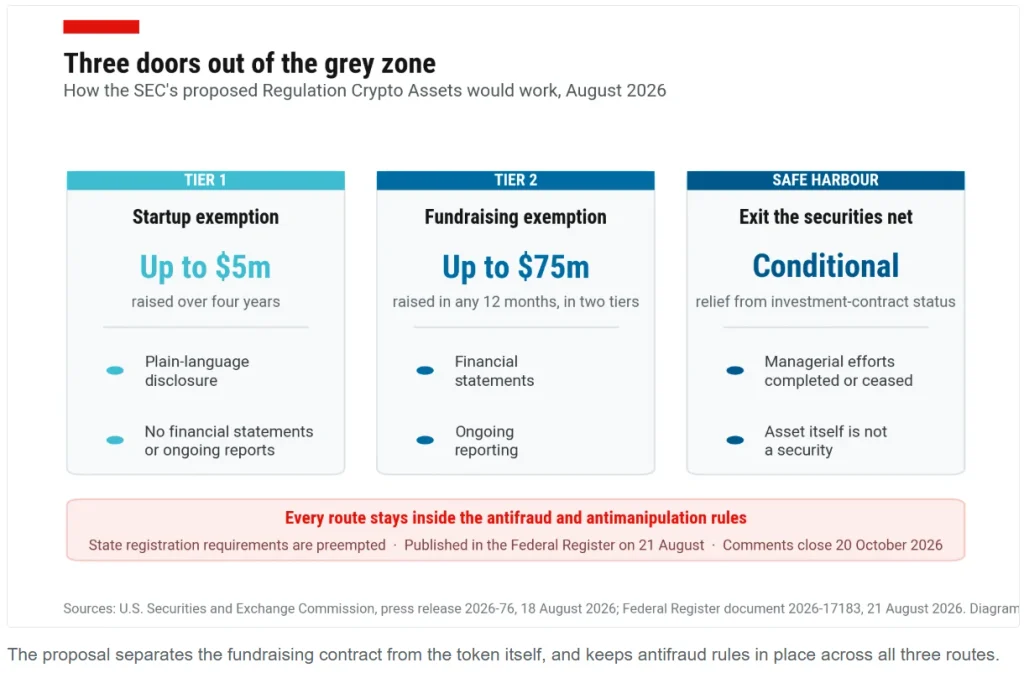
The first door is a startup exemption. An issuer may raise up to $5 million across a four-year window. Disclosure stays plain and simple. Founders write in their own words rather than filling in dense forms.
The second door suits larger projects. It permits up to $75 million in any 12-month period, split across two tiers. In exchange, the issuer must publish financial statements and file ongoing reports.
The third door matters most for investors. A conditional safe harbour would treat a qualifying token as something other than a security. Chairman Paul Atkins set out the test in simple terms. Relief applies “once an issuer has completed or permanently ceased all essential managerial efforts” promised under the original investment contract.
Commissioner Hester Peirce set out the thinking behind the draft. Rules, she argued, “should be written so that well-intentioned people can follow them without having to abandon legitimate pursuits”. She also conceded that the exemptions “will not fit every model”.
Two further details carry weight. State registration rules would be set aside, which would remove a costly patchwork for issuers. Meanwhile, the rules against fraud and market abuse still apply to every route.
What the proposal leaves out
Notably, the draft covers offerings rather than market structure. It does not settle how exchanges, brokers, and custodians should be licensed. Nor does it divide oversight between the SEC and the Commodity Futures Trading Commission. Congress still holds that pen. A legislative tracker maintained by Latham & Watkins shows the next step. The Senate turns to the Digital Asset Market Clarity Act on 15 September. However, that ballot is a cloture vote on the motion to proceed. It decides only whether debate may begin, not whether the bill passes. Sixty votes are needed, so even this first hurdle looks demanding.
Why the rally faded almost as fast as it arrived
Context explains the mood. Bitcoin peaked at $126,198 in October 2025. It then fell for the better part of a year.
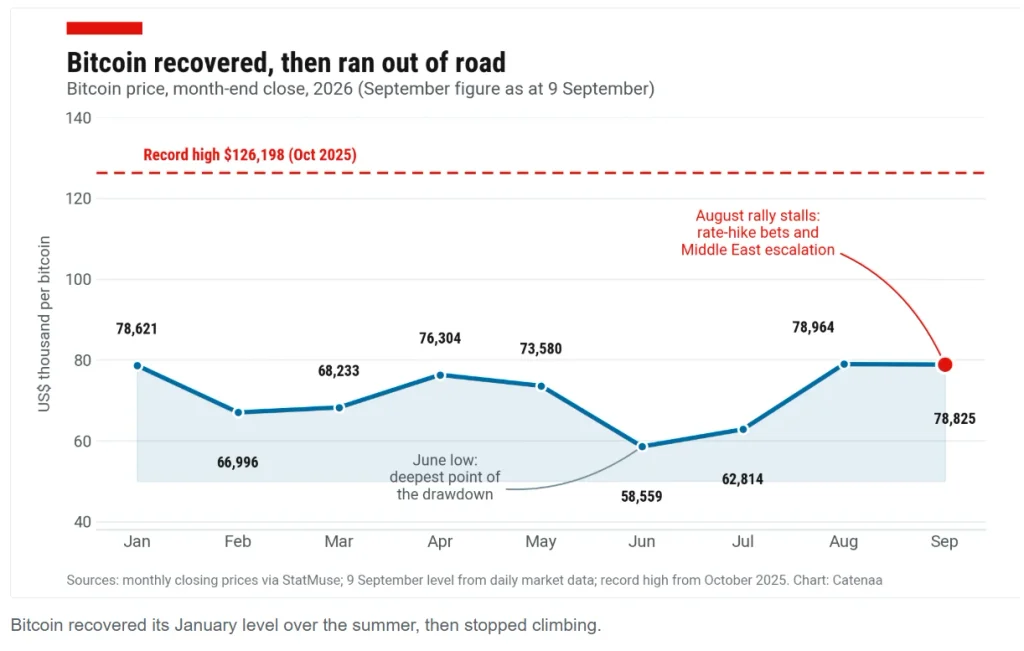
Research from asset manager VanEck, published in its mid-August ChainCheck, put the drawdown at 49% on 11 August. Mining difficulty had dropped 18.3% from its November 2025 peak. Daily miner revenue had fallen 46% year on year. Eight of the twelve capitulation signals had switched on.
A sharp recovery followed. Bitcoin climbed above $81,000 by 4 September. Two events helped: the SEC announcement and a US Treasury decision to double its buyback of long-dated debt. Exchange-traded funds joined in. Spot bitcoin funds took in roughly $3.8 billion over three weeks, their strongest stretch of the year. One day, 3 September, brought $731 million. Total fund assets briefly passed $103 billion.
Then the mood soured again. Two forces did the damage. First, traders raised the odds of a Federal Reserve rate increase this month. CME FedWatch pricing put them above 60% on 8 September. Second, renewed fighting between the United States and Iran pushed Brent crude close to $100 a barrel. Higher rates and higher energy costs both hurt assets that pay no income.

What stablecoin data says about real crypto adoption
Prices tell only half of the story. The plumbing beneath them behaved very differently.
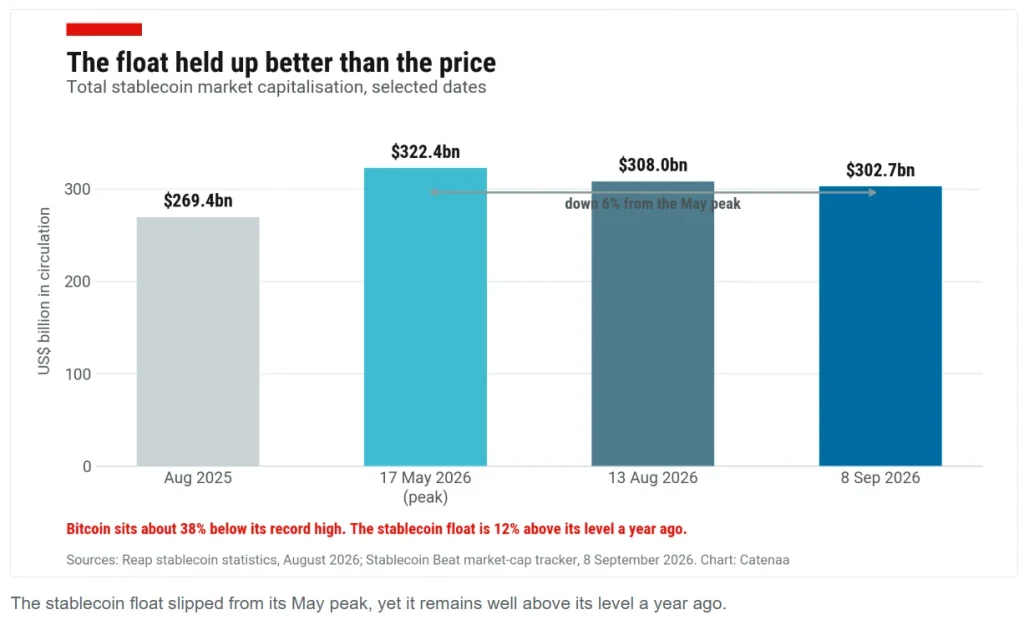
Total stablecoin market capitalisation stood at $302.7 billion on 8 September, according to the Stablecoin Beat tracker. That sits about 6% below the peak of $322.4 billion recorded on 17 May. Even so, the float is roughly 12% larger than the $269.4 billion recorded a year earlier.
Compare the two moves. Bitcoin sits some 38% below its record. The stablecoin float has fallen barely 6% from its own peak. Settlement demand, in other words, proved far stickier than speculative demand.
Concentration remains the obvious risk. Dollar tokens issued by Tether and Circle account for roughly 85% of the float between them. Regulation has encouraged that scale. The US GENIUS Act and the European Union’s MiCA regime both gave banks and payment firms a licence to build.
What investors should watch before the comment window closes
First, watch mid-September. The Senate votes on market-structure legislation on 15 September, and the Federal Reserve announces its decision on 16 September. Both events land in the same 48 hours.
Second, watch the comment file. A proposal is not a rule, and the deadline of 20 October only starts the argument. Industry lawyers will press for wider limits. Investor groups will push the other way.
Third, watch the boundary line. The safe harbour depends on managerial efforts ending. That is a judgment call, not a bright line. Expect disputes over when a network is spread out enough to qualify.
Finally, keep the two stories separate. Regulatory clarity lowers the cost of building in the United States. It does not lower the discount rate, refill oil tankers, or create fresh demand for tokens. Right now, macro forces are setting the price.