

A winter storm in Texas shut down mining rigs in January 2026. Two weeks later, the network quietly rewrote its own rules. Here is the machine that made that happen.
In Summary
A hash function turns any data into a short, fixed-length fingerprint. The same input always gives the same result.
Tiny input changes produce completely unrelated outputs. That avalanche effect makes tampering easy to spot.
Each block contains the previous block’s hash. Editing an old block therefore breaks every block after it.
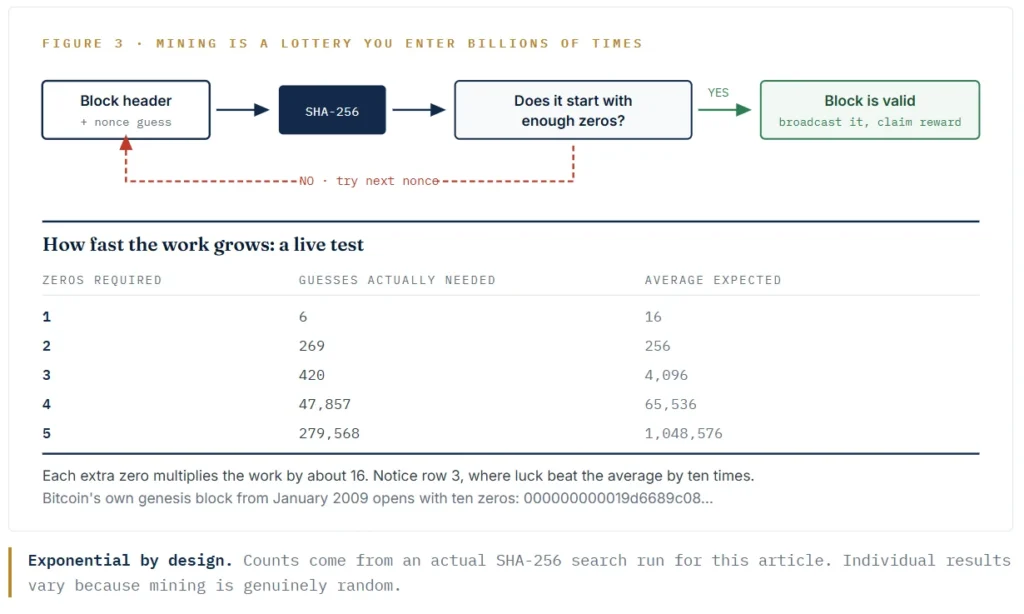
Mining is guessing. Miners hunt for a nonce that makes the block hash start with enough zeros.
Each extra required zero multiplies the expected work by roughly sixteen.
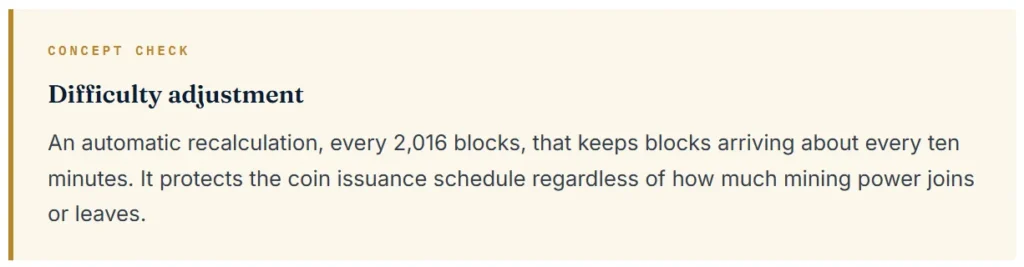
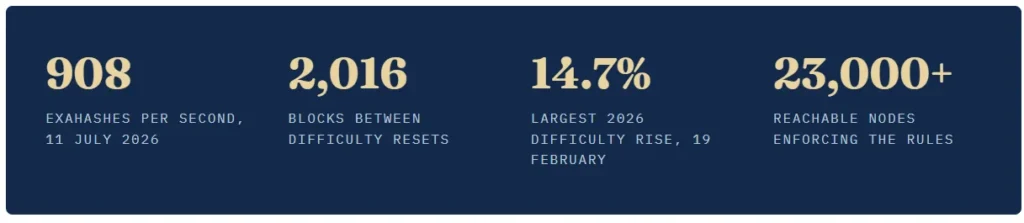
Difficulty resets every 2,016 blocks to hold block times near ten minutes. No vote is involved.
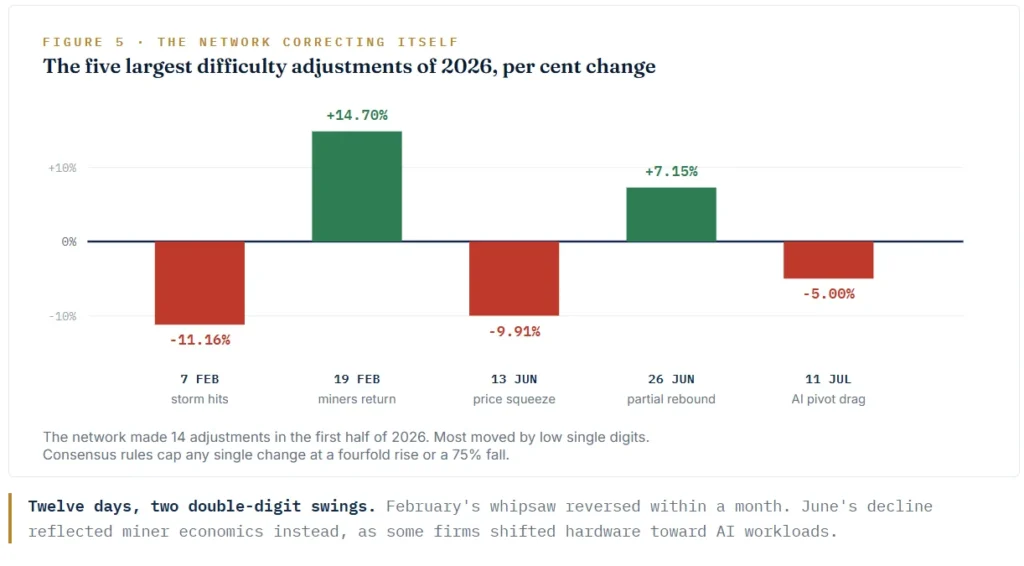
Winter Storm Fern proved the rule works. Difficulty fell 11.16% in February, then rose 14.7% twelve days later.
Security rests on cost, not impossibility. Smaller chains with less computing power have been attacked.
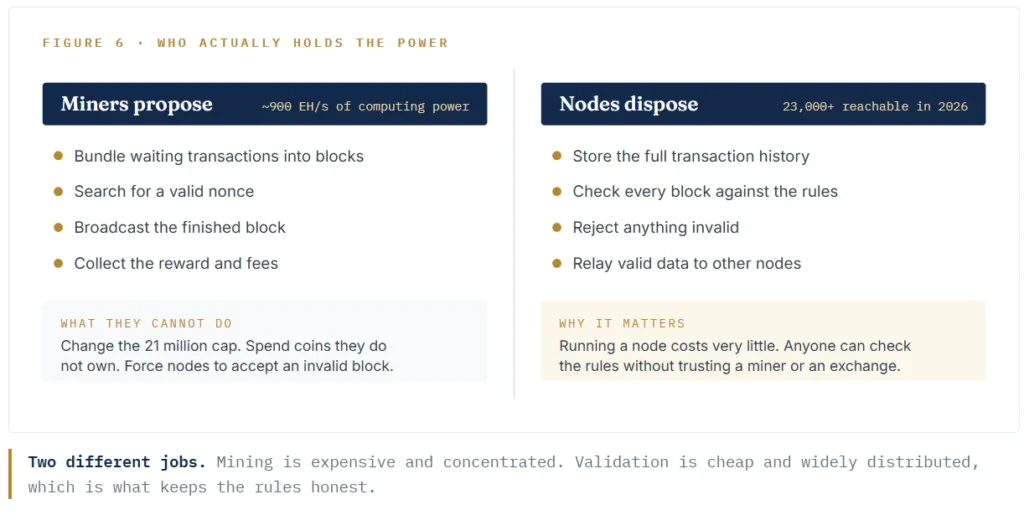
Miners order transactions, yet nodes decide what counts as valid. That separation is the real safeguard.
In late January 2026, a winter storm swept across Texas.
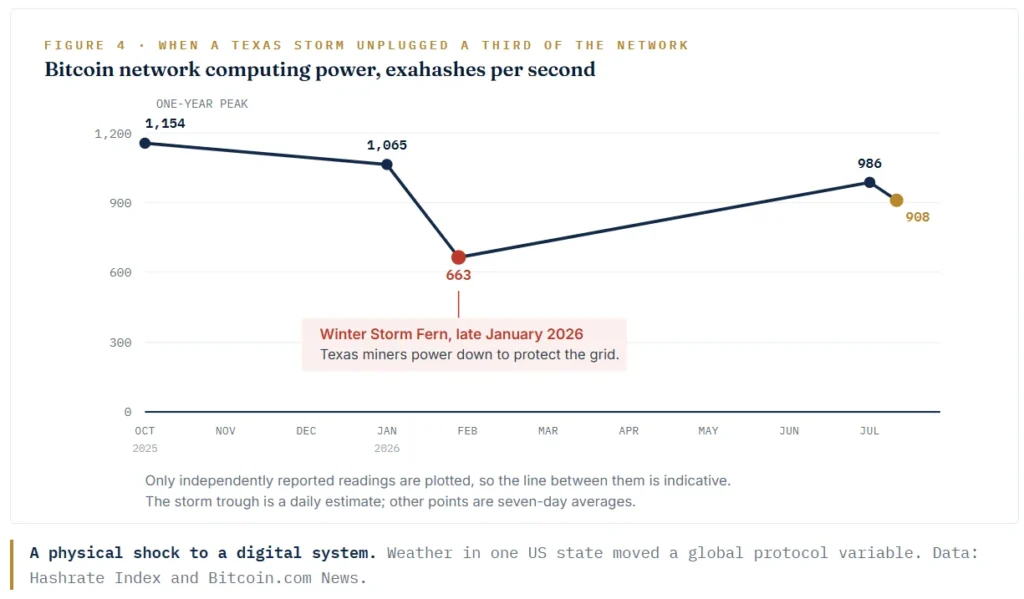
Winter Storm Fern drove temperatures down and power demand up. Grid operators needed relief, so large bitcoin mining sites switched off their machines.
The network felt it within hours. Total computing power fell by roughly a third, from a peak near 1,130 exahashes per second to about 663.
Then something strange happened. On 7 February, mining suddenly became 11.16% easier.
No committee met. Nobody signed anything off. A rule simply fired on schedule.
That self-correction sits at the heart of how a blockchain works. To understand it, we need to open the machine.
First, Meet the Hash
Everything starts with one tool: the hash function.
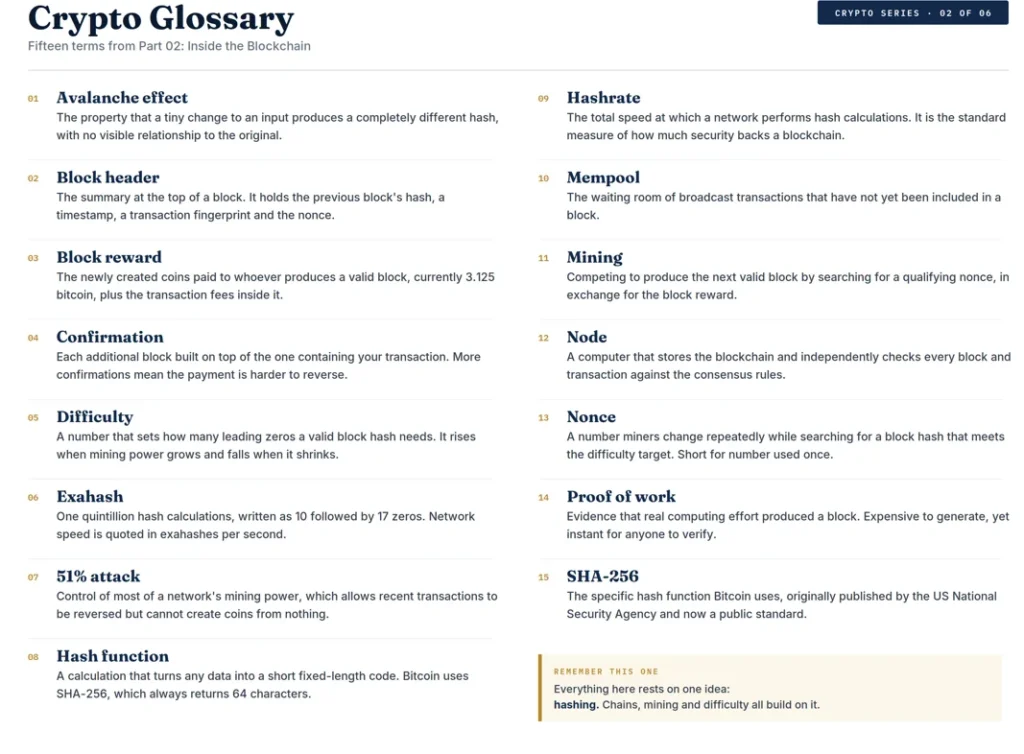
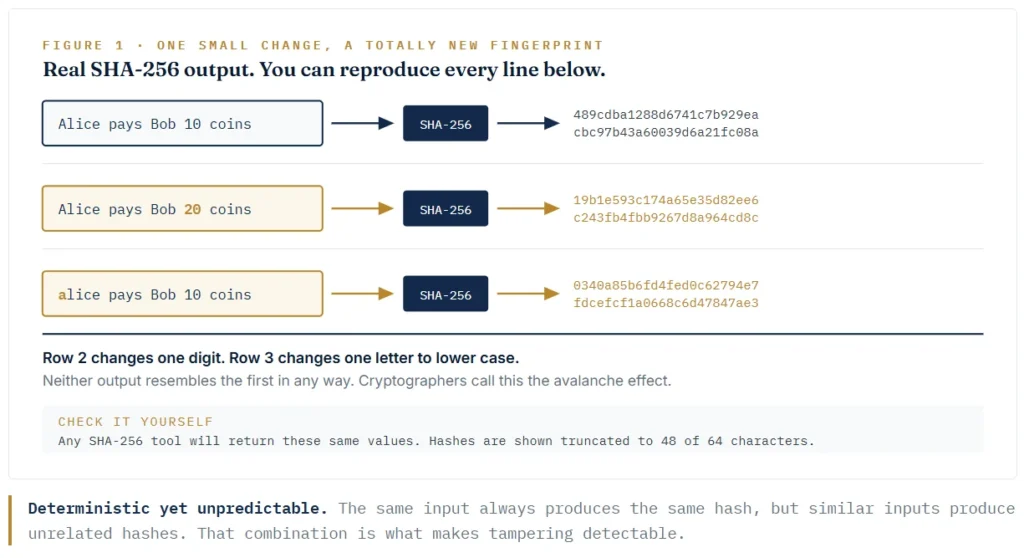
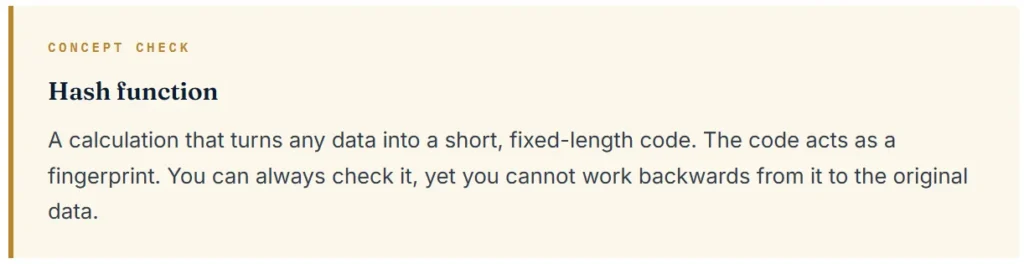
Feed it any text, and it returns a fixed-length code. Bitcoin uses SHA-256, which always returns 64 characters.
Three properties make it powerful. The same input always gives the same output. A tiny change gives a completely different output. And you cannot run it backwards.
Why a Hash Works Like a Seal
That behaviour makes a hash an excellent seal.
Publish the hash of a document today. Anyone can later verify whether that document has changed.
If a single comma moves, the hash will not match. Tampering becomes obvious instead of hidden.
Bitcoin uses this trick at every level. Transactions get hashed, blocks get hashed, and those hashes get hashed again.
How Blocks Chain Together
Now add the second idea.
Transactions arrive constantly and wait in a queue. Roughly every ten minutes, a batch of them gets bundled into a block.
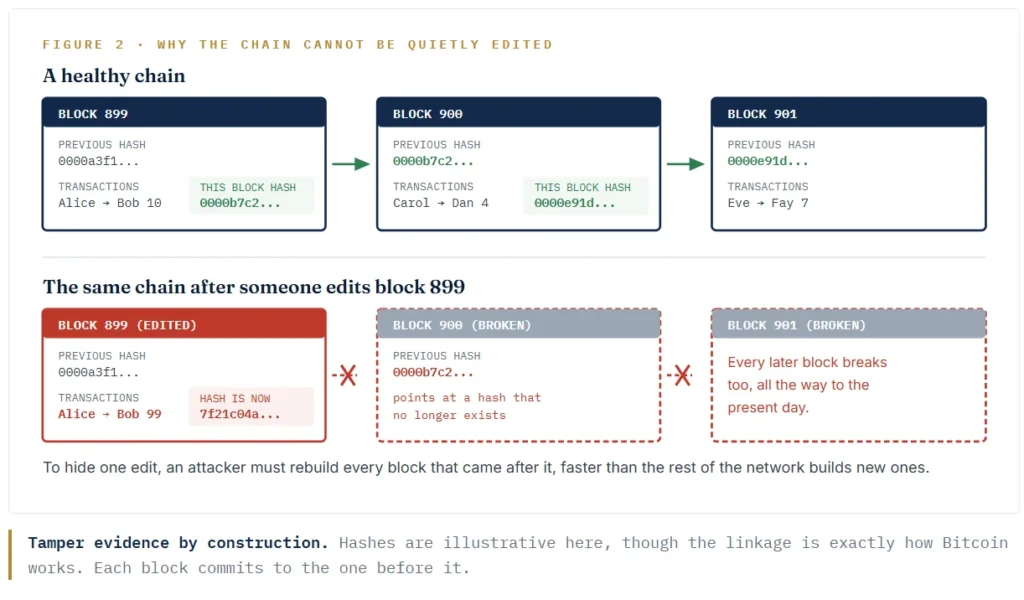
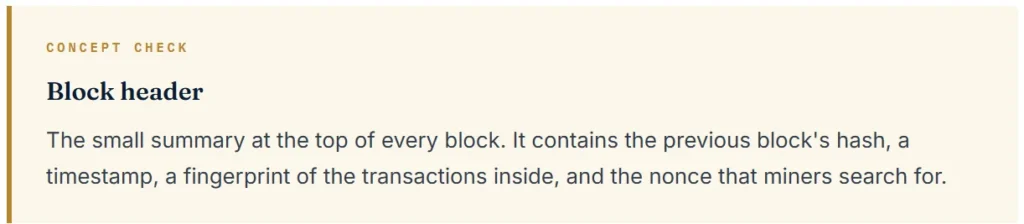
Each block carries a header. Inside it sit a summary of the transactions, a timestamp, and the hash of the block before it.
That last item does the real work. Because block 900 contains block 899’s hash, the two are welded together.
Alter anything inside block 899 and its hash changes. Block 900 then points at a fingerprint that no longer exists.
So the break spreads forward through every later block. Rewriting one old entry means rewriting everything after it.
Mining Is a Guessing Game
So who assembles these blocks, and why bother?
Miners do. They compete against each other, and the winner earns newly created coins plus transaction fees.
Today that reward is 3.125 bitcoin per block. Roughly 144 blocks get found each day.
Winning means finding a number called a nonce, and nothing else works. Add that nonce to the block header, hash the header, then inspect the result.
The rule is blunt. Whatever comes out must start with enough zeros.
No shortcut exists. Miners guess, hash, and guess again, billions of times every second.
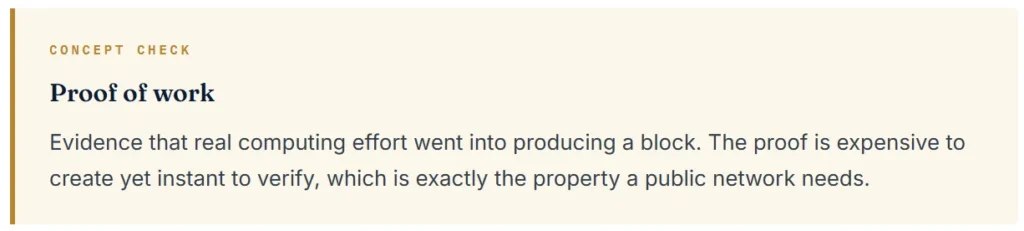
Verifying a winning guess, by contrast, takes a fraction of a second. Hard to find, easy to check: that asymmetry is the whole point.
What Difficulty Actually Does
Here is where Winter Storm Fern comes back.
Every 2,016 blocks, roughly a fortnight, the network measures its own pace. Nodes compare the time actually taken against the two-week target.
Blocks arriving too quickly? Difficulty rises. Arriving too slowly? Difficulty falls.
Each node computes the new value on its own, using the same timestamps. No vote happens, and no negotiation is possible.

Its purpose is duller than that. It keeps the coin issuance schedule steady, regardless of who is mining and where they sit.
When Texas rigs switched off, blocks slowed. Two weeks later, difficulty fell 11.16%.
Mining then became cheaper, so the machines returned. Blocks ran ahead of schedule, and on 19 February difficulty leapt 14.7%.
That was the biggest rise since 2021. It pushed difficulty to a record 144.4 trillion.
How Many Blocks Until It Is Safe?
You may have seen an exchange say “3 confirmations”. Here is what it counts.
A confirmation is simply a block. The block holding your payment counts as one. Each new block on top adds another.
Why should that matter? Two miners can find a block at almost the same moment. For a short while, the chain then has two tips.
One branch soon falls behind and gets dropped. Any payment sitting only in the losing branch returns to the queue.
Deeper blocks are safer, because more work now sits on top of them. Reversing six blocks means beating the whole network six times over.
Many exchanges wait for six blocks, or roughly an hour. Small payments often clear after just one.
So bitcoin offers no single moment of finality. It offers rising confidence instead.
That gap matters before you send anything large. A bank transfer either clears or fails, whereas a block payment simply gets safer with time.
The Cost of Cheating
Proof of work explains why fraud is so hard.
To rewrite history, an attacker must redo the work for every affected block. Meanwhile, the honest network continues to extend the genuine chain.
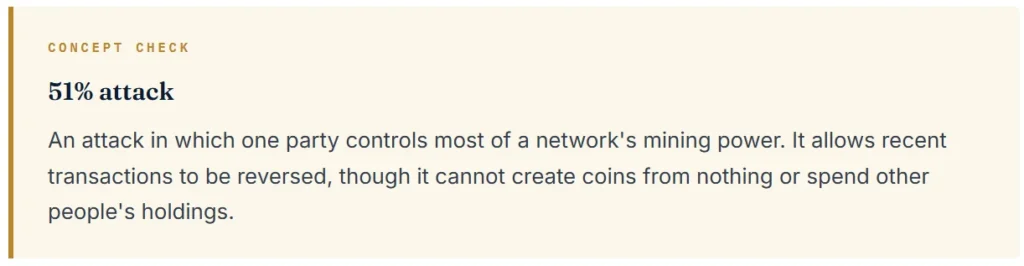
The attacker must therefore out-compute everyone else combined. People call this a 51% attack.
At roughly 900 exahashes per second, matching the network would require billions in hardware and electricity costs.
Notice the design choice, though. Security rests on cost, not on some unbreakable lock.
Smaller blockchains with far less computing power have indeed been attacked. Ethereum Classic was hit twice in January 2019 and three times in August 2020.
Coinbase put one August 2020 incident at about 460,000 coins, worth roughly $3.2 million.
Miners Propose, Nodes Dispose
One common confusion deserves clearing up.
Miners do not control Bitcoin. They order transactions and secure the record.
Nodes enforce the rulebook. Bitnodes counted more than 23,000 reachable nodes during 2026, spread across dozens of countries.
Every node checks each block against identical rules. An invalid block gets rejected, however much power produced it.
That split matters a great deal. Computing power decides ordering, while the wider network decides validity.
The Energy Question
All that guessing burns real electricity.
The US Energy Information Administration reported a wide range for 2023, from 67 to 240 terawatt hours. Its central estimate sat near 120.
Digiconomist estimated usage at close to 155 terawatt-hours in early 2026. Poland uses a similar amount each year.
Critics call the spending wasteful. Defenders say the power buys a kind of safety no other open system offers.
Both readings can sit together. The power draw is real, and so is the property it protects.
Why This Matters
Part 01 asked how you stop someone spending the same coin twice.
You now have the full answer. Hashing makes records tamper-evident, chaining spreads that protection backwards, and proof of work makes rewriting history expensive.
Difficulty then holds the whole system to a steady pace, whatever the weather does in Texas.
Part 03 turns to ownership. If nobody issues you an account, what exactly proves that a coin is yours?