
Kalshi lets people trade on real events, from elections to bitcoin. Here is how its contracts, partners, fees and legal battles fit together.
In Summary
Kalshi is a US exchange, regulated by the CFTC, where yes/no event contracts pay $1 or nothing.
It runs its own exchange (approved 2020) and clearinghouse (approved 2024). Brokers such as Robinhood and Coinbase plug in.
Catenaa’s scan of 15,919 series: sports and crypto hold 92.6% of contracts traded but only 28.0% of listings.
Taker fees peak at 1.75 cents per contract at a 50 cent price, yet cost long shots the most as a share of price.
Appeals courts are split on sports contracts. New Jersey has asked the Supreme Court to decide.

At 8:10 PM Eastern on election night, 3 November 2026, one set of odds jumped to 99%. The question was which party would control the House. Kalshi says its traders reached that level hours before the TV networks called it.
That company is Kalshi. It runs a US exchange where people trade on the outcome of real events. Elections are only one part. Sports, bitcoin prices, interest rates and even the weather are others.
In October 2026, Kalshi raised $1 billion at a $40 billion valuation. It also sits at the centre of a legal fight that may reach the Supreme Court. So how does it work, and who are the players around it? This guide walks through the whole ecosystem, step by step.
What Is Kalshi?
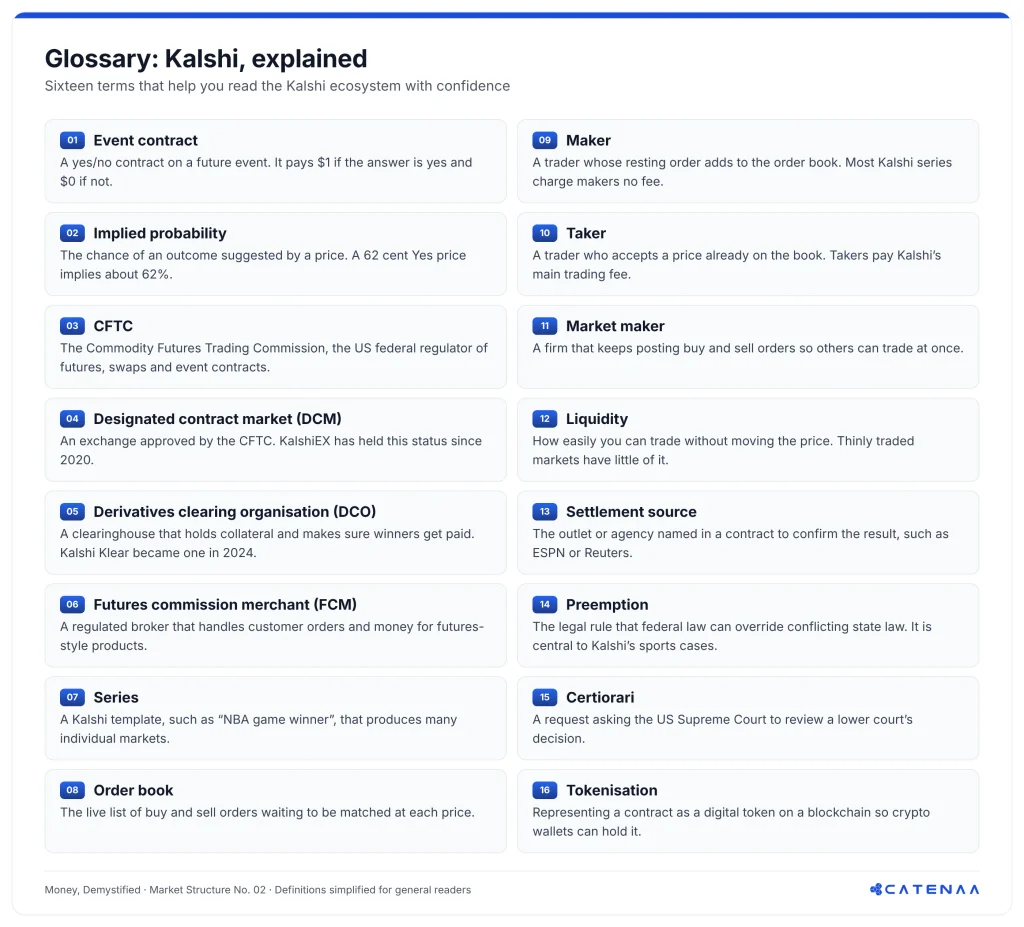
Kalshi is a regulated exchange for event contracts. An event contract asks a yes-or-no question about the future. Will the Fed cut rates? Which team wins tonight? Does bitcoin close above a set price?
Two MIT graduates, Tarek Mansour and Luana Lopes Lara, founded the company in New York in 2018. Both had worked as traders. Their idea was simple: let anyone trade on events through a fully regulated venue.
The Commodity Futures Trading Commission (CFTC) approved Kalshi’s exchange, KalshiEX, in November 2020. That made it a designated contract market, the same legal class as large futures exchanges. As a result, Kalshi argues that it answers to a federal regulator rather than state casino boards. That point now sits at the heart of its legal battles.
How a Kalshi Contract Works
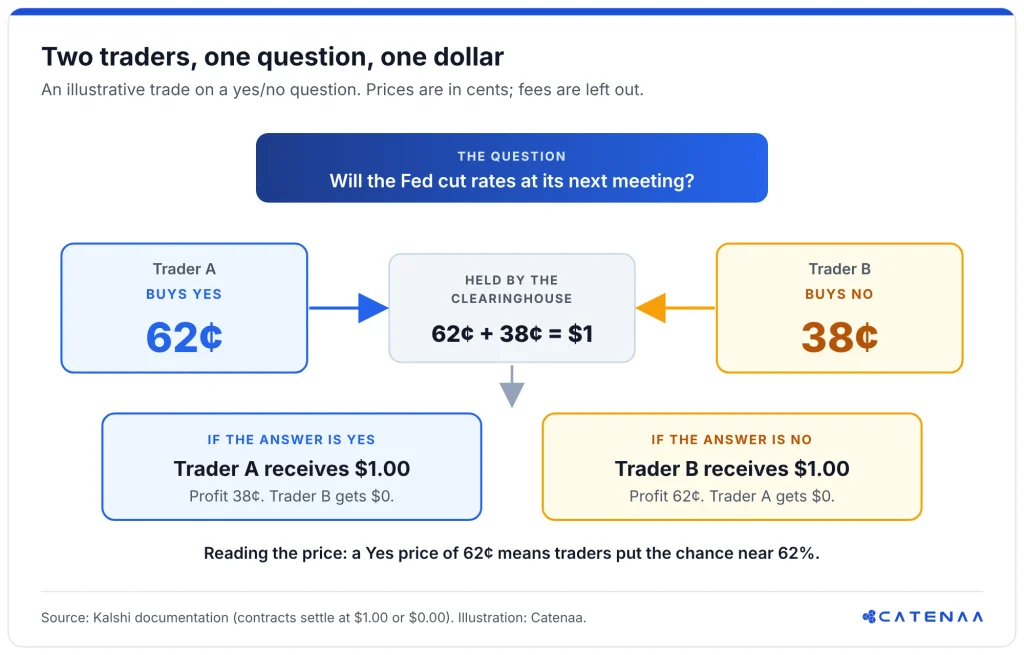
Every contract settles at either $1.00 or $0.00. If the event happens, Yes holders collect $1 per contract. Should it not happen, No holders collect it instead.
Prices therefore sit between zero and one dollar. A Yes price of 62 cents implies roughly a 62% chance. Kalshi’s own documentation says the price can be read as the implied probability.
Figure 1 shows the mechanics. One trader buys Yes at 62 cents. Another buys No at 38 cents. Together they fund the $1 prize, which stays locked until the answer is known.
Importantly, Kalshi matches buyers with sellers. It says it does not win when its customers lose. Instead, it earns money from trading fees. By contrast, a traditional sportsbook sets its own odds and takes the other side of each bet.
The Kalshi Ecosystem, Layer by Layer
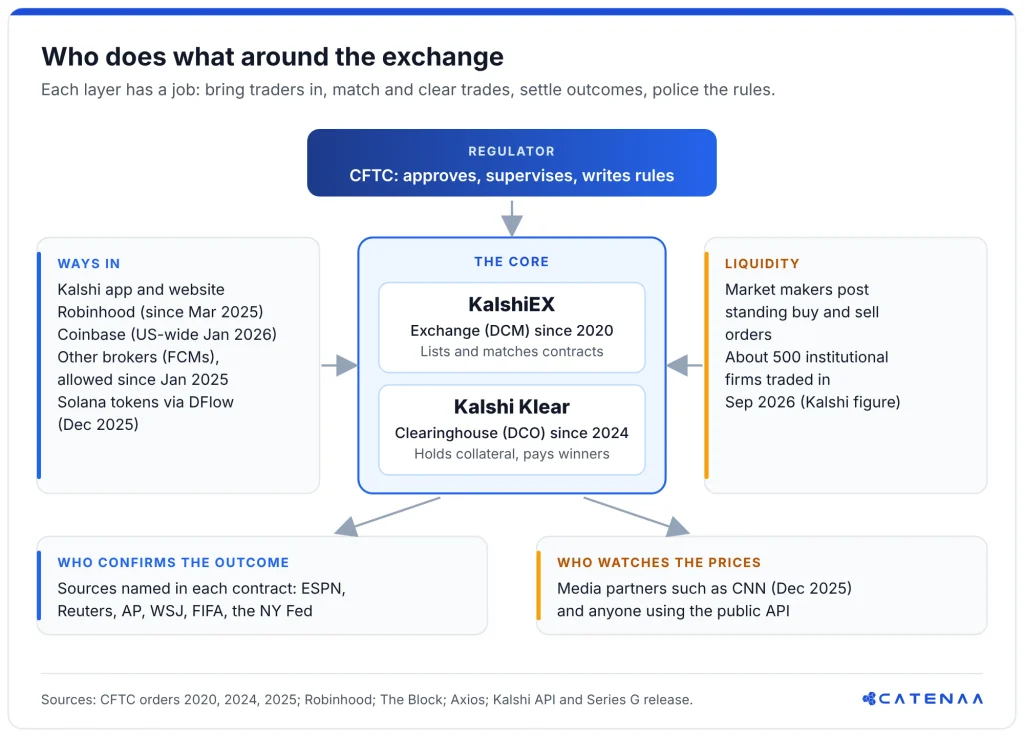
Kalshi is more than one app. It is a set of linked companies and partners, mapped in Figure 2.
The core: exchange and clearinghouse
KalshiEX lists and matches contracts. A sister company, Kalshi Klear, clears them. The CFTC registered Kalshi Klear as a derivatives clearing organisation in August 2024. In plain terms, Kalshi now runs both the trading floor and the vault.
The ways in: apps, brokers and crypto
Many users never open the Kalshi app. Robinhood launched a prediction markets hub through Kalshi in March 2025. Coinbase then rolled out Kalshi markets across the US in January 2026.
Brokers can do this because the CFTC amended Kalshi’s licence in January 2025. The change removed a ban on futures brokers, known as FCMs, handling customer trades. Separately, Kalshi began offering tokenised versions of thousands of markets on Solana in December 2025. That move opened a door to crypto wallets.
The liquidity, the referees and the audience
Market makers post standing buy and sell orders, so others can trade at once. Kalshi says about 500 institutional firms traded on the exchange in September 2026.
Each contract also names who confirms the result. Our scan of Kalshi’s series found ESPN, The Wall Street Journal and Reuters among the most cited sources. Finally, CNN agreed in December 2025 to show Kalshi odds on air. Anyone can also pull prices through Kalshi’s public API.
What People Actually Trade on Kalshi
Kalshi often presents itself as a tool for forecasting news and the economy. The trading data tells a more nuanced story.
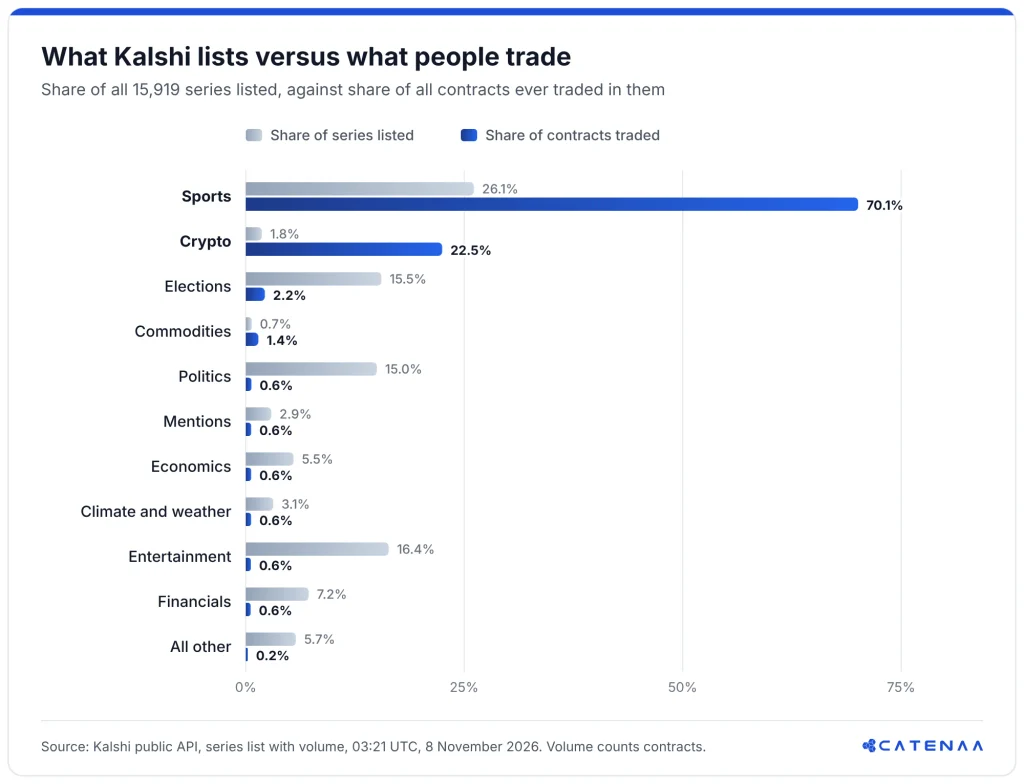
We pulled every series listed on Kalshi’s public API on 8 November 2026. A series is a template, such as “NBA game winner”, that produces many markets. We then compared each category’s share of listings with its share of contracts traded.
The gap is striking (Figure 3). Sports make up 26% of listed series but 70% of all contracts traded. Crypto is even more lopsided, with under 2% of series yet 22% of contracts. Together, the two account for nearly 93% of trading.
Meanwhile, elections and politics fill 31% of the catalogue. However, they hold under 3% of contracts traded. Entertainment, economics and weather follow the same pattern. They are plentiful but thinly traded.
Concentration runs deep. The ten busiest series hold 51% of all contracts (Figure 4). A single product, a bet on bitcoin’s price 15 minutes ahead, holds 15% alone. At the other end, 3,646 series, or 23% of the list, show no trades at all.
This matters for readers. A thinly traded market can show a price that few people have tested. So check the volume before you treat a Kalshi price as a forecast.
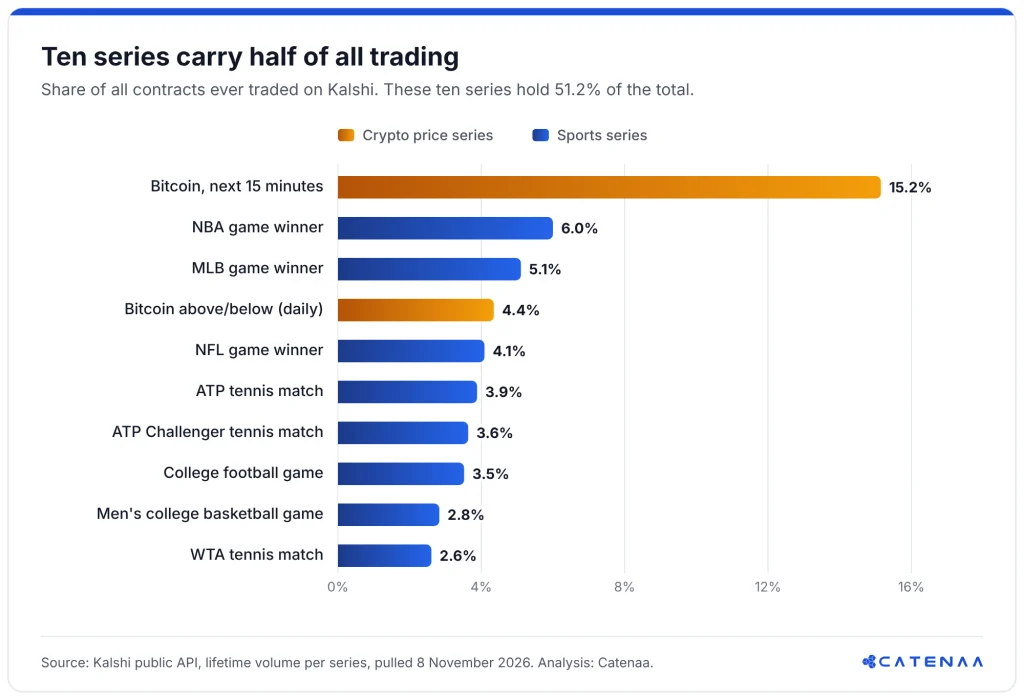
Method: Catenaa called Kalshi’s public “Get Series List” endpoint with volume included at 03:21 UTC on 8 November 2026. It returned 15,919 series. Shares use Kalshi’s reported lifetime contract volume for each series, grouped by Kalshi’s own category label. Volume counts contracts, not dollars spent.
How Kalshi Makes Money
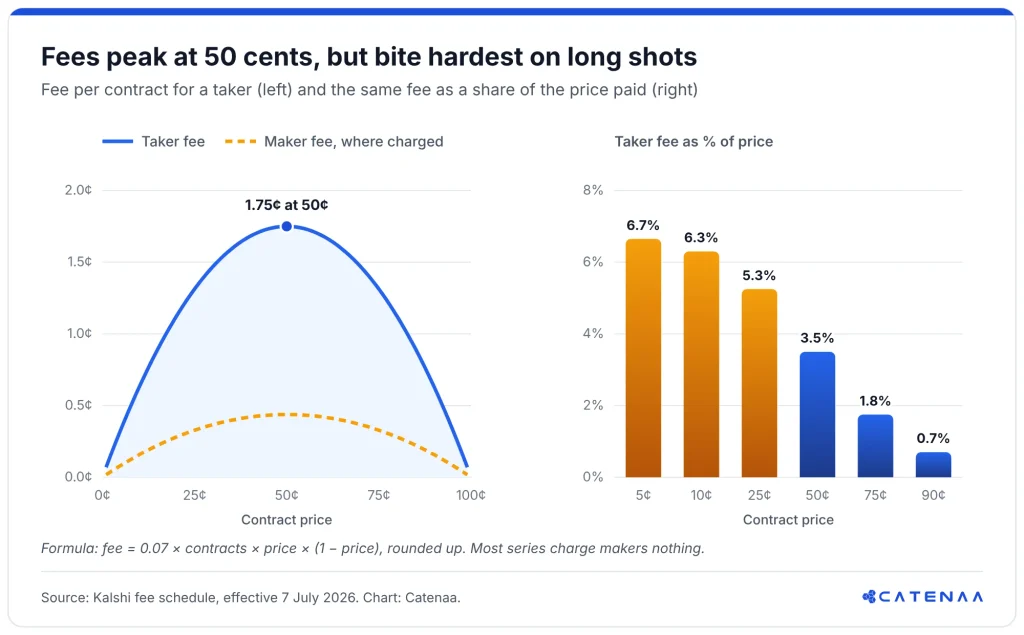
Kalshi earns most of its revenue from trading fees. Its fee schedule charges takers 0.07 times contracts, times price, times one minus price. A taker is a trader who accepts a price already on offer.
That formula produces a curve (Figure 5). The fee peaks at 1.75 cents per contract at a 50 cent price. Yet long shots pay the most relative to their cost. A 10 cent contract carries a 0.63 cent fee, or 6.3% of its price. By contrast, a 90 cent contract pays the same 0.63 cents, just 0.7% of its price.
Makers, who post resting orders, pay nothing on most markets. In fact, our scan found only 163 of 15,919 series with maker fees, mostly in sports.
The business is growing fast. Kalshi says annualised trading volume now exceeds $1 trillion. For context, the CFTC put 2025 volume across all registered prediction markets at over $25 billion. Investors have priced in that growth. The October round valued Kalshi at $40 billion, about 3.6 times the $11 billion valuation it confirmed in December 2025.
Partners profit too. Robinhood reported $173 million in event contract revenue for the third quarter of 2026, up more than sixfold. However, Robinhood also co-owns Rothera, a joint venture with Susquehanna. Rothera has traded over 6.4 billion contracts since launch. So one of Kalshi’s biggest distributors is also building a rival business.
Kalshi vs Polymarket: Key Differences
Kalshi’s best-known rival is Polymarket, which we covered in a five-part series. The two look alike on screen. Underneath, they differ in important ways.
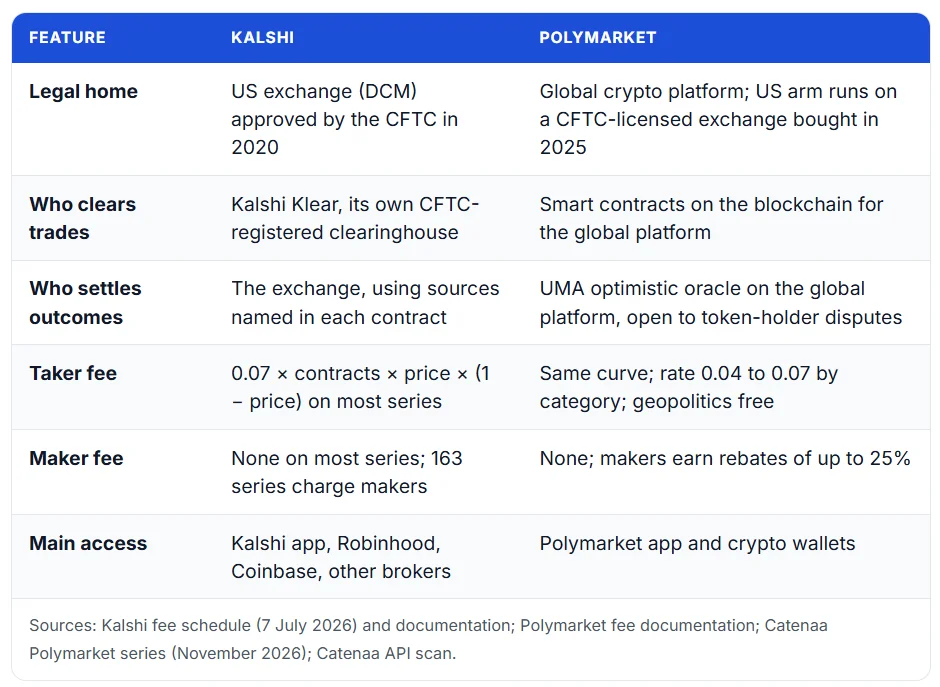
Kalshi began inside US regulation. Polymarket grew up offshore on a blockchain, then bought a licensed US exchange in 2025. Kalshi settles markets itself, using the sources named in each contract. Polymarket’s global platform relies on UMA, a crypto oracle where token holders can dispute results.
Fees differ as well. Polymarket uses the same price curve, but its rate ranges from 0.04 to 0.07 by category. It also pays rebates to makers. The table sets out the main contrasts.
The Legal Fight Over Kalshi
Kalshi’s story is also a string of legal battles (Figure 6).
The first was with its own regulator. In September 2023, the CFTC blocked Kalshi’s contracts on which party would control Congress. Kalshi sued and won. On 6 September 2024, Judge Jia Cobb vacated the CFTC’s order. The CFTC appealed, then dropped the appeal in May 2025.
Next came a fight with the states, and it is about sports. Many states argue that a sports contract is simply a bet. In their view, Kalshi needs a gambling licence. Kalshi argues that federal law gives the CFTC exclusive control.
The appeals courts now disagree. In April 2026, the Third Circuit sided with Kalshi against New Jersey by two votes to one. Months later, the Ninth Circuit went the other way and backed Nevada. It then refused to rehear the case in November.
New Jersey has now asked the Supreme Court to settle the split. Kalshi’s response is due on 7 December 2026. Notably, the National Football League and the American Gaming Association have both filed briefs in the case.

Meanwhile, the CFTC has sided with the exchanges. In April 2026, it sued Arizona, Connecticut and Illinois to defend its exclusive jurisdiction. Weeks later, it sued New York. It is also writing new rules. In October 2026, it declared that casino-style games are not swaps. Chairman Michael Selig put it bluntly: “Casino-style gambling products are not derivatives.”
Tribal nations are pushing back too. In early November 2026, a federal judge barred Kalshi’s sports contracts on two California tribes’ lands.
What Readers Should Watch
Kalshi has built something new: a federally regulated market for almost any question. Its prices now appear on news channels and inside brokerage apps. Growth has been remarkable by any measure.
Still, readers should keep four risks in mind:
- Legal risk. A Supreme Court ruling could reshape where sports contracts are allowed.
- Concentration. Sports and crypto drive most trading, so rule changes there would hit hard.
- Thin markets. Many series trade little, so their prices may mislead.
- Self-reported data. Headline figures, such as the $1 trillion run rate, come from Kalshi itself.
Accuracy claims deserve the same care. Kalshi says its favourites won 479 of 487 resolved midterm races. Yet the recap does not say how close those races were. Calling a safe seat is easy, and the hard calls matter more.
The bottom line is simple. Kalshi turns opinions into prices, and prices into data. Used with care, that data can inform. Handled carelessly, it is just another way to gamble.
Disclaimer. This article is for education only. It is not investment, legal or betting advice. Event contracts can lose their full value. Rules differ by state and country, and court cases are ongoing. Figures attributed to Kalshi, Robinhood or Polymarket are company statements. Catenaa’s own analysis uses Kalshi’s public data as of 8 November 2026.