

Machines already choose how orders reach the market. The harder question is whether they can choose what to own, and what happens when millions of them reach the same conclusion at the same moment.
In Summary
AI is already embedded in markets. IOSCO found that 63% of surveyed broker-dealers use AI in algorithmic trading.
Supervisors published tools rather than bans. IOSCO issued an AI supervisory toolkit on 25 May 2026 that explicitly covers agentic techniques.
Client duties do not change. ESMA has reminded firms that MiFID II obligations apply whenever AI touches investment services.
Concentration is the systemic worry. The Bank of England notes AI companies now make up around half of the S&P 500, up from about a quarter in 2022.
Correlated agents are the real hazard. Similar models, similar data, and similar triggers can turn a small shock into a synchronised one.
Automated investing is not new. Index funds mechanised allocation decades ago. Execution algorithms mechanized trading in the 2000s. Robo-advisers mechanised rebalancing in the 2010s.
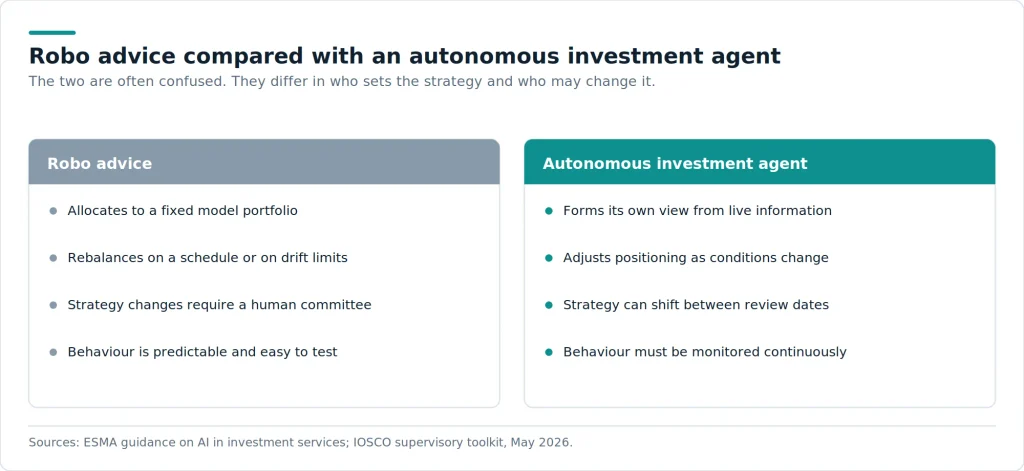
Each wave automated a rule that humans wrote. An agent does something different. It writes part of the rule itself, then acts on it.
That difference sounds academic until a market turns. A rule-based system keeps doing what it was told. An adaptive system changes its mind, and it does so without waiting for a committee meeting.
What machines already do
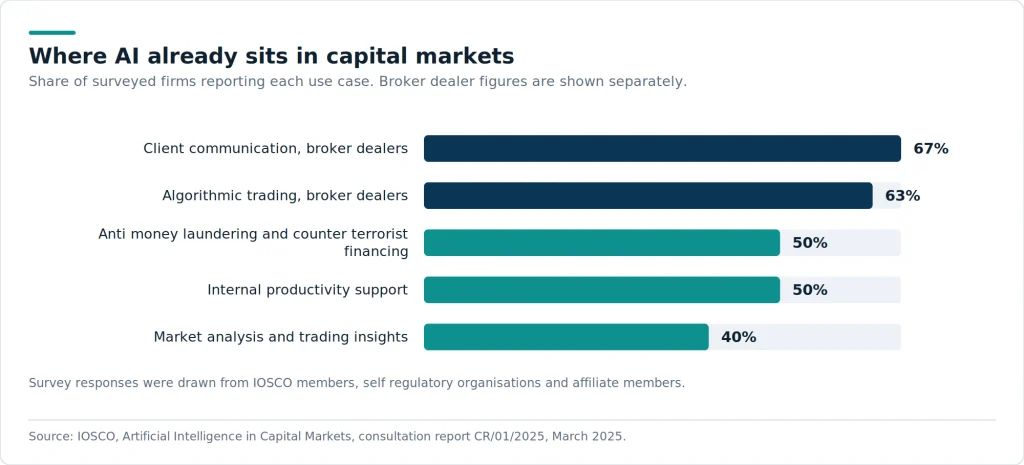
Start with the evidence rather than the promise. IOSCO surveyed its members and affiliates and published the results in March 2025. Among broker-dealers, 63% reported using AI in algorithmic trading and 67% in client communication.
Across the wider sample, half reported AI use in anti-money laundering work and half in internal productivity. Market analysis followed at 40%. In short, AI sits closer to operations than to allocation.
Marketing has moved faster than practice. Many products described as AI-powered simply use models for research support. Investors should therefore ask which specific step the machine actually controls.
Where autonomy can safely enter
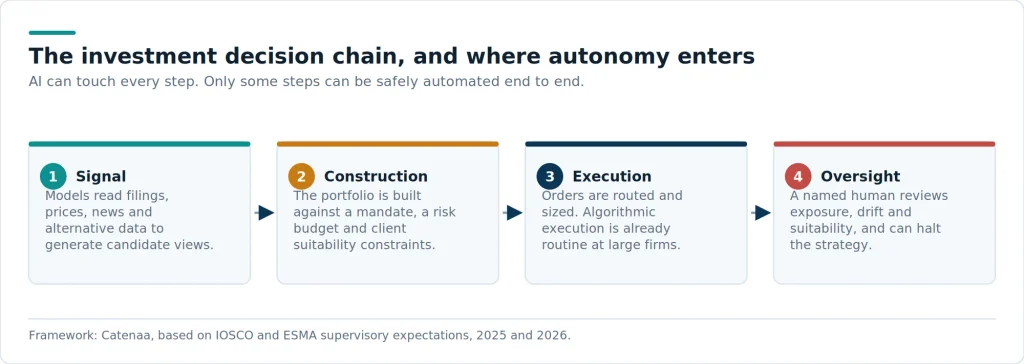
Think of investing as four linked steps: signal, construction, execution, and oversight. Execution is already automated at scale. Signal generation is increasingly automated. Construction sits in between.
Oversight is the step that must remain human, and regulators are explicit about it. Someone must be able to explain the mandate, notice drift, and stop the machine.
Tax and cash management sit lower on the risk ladder. Harvesting losses, sweeping dividends, and rebalancing toward target weights follow clear rules. Consequently, they automate well and fail visibly.
The rules did not disappear
A common misconception holds that AI investing sits outside existing regulation. It does not. ESMA stated plainly that firms using AI must still comply with MiFID II organisational and conduct requirements, including acting in the client’s best interest.
IOSCO reinforced the point with a practical toolkit. Its final report of May 2026 sets out oversight tools covering governance, risk management, third-party dependencies, disclosure and recordkeeping. Agentic techniques appear inside the scope.
In the United States, the direction shifted differently. The SEC withdrew its proposed predictive data analytics conflicts rule in June 2025 and said it would issue a fresh proposal if it acted again. Existing fiduciary and antifraud duties, however, still apply.
Disclosure carries weight in every jurisdiction. If a client believes a person is choosing investments while software actually decides, the firm has a conduct problem long before it has a performance problem.
The question of skill
Can a model actually outperform? Honest answers remain scarce. Markets adapt, and a signal that works widely stops working. Furthermore, published live track records for fully autonomous strategies are rare and short.
There is also a measurement problem. A strategy that trades quickly can look brilliant in a backtest and fail in live spreads. Therefore, evidence should come from audited performance, not from demonstrations.
Risk management may prove to be the stronger use case. Models excel at watching exposure limits, spotting drift, and flagging concentration. Those tasks reward vigilance rather than insight, and machines never get bored.
The systemic risk nobody can diversify
Here is the question that keeps supervisors awake. What happens when many agents read the same data and reach the same conclusion within the same second? The IMF calls this algorithmic herding.
Concentration makes it worse. The Bank of England reported in July 2026 that AI companies account for around half of the S&P 500, compared with roughly a quarter in 2022. It also flagged correlated momentum positions that can amplify volatility as markets fall.
Model concentration compounds market concentration. If most firms buy similar models from a handful of providers, diversity of thought falls. The FSB has therefore focused on third party dependencies as a core vulnerability.
Regulators have limited tools here. They can require kill switches, stress testing, and reporting. They cannot easily require diversity of strategy. That gap is why herding remains an open policy problem.
Liquidity is the transmission channel to watch. Automated selling into a thin market moves prices further than the same order would on a calm day. Speed, in that setting, converts a small error into a large one.
What investors should ask
Four questions cut through most marketing. Who sets the strategy? What can the system do without approval? How is performance verified? What triggers a shutdown?
Retail investors should add a fifth. Is the product actually autonomous, or simply automated? Regulatory data suggests the latter dominates: the FCA survey found only 2% of AI use cases run fully autonomously.
Answers to those questions should appear in documents, not conversations. A mandate, a risk policy, and an audited track record are testable. Enthusiasm is not.
Investment is where AI meets uncertainty. Credit is where it meets fairness. In the next part, we ask whether an algorithm should decide who gets the money.