

For a decade, artificial intelligence has read financial data and offered opinions. In 2026, it started signing the instruction. This is what changes when software stops advising and starts acting.
In Summary
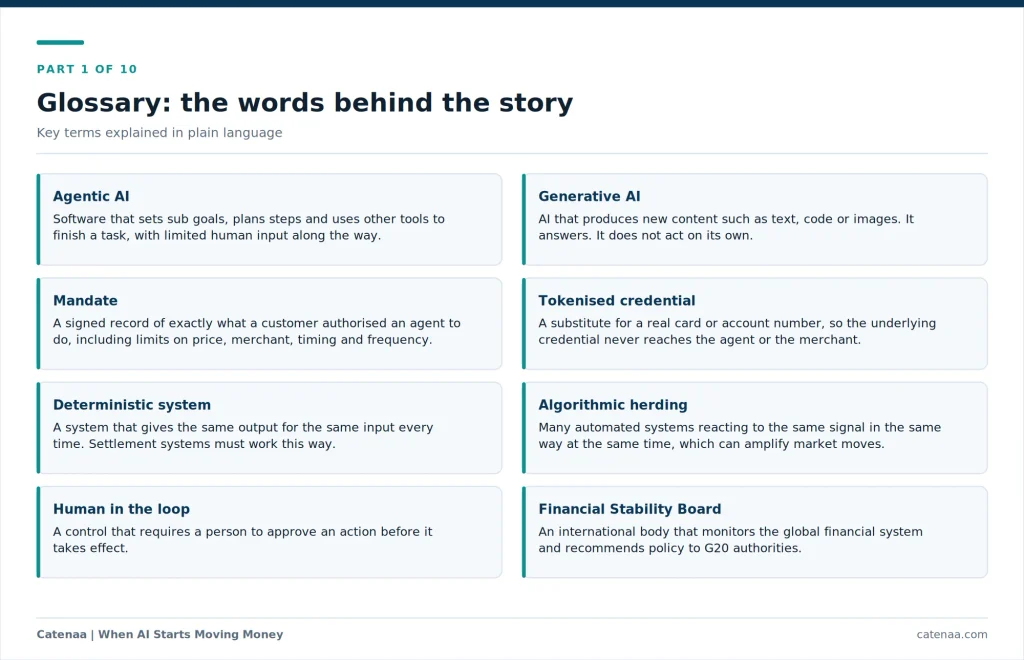
Agentic AI plans and completes multi-step tasks with minimal human input, unlike a chatbot that only answers questions.
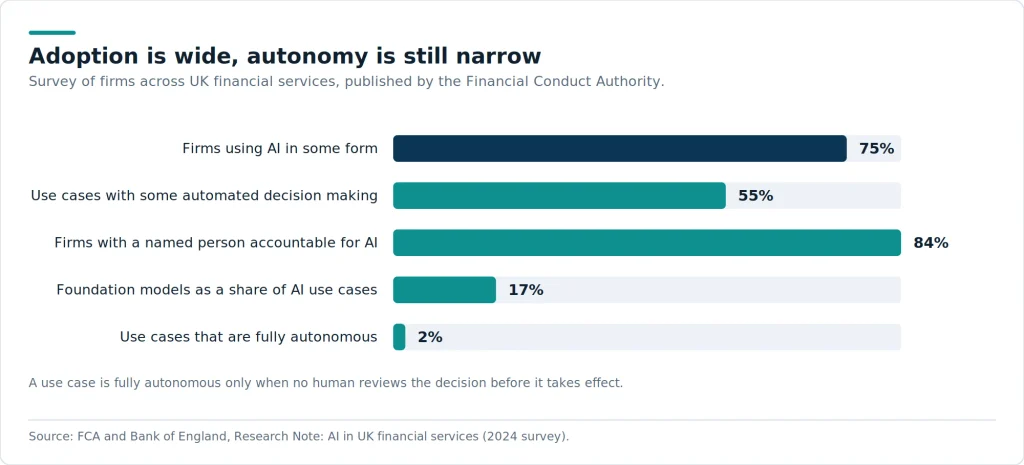
Adoption is broad but supervised. In the UK regulator survey, 75% of financial firms used AI while only 2% of use cases ran fully autonomously.
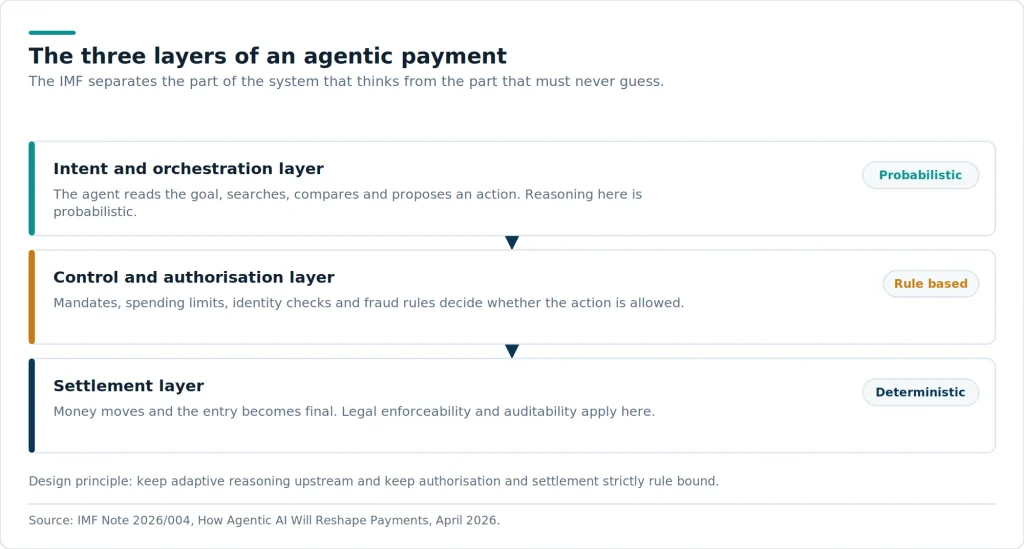
The IMF warns of a structural tension: agents reason in terms of probabilities, while payment systems demand finality, auditability, and legal certainty.
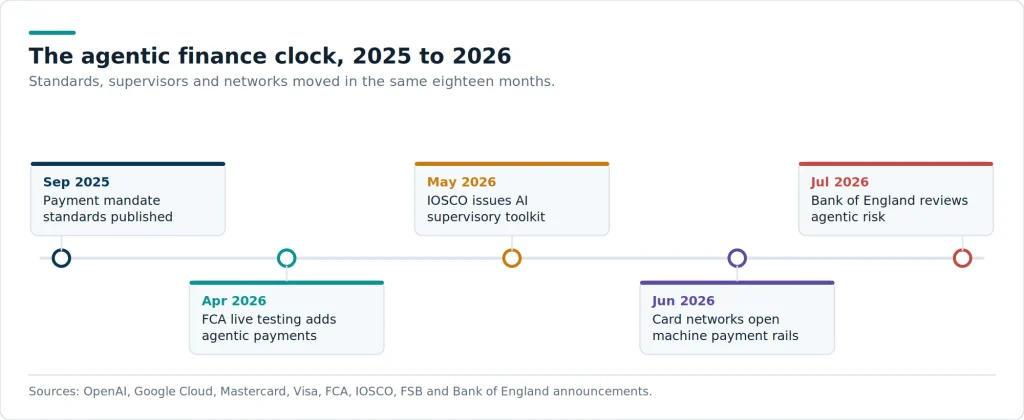
Payment networks built the plumbing first. Mandates, agent identity and tokenised credentials now sit between the agent and the money.
Supervisors moved in 2026. IOSCO, the FSB, the FCA, and the Bank of England all published work that names agentic AI directly.
A treasurer approves a hedge in nine seconds. A shopper never sees a checkout page. A bank runs a compliance check that no analyst has opened. None of these moments look dramatic. Together, however, they mark a shift that the financial system has been preparing for since generative AI arrived.
Until recently, AI in finance mostly produced text. It summarised filings, drafted memos, and answered customer questions. The human then decided. Now the sequence is reversing. Software increasingly decides first and reports afterwards.
What agentic finance actually means
The IMF offers the clearest working definition. In an April 2026 note, staff described agentic AI as autonomous systems that sense their environment, set goals and perform multistep tasks with little human input. Three capabilities separate these systems from earlier tools: planning, adaptation and the ability to use other software.
The Bank of England reached a simiconclusiontion. Its July 2026 Financial Stability Report defines agentic systems as those that plan and carry multi-stepstep tasks at machine speed using external tools with limited human oversight. Notice the phrase machine speed. It matters more than any single capability.
Think of the difference this way. A chatbot is a very good librarian. An agent is a junior colleague with a corporate card, to-do list, and a login. The librarian cannot cost you money. The colleague can.
From analysis to execution
The journey has four visible steps. First, AI analysed. Second, it advised. Third, it drafted actions for a human to approve. Fourth, it began executing inside limits that someone set in advance. Most large institutions now sit between the third and fourth step.
Citi illustrates the pattern. In April 2026 the bank launched Arc, a platform for building AI agents, and reported that more than 80% of its 180,000 colleagues with access to AI tools use them regularly. Bank of America shows the same trend on the customer side. Its virtual assistant Erica has handled 3.2 billion interactions since 2018.
Neither example is autonomous finance yet. Both, however, build the muscle memory that autonomy requires: shared data, logged decisions and clear ownership.
Why the rails changed first
Payments moved before advice did, and for a practical reason. An agent cannot buy anything unless a network can answer three questions. Who is this agent? What did the customer actually authorise? Who pays if the answer turns out to be wrong?
The card network responded with new infrastructure. Mastercard launched Agent Pay for Machines in June 2026, a service built for very high volumes of very small payments between systems. Visa announced a partnership with OpenAI in the same month, using tokenised credentials with user-defined limits on spending, merchant category and approvals.
The design logic is simple. A mandate records the instruction. A token carries the credential. A limit caps the damage. Consequently, the agent gains freedom to act without gaining freedom to improvise with someone else’s balance.

Regulators arrived faster than expected
Supervisors did not wait for a crisis. IOSCO published a supervisory toolkit for AI in capital markets on 25 May 2026, and it explicitly covers emerging agentic techniques. The Financial Stability Board followed in June with a consultation setting out twelve sound practices for AI governance inside financial institutions.
The FCA went further and tested in public. Its second AI Live Testing cohort, announced in April 2026, includes Barclays, UBS, Lloyds Banking Group and Experian. Among the use cases under supervision sit agentic payments and consumer credit score insights.
The risks that follow the money
Speed creates new failure modes. The IMF note lists several. Agents may behave alike and produce algorithmic herding. Credentials spread across more interfaces, which widens the attack surface. Liability becomes blurred when no human clicked anything.
Concentration worries supervisors most. A small number of model providers now sit underneath many financial workflows. The Bank of England noted that AI companies account for around half of the S&P 500, up from about a quarter in 2022. Operational dependence and market exposure therefore point in the same direction.
Model error adds a quieter danger. An agent that misreads a policy document still sounds confident. Unlike a spreadsheet, it will not flag its own uncertainty. Institutions therefore need evidence trails rather than reassurance.
Why 2026 reads as the turning point
Technology rarely changes finance on its own. Three ingredients must arrive together: a capable system, a way to authorise it, and a supervisor willing to engage. All three landed within a single eighteen month window.
That timing explains the sudden vocabulary shift inside banks. Executives stopped talking about copilots and started talking about mandates, guardrails and audit logs. In short, the conversation moved from capability to control.
What to watch next
Three questions will decide how far this goes. Can institutions prove what an agent was authorised to do? Can supervisors see agent behaviour in near real time? Can customers recover money when an agent gets it wrong?
The rest of this series follows the money through the system. We begin where agents already spend: the checkout page that may be about to disappear.