

Shopping used to end with a button. Increasingly, it ends with a signed instruction that a shopper never sees. Here is how agentic commerce works and who stands to lose the customer relationship.
In Summary
OpenAI and Stripe launched Instant Checkout inside ChatGPT in September 2025 and published the Agentic Commerce Protocol as an open standard.
Google’s Agent Payments Protocol answers three questions: did the user authorise this, is the request authentic, and who is accountable if it is wrong.
Visa’s Agentic Ready programme moved from 20 partners in Europe to a planned 85 partners across Asia Pacific and Latin America during 2026.
Consumers accept help far more readily than autonomy. Only 10% say they are comfortable letting an agent complete a purchase alone.
Merchants keep the order and the margin. The AI platform, however, increasingly owns discovery, comparison and the moment of choice.
Picture a household buying replacement running shoes. The shopper names a budget, a size and a preferred brand. An assistant then searches, compares, applies a discount code, and places the order. No product page opens. No checkout button appears.
That sequence is no longer a demo. It is a product, and the payments industry rebuilt part of its plumbing to support it.
What agentic commerce actually is
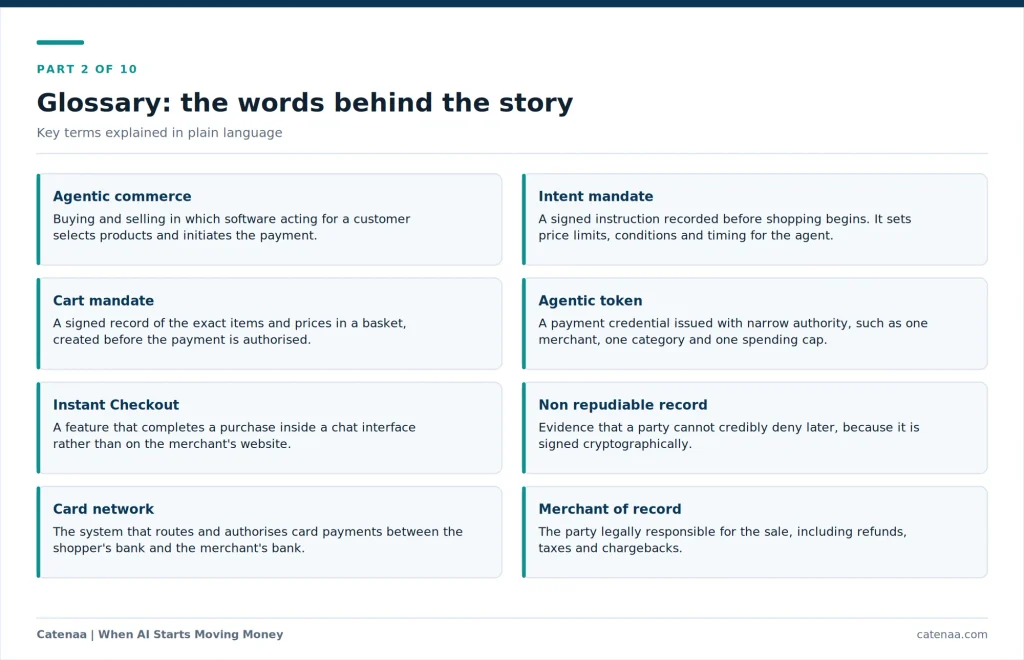
Agentic commerce describes purchases initiated by software acting for a person. OpenAI launched the consumer version on 29 September 2025, when it introduced Instant Checkout in ChatGPT. Etsy sellers came first. Shopify merchants followed. Merchants pay a small commission on completed purchases.
Crucially, the companies published the underlying specification. Stripe and OpenAI released the Agentic Commerce Protocol as an open standard, and Stripe described it as a shared way for agents and businesses to transact. Open standards spread faster than proprietary rails. That decision mattered.
Two changes make this different from earlier shopping bots. The agent now completes the transaction rather than handing the shopper back to a website. Moreover, the merchant keeps control of pricing, fulfilment, and the customer record.
The mandate solves the trust problem
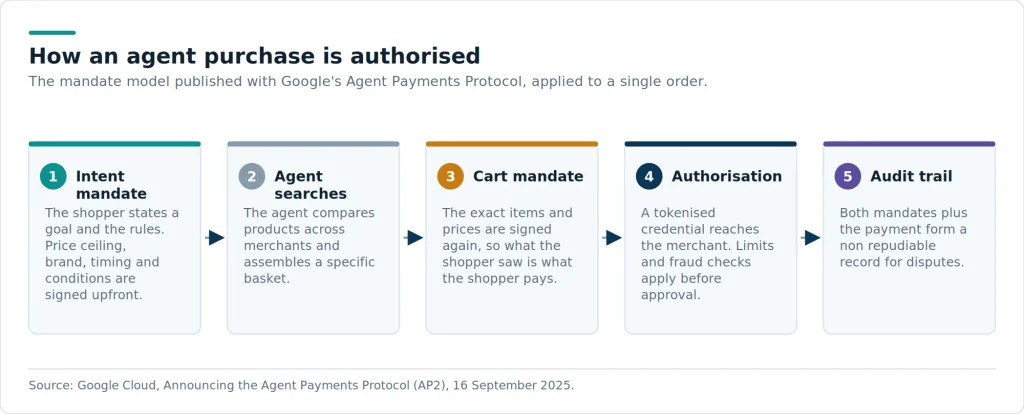
Merchants had an obvious objection. How do you know an agent speaks for a real customer? Google answered on 16 September 2025 with the Agent Payments Protocol, built with more than 60 payments and technology companies, including American Express, Mastercard, PayPal, and Worldpay.
AP2 introduces mandates. An intent mandate captures the original instruction and its limits. A cart mandate captures the exact basket. Both are cryptographically signed. Together, they create a record that neither side can later deny.
Consider why that structure matters. Without the first signature, the agent could exceed the budget. Without the second, the price could change between selection and payment. The pair therefore converts a conversation into evidence.
Networks rebuilt the rails
Card networks moved quickly because they sit at the exact point of doubt. Mastercard introduced Agent Pay in April 2025, using agentic tokens that carry task-specific authority. Visa took a testing route instead.
Visa’s Agentic Ready programme expanded on 29 April 2026 from more than 20 partners in the United Kingdom and Europe to 85 partners across Asia Pacific and Latin America. Participants test enrolment, tokenisation, authentication and authorisation with live cards and real merchants.
In June 2026, Visa also partnered with OpenAI. The design uses tokenised credentials, real-time authorisation and user-defined limits on spending, merchant category and required approvals.
Testing rather than launching reveals a deeper truth. Agent payments break at the edges, not in the demo. Enrolment, step-up authentication, and refund handling all need rework before volume arrives.
Consumers draw a firm line
Enthusiasm and delegation are not the same thing. Mastercard’s Signals research, published in August 2026, found that 85% of consumers are open to working with agents to discover products. Yet only 10% feel comfortable letting an agent complete a purchase without them.
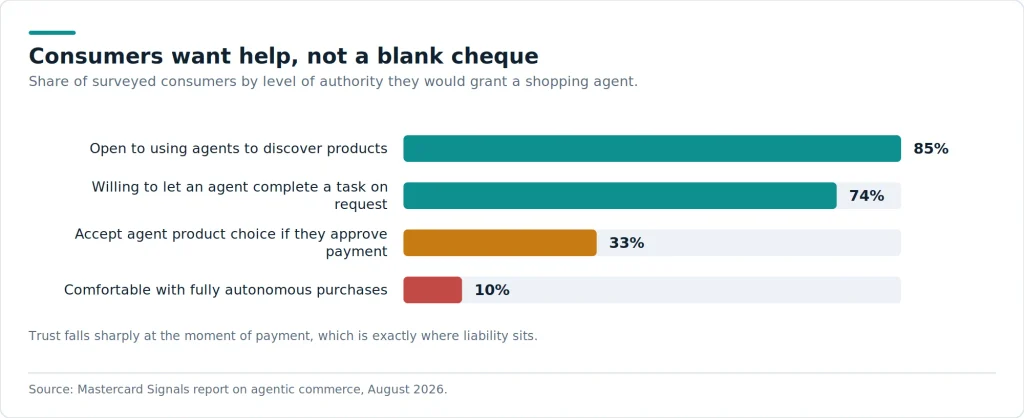
Banks should read that gap carefully. Controls are not a friction in this market. They are the product. A clear spending limit, a visible approval prompt, and a fast refund path all increase the willingness to delegate.
Who actually owns the customer?
This is the commercial question underneath the technology. The merchant still ships the goods and keeps the order record. The bank still funds the purchase. The network still authorises it. Nevertheless, the assistant owns the moment of choice.
Discovery is where brand preference forms. If an agent selects from a shortlist, then placement inside that shortlist becomes the new shelf space. Merchants therefore face a familiar risk with an unfamiliar gatekeeper.
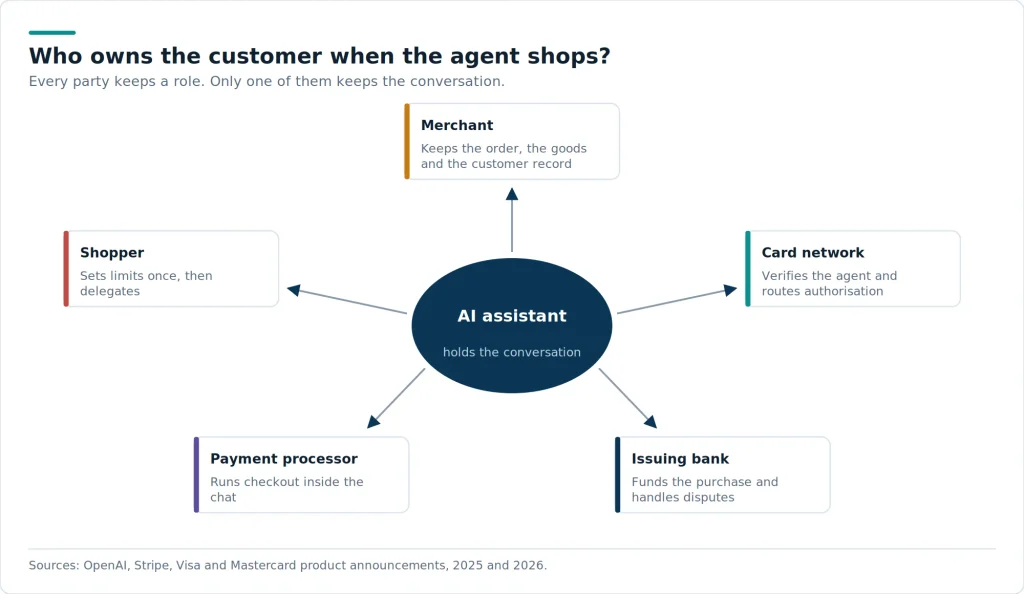
Banks face a subtler version of the same risk. Card issuers spent two decades buying the top-of-wallet position through rewards. An agent, by contrast, may simply pick whichever credential clears fastest inside the stated limits.
The unresolved problems
Three issues remain open. First, disputes. If an agent buys the wrong item within its limits, refund rules built for human error fit awkwardly. Second, fraud. The IMF warns that agents widen the attack surface because credentials pass through more interfaces.
Third, competition. Whoever verifies the agent’s identity gains leverage over everyone else. Standards bodies know this, which explains why so many rival firms joined the same protocols so quickly.
For merchants, the practical response is unglamorous. Clean product data, accurate stock levels, and machine-readable policies now decide whether an agent can transact with you at all. Search engine optimisation is becoming agent optimisation.
Regulators are watching the same seams. The FCA already lists agentic payments among the use cases inside its supervised testing programme. Supervision arriving this early is unusual, and it signals how quickly the volume could build.
Retail is only the visible edge. In the next part, we move from the shopping basket to the current account and ask whether the banking app itself survives.