

Banking apps taught customers to tap through menus. Agents ask them to state a goal instead. That sounds small. In practice, it rewrites consent, product design, and accountability.
In Summary
Scale already exists. Bank of America logged 30 billion client digital interactions in 2025, including around 700 million with its virtual assistant.
Autonomy does not. The UK regulator survey found that only 2% of AI use cases run without human involvement.
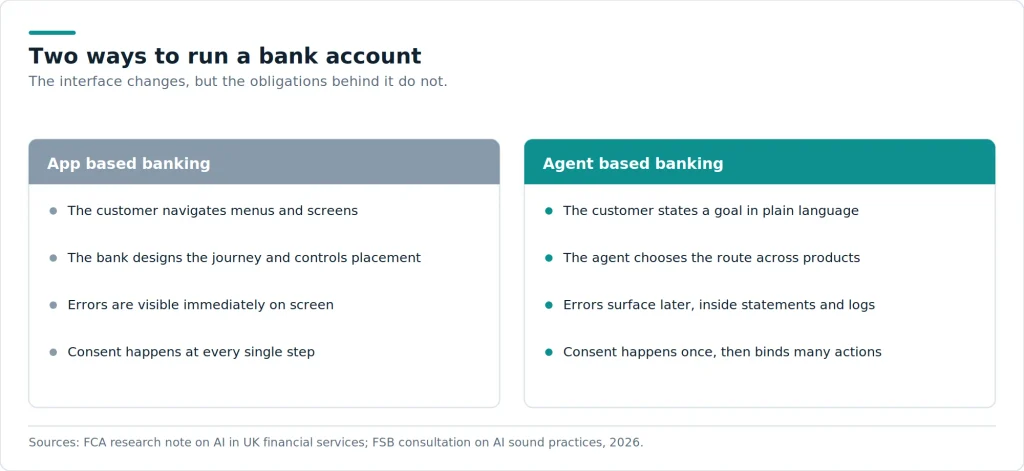
Conversation changes consent. One instruction can authorise many later actions, so mandates and limits replace screen-by-screen approval.
Supervisors are testing this in public. The FCA’s AI Live Testing cohort includes agentic payments and consumer credit score insights.
The IMF flags a conflict of interest risk: an agent may optimise for the provider rather than the customer unless duties are explicit.
Ask most people what their bank looks like, and they will describe an app. Tiles, menus, a balance at the top. That design has barely changed in a decade. Now it faces its first serious challenger.
An agent does not present options. It asks what you want and then does it. Consequently, the screen stops being the product and becomes the receipt.
The volumes were already there
Retail banking reached machine scale long before agents arrived. Bank of America reported 30 billion client digital interactions during 2025, up 14% on the year. Its assistant Erica has processed 3.2 billion interactions since launch, with 20.6 million clients using it during 2025 alone.
Numbers of that size make a human first service model impossible. Banks already automate the routine. The open question concerns judgement, not volume.
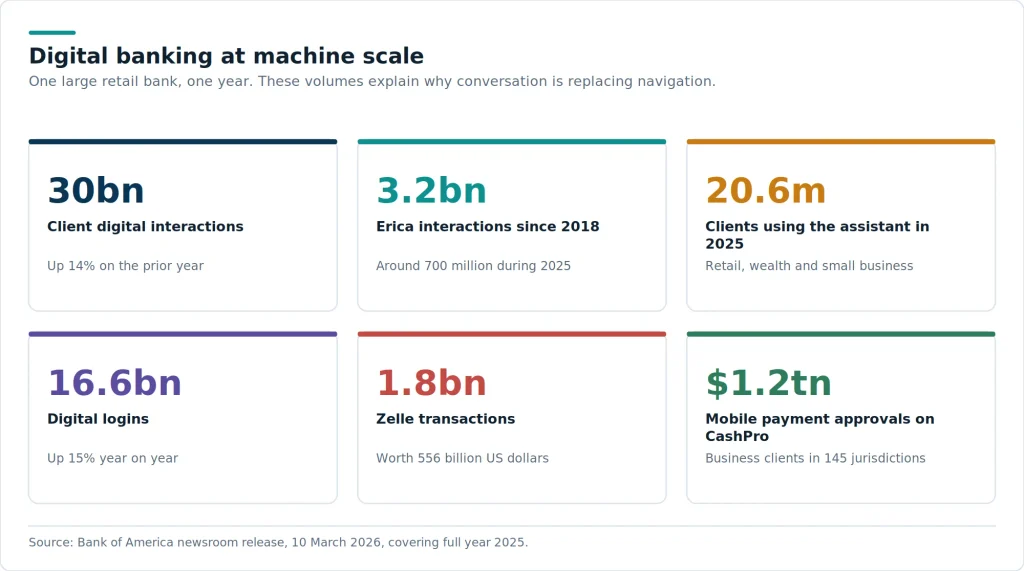
Consider the arithmetic. Thirty billion interactions across a year work out to roughly 950 every second. No branch network, however large, could absorb that. Automation is therefore the baseline, not the innovation.
What an agent actually does differently
Today’s assistant answers questions. It tells you your balance and shows a transaction. An agent, by contrast, completes tasks. It sweeps idle cash into a savings pot. It cancels a subscription you stopped using. It splits a salary across three goals.
The change is subtle but structural. A chatbot reduces effort. An agent reduces decisions. Once decisions move, so does responsibility.
Banks are building the internal version first. Citi launched an agent platform in April 2026 and reported that over 80% of its 180,000 colleagues with AI access use the tools regularly. JPMorgan Chase onboarded 200,000 employees to its LLM Suite within eight months. Employee deployment builds the controls that customer deployment will need.
Small tasks matter more than they look. Dormant subscriptions, idle balances and missed payment dates quietly cost households real money each year. An agent that fixes those delivers value without touching a single investment decision.
Consent is the hard part
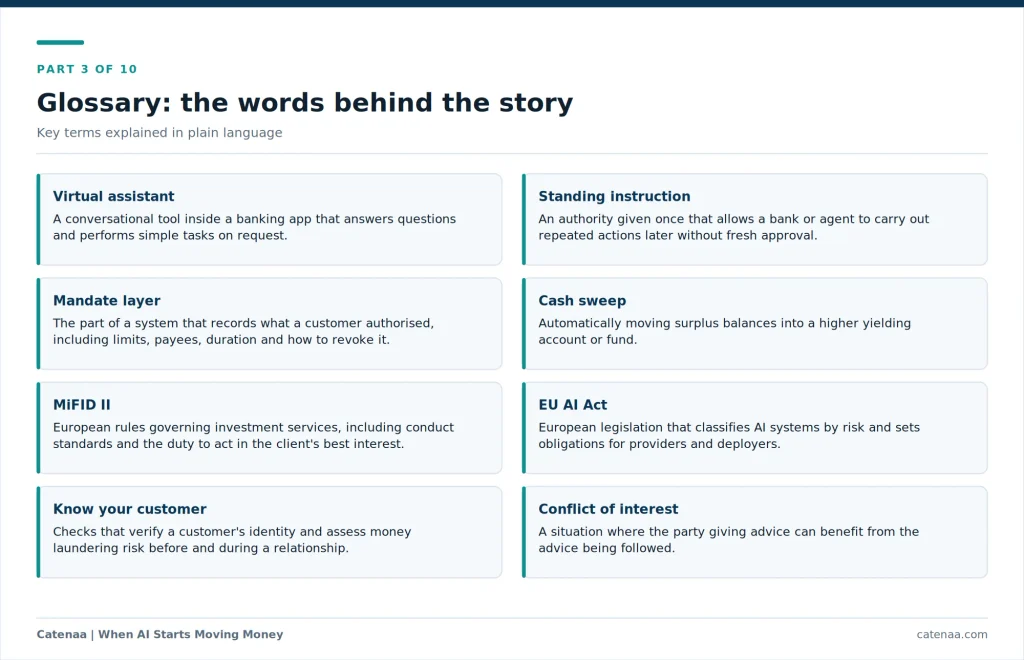
In an app, consent is granular. You approve each payment on screen. In a conversation, consent becomes a standing instruction. Pay my bills. Keep two months of expenses liquid. Move surplus into the best available rate.
Each of those sentences authorises many future actions. Therefore, banks need a mandate layer that records scope, limits, duration, and revocation. Without it, disputes become arguments about what a customer meant.
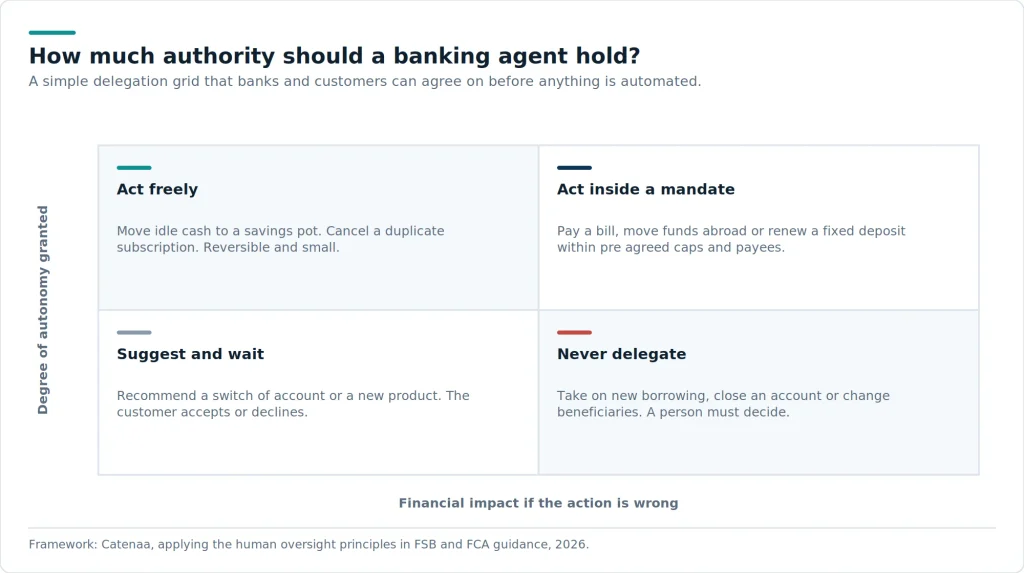
Revocation deserves equal attention. Customers must be able to withdraw authority instantly, and firms must be able to prove when the withdrawal took effect. Otherwise, a cancelled mandate becomes the next complaint category.
Supervisors moved early
Regulators are not waiting for complaints. The FCA opened its second AI Live Testing cohort in April 2026 with Barclays, UBS, Lloyds Banking Group, Experian and others. Use cases under supervision include agentic payments, credit score insights, anti-money laundering, and know your customer checks.
Europe added structural rules. Under the EU AI Act framework, transparency obligations apply from August 2026, while high-risk obligations for areas such as creditworthiness assessment now apply from 2 December 2027. ESMA had already reminded firms that MiFID II duties apply whenever AI touches investment services.
The FSB, meanwhile, put governance on the agenda for boards. Its June 2026 consultation set out twelve sound practices covering the full AI lifecycle inside financial institutions.
Notice the pattern across these interventions. None of them ban autonomy. Instead, they demand evidence: who approved the system, what it was allowed to do, and how a firm would detect the moment it started behaving oddly.
The conflict of interest problem
Here lies the sharpest risk. An agent recommends. Recommendation is where incentives hide. The IMF warns that agents could optimise for provider incentives rather than user welfare and could nudge behaviour at scale.
Imagine an agent that always sweeps cash into the bank’s own savings product. It is convenient. It may also be worse than the market. Customers will rarely notice because they never see the comparison.
Disclosure alone will not fix that. Duties will have to be encoded, tested, and logged. Otherwise, the agent becomes a very persuasive salesperson with no memory of saying no.
Comparison duties, therefore, become central. If an agent claims to find the best rate, it must show the field it searched. Furthermore, a bank that restricts that field should say so plainly rather than burying it in terms.
What happens to the app
The app will not vanish. It will change the job. Instead of hosting the journey, it becomes the place where customers review what their agent did, adjust limits, and revoke authority.
Think of a car dashboard rather than a steering wheel. The controls remain. The driving does not always require them.
Retail banking is only one half of the story. Corporates run far larger balances with far smaller teams. In the next part, we look at the AI treasurer.