


Table of Contents
- Table of contents will be generated automatically when the page loads.
The Digital Asset Market CLARITY Act advanced 15-9 through the Senate Banking Committee on May 14, 2026. Yet a thin, understaffed CFTC now threatens the rules it would have to write. Here is what regulatory clarity really means for Bitcoin, and why agency staffing is the true bottleneck.
In Summary
The 15-9 vote was in the Senate Banking Committee, not full Senate passage. The bill still needs the Senate floor, House reconciliation, and a presidential signature.
The CLARITY Act splits oversight: the SEC governs fundraising, while the CFTC governs spot trading of “digital commodities” once a network looks decentralized.
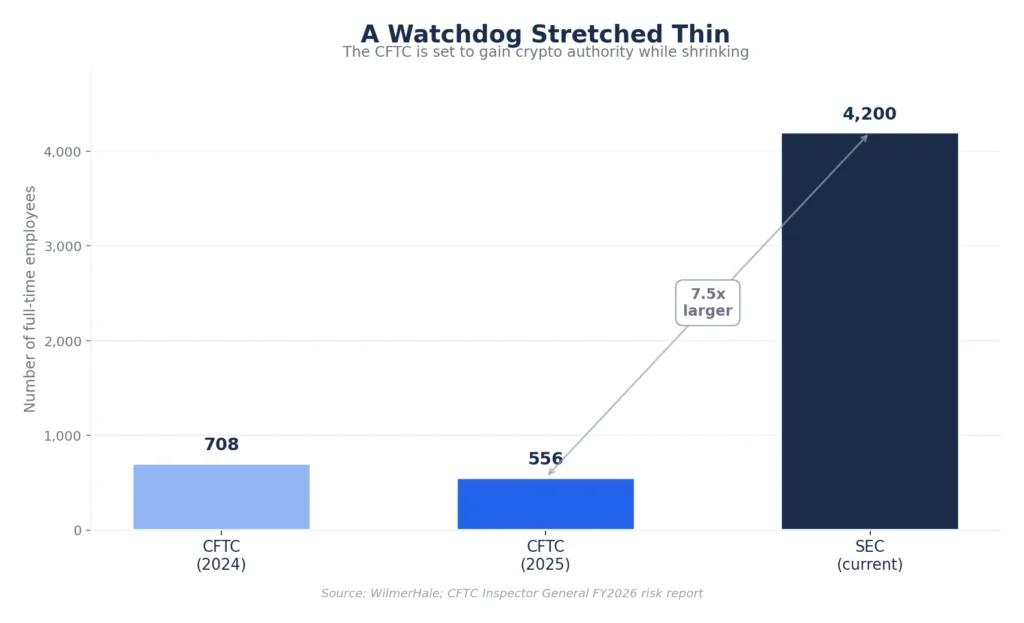
The CFTC is small and shrinking. Its workforce fell by about 20% under the current administration, to roughly 600 staff, compared with the SEC’s ~4,200.
Analysts warn the bill likely needs Senate passage by late July 2026, or its odds fade sharply before the midterms.
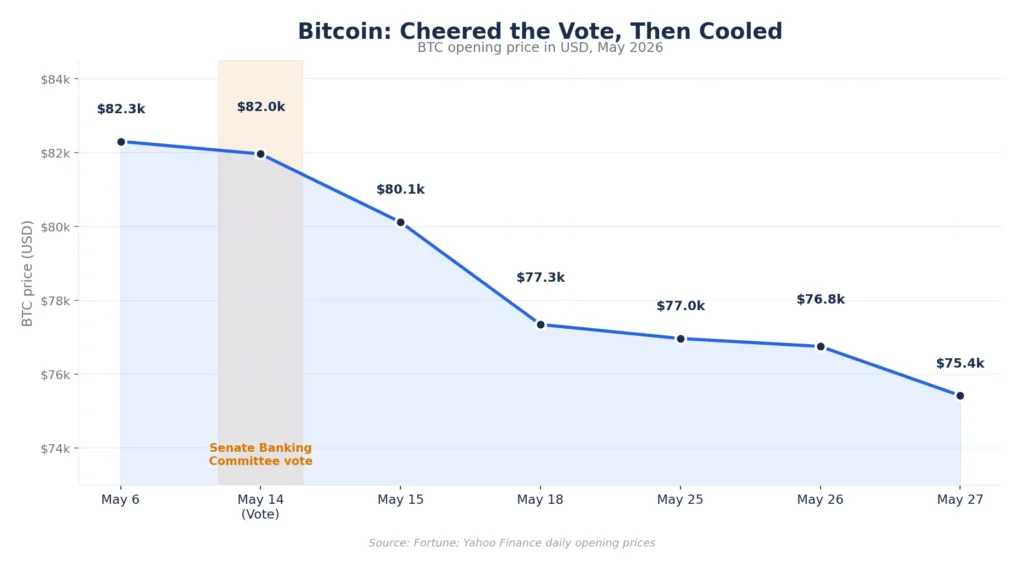
Markets cheered the vote, then cooled. Bitcoin touched ~$82,000 in early May, but trades near $75,400 today amid ETF outflows.
What Just Happened in the Senate
First, let’s set the record straight. On May 14, 2026, the Senate Banking Committee voted 15-9 to advance the CLARITY Act (H.R. 3633). Committee Chairman Tim Scott secured a bipartisan result through a last-minute maneuver, according to CoinDesk.
Importantly, this was not the full Senate. All 13 Republicans backed the bill, joined by just two Democrats, Senators Ruben Gallego and Angela Alsobrooks (CNBC). The House had already passed its version in July 2025 by 294-134 (Blockchain Council).
Meanwhile, the opposition stayed loud. Senator Elizabeth Warren filed 44 amendments and argued the bill was not ready for prime time. Her core worry: companies could sidestep investor protections by moving “on-chain.”
What the CLARITY Act Actually Does
So why does this bill matter so much? In short, it answers a question that has fueled years of lawsuits: who regulates crypto?
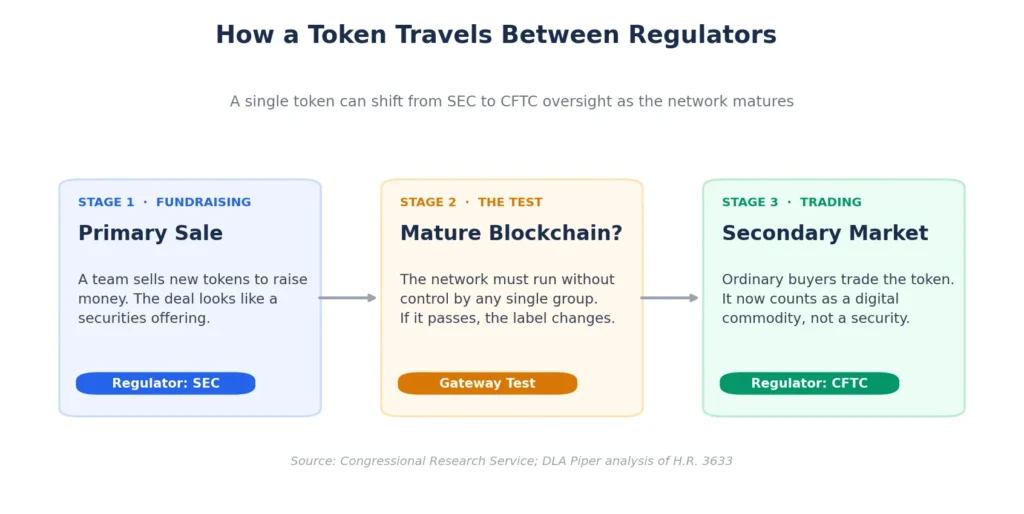
The answer is a split. The Securities and Exchange Commission (SEC) keeps authority over fundraising and token issuance. The Commodity Futures Trading Commission (CFTC) gains authority over spot trading of “digital commodities” (DLA Piper). The diagram below shows how a single token can move between the two regulators over its life.
The “Digital Commodity” Question
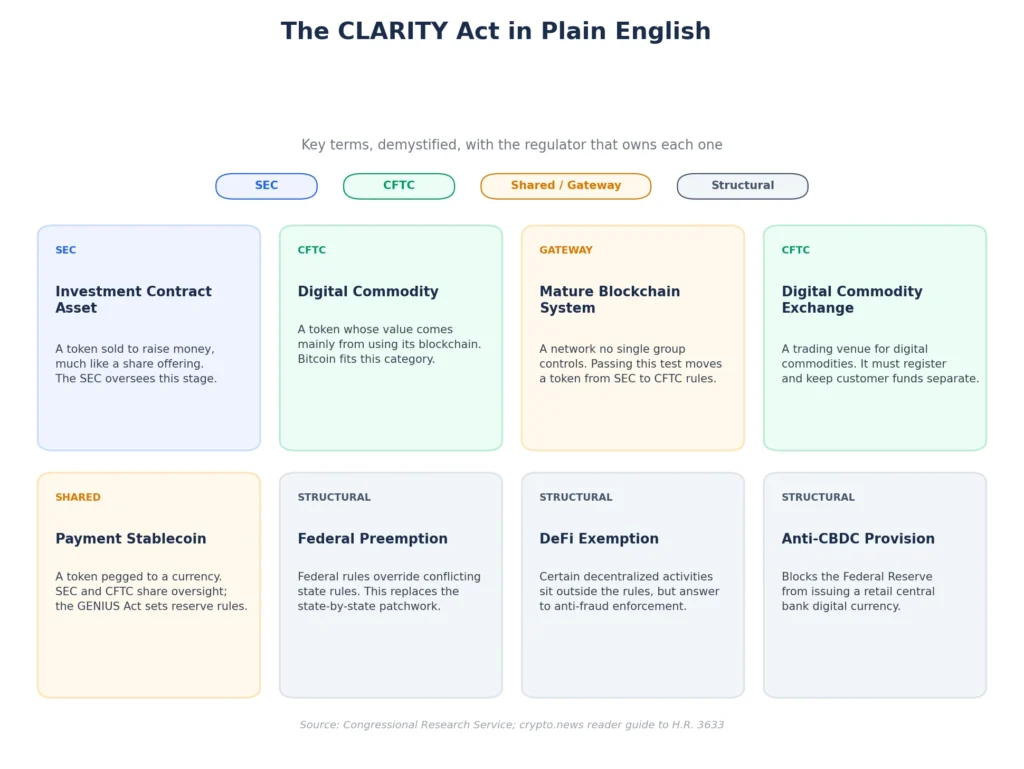
At the heart of the bill sits one definition. A “digital commodity” is a digital asset whose value comes mainly from the use of its blockchain (crypto.news). Notably, the term excludes securities, derivatives, and stablecoins.
Why does this matter? Because the label decides the rulebook. The SEC has historically taken a tougher line on crypto than the CFTC (FinTech Weekly). Therefore, landing in CFTC territory generally means a lighter compliance burden.
The Mature Blockchain Test
Tokens rarely start out decentralized, though. So the bill adds a “mature blockchain system” test. A network reaches maturity when no single person or group controls it (beincrypto). Once certified, the issuer escapes certain SEC disclosure rules.
As a result, the same token can shift hands between regulators without changing its code. That elegance is also a weakness, because someone must actually run the test and police the markets that follow.
Why Regulatory Clarity Matters for Bitcoin
Bitcoin already sits comfortably on the commodity side of the line. Even so, the CLARITY Act still matters for it.
Clear rules tend to draw institutional money. Firms like Coinbase, Circle, and Ripple have lobbied for the bill precisely because predictable oversight legitimizes the industry (CNBC). Furthermore, a federal framework reduces the patchwork of state rules that has long frustrated builders.
Public opinion appears to agree. One poll cited by Bitcoin.com found 52% of Americans support the legislation. Roughly 70% felt the country should already have such rules in place.
The Global Stakes: Why US Leadership Hangs in the Balance
The race for crypto rules is not only domestic. It is global. And capital tends to flow toward whichever jurisdiction offers the clearest path.
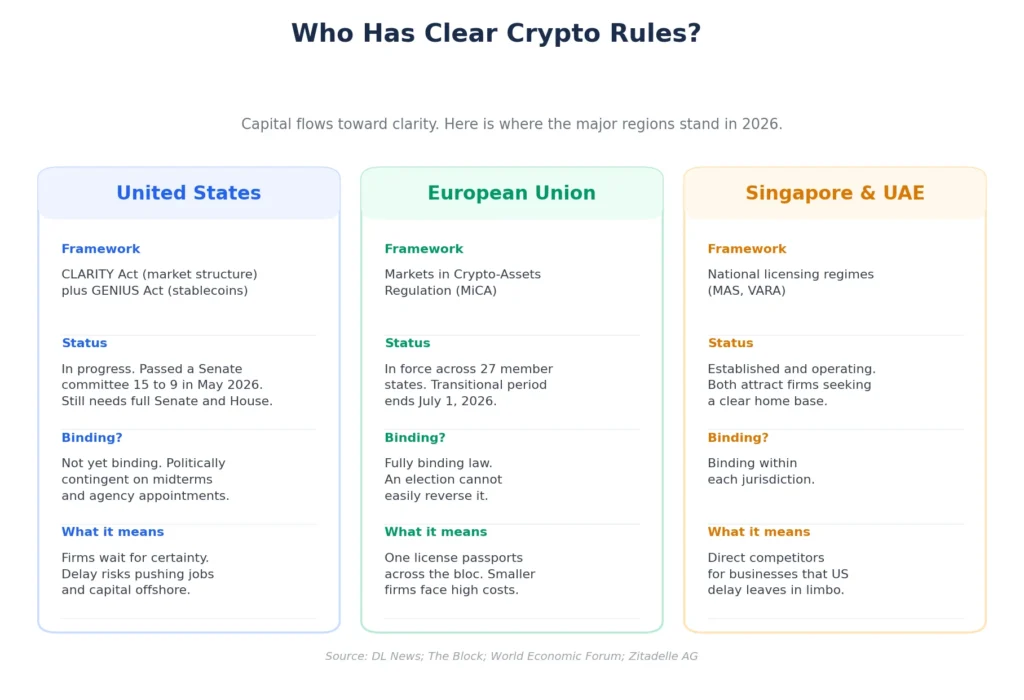
Europe has already moved. The EU’s Markets in Crypto-Assets Regulation, known as MiCA, binds all 27 member states, and its transitional period ends on July 1, 2026. Singapore and the UAE run their own established regimes too. Therefore, the US is no longer setting the pace by default.
Experts frame the danger bluntly. Without a federal framework, the SEC and CFTC keep fighting over turf, and firms keep operating in a gray zone. As one analyst told DL News, “Capital goes where there’s clarity.” A failure to pass CLARITY would make offshore issuers more competitive while shrinking the overall market.
Industry has noticed. More than 100 US crypto firms, including Coinbase and Ripple, urged the Senate to act. Their warning was direct: continued delay risks pushing investment and jobs offshore.
Yet there is a deeper contrast worth weighing. MiCA is a binding law that an election cannot easily undo. The US framework, by comparison, remains politically contingent. Agency appointments and the November 2026 midterms could still reshape it. As a result, businesses cannot yet treat US rules as a stable long-term foundation.
Even so, the US has built momentum. The GENIUS Act became law in July 2025, setting stablecoin rules around 1:1 reserves, redemption rights, and independent checks. Meanwhile, a joint SEC and CFTC ruling on March 17, 2026 classified 16 cryptocurrencies, including Bitcoin, Ethereum, and XRP, as digital commodities. CLARITY would complete this half-built structure. The comparison below shows where the major regions stand.
The Real Bottleneck: CFTC Staffing
Here lies the problem the headlines often miss. A law is only as strong as the agency that enforces it. And the CFTC, soon to be crypto’s main cop, is stretched thin.
A Capacity Crisis
Consider the numbers. The CFTC’s headcount fell roughly 20% under the current administration, leaving about 600 staff (WilmerHale). By contrast, the SEC employs around 4,200 people. The chart below makes that gap impossible to ignore.
Leadership has changed, too. The Senate confirmed pro-crypto lawyer Mike Selig as CFTC Chair in December 2025 by a 53-43 vote, and his term runs through April 2029 (Yahoo Finance). However, several commissioner seats remain empty. Selig himself has said the agency is leaning on AI and automation to cover the gaps left by staff cuts.
A new spot-market regime demands a great deal: registrant categories, surveillance systems, custody rules, and enforcement teams. That is a heavy build for a small agency. The CFTC’s own inspector general flagged digital asset regulation as a top risk for fiscal 2026.
The Independence Question
Money is only half the worry. Independence is the other half. A recent report raised concerns that leadership had softened enforcement against major firms (CryptoSlate).
Consequently, the debate has shifted. The question is no longer only whether the CFTC has enough people. It is whether those people stay free to ask hard questions of powerful companies.
How Markets Reacted
Traders responded fast to the committee win. Bitcoin climbed toward $82,000 on the news, while crypto stocks jumped, including Coinbase and Strategy (Yahoo Finance).
That optimism has since faded, though. Bitcoin trades near $75,400 today, pressured by ETF outflows and Middle East tension rather than policy (Fortune). The chart below tracks the round trip.
The Road Ahead
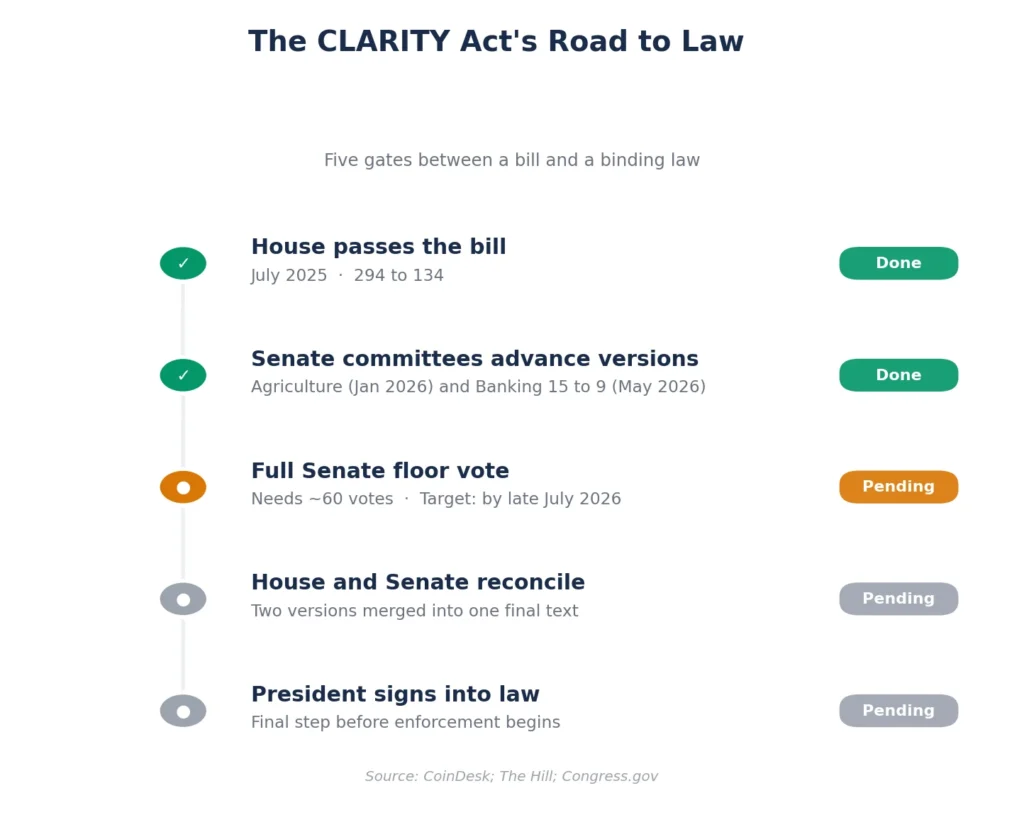
The path to law remains long. After the committee, the bill faces a full Senate floor vote, where it likely needs 60 votes (CoinDesk). Next, the Senate and House must reconcile their versions before anything reaches the President.
Timing adds pressure. Stifel strategist Brian Gardner warned the Senate should act by late July, ideally June. Otherwise, the bill’s prospects would weaken before the November midterms (The Hill). The stepper below shows where things stand.
What This Means for You
The implications extend beyond a single vote, so it helps to separate them by audience.
For investors, the signal is measured optimism. Clearer rules could deepen US markets, attract institutional investors, and reduce legal risk over time. However, the framework is neither final nor permanent. Therefore, treat the late-July Senate deadline and future CFTC commissioner appointments as the real signals to watch, not the committee headline.
For builders and founders, the calculus is structural. A US framework would reduce the pull of offshore hubs like Singapore and the UAE. Still, the rules remain reversible in a way MiCA is not. As a consequence, many teams now run multi-jurisdictional strategies rather than betting on a single regime.
For students and curious readers, the lesson is the most durable takeaway here. Passing a law is a visible victory. Building the capacity to enforce it remains largely invisible, yet it determines whether the law actually works.
This is where the two halves of the story finally meet. The US may well win the legislative race against Europe. Even so, an understaffed CFTC could still lose the enforcement race. A rulebook without referees protects no one. In short, regulatory clarity is necessary for US crypto leadership, but it is not sufficient on its own.
The Bottom Line on Implications
- Clarity is a magnet for capital. Markets, jobs, and firms gravitate toward jurisdictions with clear rules.
- The US is racing the clock and the world. MiCA is already binding across 27 states, while CLARITY still sits in the Senate.
- Passage is only half the battle. Enforcement depends on a CFTC that is shrinking even as its mandate grows.
- Watch the signals, not the headlines. The late-July deadline, commissioner appointments, and whether the CFTC accepts registrant funding will reveal more than any single vote.
Glossary: Key Terms Explained
- CLARITY Act: A US bill that sets federal rules for crypto markets and divides oversight between the SEC and the CFTC.
- SEC (Securities and Exchange Commission): The regulator for stocks, bonds, and other securities, including crypto fundraising.
- CFTC (Commodity Futures Trading Commission): The smaller regulator for commodities and futures, set to oversee crypto spot trading.
- Digital commodity: A token whose value comes mainly from the use of its blockchain, treated like a commodity rather than a security.
- Mature blockchain system: A network that runs without control by any single group, which can change a token’s regulatory status.
- Spot market: A market where assets trade for immediate delivery, as opposed to futures contracts.
- Markup: The committee stage, where lawmakers debate and amend a bill before voting to advance it.
- Reconciliation: The process of merging the House and Senate versions of a bill into one final text.
- ETF outflows: Money leaving exchange-traded funds, often a sign of weakening investor demand.