

September 27, 2026 – Total supply has flattened since spring, and two coins still hold most of it. Distribution deals, not technology, now decide market share.

In Summary
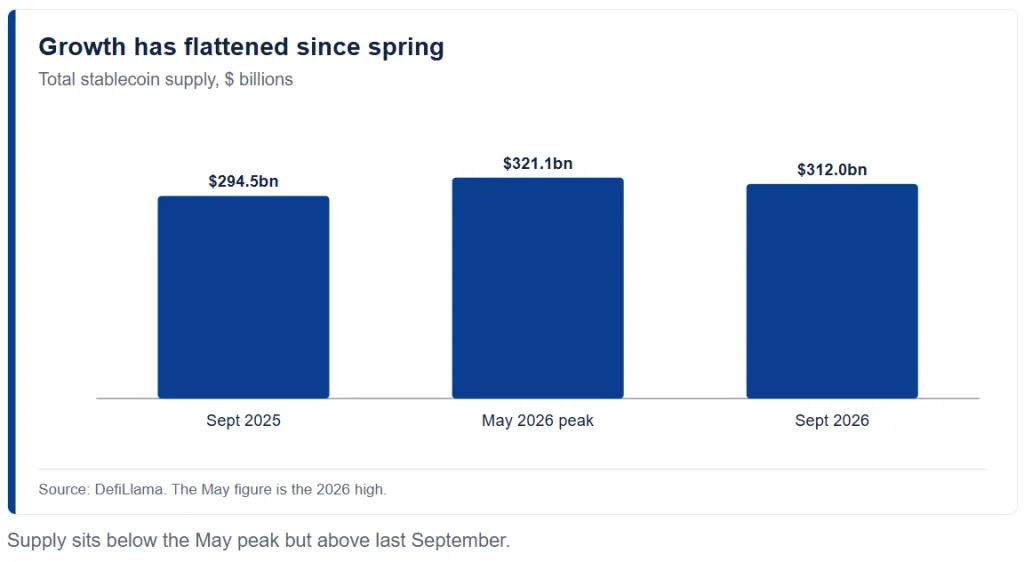
Total stablecoin supply stands near $312 billion, about 3% below the May peak of $321 billion.
Supply has grown about 6% over the past year, a slower pace than earlier in 2026.
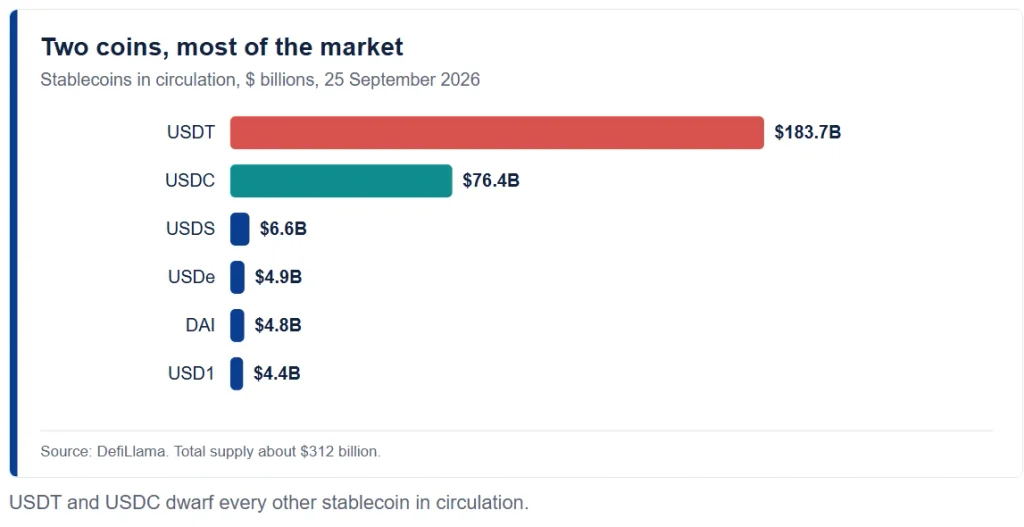
USDT holds about $184 billion and USDC about $76 billion, together roughly 83% of the market.
Circle sold $100 million of stock to Binance and signed a five-year USDC promotion deal.
S&P Global Ratings gave three of 11 assessed stablecoins its weakest score in August.
Stablecoin supply has stalled near its highs. The total stands at about $312 billion, DefiLlama data show. That is roughly 3% below the peak of $321 billion set in May.
Growth over the year still looks solid. Supply sat near $294 billion a year ago, so the market has added about 6%. The pace, however, has slowed sharply since spring.
Two coins dominate as usual. Tether’s USDT accounts for about $184 billion. Circle’s USDC follows with roughly $76 billion.
What the Stablecoin Supply Shows
Concentration is the headline. The top two tokens hold about 83% of all supply. No third coin comes close.
Behind them, the field thins quickly. USDS holds about $6.6 billion, while USDe and DAI each sit near $4.8 billion. USD1 rounds out the top six at $4.4 billion. Everything else together accounts for barely a tenth of the market.
Stablecoin supply tracks demand for onchain dollars. Traders use these tokens as collateral, as settlement money and as savings. A flat total therefore suggests steady, rather than surging, activity.
The composition matters too. Most supply sits on a handful of large chains, close to trading venues. Payment use, by contrast, spreads across many smaller networks.
Distribution Is the New Battleground
Issuers no longer compete on technology alone. They pay for shelf space, much as fund managers do. Circle showed that clearly this week.
The company sold $100 million of stock to Binance at $80.84 a share, a filing shows. Alongside that, it signed a five-year deal to promote USDC on the exchange. Circle pays a monthly fee tied to balances held.
Economics explain the trade. Circle earns reserve income on the assets backing USDC. Growing the float therefore raises revenue, even after paying distribution costs.
Rivals use similar tactics. Issuers fund wallet integrations, exchange listings, and merchant rebates. Each deal buys balances that might otherwise sit elsewhere.
The Business Behind the Float
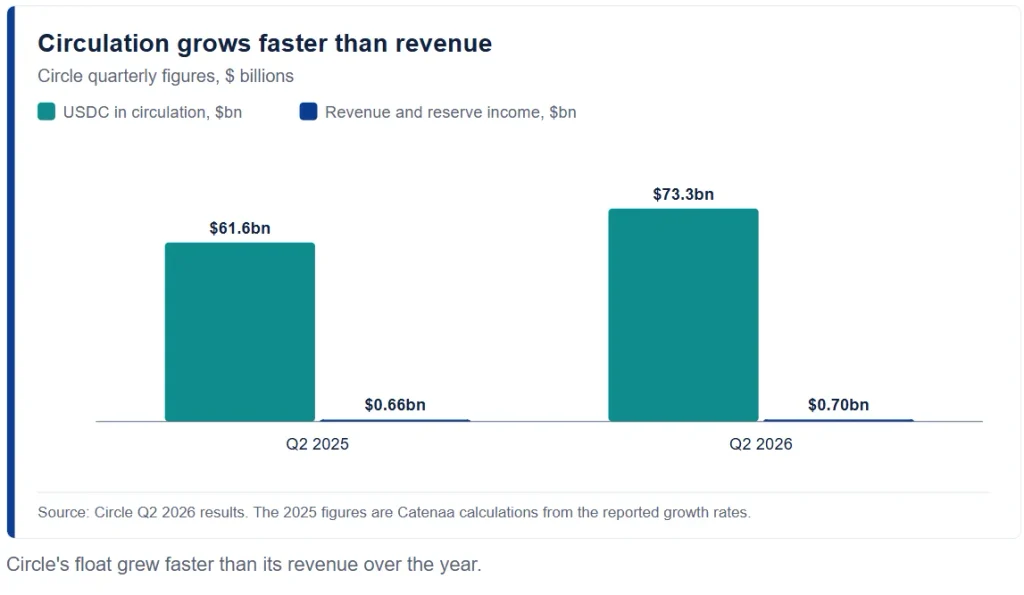
Circle’s second-quarter results show the model. USDC in circulation reached $73.3 billion at the end of June, up 19% from a year earlier, the company reported. Onchain transaction volume hit $14.8 trillion.
Revenue and reserve income came to $701 million, a 7% rise. Net income from continuing operations reached $48 million. Adjusted earnings before interest, tax, depreciation and amortisation stood at $143 million.
Notice the gap between growth rates. Circulation rose 19%, yet revenue rose only 7%. Lower interest income per dollar explains much of that difference, and distribution payments explain the rest.
Quality Varies More Than Size
Not all stablecoins carry the same risk. S&P Global Ratings scored 11 of them in August on a scale of 1 to 5. Four earned a 2, meaning strong.
Three received the weakest score of 5. Among them was the largest coin by supply. Size and safety clearly do not move together.
Reserves, disclosure, and governance drive those assessments. A coin backed by short-dated Treasuries and audited monthly scores better than one with opaque holdings. Investors rarely price that difference in normal times.
Stress changes that quickly. In a panic, holders redeem the weakest coin first. Depegs have historically lasted hours, yet they reshape market share for months.
Regulation Is Catching Up
Rulemaking has moved quickly this year. Britain finalised its stablecoin regime before the summer, the FCA chief executive said. Work continues on using these tokens as settlement assets.
Europe has its own framework, and American agencies keep issuing guidance. Each regime demands reserve quality, redemption rights and disclosure. Compliance costs therefore favour larger issuers.
That trend could entrench the duopoly. Smaller coins struggle to fund audits, licences and legal teams. Consequently, consolidation looks likely over the next few years.
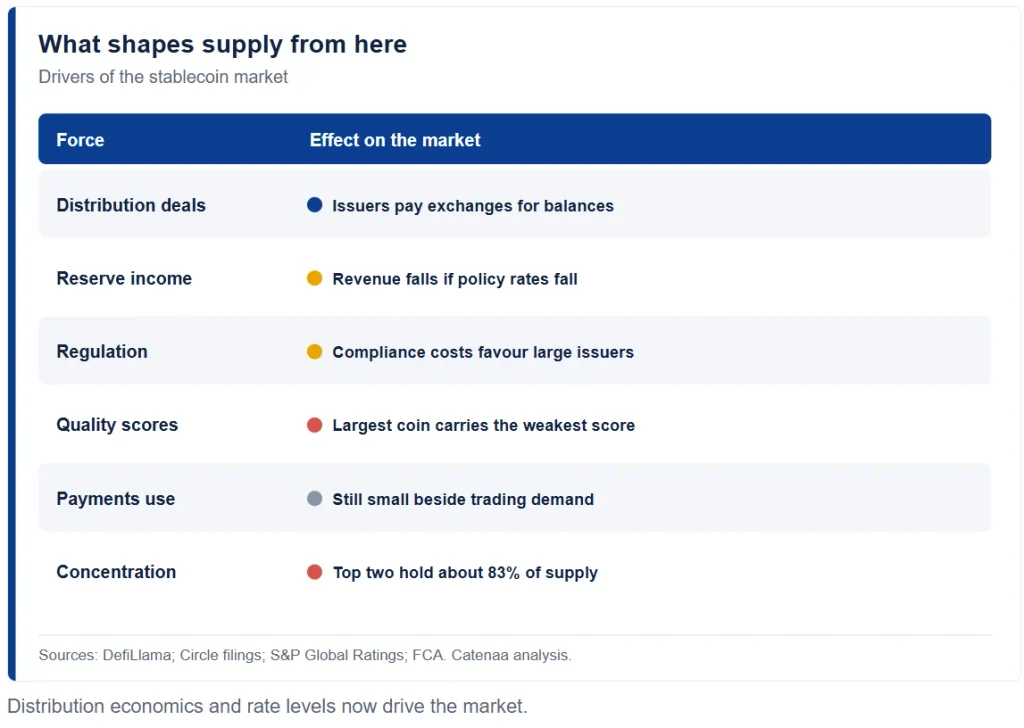
What to Watch Next
Three signals will show where stablecoin supply goes next. First, whether the Binance deal lifts USDC balances in the fourth quarter. The next results should reveal that.
Second, whether interest rates hold up. Reserve income falls with policy rates, which would squeeze issuer margins. Cuts would test business models built on high yields.
Third, whether payment use grows beyond trading. Merchant settlement and cross-border payouts remain small today. Real adoption there would add demand that does not depend on market cycles, which is what issuers keep promising investors.
For now, the market looks mature rather than stagnant. Stablecoin supply is large, concentrated and slowly growing. The contest has shifted from launching coins to winning distribution, and that fight favours the biggest balance sheets.