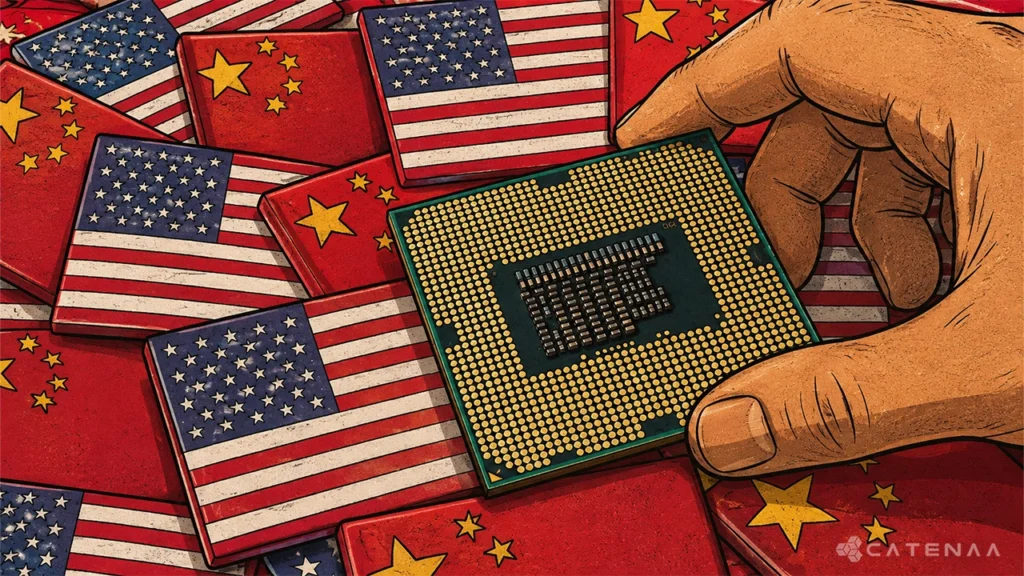


Catenaa, Thursday, November 26, 2026- US restrictions on chips to China and a crackdown by AI leaders on distillation have slowed AI development in China.
Reuters reported that Z.AI has encountered setbacks with its upcoming flagship model. At the same time, Moonshot AI could see its development cycle extend to at least a year if access to overseas computing resources is disrupted.
The restrictions could undermine the cost advantage Chinese AI developers have maintained against their American competitors, Reuters reported. Stronger protections introduced by OpenAI and Anthropic against unauthorised distillation are adding to the challenges created by US semiconductor controls.
Reuters reported that new US export controls introduced in November restrict Chinese companies’ access to computing power without licensing for advanced US chips in overseas data centers, closing a route Chinese firms have used to obtain Nvidia-powered computing capacity without importing the processors directly.
Sources told Reuters that Z.AI, also known as Zhipu AI, had planned to release its next flagship model, GLM-5.5, this month but has yet to do so.
“The model, designed with roughly 3 trillion parameters – a measure of its size – has been held up partly by increasingly effective safeguards against distillation,” one of the people told Reuters.
Z.AI had hoped to complete training and release the model by year-end, but new US computing restrictions could push its launch into the first quarter of 2027 or later, the person said.
On Monday, the company released GLM-5.4, built on an existing model with 750 billion parameters. Z.AI says a new design enables it to match the performance of models with 2 trillion to 3 trillion parameters.
In September, Anthropic alleged that Chinese AI developers, including Alibaba, Moonshot, and Z.AI. were suspected of being involved in nearly 200 million exchange distillation campaigns.
OpenAI has made similar accusations against Moonshot, and both US companies have taken measures to block unauthorised distillation.