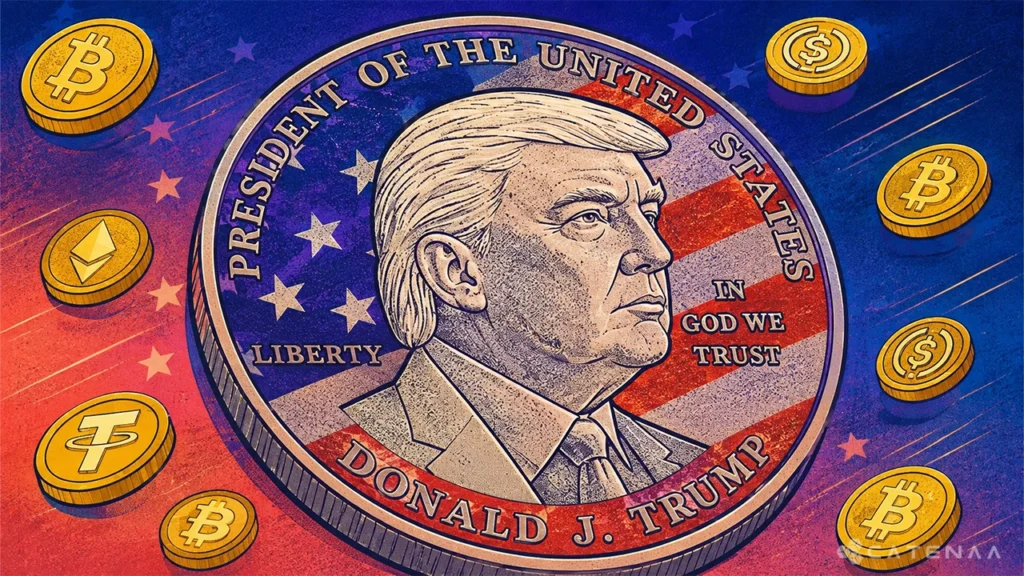


Catenaa, Saturday, August 08, 2026- Growing public opposition to President Donald Trump’s cryptocurrency business interests is emerging as a new risk factor for politically affiliated digital assets, as recent opinion polls indicate that a majority of U.S. voters disapprove of the president’s earnings from the sector.
The findings arrive as lawmakers continue debating ethics provisions that could influence the future regulatory landscape for politicians with substantial cryptocurrency holdings.
According to surveys cited by Democratic Sen. Elizabeth Warren, 55% of voters disapprove of Trump’s cryptocurrency-related earnings, while 44% strongly disapprove.
A separate survey commissioned by the Progressive Policy Institute and GBAO found that between 71% and 75% of respondents support prohibiting federal officials and their immediate families from profiting from cryptocurrency businesses, including after being informed of Trump’s business background.
The polling has added momentum to an already contentious debate over political conflicts of interest in digital assets.
Critics argue that elected officials should not financially benefit from industries they help regulate, while supporters maintain that private business ownership should not automatically prevent participation in public office.
The issue has gained prominence as Congress considers broader cryptocurrency legislation, including proposals designed to establish comprehensive federal regulatory frameworks for digital assets.
Ethics provisions have become one of the principal areas of disagreement during negotiations.
Political uncertainty has also affected the TRUMP cryptocurrency token, which has weakened amid the debate.
The token recently traded around $1.45, declining approximately 9.4% over the previous week, reflecting cautious investor sentiment toward politically associated digital assets.
Unlike traditional cryptocurrencies, politically branded tokens remain especially sensitive to legislative developments, public opinion and election-related events.
Analysts note that sentiment surrounding public figures can increasingly influence price movements independently of broader cryptocurrency market conditions.
Market participants are now closely monitoring whether public opinion translates into legislative action.
If Congress advances measures restricting cryptocurrency ownership or financial interests among senior government officials, politically linked digital assets could face additional pressure.
Conversely, prolonged political negotiations without concrete legislative changes could allow prices to stabilize if broader cryptocurrency market conditions improve.
The debate also reflects growing attention to governance standards within the expanding digital asset industry.
The controversy illustrates how cryptocurrencies are becoming increasingly intertwined with mainstream politics.
Beyond technological innovation and financial markets, digital assets are now emerging as subjects of public policy, ethics and electoral debate.
For investors, political developments may become an increasingly important factor alongside macroeconomic conditions, regulation and blockchain adoption.
The outcome of congressional discussions could influence not only politically associated tokens but also broader perceptions of regulatory certainty across the cryptocurrency sector.
Public opinion surveys suggest cryptocurrency has evolved into a mainstream political issue rather than a niche financial topic.
As lawmakers continue negotiating digital asset legislation and ethics provisions, political developments may increasingly shape investor confidence in projects linked to public officials.
The debate underscores the growing intersection between cryptocurrency markets, public trust and government oversight.
The expansion of cryptocurrency ownership among politicians, corporations and financial institutions has intensified calls for clearer ethics rules governing digital asset holdings by public officials. While Congress continues working on broader cryptocurrency legislation, questions surrounding conflicts of interest have become central to the policy debate. Political tokens linked to public figures represent a relatively new segment of the digital asset market and remain particularly sensitive to regulatory developments, election cycles and changes in public sentiment.