

November 05, 2026 – The CFTC opened the door to perpetual contracts on individual US stocks. Within hours, an alliance that includes Cboe and Citadel Securities asked a court to shut it.

In Summary
The CFTC said on 3 November that perpetual futures on individual US stocks can begin trading.
The Capital Markets Alliance, whose members include Cboe and Citadel Securities, sued the CFTC the same day.
The suit argues the products are security-based swaps under SEC jurisdiction, not security futures.
Filings by Kalshi, Coinbase Derivatives and Bitnomial became deemed approved after a 45-day review lapsed.
The alliance wants the approvals vacated and blocked while the case proceeds.
Stock perpetual futures cleared CFTC review on 3 November, and a legal fight began the same day. The Commodity Futures Trading Commission said such contracts can begin trading for the first time on CFTC-registered exchanges. Hours later, a Wall Street trade group sued to stop them. Any exchange that lists them must also register with the SEC for these products.
What the CFTC allowed
Perpetual contracts never expire. Instead, buyers and sellers swap regular funding payments that keep the price close to the asset it tracks. Crypto traders have used them for many years, mostly on offshore venues outside US rules. Now the model is coming to individual US stocks.
Three platforms filed products on 18 September: Kalshi, Coinbase Derivatives and Bitnomial. The CFTC did not issue an approval order. Rather, it let the 45-day review period run out, so the filings became “deemed approved,” according to the lawsuit. That window closed on 2 November.
CFTC Chairman Michael Selig welcomed the shift. He said the products let American traders avoid “offshore, and often unregulated, venues.” Moreover, he said both agencies had left what SEC Chairman Paul Atkins called a regulatory “no man’s land.”
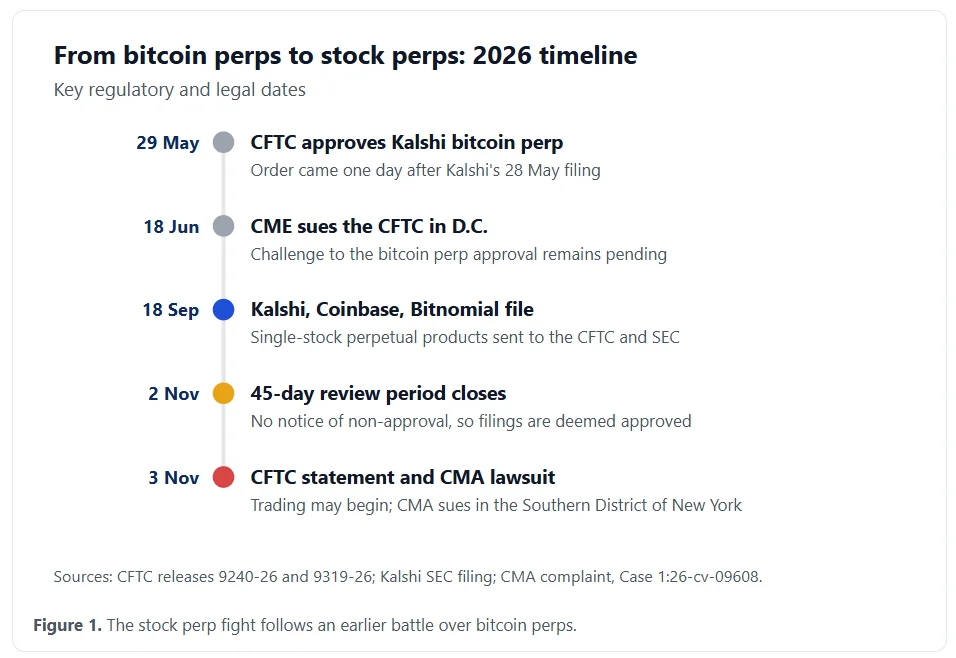
This is not the first clash over perps. In May, the CFTC approved a Kalshi bitcoin perpetual one day after the filing. CME then challenged that order in federal court in Washington. That case is still pending, the new complaint notes.
Why Wall Street sued over stock perpetual futures
The plaintiff is the Capital Markets Alliance, a New York trade association. Its members include Cboe, Citadel Securities and Healthy Markets Association, Cboe said. The group filed in the Southern District of New York, case number 1:26-cv-09608.
Its core claim is blunt. “Single-stock perpetuals are not security futures. They are security-based swaps,” the complaint states. That label matters because Congress put security-based swaps under the SEC. Moreover, retail investors may buy them only on SEC-regulated national securities exchanges.
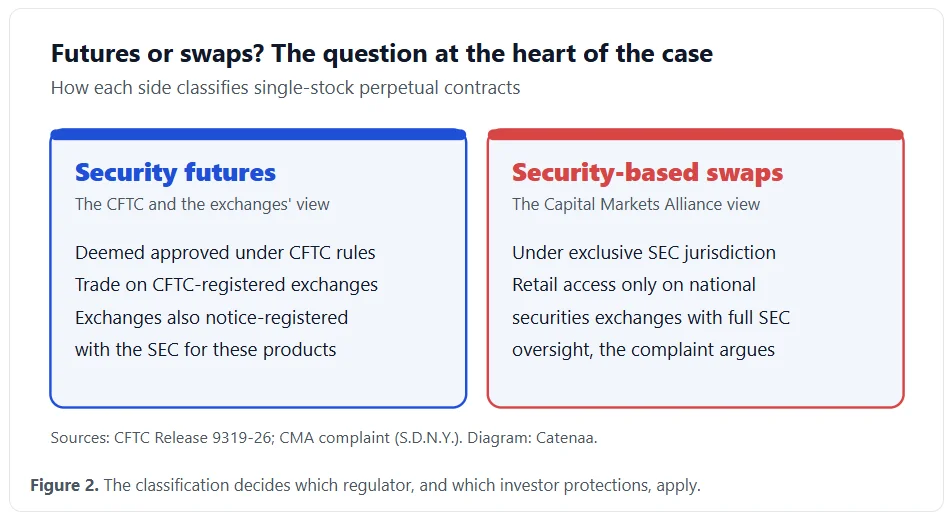
The alliance asks the court to declare the approvals unlawful and vacate them. It also wants the court to bar the CFTC from giving them effect while the case runs. In addition, it says the agency changed its past view without saying why.
The alliance says it is defending how US stock markets work. “Coherent regulatory oversight underpins the global preeminence of U.S. securities markets,” said Adam Ford, its secretary, in a statement.
How the products would work
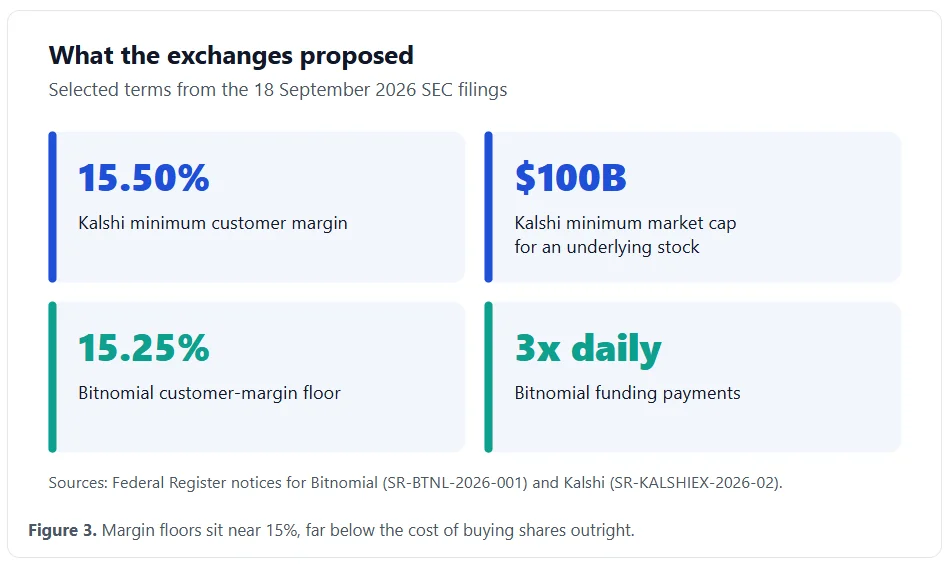
The exchange filings show the design. Bitnomial’s notice sets a 15.25% customer-margin floor for unhedged positions. Each contract covers 100 shares, and funding settles three times a day. Trading would run 24 hours a day, five days a week.
Kalshi’s terms look similar. Its filing requires margin of at least 15.50% of a position’s value. An underlying stock also needs a market value of at least $100 billion.
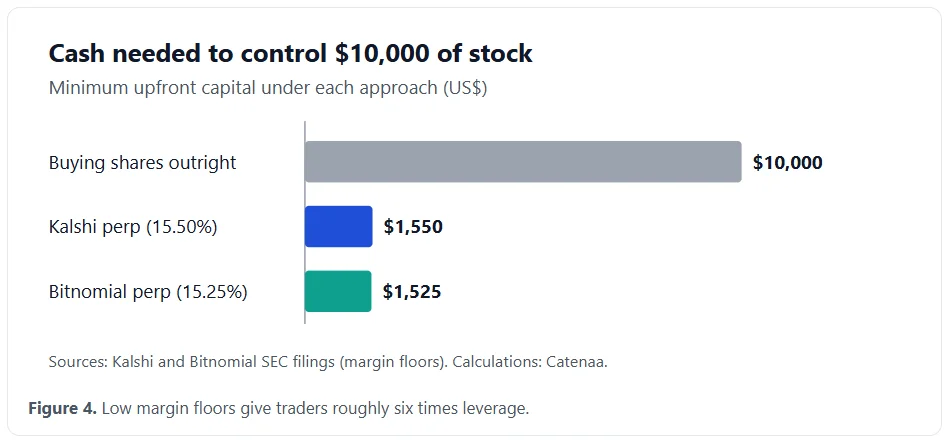
That margin implies sizable leverage. Under Kalshi’s floor, a trader could control $10,000 of stock with about $1,550. Buying the same shares outright would take the full $10,000.
Stakes in the case are large. According to the complaint, offshore stock perpetual volume grew more than 50-fold to nearly $700 billion in August 2026. Those figures are the plaintiff’s own allegations. For now, stock perpetual futures can list. Even so, the court could still pause them if it grants the alliance’s request for interim relief.