

September 26, 2026 – A five-year exemption lets tokenised share venues use automated market makers, provided they cap volumes, verify rights and let issuers object.

In Summary
The SEC granted five-year conditional relief from the exchange definition for Tokenized Securities Venues.
A second exemption frees qualifying liquidity providers from dealer registration.
Conditions include symbol and volume limits, matching shareholder rights, and issuer notice before listing third-party tokens.
Smart contracts must be auditable, public and deployed on permissionless ledgers.
CFTC staff updated crypto FAQs on 24 September, covering tokenised investments and blockchain recordkeeping.
American regulators have opened a door for tokenised stock trading. The SEC granted five-year conditional relief to venues that trade tokenised shares, the agency announced. Those venues may now use automated market makers and pooled liquidity.
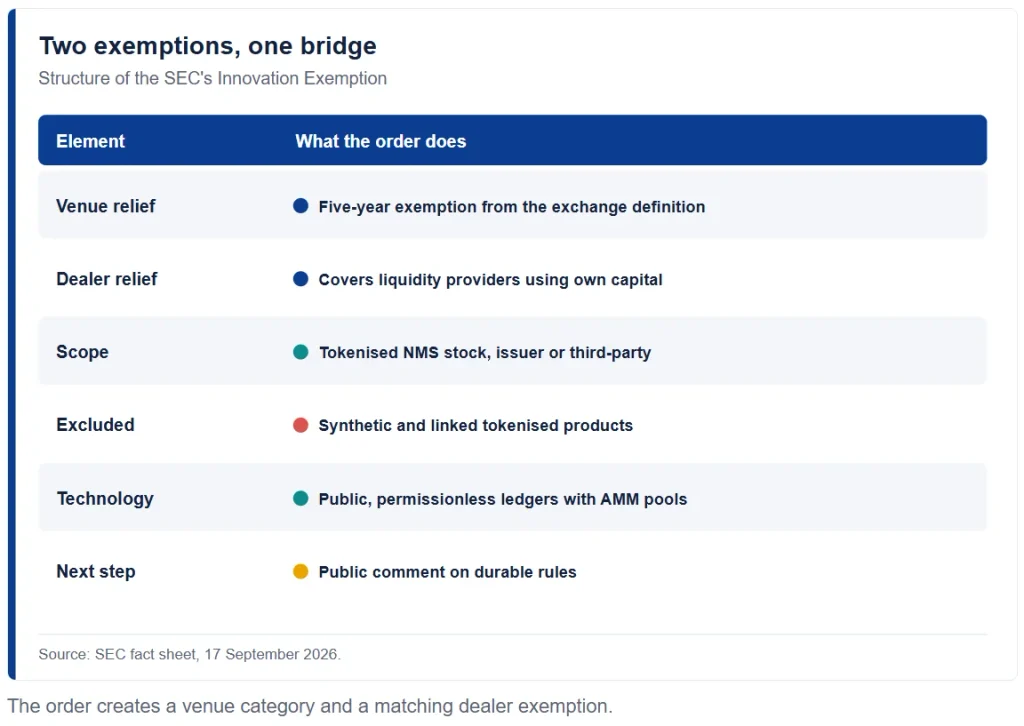
The relief carries a name: the Innovation Exemption. It exempts qualifying venues from the definition of an exchange. A second exemption covers certain liquidity providers.
Paul Atkins, the SEC chairman, framed the order as a bridge. The Commission is acting “within its statutory authority” to bring capital markets “into the digital age,” he said.
What the Tokenised Stock Order Covers
The order defines a new type of venue. A Tokenized Securities Venue brings buyers and sellers together through pooled liquidity. It also sets standards for who may trade there.
The label matters for lawyers. Such a venue would normally count as an exchange, which brings a heavy rulebook. The relief lifts that burden for five years.
Tokenised stock means something precise here. It covers shares tokenised by the issuer, or by an unaffiliated third party, the fact sheet explains. Synthetic products, such as tokenised linked securities, fall outside the relief.
The second exemption targets market makers. Liquidity providers using proprietary capital may avoid dealer registration. Their securities activity must stay limited to these pools.
The Conditions That Come With It
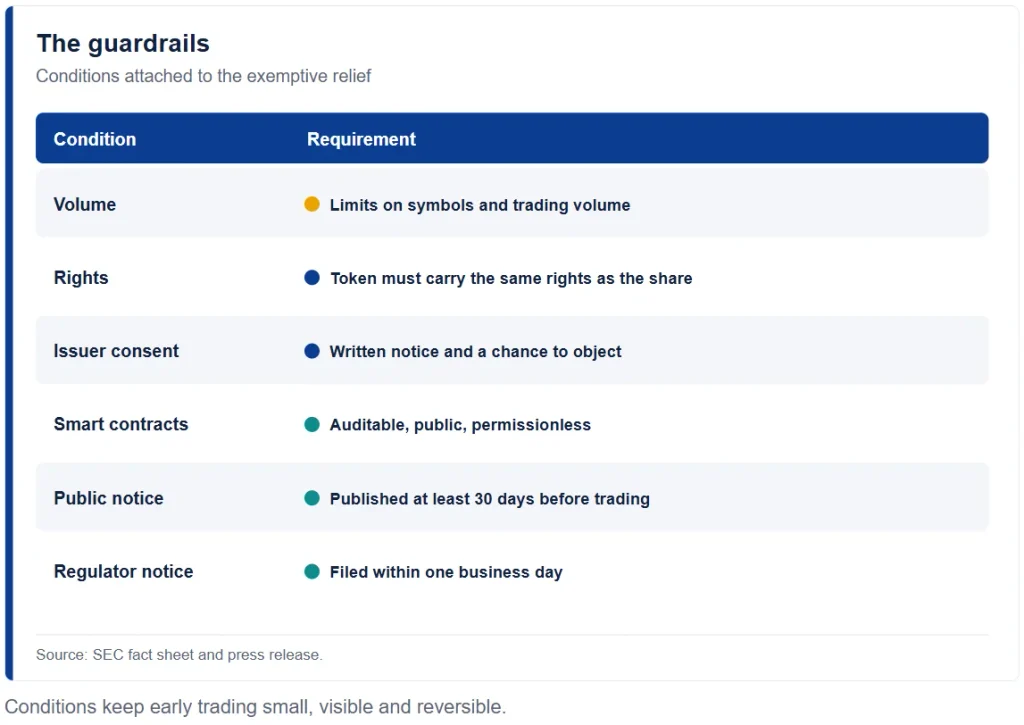
Relief is not unconditional. Venues face limits on the number of symbols and on the volume traded. Those caps keep early activity small and easy to monitor.
Rights must match as well. A venue must verify that a token carries the same rights and privileges as the underlying share class. Otherwise investors would hold something different in substance.
Issuers get a say in the process. Before listing a third-party token, the venue must notify the issuer and allow an objection. Smart contracts must also be public, auditable and deployed on permissionless ledgers.
Transparency runs through the rest. Venues must publish a notice at least 30 days before operating. They must then tell the Commission within one business day.
Why the SEC Moved Now
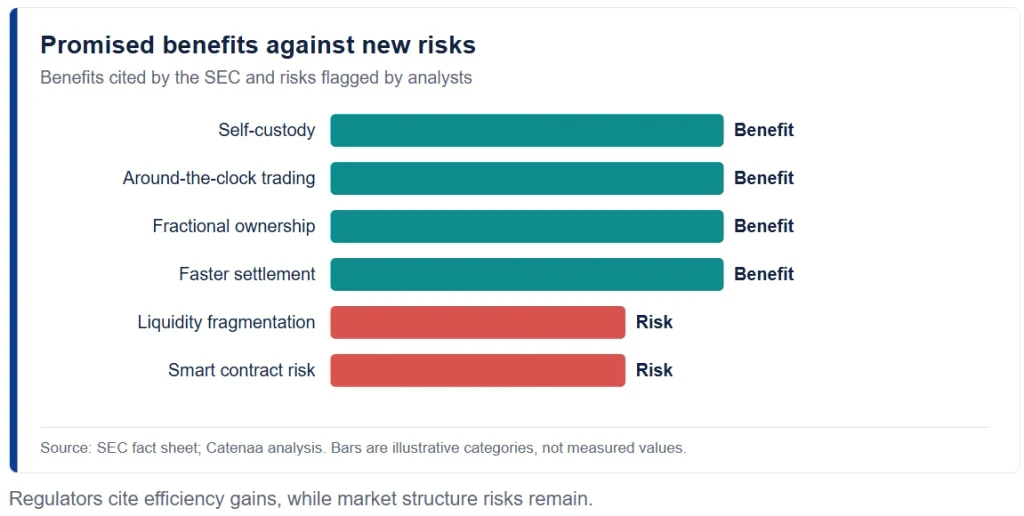
Technology has outrun the rulebook. Shared ledgers already support self-custody, part shares and near-instant settlement. Trading listed shares that way, however, sat awkwardly with the old rules.
Demand has grown too. Traders want to hold shares in the same wallet as their crypto. Firms building those venues asked for a legal path.
The Commission therefore chose temporary relief over silence. Five years gives builders time to test models. Meanwhile, the order solicits comment on what durable rules should look like.
Atkins made that sequencing explicit in his statement. Exemptive relief acts as a bridge toward proper rulemaking. Markets, in other words, get a sandbox with guardrails.
Washington Is Moving in Parallel
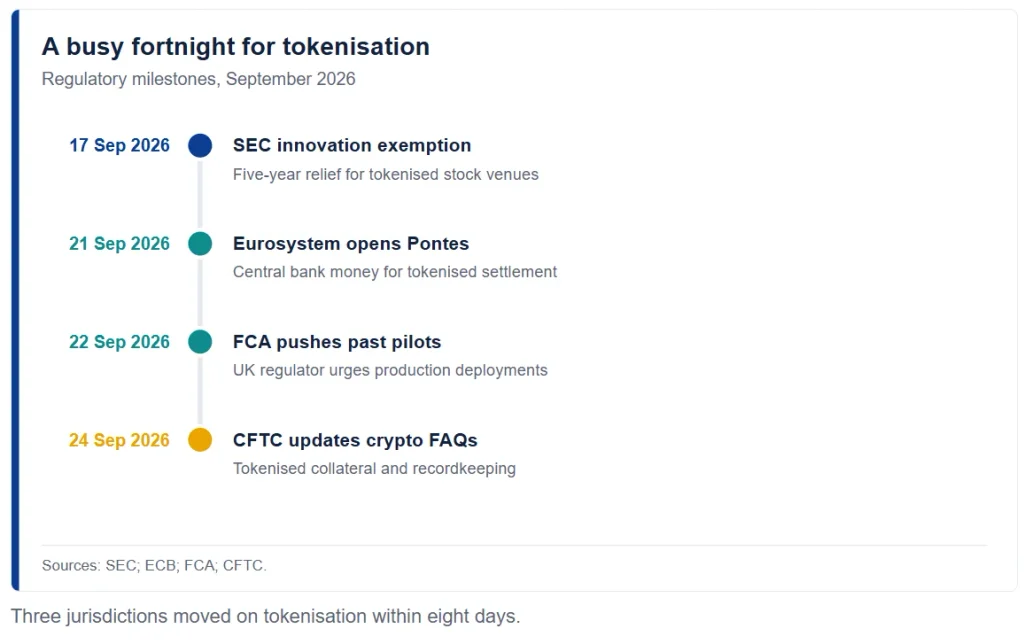
The derivatives regulator has taken similar steps. On 24 September, CFTC staff updated their crypto FAQs. The changes cover tokenised forms of permitted investments and blockchain recordkeeping.
Those updates build on earlier guidance about tokenised collateral. Together, the two agencies now address trading, custody and margin. That coverage reduces the legal gaps that deterred large firms.
Timing matters for competition. Britain and the European Union are pushing their own agendas. The Financial Conduct Authority chief executive urged firms to move beyond pilots this week.
What Happens Next
Watch three markers over the coming months. First, which venues publish the required notice and start trading. Second, which issuers object to third-party tokenisation of their shares.
Third, watch the comment file. Responses will shape whether the SEC writes permanent rules or extends relief. Trading firms, exchanges and issuers all have reasons to engage.
For now, tokenised stock trading has a legal path in the United States. The conditions keep it small and visible. That combination suits a regulator testing an idea in public. It also gives firms a reason to build rather than wait.