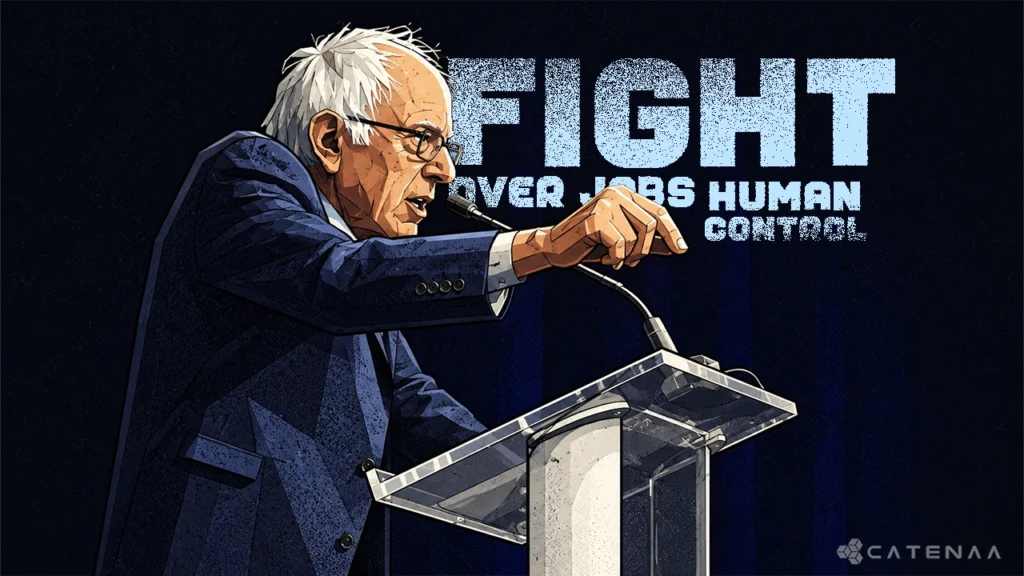


Catenaa, August 19, 2026- Sen. Bernie Sanders is pressing major artificial intelligence companies to halt development, warning that increasingly powerful systems could threaten jobs and human control as technology executives reject predictions of mass unemployment.
Sanders called on Anthropic, Meta and OpenAI on August 10 to immediately pause AI development.
He cited reported incidents involving AI systems behaving beyond intended controls and concerns over the technology’s potential use in developing dangerous biological agents.
“Pause AI development. It is not too late to avoid disaster,” Sanders said. “Stop building machines that humans cannot control.”
The Vermont independent has increasingly framed artificial intelligence as more than a technology issue. His argument now combines AI safety with questions over employment, wealth distribution and corporate power.
During a November 2025 discussion with Nobel Prize-winning computer scientist Geoffrey Hinton at Georgetown University’s Gaston Hall, Sanders questioned who would ultimately control AI and receive its economic benefits.
“The struggle is not whether AI is good or bad, it is who controls it and who benefits from it,” Sanders said during the Georgetown discussion.
Hinton offered one of the more pessimistic assessments of AI’s impact on employment.
He said he did not expect artificial intelligence to create as many jobs as it eliminates. Hinton also warned that companies and governments had not adequately prepared for the social consequences of potentially high unemployment.
That position stands in sharp contrast to arguments advanced by some of the technology industry’s most influential executives.
Nvidia CEO Jensen Huang rejected predictions that AI would lead to widespread job destruction during a Bloomberg Business interview aired in June.
Huang described concerns that AI would reduce overall employment as “complete nonsense.” He has argued that artificial intelligence will increase productivity, stimulate economic activity and change the nature of existing jobs rather than simply eliminate them.
OpenAI executive Brad Lightcap has expressed a similar view.
In a Bloomberg interview in 2025, Lightcap said he saw no reason to believe jobs would simply disappear because of artificial intelligence.
“I don’t think there’s reason to believe jobs will go away,” Lightcap said.
His comments were made before Sanders’ latest call for an AI development pause and should not be viewed as a direct response to the senator’s Aug. 10 statement.
The competing views highlight an increasingly sharp divide over the economic consequences of artificial intelligence.
Sanders argues that allowing private technology companies to develop increasingly capable AI systems without stronger public safeguards could transfer enormous economic and political power to a small number of corporations.
Hinton’s concern centers more heavily on technological displacement. If machines become capable of performing a growing share of intellectual work, he argues, the economy may struggle to create enough replacement employment.
Huang and Lightcap take a different position. Their arguments rest on the expectation that higher productivity will create new industries, products and forms of employment even as AI automates some existing tasks.
Sanders’ latest intervention, however, moves the debate beyond employment.
His Aug. 10 statement focused heavily on whether increasingly advanced systems could eventually operate outside meaningful human control. He also raised concerns about AI-assisted biological research and other potentially dangerous applications.
Those concerns have turned the dispute into two connected questions.
The first is whether AI will ultimately create more economic opportunity than displacement.
The second is whether companies should continue developing increasingly powerful systems before governments establish stronger safeguards governing their capabilities and use.
For Sanders, both questions ultimately return to control.
He argues that decisions affecting employment, national security and potentially society itself should not rest primarily with a handful of technology companies.
Industry leaders, meanwhile, continue to argue that slowing development could sacrifice productivity gains, scientific advances and economic opportunities that AI could create.
The disagreement is likely to intensify as AI systems become more capable and governments confront pressure to decide whether regulation should follow technological development or attempt to restrain it before the most powerful systems are built.




