

October 21, 2026 – A newly formed Revolut entity says it holds a distributed ledger licence in Gibraltar. It joins a UK permission, an EU registration and a conditional US bank approval that carries real limits.

In Summary
Revolut says Revolut Global Digital Assets Limited has received a distributed ledger technology provider licence from the Gibraltar Financial Services Commission.
Gibraltar’s framework applies ten regulatory principles, covering capital for an orderly wind-down, client asset segregation, governance and market integrity.
The company has not said which markets or services the Gibraltar entity will cover, and Catenaa could not verify the entry on the regulator’s register.
In the United States the OCC granted only preliminary conditional approval on 2 September, with a 10 percent tier 1 leverage floor for three years.
That approval excludes the proposed retail foreign exchange business, and deposit insurance and holding company approvals remain under review.
Revolut says a new arm has won a crypto licence in Gibraltar. The entity, Revolut Global Digital Assets Limited, holds a ledger technology permission. It will run the firm’s international crypto work.
One caveat belongs upfront. The firm shared this by statement. Catenaa could not check the regulator’s public register, which blocks automated access.
What a Gibraltar crypto licence requires
The territory built its regime early. Firms fall in scope once they use the technology to move or hold value that belongs to others.
Ten tests then apply. They run from honesty and fair dealing to capital, risk and client money. Governance, systems, crime checks and market conduct round out the list.
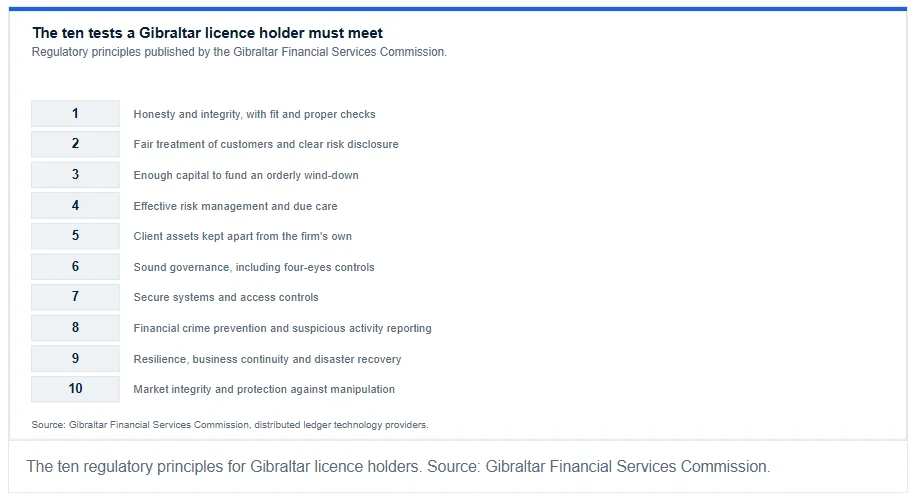
Capital gets a sharp test. A firm must hold enough to wind down in good order, not merely to trade.
Banks are not exempt. Any lender offering wallets or coin services needs the same permission. Using the technology purely for back-office work does not count.
Client money gets another. Firms must keep customer assets apart from their own, which matters most when a venue fails.
Gibraltar refreshed the rules in 2020. Guidance notes now sit behind each principle, alongside separate notes on scope and outsourcing.
Where this sits in the stack
The group now holds four separate permissions. Its UK arm answers to the Prudential Regulation Authority, while an EU entity serves the bloc under the MiCA regime.
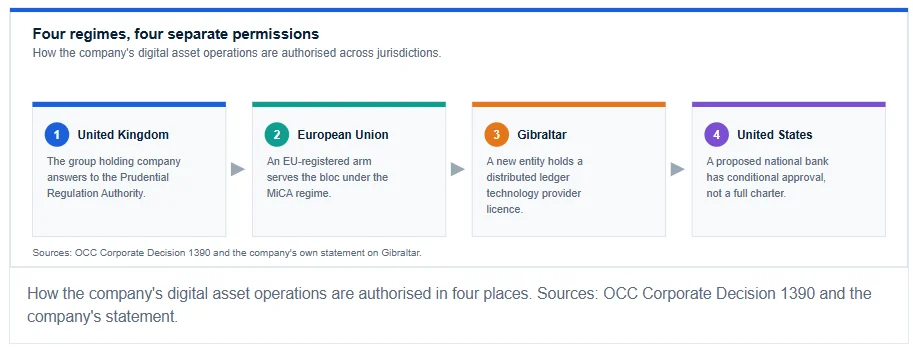
Gibraltar adds a third base. Notably the firm has not said which markets it will serve from there, nor when.
So the licence reads as groundwork. It buys optionality rather than a live product.
Each regime also brings its own rulebook. Therefore the firm must run parallel compliance teams, rather than one global set of controls.
The American piece is thinner
Washington granted less than the headlines suggested. The regulator gave a conditional nod on 2 September, for a bank in Stamford, Connecticut with no branches.
Conditions bite hard. The bank must hold a tier 1 leverage ratio of at least 10 percent for three years. It must also clear senior hires in advance.
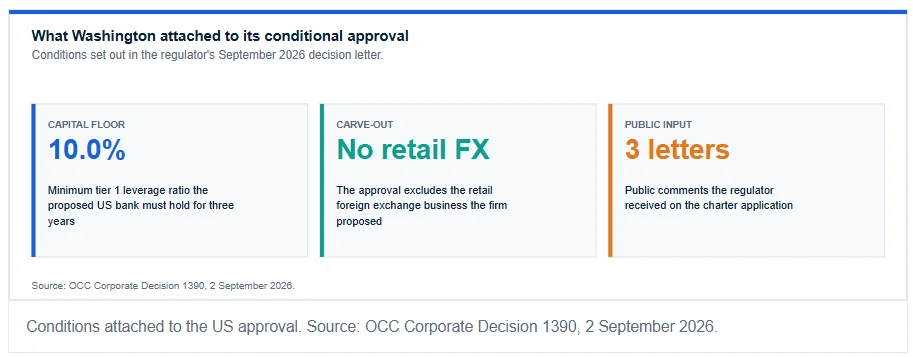
One business fell outside the grant. The approval leaves out the retail currency trading arm, which needs a separate sign-off.
Only three parties wrote in. Reviewers found no serious supervisory or legal issue in those letters.
Scope is narrow by design. The proposed bank would run from one office, with no branch network and no trust powers.
Stablecoins sit at the edge
Token plans get precise treatment. Revolut-branded stablecoins would come through a third party. Yet the bank will neither issue them nor hold the reserves.
Its role stops at marketing, access and custody. Moreover it promises to follow the GENIUS Act rules once they take effect.
What is still missing
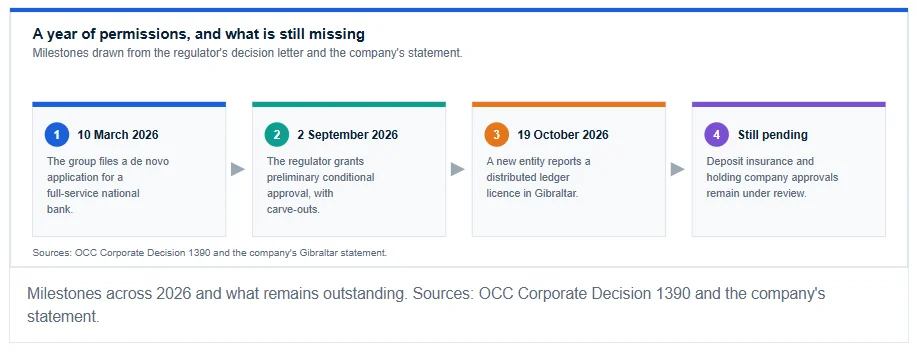
Plenty remains unfinished. Deposit insurance and holding company approvals both sit under review, so the American bank cannot open yet.
Watch three markers. First, a register entry in Gibraltar. Second, the first named market served from there. Third, whether the US carve-outs ever lift.