

August 19, 2026 – America’s national bank regulator took 40 de novo applications in 18 months. Digital asset firms now sit inside the federal perimeter.
In Summary
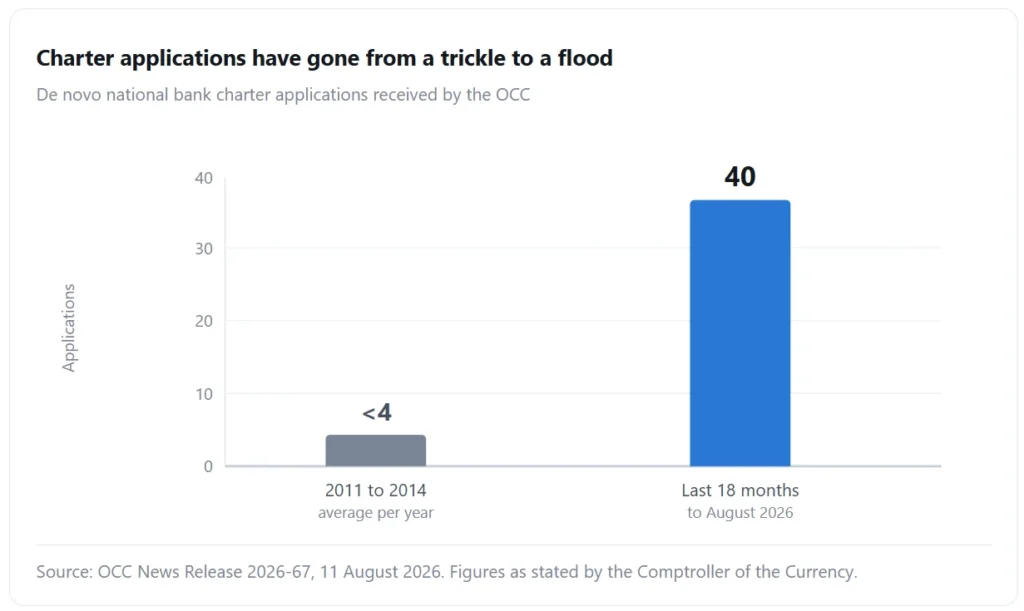
The Office of the Comptroller of the Currency (OCC) received 40 de novo charter applications over the past 18 months. Between 2011 and 2014, it received fewer than four a year.
On 11 August 2026, Comptroller Jonathan V. Gould said that “America and the OCC are once again open for business”.
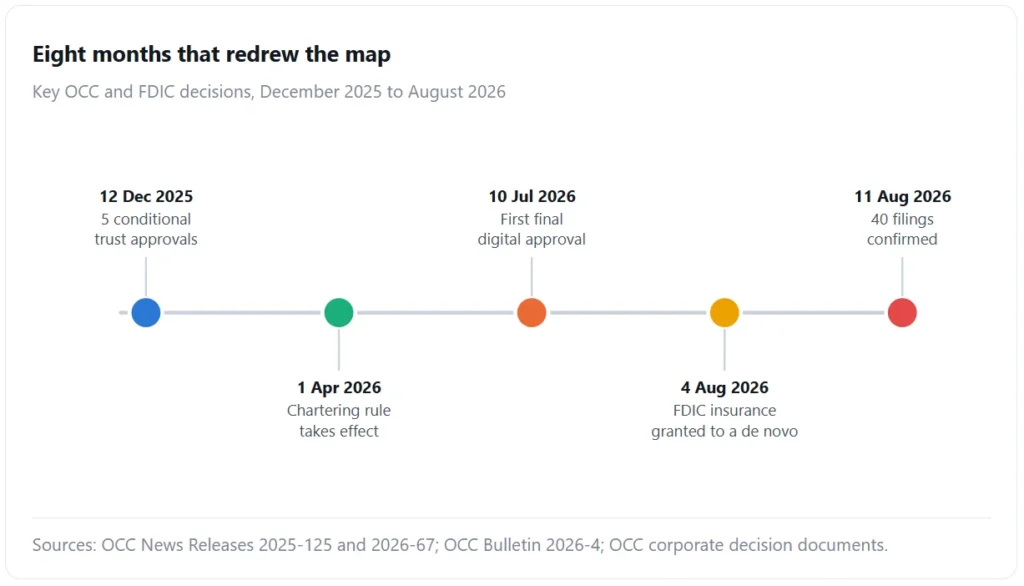
Five digital asset firms won conditional national trust bank approvals on 12 December 2025. Circle’s unit received final approval on 10 July 2026.
A rewritten chartering rule took effect on 1 April 2026. It lets trust-only national banks run custody and other non-fiduciary lines.
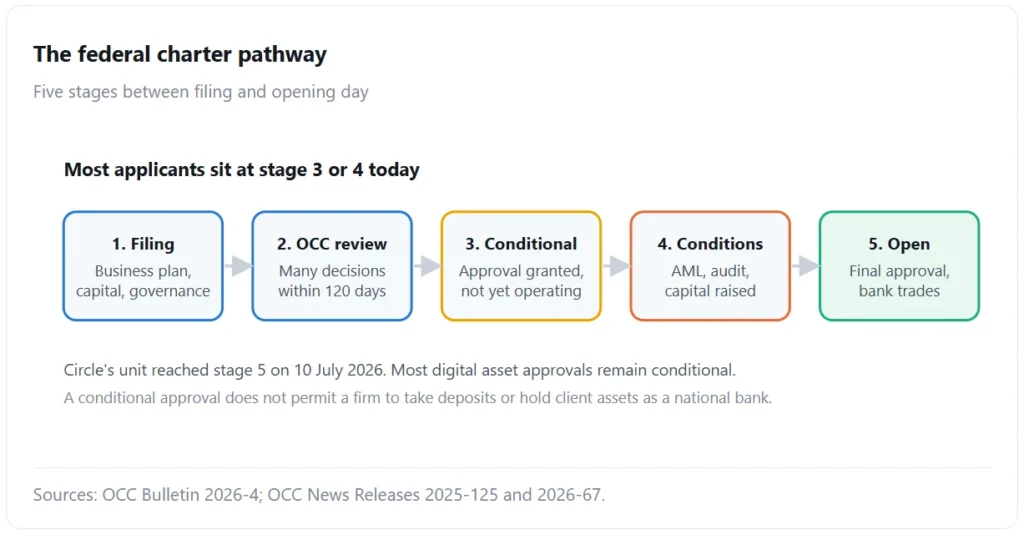
Many charter decisions now land within 120 days of a complete filing, so the funding clock for applicants has shortened sharply.
A charter cuts sponsor-bank fees and deposit risk. However, it also brings capital rules, examinations, and far heavier compliance costs.
A US bank charter was once out of reach for fintech founders. That wall has now come down. On 11 August 2026, the OCC said it took 40 new bank filings in the past 18 months. By contrast, the same agency saw fewer than four a year from 2011 to 2014. In some of those years, it saw none at all.
Comptroller Jonathan V. Gould put the shift in blunt terms. “De novo chartering is a sign of a healthy banking system,” he said. He then added that “America and the OCC are once again open for business”. Moreover, he said firms in lawful lines of work should have a path to a charter. That includes firms in digital assets.
Why the watchdog changed its tune
Two forces met at the right moment. Firstly, the OCC set out to revive new bank formation. Almost no new national banks had opened for a decade. Secondly, the Federal Deposit Insurance Corporation (FDIC) rebuilt the way it reviews deposit coverage. The OCC welcomed that step in public on 11 August.
Meanwhile, speed counts as much as goodwill. Many charter rulings now land within 120 days of a full filing. Earlier this year, a full-service bank won final sign-off and opened its doors. No new bank had done that in five years. As a result, founders can plan a charter around a funding round. Before, they faced a long legal siege.
Digital asset firms lead the queue
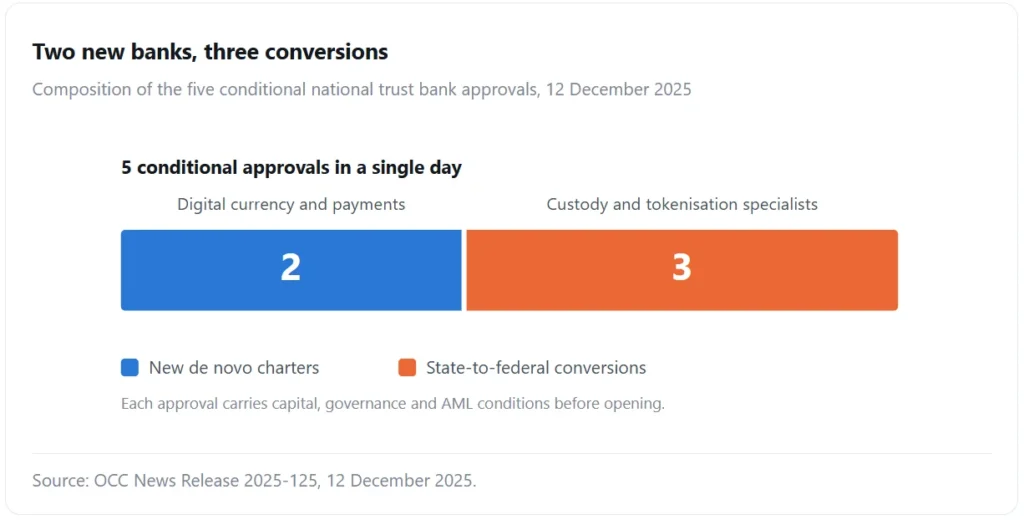
In fact, the December batch remains the clearest signal. On 12 December 2025, the OCC gave five trust bank filings the green light. Two were brand-new banks. They were First National Digital Currency Bank and Ripple National Trust Bank. Three were switches from state charters. Those three were BitGo Bank & Trust, Fidelity Digital Assets, and Paxos Trust Company.
Gould set out the logic in plain terms. “New entrants into the federal banking sector are good for consumers, the banking industry and the economy,” he said. In his view, they bring fresh goods, services, and credit. They also keep the system honest.
Circle’s unit turned that nod into full approval on 10 July 2026. Even so, one caveat matters here. A conditional nod is not a licence to trade. Firms must still meet terms on capital, control, and money laundering checks. Only then may they open the doors.
What the April rule changed
OCC Bulletin 2026-4 sounds dry. Yet it cleared a real hurdle. The rule rewrote 12 CFR 5.20, the chartering text. It used to speak of “fiduciary activities”. Now it speaks of “operations of a trust company and activities related thereto”.
Furthermore, that swap matters for custody firms. Holding a client’s crypto often falls outside the trust duty. So the old text left filers guessing. The OCC stressed that the change “would neither expand nor contract” its power to charter banks. Even so, it settled a doubt that had stalled filings for years.
Where stablecoin law fits in
This charter push does not stand alone. The GENIUS Act became law on 18 July 2025. It set federal rules for firms that issue payment stablecoins. Those rules demand full backing in safe, liquid assets. They also demand redemption within two business days.
A national trust charter gives an issuer a clean home for that work. The firm can hold reserves, run redemptions and answer to one federal watchdog. Therefore, the charter queue and the stablecoin rulebook now pull in the same direction.
One limit is worth stressing. A trust charter is not a full bank licence. Trust banks hold and move client assets. They do not take retail deposits or write loans. Firms that want to lend must file for a full charter instead.
Why investors should care
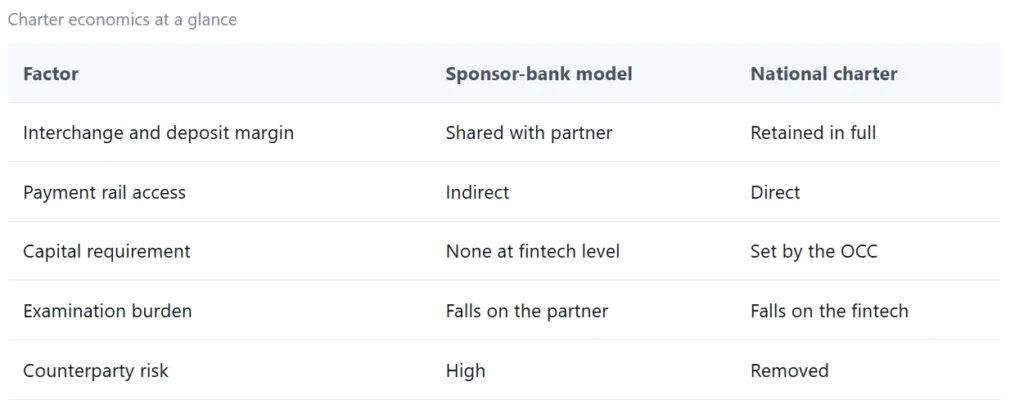
Above all, a charter changes the maths of a fintech. Partner banks charge a fee on every account and every card swipe. By contrast, a chartered bank keeps that margin. It also plugs straight into payment rails. Renting those rails is costly.
In addition, risk shifts too. Fintech deposits held at partner banks rely on that partner staying sound. Recent software failures froze client cash for weeks. Therefore, a charter cuts out a partner that many investors no longer trust.
Similarly, value follows structure. Banks trade on book value and net interest margin. Young fintechs trade on sales multiples. So as more of them win charters, analysts will judge them by bank yardsticks. That shift can trim a rich multiple fast.
The risks that remain
An open door swings both ways. Bank capital is dear, and examiners ask hard questions. Moreover, a charter binds a fast firm to quarterly reports, cash rules, and consumer reviews. Small teams often underrate that load.
Policy can also turn. Charter policy reflects the sitting Comptroller. A future chief may take a harder line. Investors should thus treat a conditional nod as an option, not as an asset.
What happens next
For now, watch three things over the coming quarters. Firstly, count how many conditional nods become live banks. Secondly, read the terms tied to each ruling, since tough terms can gut the business case. Thirdly, note whether big brokers and fund houses file for trust charters of their own.
Deal flow offers a further clue. Card networks have spent this year buying stablecoin rails and fraud tools. Those buyers want partners that sit inside the federal net. Consequently, a charter may soon shape who gets bought and at what price.
The door is open. Walking through it, however, still costs real money and real time.