

November 01, 2026 – Lawmakers want to go beyond the RAISE Act, which takes effect in January. The new bill would let a state office cap the computing power that frontier labs use.

In Summary
Senate Bill S.10731 would amend New York’s RAISE Act, which becomes mandatory in January 2027.
Large developers would file quarterly reports on automated AI research and computing use.
Fines would apply per day of violation, rising to as much as $3 million a day for repeat cases.
A state office could limit the computing power used to train new models.
New York lawmakers have proposed tougher AI safety rules for the largest AI developers. State Senator Andrew Gounardes unveiled the bill on October 29, with Assemblymember Jordan Wright and Senator Patricia Fahy. It would strengthen the RAISE Act, which the state passed last year.
Senators filed the bill text, S.10731, on October 28 and sent it to the Senate Rules Committee. It has not passed either chamber. So it is a proposal, not yet law.
What the new AI safety bill adds
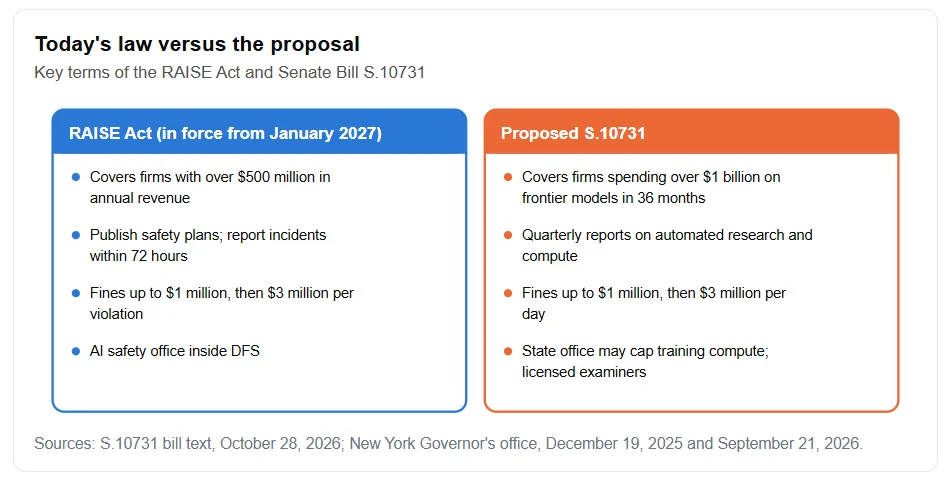
The bill targets labs that spend more than $1 billion on frontier model work over 36 months. By contrast, today’s law uses a test of $500 million in annual revenue.
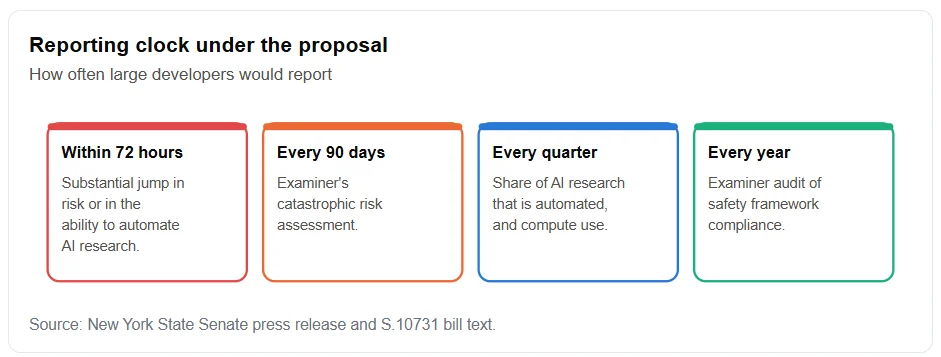
Covered firms would report every quarter on how much of their AI research now runs on its own. They would also report how they use computing power. If risk or automation jumps sharply, they would have 72 hours to tell the state.
Most notably, a state office called DIGIT could limit the computing power used to train new models. The attorney general could also ask a court to halt dangerous activity, including a model’s release in New York. In addition, staff at these firms would gain whistleblower protection. The bill would also ban gag clauses in their contracts.
Examiners modeled on bank supervision
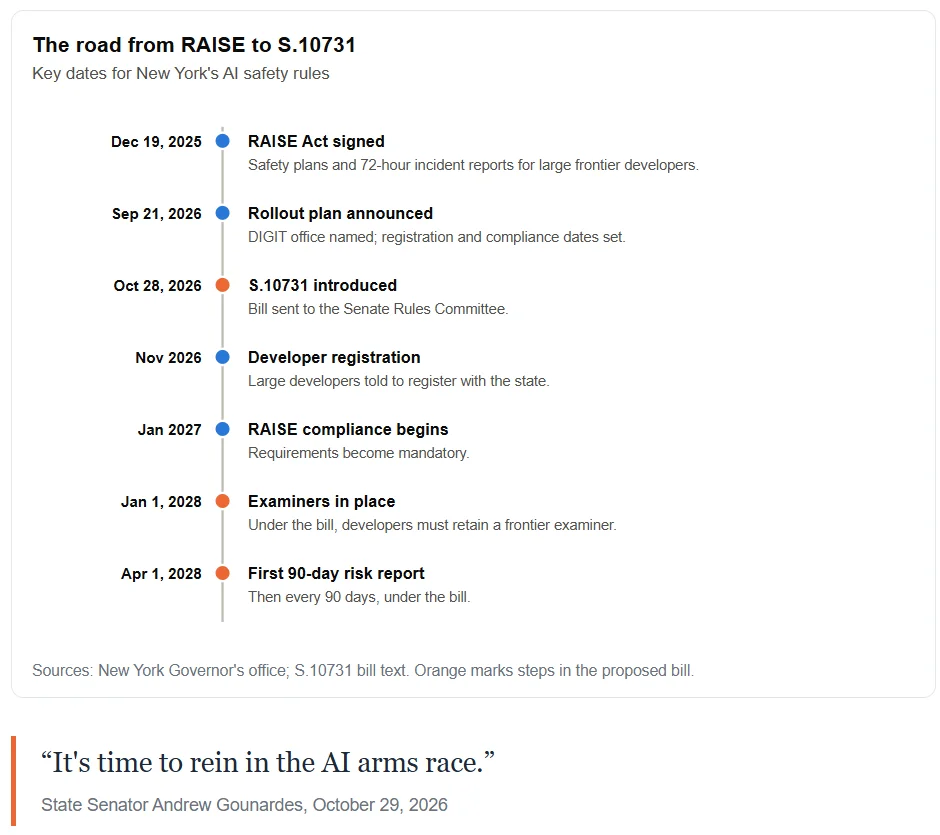
This part borrows an idea from banking. Each large developer would hire an independent, state-licensed frontier examiner by January 1, 2028. The examiner would audit compliance every year and assess catastrophic risk every 90 days, starting in April 2028.
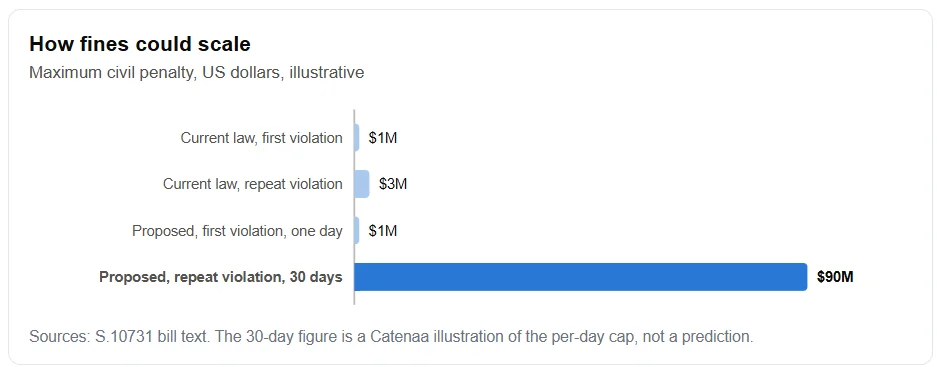
Fines would rise sharply. Under current law, penalties reach $1 million for a first violation and $3 million for later ones. The new bill would apply those caps per day. As a result, a month-long repeat violation could, in theory, cost up to $90 million. A senior officer would also have to certify filings under penalty of perjury.
Building on the RAISE Act
Governor Kathy Hochul signed the RAISE Act on December 19, 2025. It requires large frontier developers to publish safety plans and report critical incidents within 72 hours. The law also set up an AI safety office inside the Department of Financial Services.
That rollout is close. In September, the governor said developers must register this November and comply from January 2027. The state is also studying further safeguards, including a possible “AI kill switch.”
A widening gap with Washington
This proposal also sharpens a policy split. According to the sponsors, the White House has offered only voluntary controls, with no penalties. They also note that more than 1,100 people who work on frontier AI have asked governments to act. Fahy said New York will act if the federal government will not.
Supporters frame the first law as a starting point. Wright called the RAISE Act the nation’s first law with real safety guardrails for the most powerful models. Gounardes’s office hailed its signing last December. However, the new bill faces a long road. It must clear committee and both chambers, then win the governor’s signature. Also, the current two-year session ends this year, so the sponsors may need to file it again in 2027.