

November 21, 2026 – MEXC ended its Visa-based stablecoin card with hours’ notice, days after a US order against the exchange. The causal link is unproven, but the dependency chain is clear.

In Summary
MEXC ended its Global Card on 18 November, citing changes by an unnamed third-party issuer.
The shutdown followed a 6 November FinCEN order, but no party has confirmed a causal link.
FinCEN alleges USD 16.7 billion in likely illicit flows through MEXC from May 2021 to May 2026.
The order binds US banks, money services businesses and brokers from 10 December.
Exchange cards rely on outside issuers and bank settlement, which creates single points of failure.
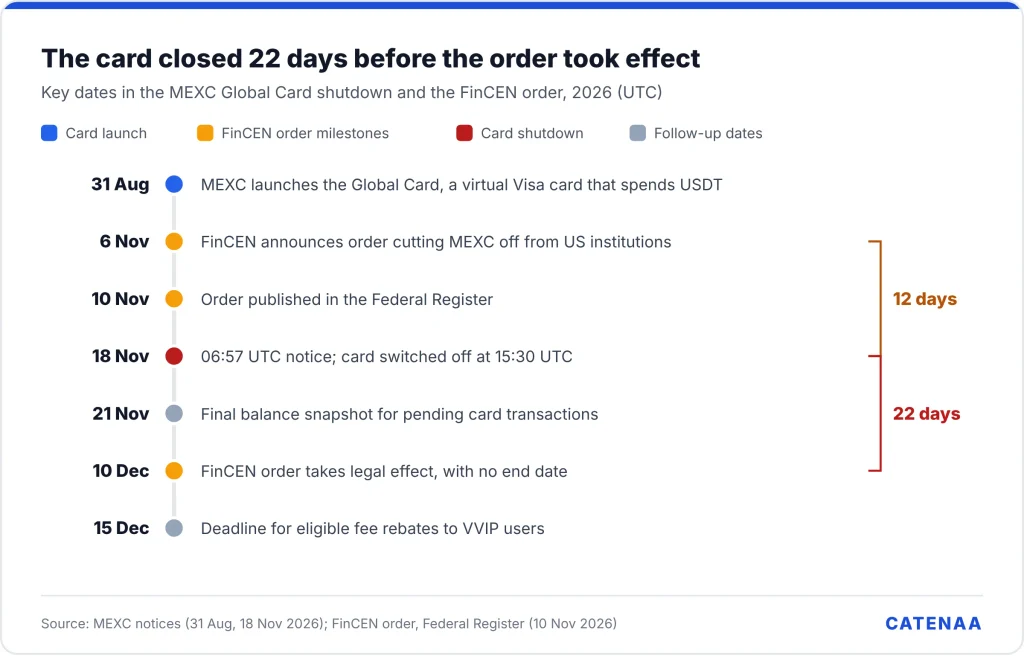
The MEXC card shutdown took effect on 18 November at 15:30 UTC, when the exchange switched off its Global Card. MEXC blamed “service adjustments by our third-party card issuer” but did not name that issuer. Its public notice appeared about eight and a half hours before the cut-off. MEXC told users to withdraw card balances and cancel recurring payments before then.
The closure came 12 days after a major US action against the exchange. On 6 November, the Financial Crimes Enforcement Network (FinCEN) ordered US institutions to stop moving funds to or from MEXC. However, MEXC has not linked the two events. Timing alone does not prove cause, so Catenaa treats the link as an open question.
What FinCEN alleges
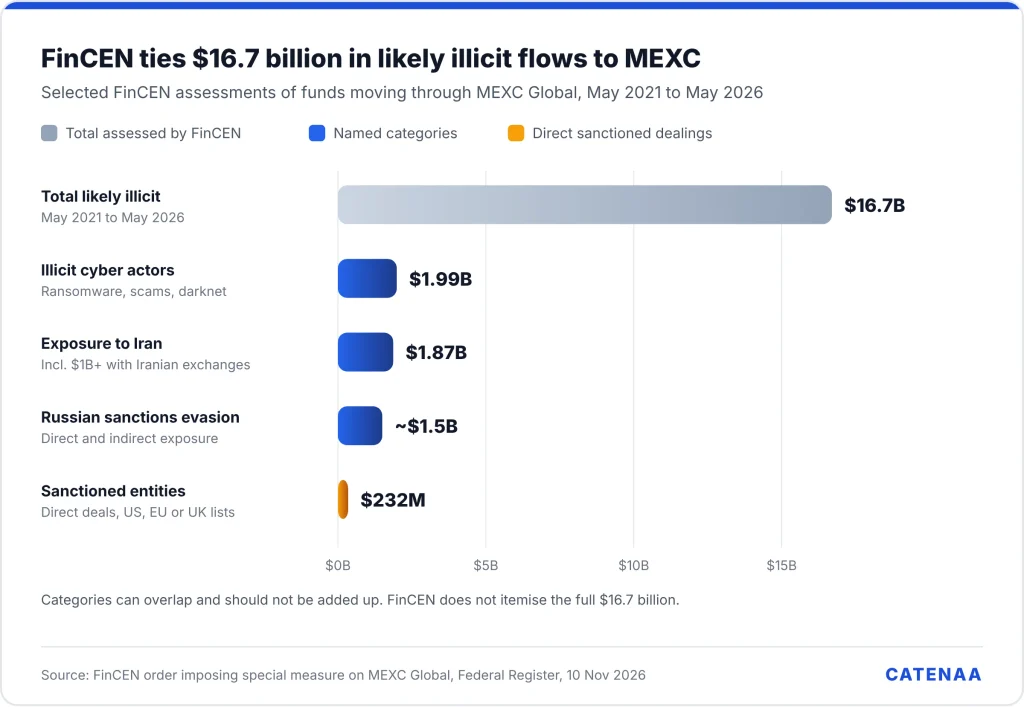
FinCEN found MEXC to be of “primary money laundering concern” tied to Russian illicit finance. The order published in the Federal Register puts likely illicit flows at USD 16.7 billion. Those funds moved through MEXC between May 2021 and May 2026, FinCEN says. That figure includes about $1.99 billion tied to cyber criminals. It also covers $1.87 billion with exposure to Iran and nearly $1.5 billion linked to Russian sanctions evasion.
The order takes effect on 10 December, with no end date. For its part, MEXC said on X on 7 November that its legal and compliance teams were reviewing the order. The exchange also said it was operating normally.
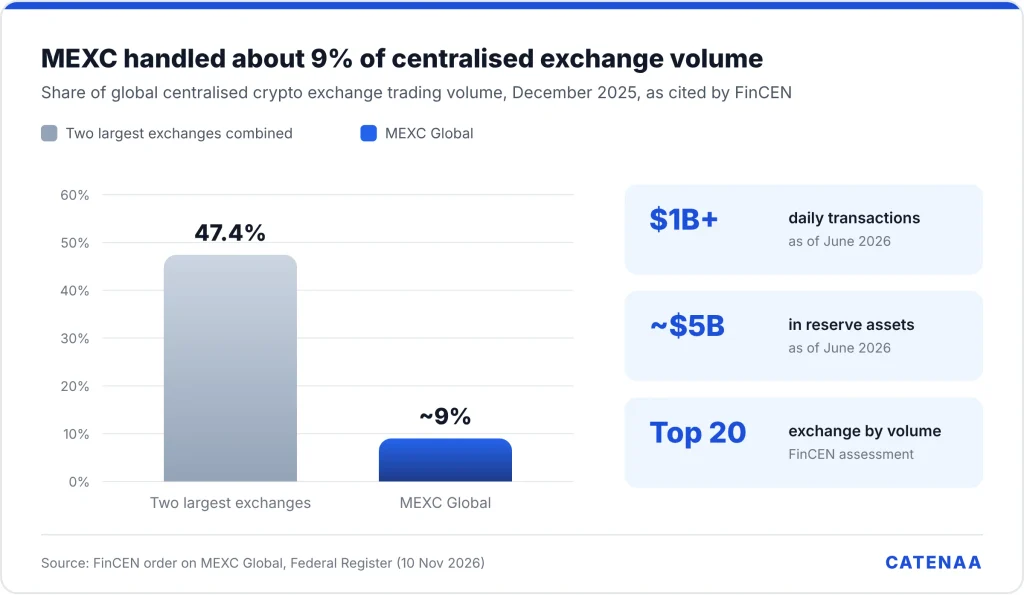
A card that lasted 79 days
MEXC launched the Global Card on 31 August as a virtual Visa card that spends USDT. It offered up to 10% cashback and limits of 80,000 USDT per purchase. Yet the launch release named only Visa. Consequently, users never saw which licensed firm actually stood behind the card.
In the end, the product ran for just 79 days. Any balance left on a card moves to the user’s spot account, with a final snapshot on 21 November. Refunds from past purchases go to users’ fiat accounts once MEXC receives them. Meanwhile, card records stay visible for three months.
Behind the MEXC card shutdown: the bank chain
MEXC did not issue the card itself. Instead, a third-party issuer held that role, according to the shutdown notice. In a typical card programme, the issuer screens users, connects to the network and settles purchases in ordinary money.
That chain creates pressure points. The FinCEN order binds the banks, money services businesses and brokers listed in federal rules as financial institutions. Card networks do not appear on that list. Even so, FinCEN chose a broad ban on fund transfers for a reason. The order says a narrower curb on correspondent accounts would miss dollars reaching MEXC through other foreign banks.
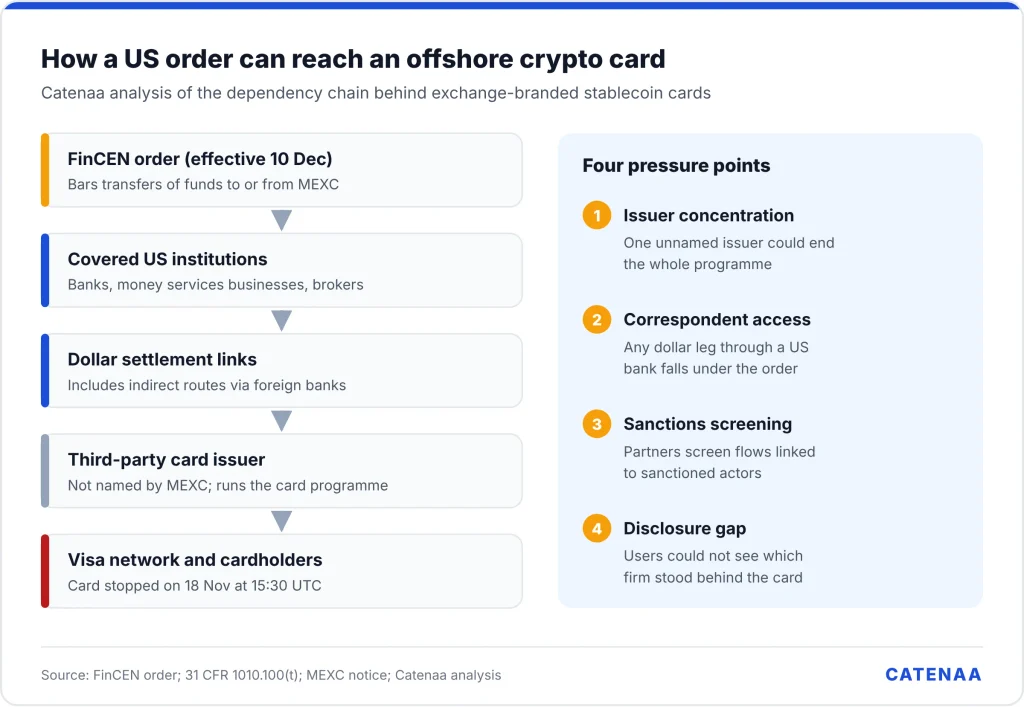
As a result, any partner that settles in dollars through US banks faces exposure from 10 December. Sanctions screening adds a second layer of risk. Moreover, a single issuer means a single point of failure. When that one partner steps back, the whole card programme stops.
What remains unknown
Several facts remain unconfirmed. MEXC has not named its issuer or explained the service adjustments. Catenaa also found no public comment from Visa on the programme’s end. Above all, no party has said the FinCEN order triggered the closure.
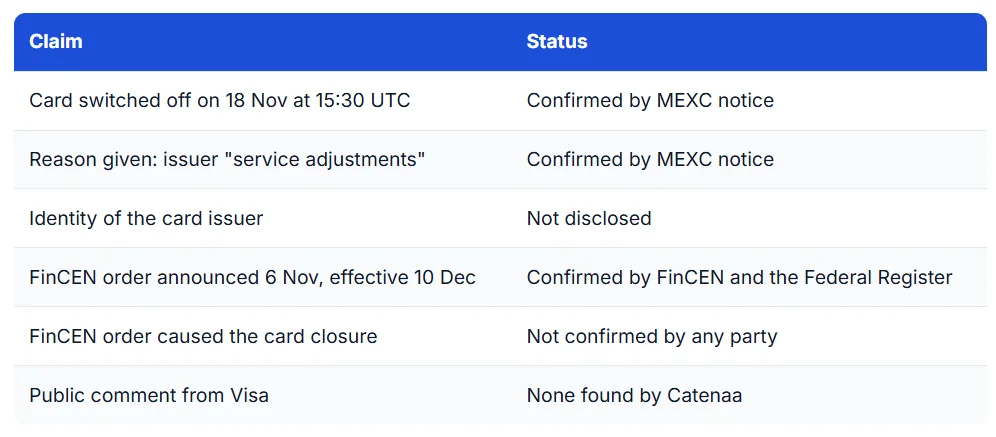
Still, the lesson for crypto payments looks clear. A stablecoin card touches bank rails at every step that involves ordinary money. When regulators squeeze those rails, a card can vanish within hours.
Editorial note. Day counts and the notice period are Catenaa calculations from timestamps in MEXC’s notices and the FinCEN order. The dependency chain in Figure 4 is Catenaa analysis, not a finding by FinCEN or MEXC. Catenaa makes no claim that the FinCEN order caused the card closure. FinCEN’s figures are allegations and assessments, not court findings. This article is for information only and is not investment or legal advice.