


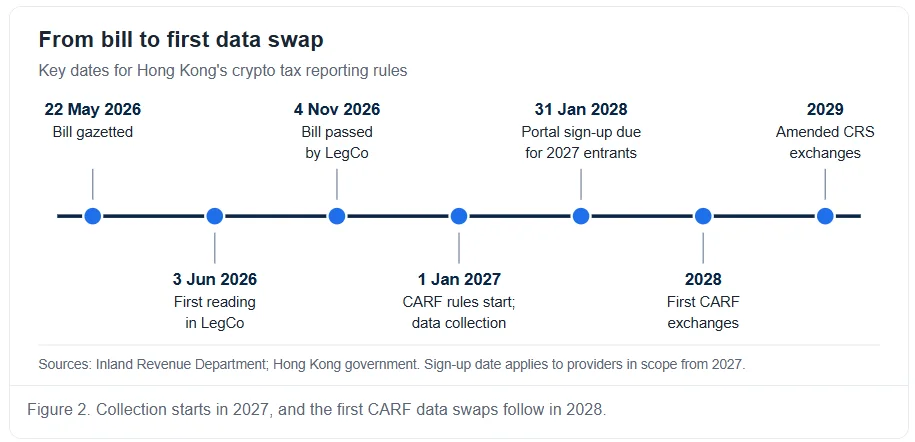
November 09, 2026 – Lawmakers passed the city’s crypto tax reporting bill on Nov. 4. Providers start collecting customer data on Jan. 1, 2027, and the tax office begins sharing it in 2028.

In Summary
Hong Kong’s Legislative Council passed the CARF and amended CRS bill on Nov. 4, 2026.
Covered crypto providers must collect customer tax data from Jan. 1, 2027.
The Inland Revenue Department plans its first CARF data exchanges in 2028, with amended CRS swaps from 2029.
Providers must register on a CARF Portal, keep records for six years and face penalties for false data.
Hong Kong crypto firms now face binding tax reporting rules. Lawmakers passed the bill on Nov. 4, the government said. From next year, covered providers must collect customer tax data on crypto trades. Then, from 2028, the tax office will share it with partner jurisdictions.
The law brings in the Crypto-Asset Reporting Framework, or CARF. That standard came from the Organisation for Economic Co-operation and Development (OECD) in 2023. Alongside it, the bill adopts an updated Common Reporting Standard (CRS), which covers bank and fund accounts.
What the Hong Kong crypto rules require
CARF applies from Jan. 1, 2027, according to the Inland Revenue Department (IRD). It targets reporting crypto-asset service providers. That means any business that swaps crypto for customers, whether as dealer, broker or trading platform. Crypto ATM operators also fall in scope.
Three kinds of activity count. First, swaps between crypto and fiat money. Second, swaps between crypto-assets. Third, transfers, including retail payments and moves to outside wallets. However, central bank digital currencies and some e-money products sit outside the rules.
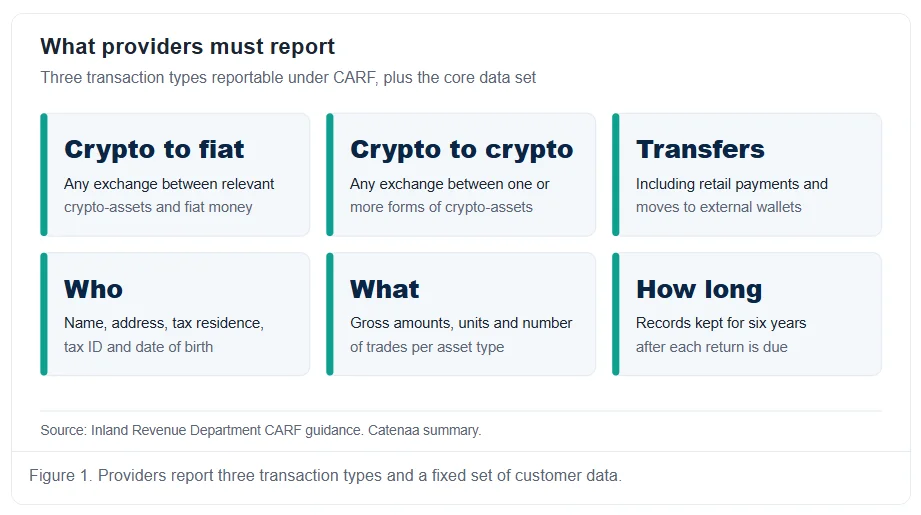
Each year, providers must report names, addresses, tax residence and tax ID numbers for reportable users. They also report gross amounts, units and trade counts for each asset type. In short, the tax office gets a yearly summary, not a live trade feed.
Deadlines, records and penalties
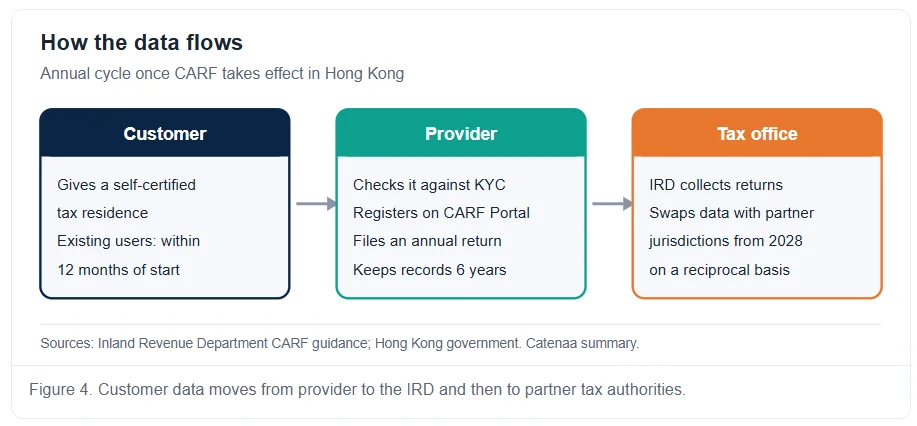
New customers must certify their tax residence at sign-up. Meanwhile, existing users have 12 months from the start date to do so. Providers must also register on a new CARF Portal. The deadline is Jan. 31 of the year after they first fall in scope.
Records must stay on file for six years after each return is due. That duty survives even if a firm closes. In addition, the law sets penalties for missed filings and false data. Some fines scale with the number of affected users.
Why Hong Kong moved now
Officials framed the law as a matter of reputation. Christopher Hui, Secretary for Financial Services and the Treasury, called the move “of paramount importance” in May. He tied it to the city’s standing as a finance hub, according to the May 20 release. On Nov. 4, he added that the rules should lift confidence among providers and digital asset users.
The city has swapped bank account data under the CRS since 2018. Now crypto joins that system. Separately, the amended CRS takes effect in 2028, with the first exchanges under it in 2029. A related ordinance on automatic exchange also starts on Jan. 1, 2027, the IRD notes.
Who feels it first
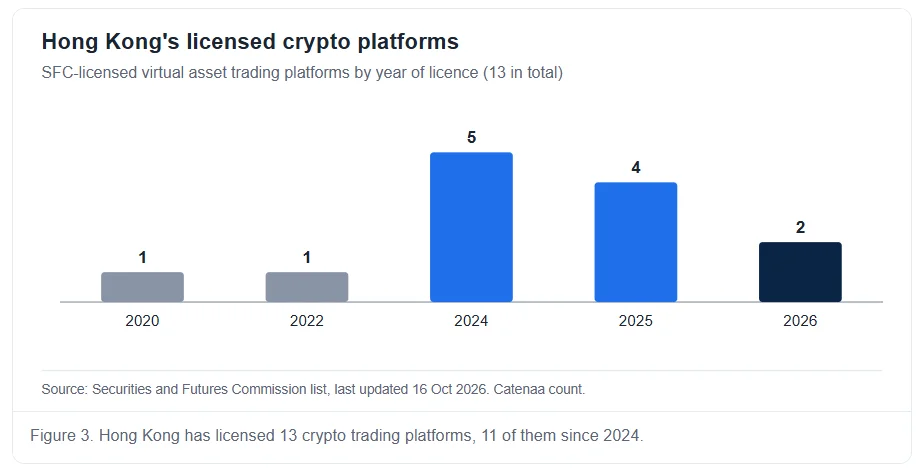
Licensed Hong Kong crypto exchanges will likely adapt fastest. The Securities and Futures Commission lists 13 licensed trading platforms as of Oct. 16. Eleven won licences in 2024 or later. Still, brokers, dealers and wallet services with a Hong Kong link must also comply.
For users, little changes at the screen. Instead, the change happens in the back office. Firms must match tax forms to know-your-customer files and build reporting systems before 2027. Overall, the law ties Hong Kong crypto markets more closely to global tax rules.
The industry had a say first. Officials ran a public consultation from December 2025 to February 2026. Professional bodies, finance firms and the crypto sector generally backed the plan, the IRD said.
The IRD says it will publish guidance, a data schema and portal details later. It has also set up a team to answer industry questions. So firms have less than two months before collection starts.