


November 11, 2026 – The OCC’s 721-page rule takes effect on January 18, 2027. Its own cost analysis shows fixed charges that land hardest on the smallest stablecoin issuers.
In Summary
The OCC’s GENIUS Act final rule takes effect on January 18, 2027, alongside the Act itself.
A $5 million capital floor now applies for an issuer’s whole life, not just its first three years.
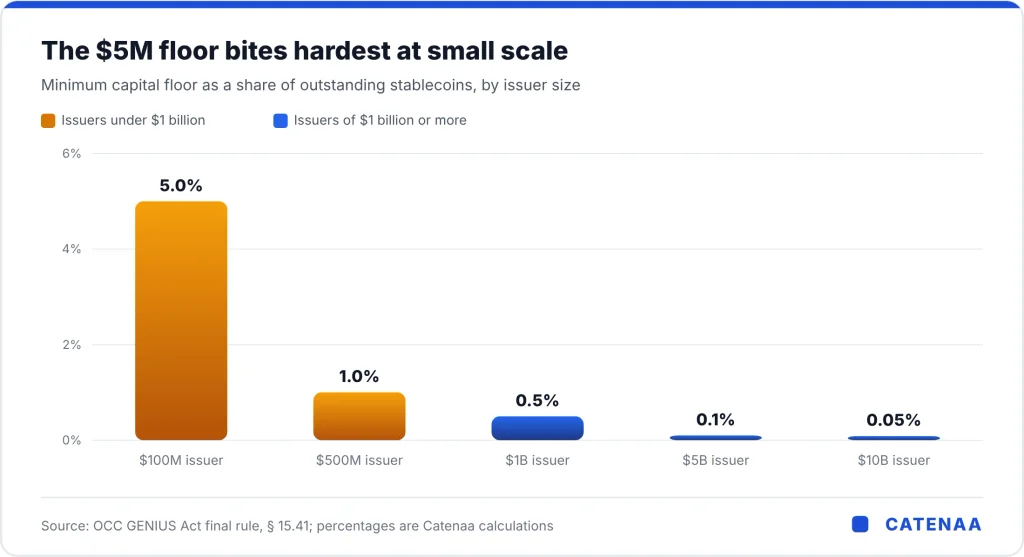
That floor equals 5% of a $100 million issuer’s tokens but only 0.05% of a $10 billion issuer’s.
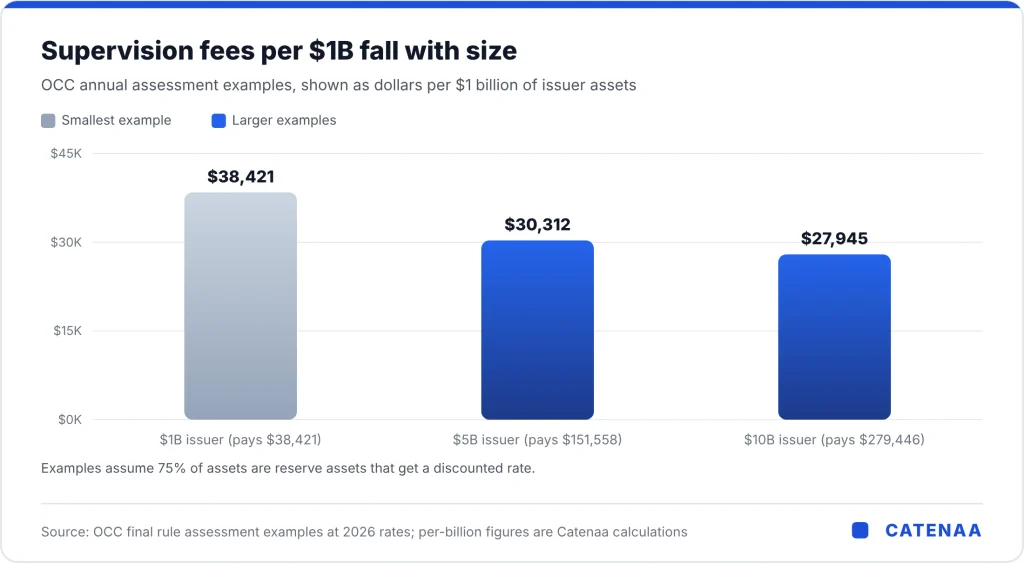
Monthly attestation costs at least $7,000, while assessment fees per $1 billion fall as issuers grow.
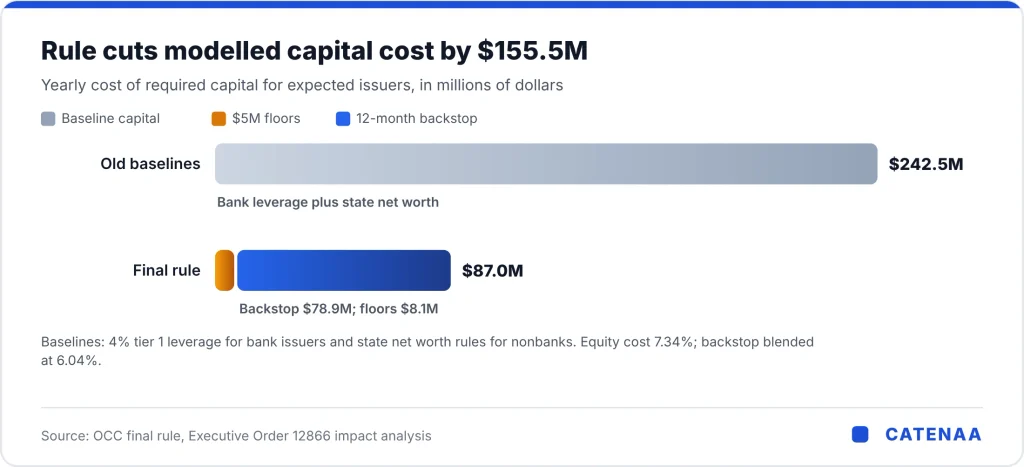
The OCC models net capital savings of $155.5 million across 39 expected issuers.
The GENIUS Act final rule sets the price of entry for federal stablecoin issuers. The Office of the Comptroller of the Currency released the rule on October 21. It takes effect on January 18, 2027.
The rule document runs to 721 pages. It covers reserves, redemption, capital and custody. However, it leaves anti-money laundering and sanctions rules to a separate process with Treasury.
Catenaa read the cost analysis to see who pays most. In short, fixed charges favour scale.
A $5 million floor weighs on small issuers
Every OCC issuer must hold at least $5 million in capital. The OCC first proposed that floor for new issuers only. In the final text, it kept the floor beyond the three-year start-up period.
Size changes how hard that floor bites. By Catenaa’s math, $5 million equals 5% of a $100 million issuer’s tokens. At $10 billion in issuance, the same floor is just 0.05%.
One commenter wanted a $15 million floor, but the OCC declined. Its charter work showed needs from $6 million to $25 million. As a result, it kept the power to set higher amounts case by case.
The backstop scales with spending
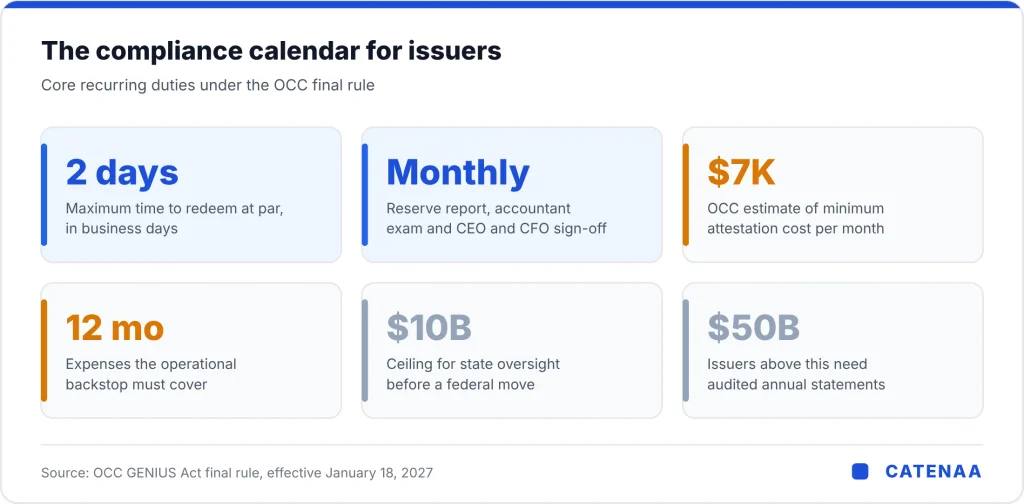
The second layer is an operational backstop. Each issuer must hold liquid assets equal to 12 months of total expenses. Up to half can come from subordinated debt.
Many commenters asked for six months instead. Even so, the OCC kept 12, though issuers may ask to exclude one-time costs. The agency modelled expenses at 0.48% of tokens outstanding, or about $1.3 billion market-wide. For example, that model implies a backstop near $480,000 for a $100 million issuer.
Monthly checks add a fixed bill
Reporting adds steady costs as well. Issuers must post a reserve report each month and pay an accounting firm to examine it. The chief executive and finance chief must also certify it monthly.
The OCC puts the minimum attestation cost near $7,000 a month. For bank issuers moving from quarterly to monthly checks, it sees $56,000 to $166,667 in extra yearly cost. Meanwhile, nonbanks under New York rules already face monthly exams. Taken together, a small issuer pays the same minimum attestation bill as a large one.
Fees per dollar fall as issuers grow
Supervision fees run the other way. The OCC example puts a $1 billion issuer at $38,421 a year. A $10 billion issuer would pay $279,446, so its cost per billion drops by about 27%.
Notably, the OCC applies a 35% discount to issuer assessments. It says that discount can rise as high as 55%.
Net savings under the GENIUS Act final rule
Overall, the OCC says the GENIUS Act final rule lowers capital costs. It puts them at $87 million, against $242.5 million under the old baselines. That implies yearly savings of $155.5 million.
Bank issuers drive much of that gain. Under the baseline, they would have held 4% leverage capital, or $2 billion, against $50 billion of tokens. Nonbanks used the state model law for net worth instead.
What to watch before January
The OCC expects 39 issuers: 25 tied to national banks or savings associations, 12 others and two consortia. However, the OCC is not yet taking applications. Its GENIUS Act page says intake starts once budget officials approve the forms.
Issuers below $10 billion can still pick a state regime. Above that line, they must move to federal oversight within 360 days or win a waiver. For scale, Circle reports $69.21 billion of USDC in circulation.
Until then, the GENIUS Act final rule leaves smaller issuers with the hardest math. Their fixed costs fall on a thin base.