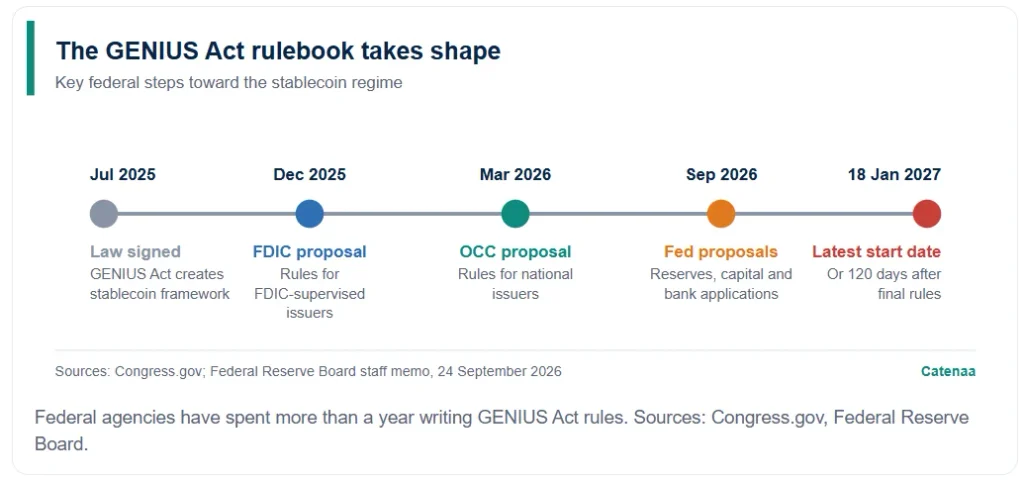


September 27, 2026 – The proposals cover bank-linked issuers under the GENIUS Act. They arrive as a $313bn stablecoin market waits for the law to take effect.

In Summary
The Federal Reserve on 24 September proposed stablecoin rules for issuers it supervises under the GENIUS Act.
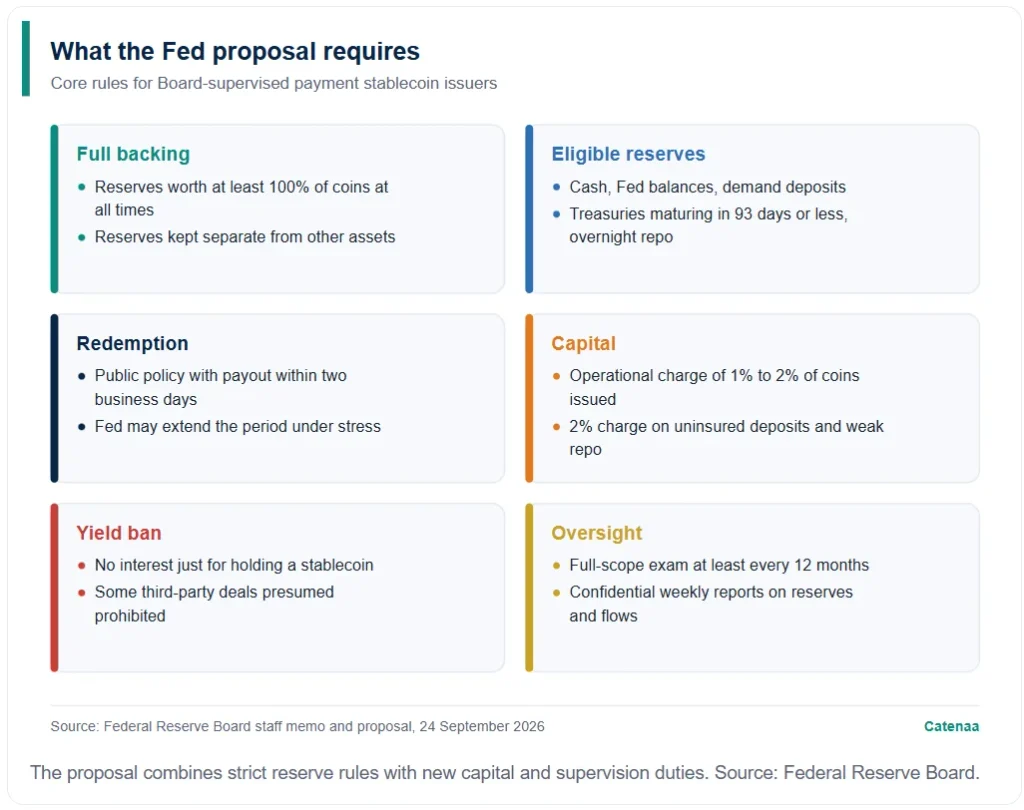
Issuers must hold reserves worth at least 100% of coins, including Treasuries maturing within 93 days, and redeem within two business days.
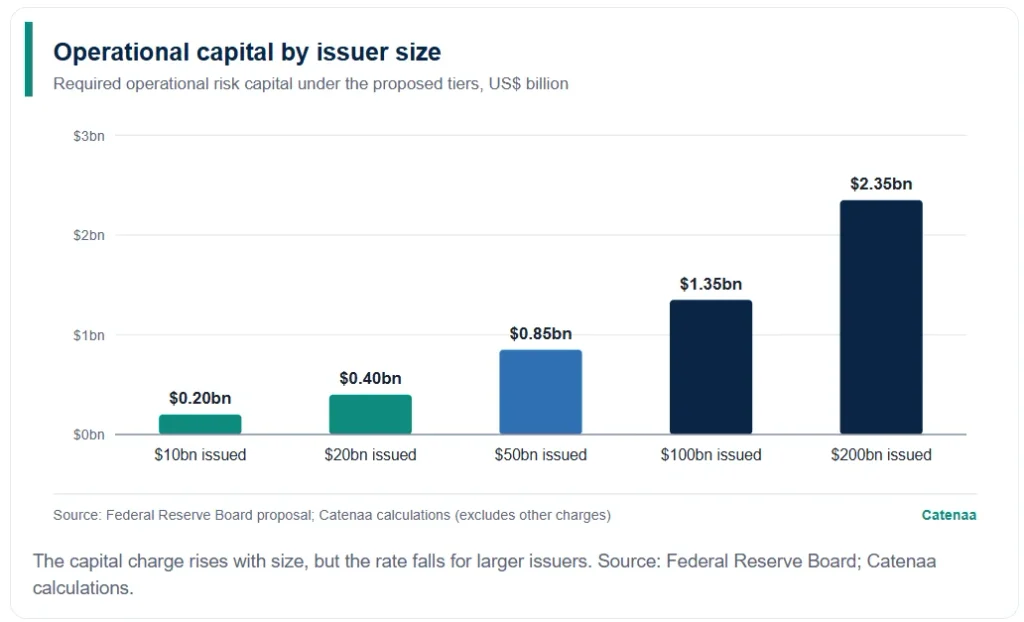
Operational capital would run from 2% of the first $20bn outstanding down to 1% above $50bn.
Governor Michael Barr backed the step but flagged gaps on redemption rights and anti-money laundering oversight.
New US stablecoin rules took shape this week. On 24 September, the Federal Reserve Board sought comment on two proposals under the GENIUS Act. Both apply to stablecoin issuers it supervises.
The first proposal covers reserves, capital and risk management. The second sets out how state member banks can apply to issue stablecoins through a subsidiary. Comments close 60 days after publication in the Federal Register.
Who the Fed stablecoin rules cover
The rules apply to a defined group, according to a Fed staff memo. It covers subsidiaries of insured state member banks that the Fed approves to issue payment stablecoins.
The group also includes large state-chartered issuers without deposit insurance. Once such an issuer has $10bn or more in coins outstanding, it moves under Fed rules. It can avoid that only with a waiver.
Other issuers answer to other regulators. The OCC, FDIC and NCUA have already issued their own proposals for the firms they oversee.
Reserves: one dollar for every coin
At the core sits a one-to-one rule. Issuers must hold reserves worth at least the face value of all coins in circulation. That test applies at all times.
The list of allowed assets is narrow. It includes cash, Fed balances, demand deposits, Treasuries maturing within 93 days and overnight repo backed by Treasuries. Funds that hold only these assets also qualify, as do tokenised versions of some of them.
If backing falls short, the issuer must alert the Fed. It then has to liquidate reserves and redeem coins, unless the Fed approves a plan to restore full backing.
Redemptions must also be quick. Issuers need a public policy that pays holders within two business days. However, the Fed may extend that window if an issuer faces a threat to its safety or to financial stability.
Capital charges scale with size
The capital regime breaks new ground. Under the plan, issuers face a 2.0% operational risk charge on the first $20bn of coins outstanding. The rate then falls to 1.5% on the next $30bn and 1.0% above $50bn.
On top of that, issuers face a charge equal to 25% of their three-year average revenue from non-reserve activities. A separate 2% charge applies to uninsured deposits and to reverse repo deals with too little collateral.
Scale matters a great deal. On Catenaa calculations, an issuer with $10bn outstanding would need $200m of operational capital. An issuer with $100bn would need $1.35bn, or 1.35% of its coins.
Failure carries teeth. Suppose an issuer misses its capital minimum at two quarter ends in a row. It would then have to sell its reserves and redeem every coin.
Yield ban and close supervision
The proposal also enforces the Act’s ban on paying interest just for holding a stablecoin. Moreover, the Fed would presume that some third-party deals break that ban, in line with the OCC’s approach.
That could matter for platforms that pass reserve income to holders as rewards. Oversight will also be close. The Fed plans a full-scope exam at least every 12 months, and issuers must file confidential weekly reports.
Barr backs the step but flags gaps
Governor Michael Barr supported the proposal in a statement. He welcomed limits on reserve assets as well as clear, standard capital rules.
However, he wants public input on whether the rule handles interest rate and foreign currency risks. He also called for clear universal redemption rights in the final rule.
Barr raised one further concern. The proposal would let the Fed act on anti-money laundering failures only when a deficiency is significant or systemic. He warned that the standard may have unknown effects on supervision.
What the stablecoin rules mean for the market
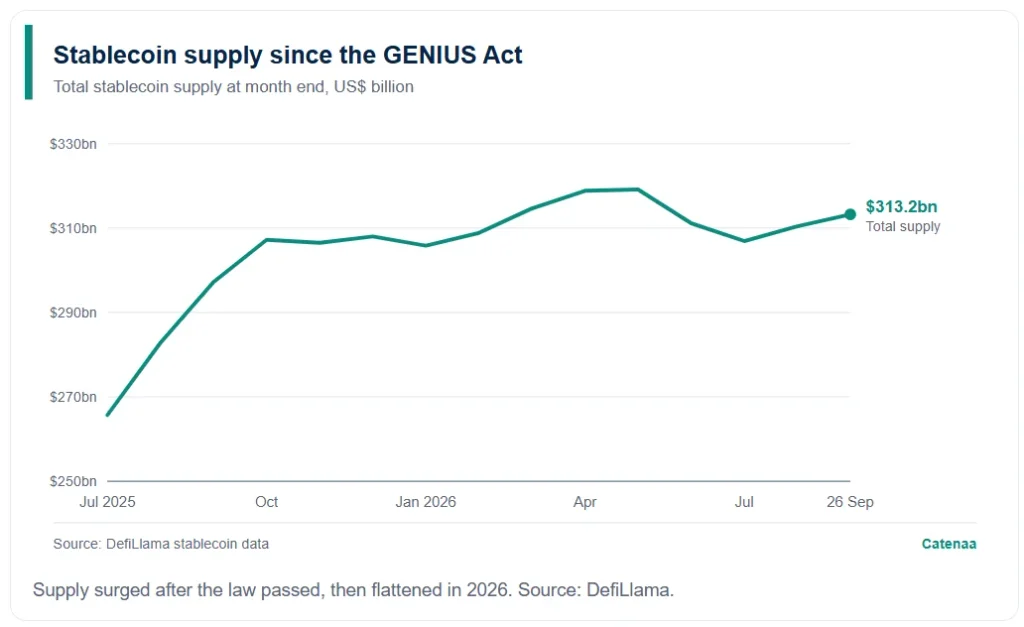
The market these stablecoin rules will govern is large. DefiLlama data put total stablecoin supply near $313bn on 26 September, up 6.1% from a year earlier.
Supply has grown about 21% since the GENIUS Act became law in July 2025. Still, it remains below the peak of roughly $322bn reached in May.
Two coins dominate. Tether’s USDT accounts for about 59% of dollar stablecoins, and Circle’s USDC for about 24%.
Timing is the key question. The Act takes effect on 18 January 2027, or 120 days after regulators issue final rules, whichever comes first.
The Fed’s proposal adds one more piece before that deadline. Meanwhile, crypto demand has picked up alongside the policy work, with bitcoin ETFs turning positive for 2026.
For issuers and banks, the comment window offers a clear chance to shape the final rules. Holders, in turn, stand to gain faster redemptions and safer reserves.