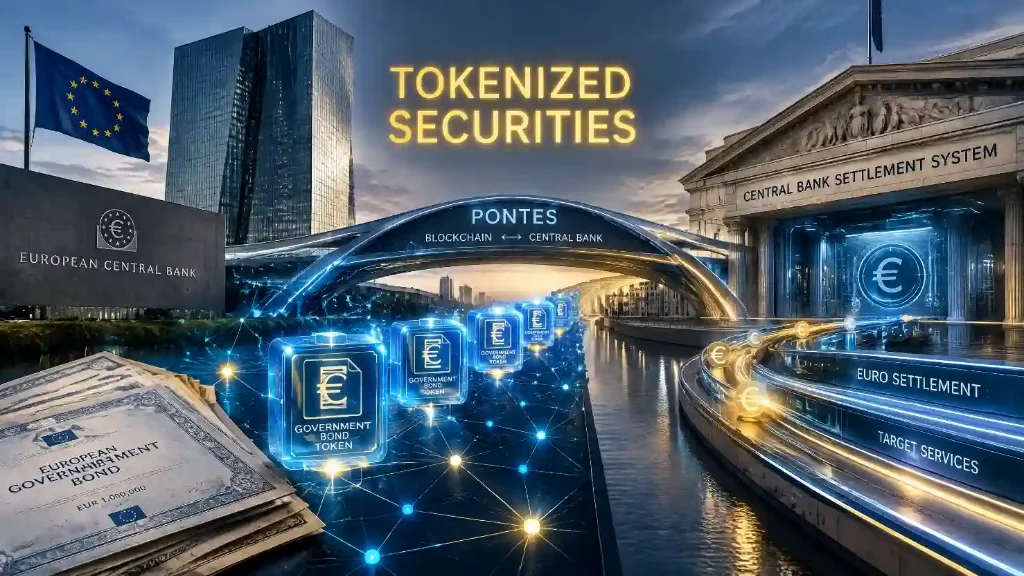


Catenaa, Tuesday, September 29, 2026- The European Central Bank is preparing to buy tokenized euro-denominated securities with part of its own investment portfolio, marking a direct move into distributed-ledger-based financial markets.
The ECB announced the plan September 21 as the Eurosystem launched Pontes, its new service for settling wholesale tokenized-asset transactions in central bank money.
Initial investments will focus on securities issued by euro-area central governments, regional governments, public agencies and European supranational institutions.
The ECB has not disclosed how much it intends to invest.
It has also not set a date for the first purchases.
The bank’s Executive Board will determine the timing and operational details after preparatory work is completed.
That decision will also depend on the availability of suitable tokenized securities and development of Europe’s broader digital financial market.
The purchases will come from the ECB’s own-funds portfolio.
That distinction is important because the portfolio is separate from the securities held or purchased for monetary-policy purposes.
The own-funds portfolio generates investment income that helps cover ECB operating expenses not related to its banking-supervision duties.
The planned tokenized investments therefore do not represent a new monetary-policy program or an attempt to influence borrowing costs across the euro area.
Instead, the ECB says it wants practical experience operating as an investor in markets using distributed ledger technology.
That will expose the institution directly to the full lifecycle of a tokenized security.
The process includes trade execution, settlement, portfolio administration and interaction with the technology supporting tokenized assets.
Until now, much of the Eurosystem’s work on tokenization has concentrated on creating infrastructure that other financial institutions could use.
The planned investment would place the ECB on the other side of that infrastructure as an actual market participant.
Transactions will settle through Pontes.
The Eurosystem launched the service September 21 to connect distributed-ledger platforms used by financial markets with its existing TARGET payment infrastructure.
That connection allows tokenized securities to settle against central bank money rather than requiring the cash leg of a transaction to use a privately issued stablecoin or another commercial settlement asset.
Central bank money is generally considered the safest settlement asset because it carries no private issuer credit risk.
For tokenized markets, preserving access to that settlement layer is becoming increasingly important as securities issuance moves onto new digital platforms.
Pontes supports two settlement models.
Transactions can use cash tokens on the Eurosystem’s distributed-ledger infrastructure or settle through T2, its real-time gross settlement system.
The service also uses a mechanism known as Hash-Link to synchronize the transfer of assets and money across different platforms.
That enables delivery-versus-payment transactions in which the asset changes hands only if the corresponding payment also completes.
The structure is designed to prevent one side of a transaction from settling without the other.
Pontes also supports greater automation between market infrastructure and the Eurosystem’s payment systems.
The ECB expects that automation to reduce manual processing and improve operational efficiency.
An initial group of banks and market-infrastructure providers has already completed onboarding.
Participants include Deutsche Bank, Santander, DZ Bank, DekaBank, BayernLB, Société Générale and the European Investment Bank.
Several distributed-ledger market operators have also joined the initial rollout.
The service will expand gradually.
The ECB plans to introduce additional features and longer operating hours as market usage develops, with full implementation expected by 2028.
Pontes grew out of Eurosystem experiments conducted in 2024.
Those trials involved dozens of transactions and market participants testing different methods of settling distributed-ledger transactions using central bank money.
The work demonstrated that tokenized securities do not necessarily require the financial system to abandon existing central-bank settlement infrastructure.
Instead, new distributed ledgers can be connected with conventional central-bank payment systems.
The ECB sees that interoperability as an important bridge while Europe’s tokenized markets develop.
Pontes is therefore intended as the near-term operational component of a larger strategy.
A second Eurosystem initiative, called Appia, is focused on the longer-term architecture of Europe’s tokenized financial system.
Appia is expected to produce a blueprint by 2028 covering infrastructure, standards, governance and interoperability.
Together, the initiatives reflect a broader effort by European authorities to ensure that tokenization develops around regulated financial infrastructure.
Tokenization converts ownership or claims on conventional assets into digital representations recorded on distributed ledgers.
A government bond, for example, can retain its conventional economic and legal characteristics while its issuance and ownership records are maintained through distributed-ledger infrastructure.
Supporters argue that this can reduce reconciliation work, automate parts of settlement and shorten processes that currently pass through several intermediaries.
Smart contracts could also automate interest payments, redemptions and other parts of a security’s lifecycle.
The technology does not remove financial or credit risk from the underlying asset.
A tokenized government bond remains exposure to the issuer of that bond.
What changes is mainly the infrastructure used to issue, trade, settle and administer it.
Tokenized bonds have already moved beyond experimental projects.
Governments, international institutions, banks and asset managers have issued blockchain-based debt instruments in several markets.
The European Investment Bank has been among the European institutions experimenting with digital bond issuance.
Commercial banks are also developing tokenized deposits, securities and funds.
The ECB’s decision to invest directly could add another layer of institutional validation to those markets.
It would make the central bank not only the provider of settlement infrastructure but also a buyer of some securities using that infrastructure.
The scale initially will be deliberately small.
The ECB described the planned allocation only as a small portion of its own funds and gave no monetary figure.
That suggests the immediate objective is operational learning rather than generating significant investment returns or materially increasing demand for tokenized bonds.
The experience could nevertheless influence how the Eurosystem develops Pontes and Appia.
Using the infrastructure itself may expose operational issues that are less apparent when a central bank functions only as a settlement provider.
Those lessons could affect future decisions on interoperability, custody, portfolio systems and settlement design.
The move also highlights the increasing overlap between conventional capital markets and blockchain technology.
The ECB is not buying cryptocurrencies or replacing government bonds with digital assets.
It is preparing to hold conventional securities whose ownership and settlement use distributed-ledger infrastructure.
That distinction places the initiative firmly within the institutional tokenization trend rather than the speculative cryptocurrency market.
For Europe’s tokenized financial sector, September 21 therefore marked two related developments.
Pontes gave market participants a live route to central-bank-money settlement.
The ECB simultaneously signaled that it intends to use that route itself.
The amount may initially be small.
The institutional significance is larger: Europe’s central bank is preparing to move from observing tokenized securities markets to participating in them directly.