


October 04, 2026 – The community bank lobby wants a judge to strike down the rule behind a wave of crypto trust charters.

In Summary
ICBA sued the OCC in Washington on October 2 over its national trust charter policy.
The suit targets a March 2026 rule, a 2021 interpretive letter, and Protego’s conditional charter.
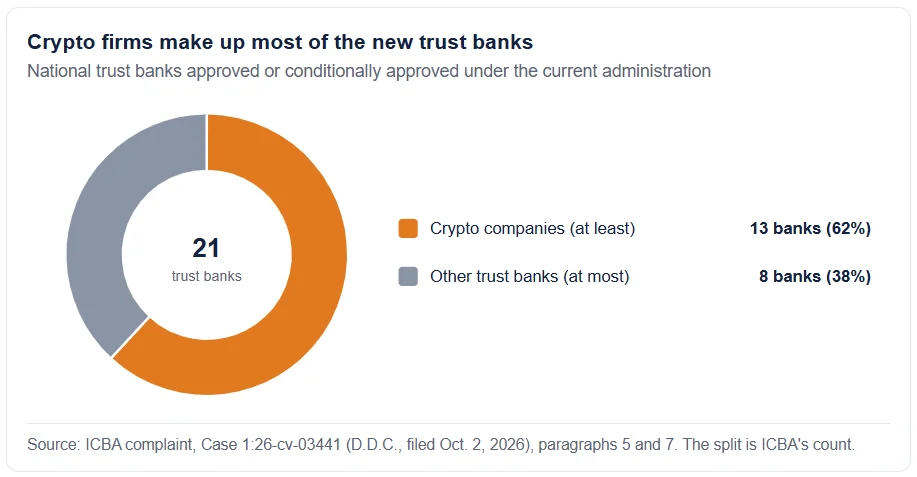
ICBA counts 21 recent trust bank approvals, at least 13 of them crypto companies.
A ruling for ICBA could freeze crypto charters as the GENIUS Act start date nears.
America’s community bank lobby has taken the fight over crypto charters to court. On October 2, the Independent Community Bankers of America sued the Office of the Comptroller of the Currency. It filed the case in federal court in Washington.
ICBA argues that the OCC has let crypto firms into banking without bank-level rules. The suit also names Comptroller Jonathan Gould. It asks the court to throw out a March 2026 rule, a 2021 guidance letter, and one specific charter.
ICBA also wants an order barring the OCC from using the rule or letter for new charters. Hunton Andrews Kurth represents the group.
Why ICBA Says Crypto Charters Break the Law
The 39-page complaint says the OCC has approved or conditionally approved 21 trust banks under the current administration. At least 13 of them, it says, are crypto companies.
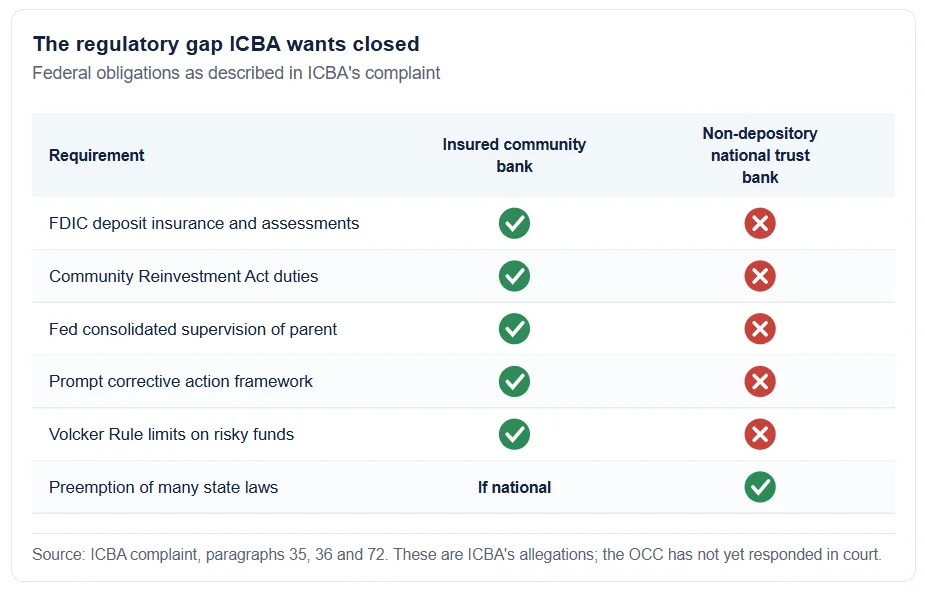
ICBA’s core claim is statutory. It says the National Bank Act allows only three kinds of national banks. These are deposit-taking banks, bankers’ banks, and trust banks doing fiduciary work.
In ICBA’s view, no category exists for firms that neither take deposits nor act as fiduciaries. At issue is a 1978 amendment about banks limited to the operations of a trust company. The agency reads that phrase broadly. By contrast, ICBA cites a 1979 Third Circuit ruling that tied it to fiduciary powers.
The complaint brings three counts under the Administrative Procedure Act. It also invokes the major questions doctrine, arguing that Congress never clearly granted such broad power.
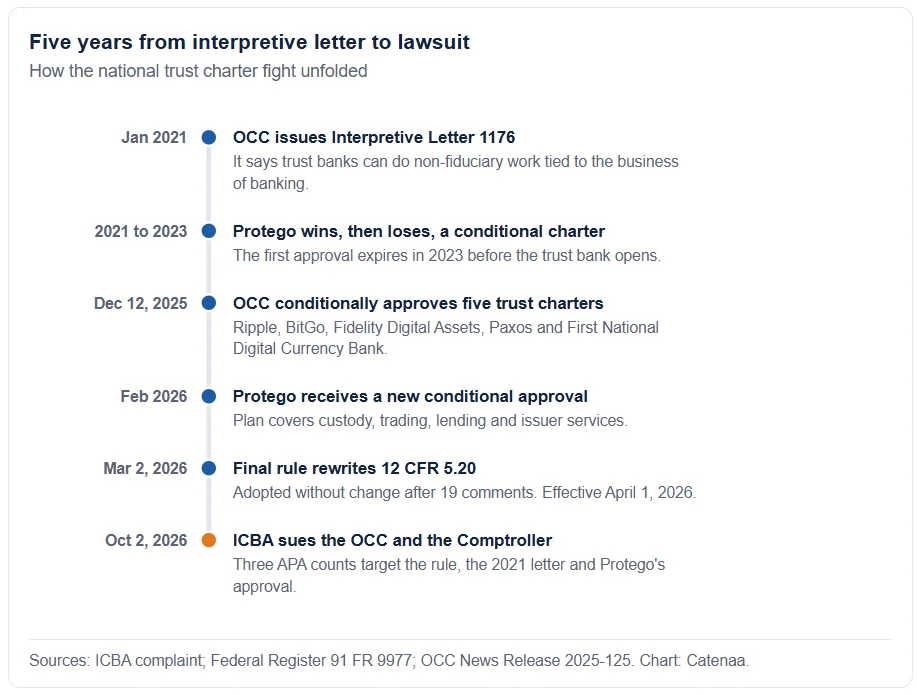
History matters here too. A 2003 OCC rule said special purpose banks doing non-fiduciary work must take deposits, pay checks or lend money. Later, in 2021, the agency said crypto applicants must first prove they had strong controls. According to ICBA, no crypto trust charter won approval in the years that followed.
The Rule at the Centre of the Case
The OCC’s final rule appeared on March 2 and took effect on April 1. It replaced the phrase fiduciary activities in 12 CFR 5.20 with the statute’s trust company language.
The agency received 19 comments and adopted the proposal without change. It said it intended to neither expand nor contract its chartering power. Notably, it called the question of a required amount of fiduciary work outside the rule’s scope.
ICBA calls that response far too thin. In its view, the OCC never fully dealt with deposit insurance or consumer confusion. Nor did it explain how it would wind down a failed trust bank.
Protego and the Wave of Approvals
The charter wave gathered pace last December. On December 12, the OCC conditionally approved five trust charters, including Ripple, BitGo, Fidelity Digital Assets and Paxos. Comptroller Gould said new entrants are good for consumers, the industry and the economy.
ICBA singles out Protego. The OCC first conditionally approved the firm in 2021, but that approval lapsed in 2023 before the bank opened. Protego reapplied in May 2025 and won a fresh conditional approval in February 2026.
According to the complaint, Protego plans custody, trading, lending and issuer services, mostly in a non-fiduciary capacity. ICBA also notes the OCC has not run an uninsured bank receivership in nearly a century.
The group has fought single applications too. In May, it urged the OCC to rescind or suspend Coinbase’s conditional trust charter. A New York lawsuit against a Coinbase unit prompted that request.
Competition, Costs and Consumer Risk
The suit leans on competitive harm. Two unnamed member banks, each under $2.5 billion in assets, spend over $1.5 million a year on compliance. Each says it lost hundreds of thousands of dollars in business this year to conditionally approved crypto firms.
In addition, ICBA says crypto trust banks could draw deposits away from local lenders. That, it argues, would leave less money for farm and small business loans.
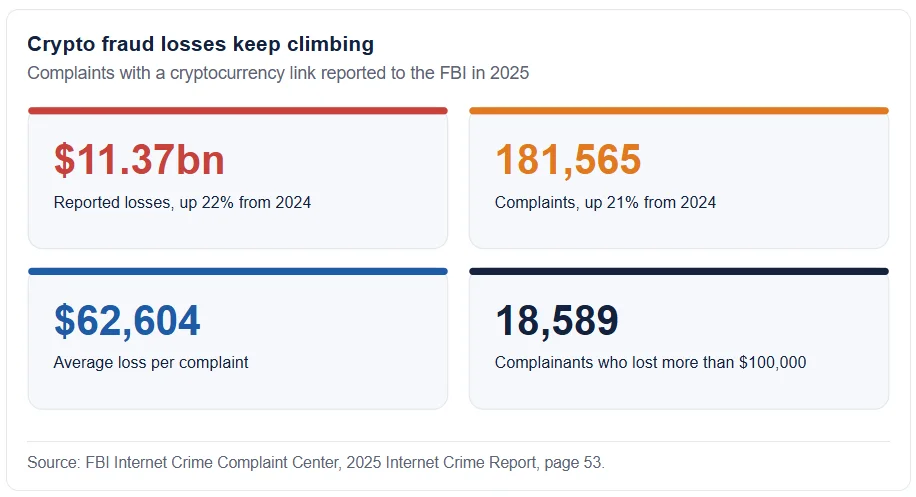
ICBA also points to fraud risk. The FBI logged 181,565 crypto-linked complaints in 2025, with losses of $11.37 billion. That figure rose 22% from 2024.
What Happens Next
The OCC now has to answer in court. Meanwhile, the GENIUS Act takes effect by January 18, 2027, at the latest. That law lets uninsured national banks chartered by the OCC issue payment stablecoins. Bank subsidiaries and approved nonbanks can issue them as well.
As a result, the timing matters for crypto firms planning stablecoin businesses under a federal charter. A ruling for ICBA could freeze crypto charters at a pivotal moment. Conversely, a win for the OCC would cement the trust charter as a federal gateway for digital asset firms.