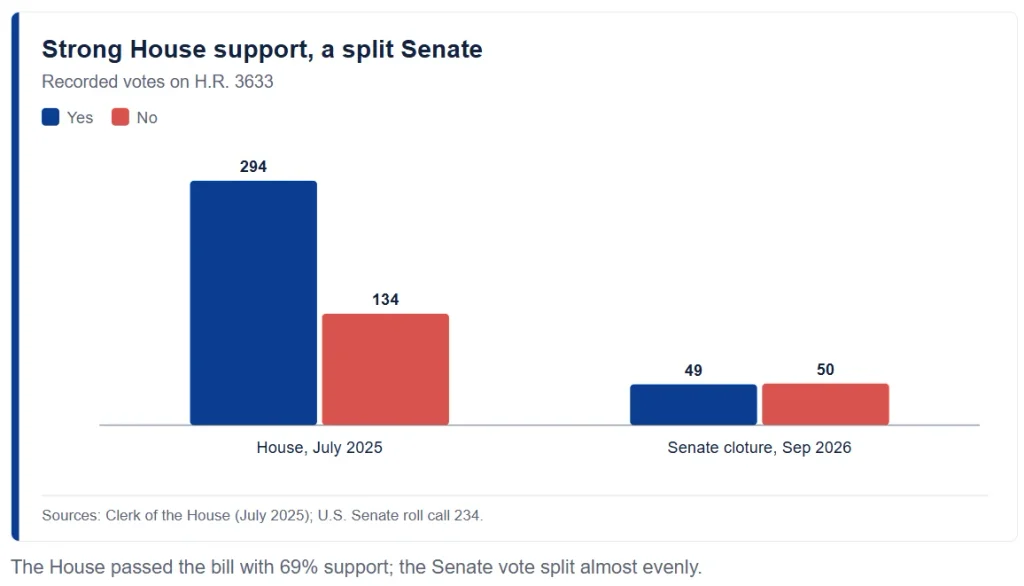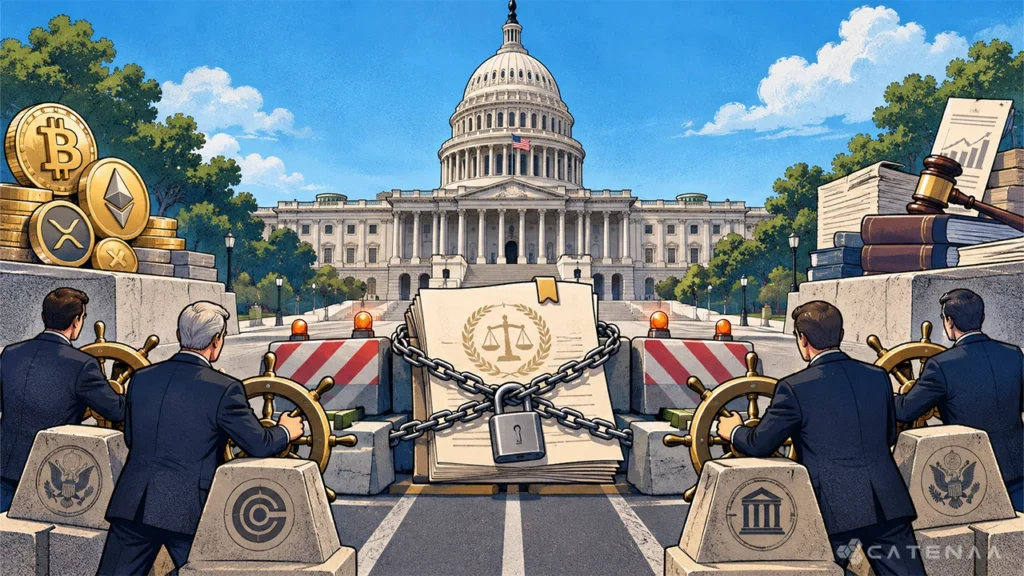


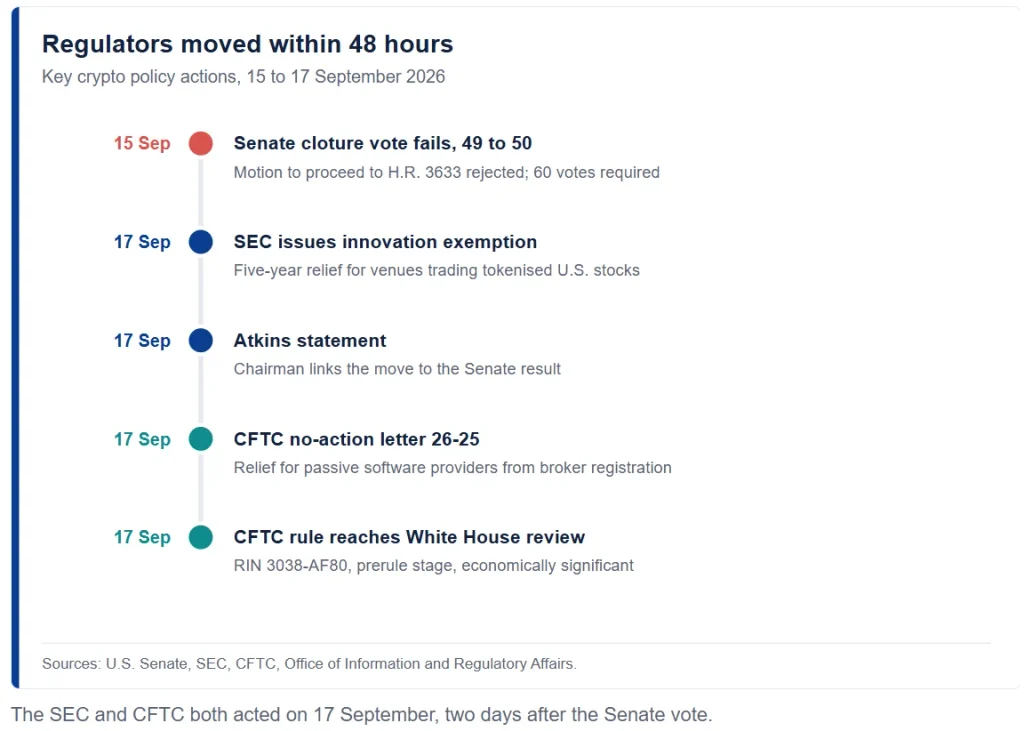
September 20, 2026 – The Senate vote failed 49 to 50. Within 48 hours, the SEC opened a path for tokenised stocks and the CFTC moved on software relief and a wider crypto rule.

In Summary
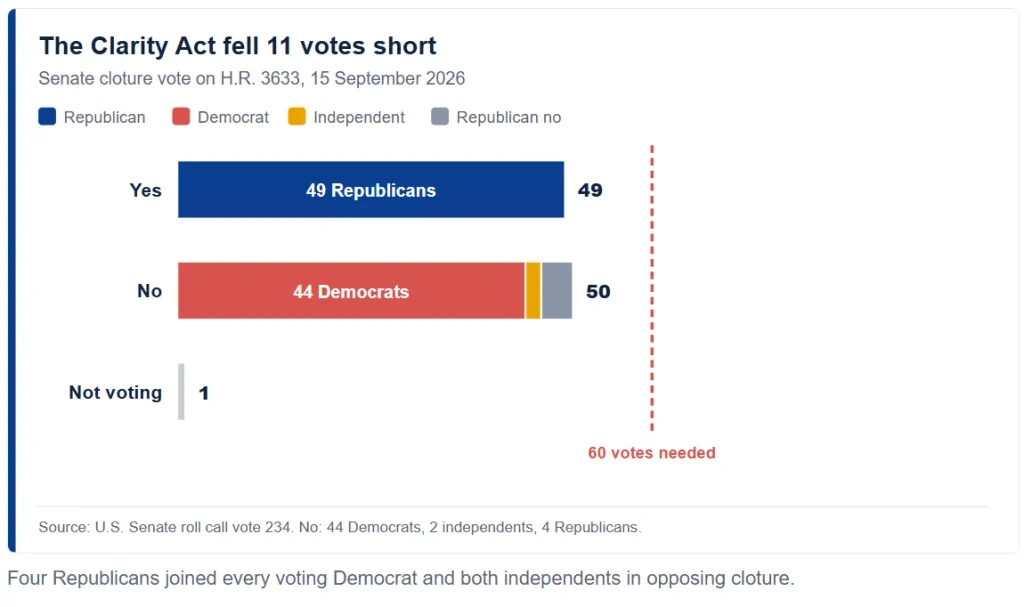
The Senate rejected cloture on the Clarity Act, H.R. 3633, by 49 to 50 on 15 September; 60 votes were needed.
Four Republicans voted no: Collins, Hawley, Moran and Tillis. No Democrat voted yes.
On 17 September, the SEC issued a five-year innovation exemption for trading tokenised U.S. stocks.
The CFTC issued no-action letter 26-25 for passive software providers on the same day.
A CFTC crypto markets rule, RIN 3038-AF80, entered White House review at the prerule stage.
The Clarity Act hit a wall in the Senate this week. Yet crypto rulemaking did not stop. Instead, the work shifted from Capitol Hill to two federal regulators, and it moved fast.
On 15 September, senators voted 49 to 50 on a motion to proceed to H.R. 3633, the Senate roll call record shows. Cloture required three-fifths of the chamber, or 60 votes. So the bill fell 11 votes short.
How the Clarity Act Vote Broke Down
The vote split mostly along party lines. All 49 yes votes came from Republicans. Meanwhile, 44 Democrats and two independents voted no, and one Democrat did not vote.
Four Republicans also opposed the motion. They were Susan Collins of Maine, Josh Hawley of Missouri, Jerry Moran of Kansas and Thom Tillis of North Carolina. Tillis first voted yes, then switched. That move lets him file a motion to reconsider, so the bill can return.
The House had passed the same bill 294 to 134 in July 2025. Therefore, the Senate stall ends more than a year of talks over which agency should police digital assets. The bill would have split that job between the SEC and the CFTC.
The SEC Moves Within 48 Hours
Two days later, the Securities and Exchange Commission acted. It issued an “innovation exemption” for trading tokenised versions of listed U.S. stocks. The relief lets qualifying Tokenized Securities Venues trade these tokens through permissioned automated market makers.
The exemption runs for five years. It also carries tight conditions. For example, tokens must give holders the same rights as the underlying shares. Smart contracts must sit on public, permissionless blockchains and stay auditable. In addition, trading must halt whenever the main exchange halts.
The SEC also granted a second exemption to liquidity providers. Firms that supply tokenised shares to these pools with their own capital need not register as dealers. Venues must also notify an issuer when a third party tokenises its stock, and issuers can object. Furthermore, the Commission capped the number of symbols and the trading volume on each venue. It is now seeking public comment on the whole framework.
Chairman Paul Atkins tied the move to the Senate result. “Earlier this week, Congress was unsuccessful in advancing the CLARITY Act,” he said in a formal statement. He added that durable rulemaking must follow this interim step, calling it a bridge rather than an end point.
The CFTC Follows a Parallel Track
The Commodity Futures Trading Commission moved on the same day. Its staff issued no-action letter 26-25 for providers of passive software. These firms build tools that route user trades to registered brokers and exchanges. As long as they meet set conditions, staff will not seek enforcement over broker registration.
Separately, the agency sent a broader rule to the White House. The Office of Information and Regulatory Affairs logged the CFTC proposal on 17 September. Its title is “Regulation Crypto Asset Transactions and Regulation Crypto Asset Markets.” The filing sits at the prerule stage.
The review office also marks it as economically significant. That label applies when a rule could affect the economy by $100 million or more a year. Consequently, the proposal faces a full cost and benefit review before it can advance.
Why Agency Rules Are Less Durable
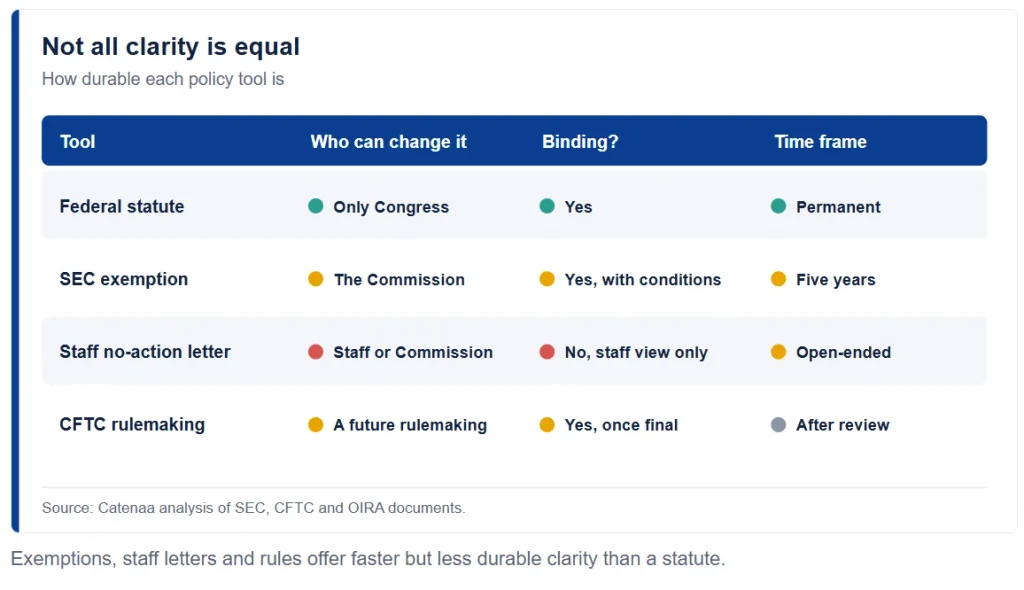
Rules from regulators can move quickly. However, they can also change quickly. A future commission can amend or withdraw an exemption. Staff no-action letters do not even bind the full commission.
By contrast, a statute stays in place until Congress changes it. That difference matters for firms deciding where to build. Clear law draws long-term capital. Temporary relief, on the other hand, tends to draw pilots and cautious launches.
Even so, the SEC’s five-year window gives firms a real runway. Likewise, the CFTC rule could become binding if it clears review and public comment. Together, these steps give the market a partial rulebook.
Stablecoins show the contrast. Congress passed the GENIUS Act in July 2025, and its rules now sit in federal law. Market structure, by comparison, remains a patchwork of agency actions. That gap is exactly what the Clarity Act aimed to close.
What Comes Next for the Clarity Act
Some senators still want a deal. Several Democrats who voted no have said talks should continue. Tillis’s procedural switch also keeps a path open on the floor.
Still, the calendar is tight. Midterm elections arrive on 3 November, and floor time is scarce. For now, crypto clarity will come from regulators, not lawmakers. Markets should expect progress through rule text, comment periods and exemptions rather than Senate votes.