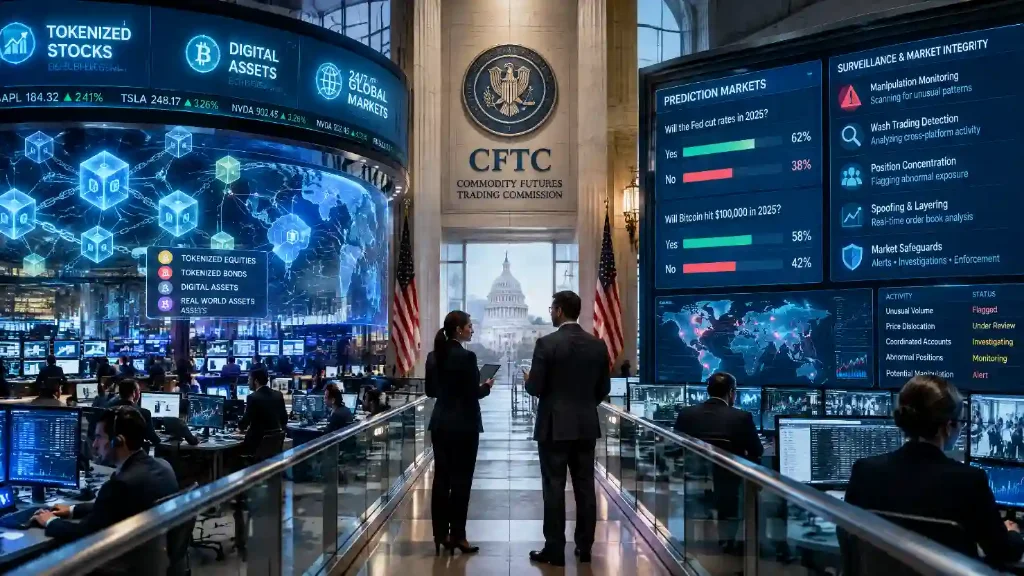


Catenaa, Thursday, September 24, 2026 – The US Commodity Futures Trading Commission is preparing financial markets for widespread tokenization and round-the-clock trading while tightening scrutiny of prediction contracts that can be manipulated by people controlling their outcomes.
CFTC Chairman Michael Selig said Tuesday that regulators must prepare existing markets for blockchain, artificial intelligence, onchain finance and 24/7 trading.
Speaking at the US Treasury Market Conference at the Federal Reserve Bank of New York, Selig said financial markets could undergo rapid technological change during the coming decade.
He said the agency expects tokenized real-world assets to become an increasingly important part of financial infrastructure.
The CFTC is also examining wider use of stablecoins by exchanges, clearinghouses and market participants.
The agency expanded its eligible collateral framework in February to include qualifying payment stablecoins issued by national trust banks.
But the same regulator is drawing a sharper line around prediction markets where traders or other individuals can directly influence contract outcomes.
The CFTC’s Division of Market Oversight issued a separate advisory Tuesday warning exchanges about so-called mention markets.
These contracts allow users to trade on whether someone will use certain words, attend an event or interact with another person.
The agency said such contracts face heightened manipulation risks because settlement can depend on conduct controlled by one person or a small group.
Designated contract markets must therefore determine whether contracts are sufficiently protected against manipulation before listing them.
The CFTC said exchanges should examine whether the person controlling an outcome faces legal, professional, contractual or confidentiality obligations that discourage deliberate interference.
Trading platforms should also establish surveillance and trading controls capable of identifying suspicious activity.
The warning follows enforcement cases showing how those vulnerabilities can emerge in practice.
The CFTC last month ordered former White House teleprompter operator Gabriel Perez to pay more than $172,000 over trading involving presidential mention markets.
The regulator found that Perez had advance access to presidential speeches and used nonpublic information to trade contracts linked to words or phrases expected in those speeches.
He made more than $107,500 in profits, according to the agency.
In a separate case, the CFTC charged former US Rep. George Santos over trading linked to whether he would attend the 2026 State of the Union address.
The regulator found that Santos traded both sides of a contract tied to his attendance while making public statements that affected market prices.
The two developments illustrate the regulatory problem facing US authorities as financial products move increasingly onchain.
Regulators want to allow markets to adopt technologies that could speed settlement, extend trading hours and reduce reliance on traditional infrastructure.
At the same time, newer market structures can create risks that existing rules were not designed to address.
The SEC took another step toward tokenized finance on September 17 by granting temporary exemptions for certain venues trading tokenized US-listed stocks.
The relief allows approved tokenized securities venues to use permissioned automated market makers and liquidity pools under specified conditions.
That decision followed growing regulatory attention toward continuous markets, blockchain settlement and tokenized financial assets across US agencies.
The CFTC has separately sought public comment on extending conventional futures trading toward 24/7 schedules.
Its approach, however, has not been to approve every new market structure automatically.
In July, the agency halted a proposed move by CME to begin continuous crude oil futures trading while regulators examined market and legal risks.
The CFTC’s latest actions suggest that distinction will become increasingly important as tokenization expands.
Blockchain infrastructure, stablecoins and continuous markets are moving closer to traditional finance.
Prediction markets are expanding at the same time, introducing contracts whose outcomes can sometimes be influenced directly by people involved in the event.
For regulators, the next stage of digital finance therefore appears to involve two processes running together.
Markets are being opened to technologies that can move assets and money faster, while products vulnerable to manipulation are facing closer examination before that expansion continues.