

September 23, 2026 – Staff at the derivatives regulator say contracts settling on one person’s words or attendance may be presumptively open to manipulation.

In Summary
CFTC staff issued an advisory on 22 September covering contracts that settle on whether a person says a word, attends an event or interacts with someone.
Staff may treat these mention markets as presumptively readily susceptible to manipulation under Core Principle 3.
Exchanges filing such contracts must show independent verification, controls, surveillance and position limits.
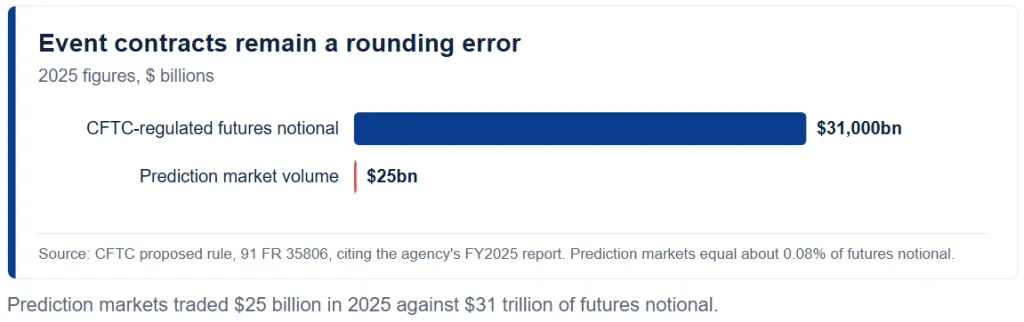
Prediction market volume topped $25 billion in 2025, about 0.08% of the $31 trillion in CFTC-regulated futures notional.
The advisory is informational, creates no new obligations and reflects staff views only.
Regulators have put a marker down on one of the strangest corners of prediction markets. On 22 September, CFTC staff issued an advisory on mention markets. These contracts pay out on whether a named person says a word, shows up somewhere, or meets someone.
The Division of Market Oversight wrote the advisory. It warns that such contracts face a high risk of manipulation. Settlement, after all, turns on the conduct of one person.
Why Mention Markets Worry the CFTC
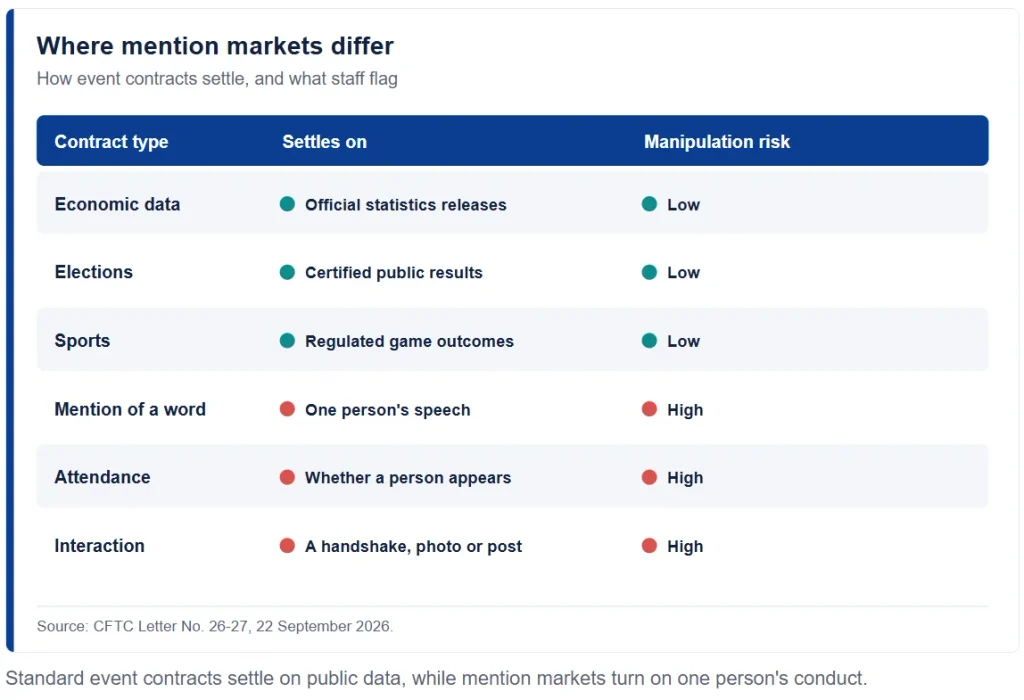
Most event contracts settle on public data. Examples include inflation prints, election results and sports scores. No single person controls those outcomes.
Mention markets work differently, the staff letter explains. A host can simply say the catchphrase that settles the contract. A trader can even pay for an on-air shout-out and force the result.
Insiders also hold an edge. Scripts, prepared remarks and guest lists count as material nonpublic information. Staff warn that such access invites social engineering and pressure campaigns.
Private settings raise the risk further. When conduct happens away from cameras, nobody can verify it well. Likewise, a stray buzzword on an earnings call may attract no scrutiny at all.
The Rule Behind the Advisory
Exchanges must follow 23 core principles under the Commodity Exchange Act. Core Principle 3 is the one that bites here. It allows a designated contract market to list only contracts that are not readily susceptible to manipulation.
Staff now say they may treat mention markets as presumptively vulnerable. Consequently, any exchange filing one should expect a higher bar. The advisory asks for a full, contract-specific analysis under Part 40.
The document stops short of a rule. It creates no new obligations and reflects staff views only. Even so, exchanges rarely ignore guidance about what staff will question.
Four Tests for a Listing
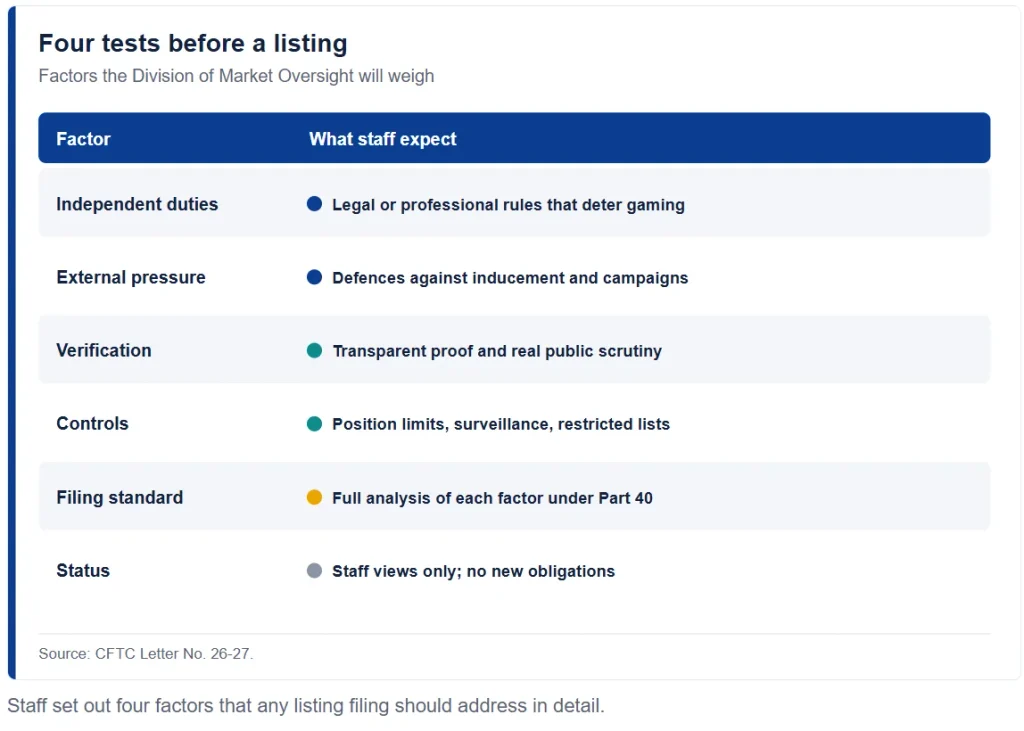
Staff set out the factors they will weigh. First, they ask whether the person who controls settlement faces independent duties. Legal, professional or contractual obligations can deter gaming of a contract.
Second, staff look at outside pressure. Traders may push the individual through inducements or public campaigns. Third, they assess whether the outcome is verifiable and subject to real public scrutiny.
Finally, staff expect robust controls. Exchanges should identify likely controllers and insiders, then apply position limits, surveillance and reporting. Restricted lists and third-party screening also feature in the guidance.
Prediction Markets Are Small but Growing
The market remains modest in size. Trading volume across CFTC-registered prediction markets topped $25 billion in 2025, the agency’s proposed rule notes. Futures markets it regulates carried about $31 trillion of notional value that year.
So event contracts represent roughly 0.08% of the total. Nevertheless, growth has been fast, and the range of events keeps widening. The CFTC first designated a prediction market as an exchange in 2004.
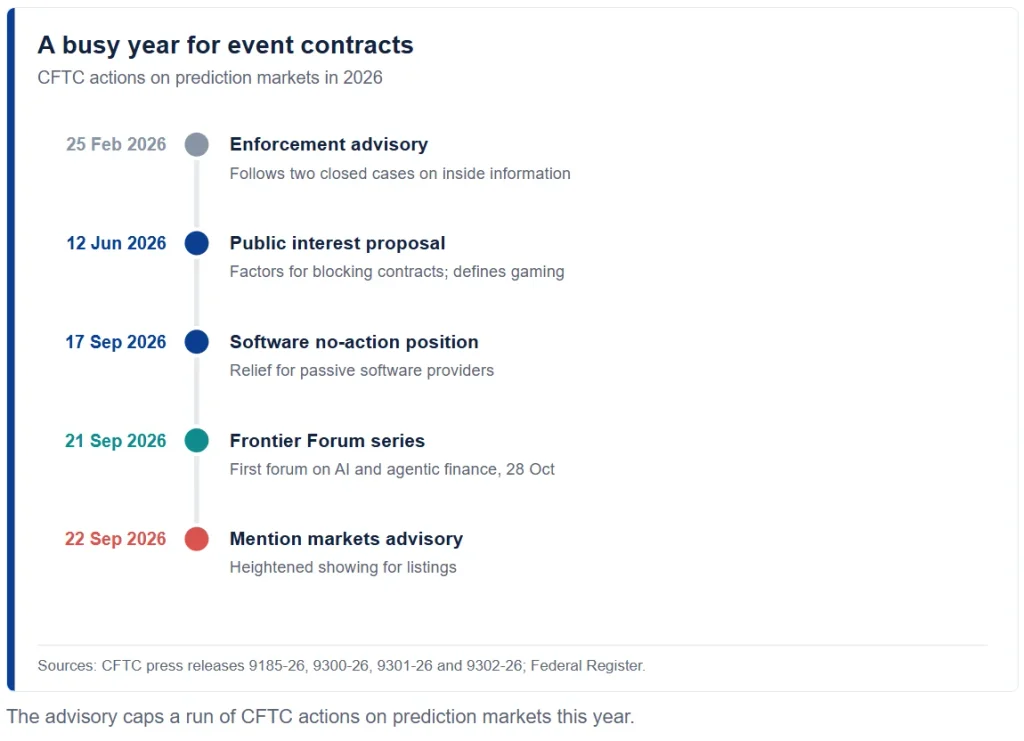
Enforcement has already touched the sector. In February, the agency published an advisory after an exchange closed two cases alleging trading on inside information. That advisory signalled scrutiny of insider trading and surveillance.
The growth story explains the attention. Exchanges have listed contracts on data, votes, games and now personal conduct. Each new theme widens the pool of people who could move a settlement.
A Busy Month for Crypto and Event Markets
The advisory lands amid a wider policy push. On 17 September, staff granted a no-action position to providers of passive software. Days later, the agency announced a Frontier Forum series on new financial technology.
Chairman Michael Selig leads that effort through the Innovation Task Force. “The technologies transforming our markets are rapidly advancing,” he said. The first forum, on 28 October, covers artificial intelligence and agentic finance.
Meanwhile, the June proposal on public interest determinations remains open. It would set out when the Commission can block a contract, and it defines gaming. Together, these steps sketch a clearer rulebook for event contracts.
What Exchanges Should Do Next
The practical message is simple. Exchanges that want to list mention markets need evidence, not assurances. They must show how their rules stop the person at the centre from trading on the outcome.
Some contracts may still qualify. A well-designed product, backed by surveillance and limits, can rebut the presumption. Staff also invite early talks before a filing. That route may save exchanges from a public rejection later.
For traders, the advisory hints at slower product launches in this niche. For policy watchers, it shows regulators drawing a line between forecasting and stunts. The crypto and event market rulebook keeps taking shape through guidance rather than legislation.