

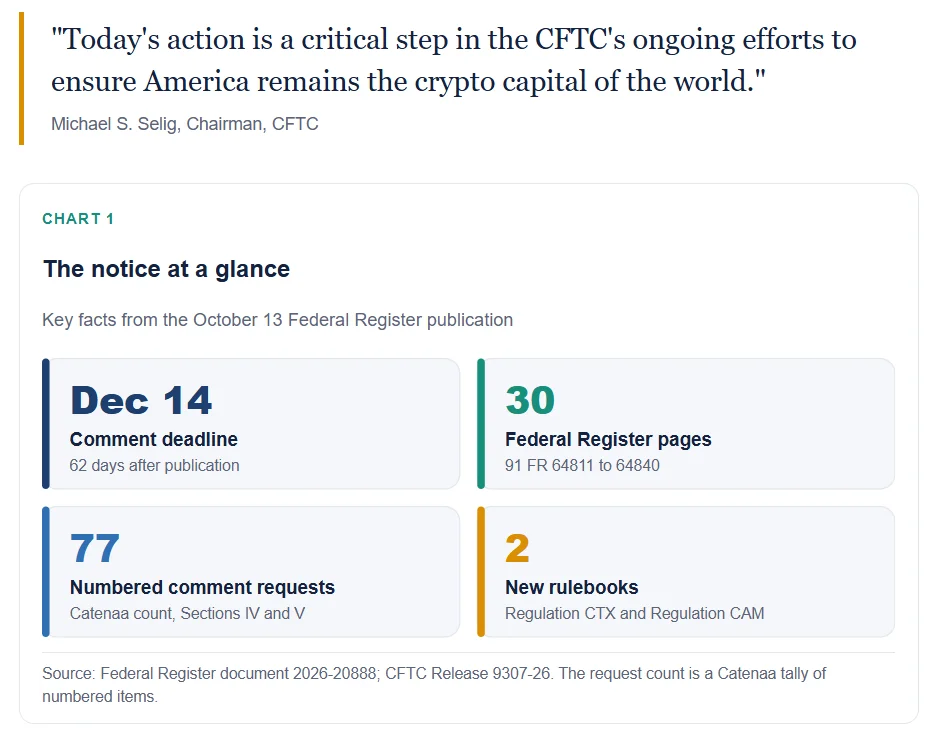
October 13, 2026 – Regulation CTX and Regulation CAM would route leveraged retail crypto trades through a new type of exchange, with comments due December 14.

In Summary
The CFTC’s advance notice on retail crypto trading was published in the Federal Register on October 13, with comments due December 14.
Regulation CTX would interpret the law on leveraged retail commodity trades, and Regulation CAM would create a new crypto asset market license.
An offer of leverage in account terms could bring even fully paid trades under federal rules until coins reach the buyer’s wallet.
Every retail trade would run through an FCM and be cleared by a DCO, though one firm could hold all three licenses.
Onchain apps that deliver coins to users may sit outside the regime, and a de minimis exemption is under consideration.
The CFTC crypto rules plan entered the Federal Register on Tuesday, starting the clock for public feedback. It aims to bring leveraged retail crypto trading onto a new kind of regulated exchange. Comments are due by December 14.
What the CFTC Crypto Rules Would Do
The notice sketches two new rulebooks, according to the agency’s release. Regulation CTX would interpret key terms in the law on retail commodity trades. Its companion, Regulation CAM, would create a “crypto asset market,” a new subtype of regulated futures exchange.
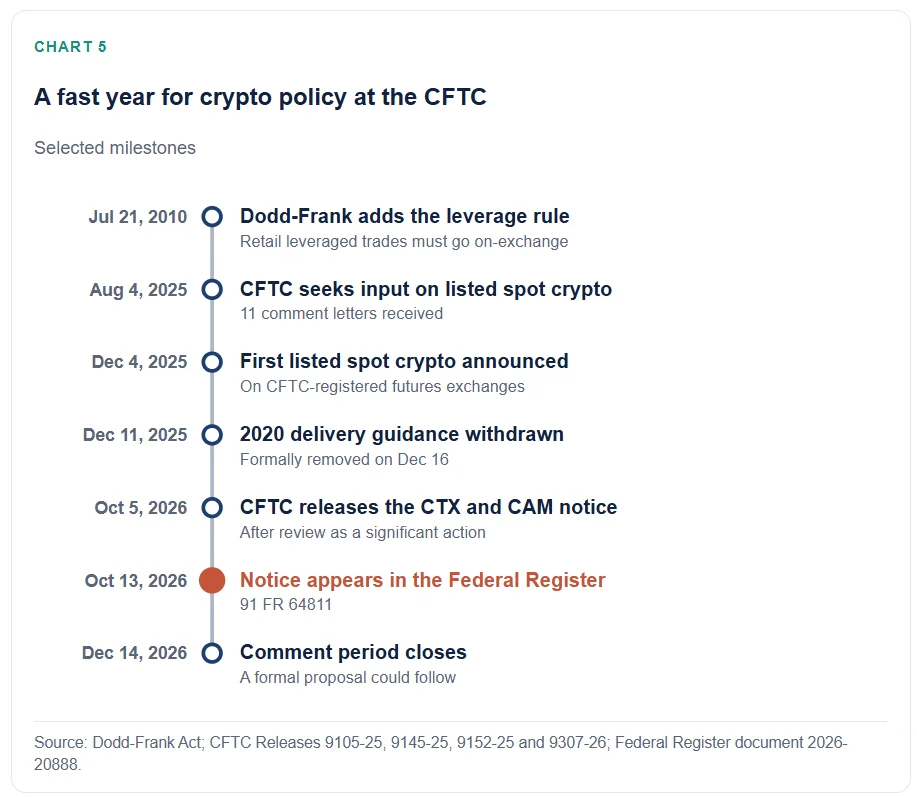
The legal hook is a 2010 provision of the Dodd-Frank Act. It requires leveraged, margined or financed commodity trades with retail customers to happen on a regulated exchange. However, trades that end in “actual delivery” within 28 days are exempt.
Chairman Michael S. Selig framed the effort as consumer protection. “The American people deserve clarity, certainty, and consumer protections in the crypto asset markets,” he said. He added that the agency wants to prevent schemes such as FTX, not just prosecute them afterwards. Indeed, the notice describes FTX’s collapse as an $8 billion fraud.
Why Fully Paid Trades Could Be Covered
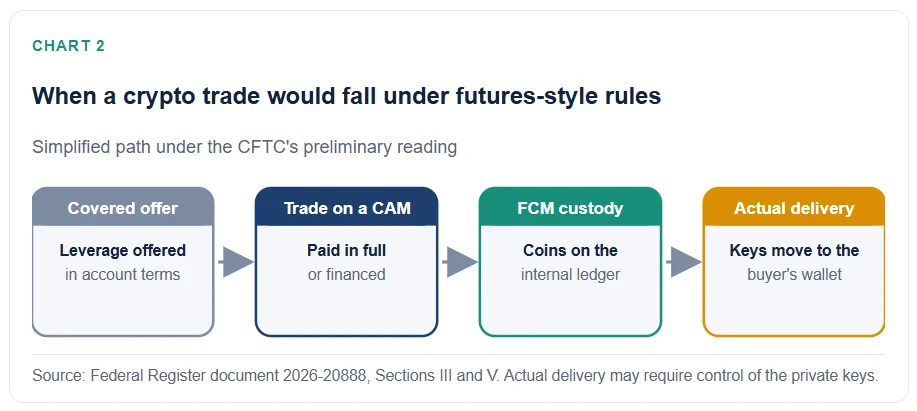
The most far-reaching idea concerns what counts as an offer of leverage. In the CFTC’s preliminary view, an offer in onboarding papers or exchange terms may be enough. That offer would then attach to every trade in the account, even when a customer pays in full. As a result, exchanges that offer margin to US retail clients could feel the broadest impact.
In other words, a cash purchase could still fall under futures-style rules while it sits on an exchange’s internal ledger. It would leave that regime only on actual delivery to the buyer. For crypto, the notice says delivery may require control of the private keys.
Staking and governance rights also matter. Actual delivery may require the ability to use those rights directly, without fees charged by an intermediary.
How a Crypto Asset Market Would Work
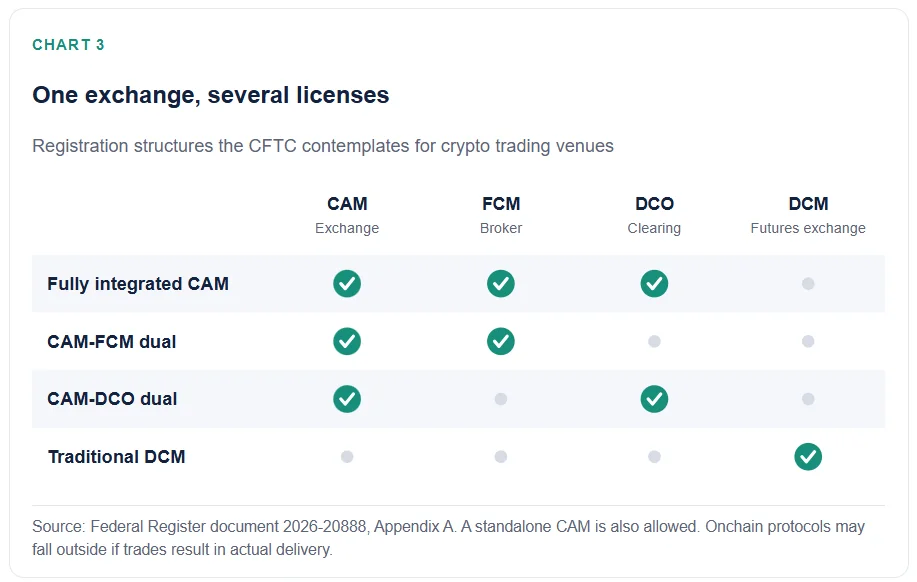
Under the plan, a futures commission merchant, or FCM, would handle every retail crypto trade. The FCM would also hold customers’ coins. Meanwhile, a clearinghouse, known as a DCO, would clear and settle the trades.
Leverage could come only from an FCM or from a bank that an FCM sponsors. In addition, each financing arrangement would have to appear in the exchange’s rulebook. The agency is also weighing whether to set margin levels itself or leave them to clearinghouses.
Notably, the design allows integrated models. One firm could register as an exchange, a broker and a clearinghouse at once. Existing futures exchanges could also offer these trades under their current license.
Who Could Sit Outside the Net
Not every venue would need to join. The CFTC says a typical onchain trading app may already deliver coins to users’ wallets. It also floats an exemption for venues with only de minimis activity. In addition, it asks whether exchanges could stay under today’s state-by-state spot regime.
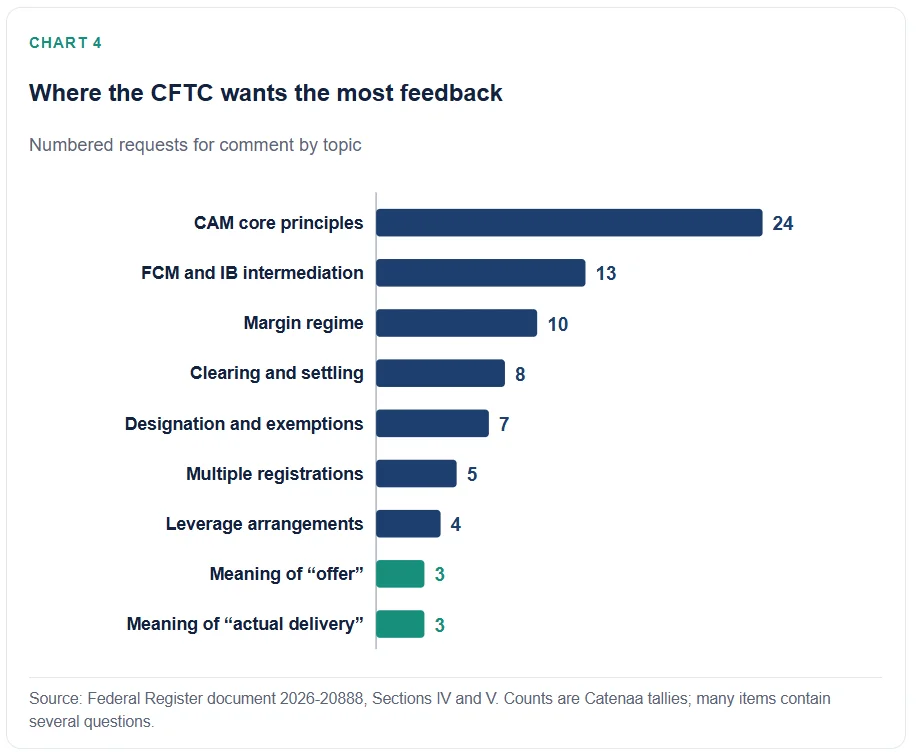
The notice poses 77 numbered requests for comment, by Catenaa’s count. Core principles for the new exchanges draw the most, with 24. Broker rules and margin follow, with 13 and 10.
How the Plan Took Shape
The proposal caps a busy year of policy shifts. In August 2025, the CFTC invited input on listing spot crypto on futures exchanges. Coinbase, Kraken and OKX US all sent letters that month, which the notice cites. For example, Coinbase argued that “crypto asset markets have several key differences from futures markets.”
In December 2025, the agency announced that listed spot crypto would trade on a CFTC-registered exchange for the first time. That same month, the agency withdrew its 2020 guidance on actual delivery. Selig was then sworn in as chairman on December 22.
The White House budget office reviewed the notice as a significant regulatory action. Finally, the CFTC released it on October 5, and the Federal Register published it on October 13.
What Comes Next
An advance notice is an early step, not a final rule. Instead, the agency will use the comments to shape any formal proposal, which would need its own comment period.
For crypto exchanges, the stakes are large. The final design could decide whether US retail crypto leverage moves onshore. It could also decide how much of today’s spot trading falls under federal oversight. Until then, the CFTC crypto rules remain a blueprint, and the comment file will show who wants changes.




