


November 29, 2026 – A Bank of Japan executive director says trust in new digital money still rests on central bank money.

In Summary
BoJ Executive Director Kazushige Kamiyama said singleness of money “should not be taken for granted”.
He tied stablecoin trust to sound reserve rules and well-designed links to central bank money.
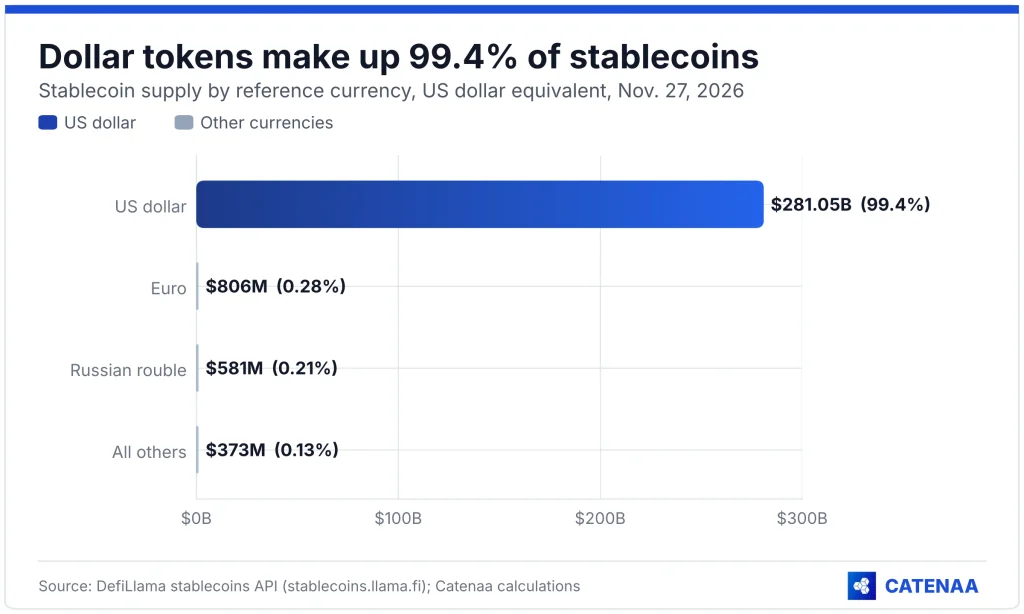
Dollar tokens make up 99.4% of the $282.8 billion stablecoin market.
The BoJ is testing tokenised settlement through its DLT Sandbox and Project Agorá.
The BoJ stablecoin message is simple: new tokens must still convert to money at face value. Executive Director Kazushige Kamiyama made the point in a Nov. 27 keynote in Tokyo. He spoke at an IMF seminar on digital money, according to the speech text.
Singleness of money is not automatic
Kamiyama said central bank money will remain “the anchor of trust” in the monetary system. It underpins the singleness of money, he said, so every form of currency converts at face value.
Crucially, he warned against taking singleness for granted. For stablecoins, he said, sound reserve rules and well-designed links to central bank money will matter.
He did not call for a ban or a cap. Instead, he expects many forms of digital money to coexist and interact.
He also looked ahead to AI. Agentic AI may soon pay on behalf of people and firms, he said. So digital money must stay safe, secure and able to work across systems.
A dollar market, for now
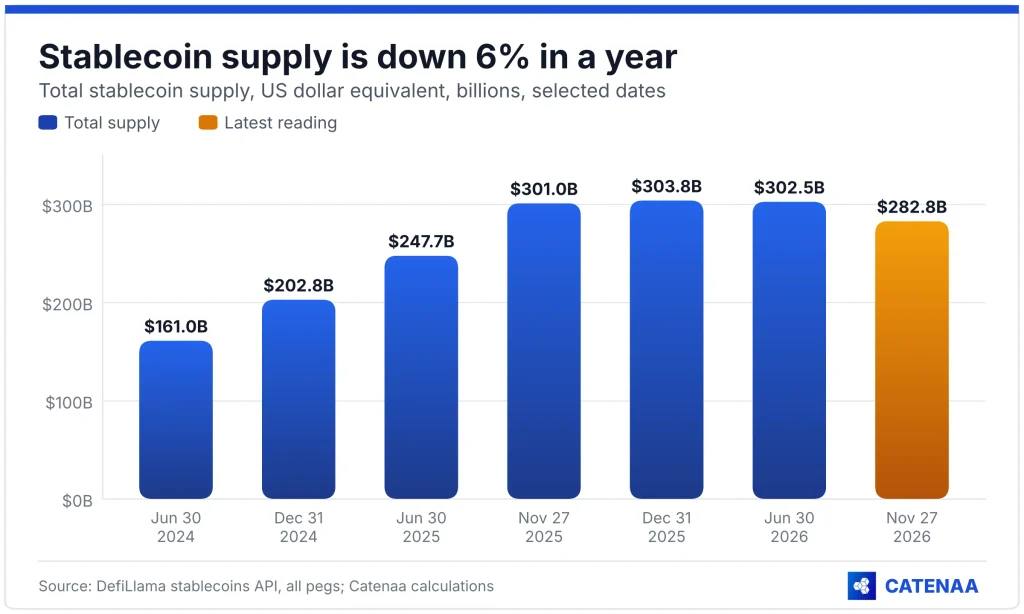
The market he spoke about is almost all dollars. Stablecoin supply totalled about $282.8 billion on Nov. 27, DefiLlama data show. Dollar tokens made up 99.4% of that total. Euro tokens came second, at about $806 million.
The market has also shrunk. Supply stood near $301.0 billion a year earlier, so it has fallen about 6%, Catenaa calculations show. As a result, any yen token starts from a tiny base in a shrinking pool.
Five risks behind the caution
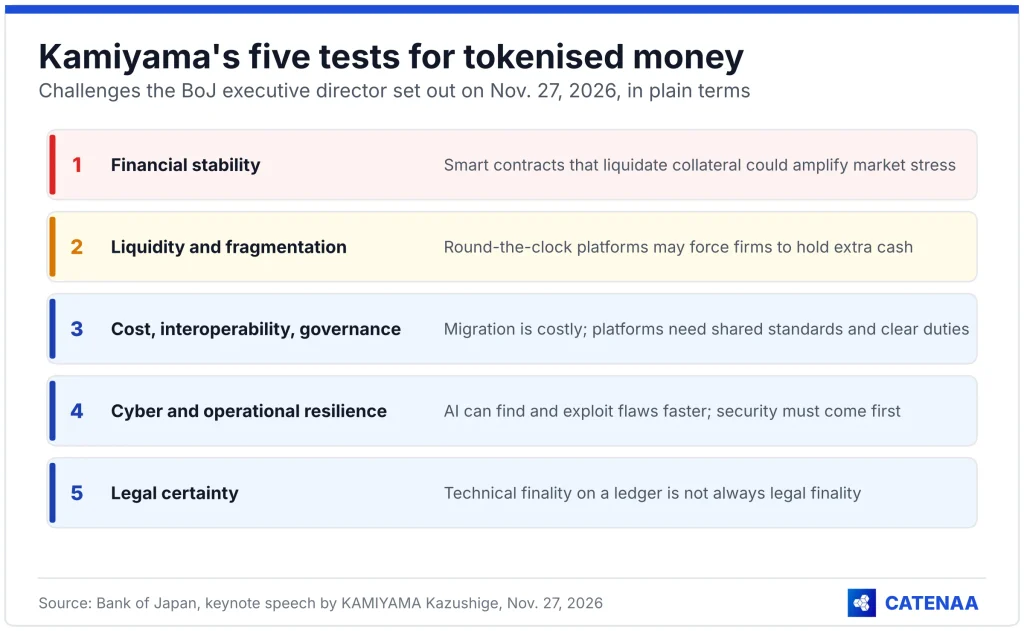
Kamiyama listed five challenges for tokenisation. First, automated margin calls and collateral sales could amplify stress. Second, round-the-clock platforms could split liquidity and force firms to hold extra cash.
Third, the cost of moving, plus weak links between platforms, could split markets. Fourth, he flagged cyber risk, noting AI’s growing ability to find and exploit flaws. Finally, he said technical finality on a ledger is not always legal finality.
How central banks are building links
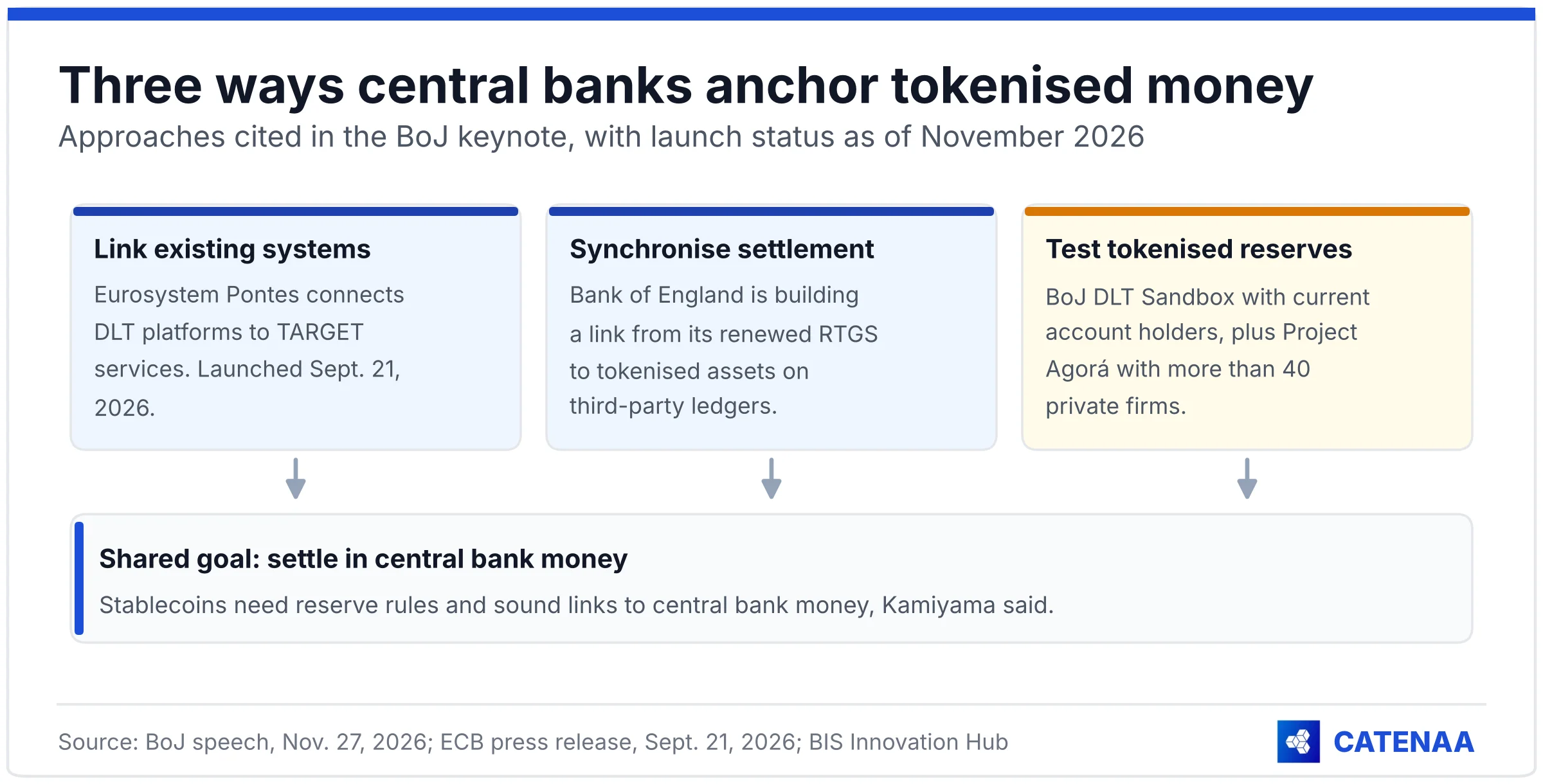
He pointed to several ways to tie tokenised assets to central bank money. The Eurosystem launched Pontes on Sept. 21, 2026, the ECB said. It lets wholesale tokenised trades settle in central bank money. Meanwhile, the Bank of England is working on a way to link its renewed RTGS system to tokenised assets.
Japan is testing its own route. The BoJ’s DLT Sandbox works with current account holders on cross-border payments, interbank settlement and tokenised JGB settlement. The bank also takes part in Project Agorá, a BIS Innovation Hub project with more than 40 private firms.
Retail work continues too, although the BoJ has made no decision to issue a digital yen, per its CBDC page.
Kamiyama also defended Japan’s current rails. BOJ-NET and private payment systems already work well, he said. So new tools must beat that real benchmark, not a theory. The BoJ plans to keep upgrading old systems while it tests new ones.
What the BoJ stablecoin view means for issuers
For issuers, the message points to reserve quality and redemption design. Tokens that redeem at par and hold liquid assets fit the singleness test best. However, the speech set no reserve ratios or new rules. Therefore, issuers should watch the FSA-led roadmap on on-chain finance for details.
The BoJ stablecoin stance also leaves room for private builders. Kamiyama said the bank does not aim to promote any single technology. Instead, it wants the tools that best meet market needs while money stays safe. For Japan, that points to a slow, tested path rather than a sudden switch.