

November 29, 2026 – New CFTC staff advice lets derivatives venues use bitcoin, ether and stablecoins toward a year of costs. The haircuts and a hard cash floor limit how far it goes.

In Summary
CFTC staff Advisory 26-31 lets SEFs, DCMs and DCOs count bitcoin, ether and payment stablecoins toward 12 months of operating costs.
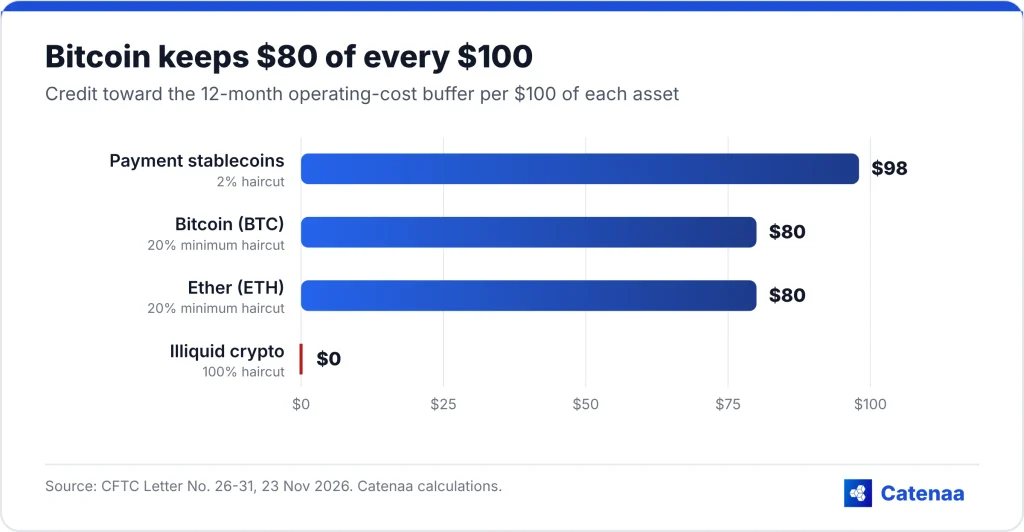
Haircuts are at least 20% for BTC and ETH, 2% for payment stablecoins and 100% for tokens that are not readily marketable.
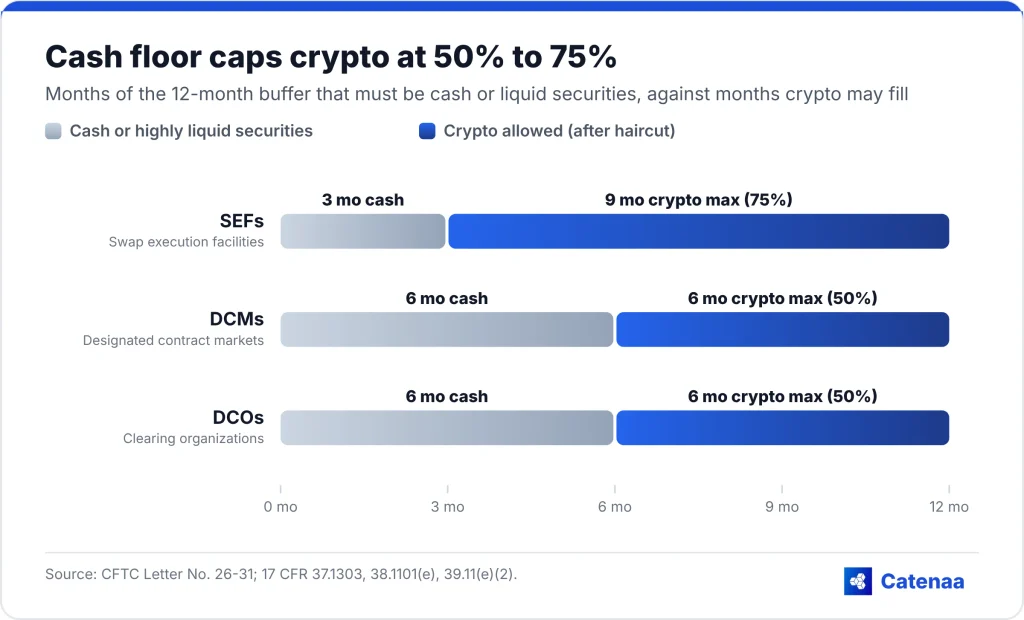
Crypto cannot fill the liquid slice, so it can cover at most 75% of a SEF buffer and 50% for DCMs and DCOs.
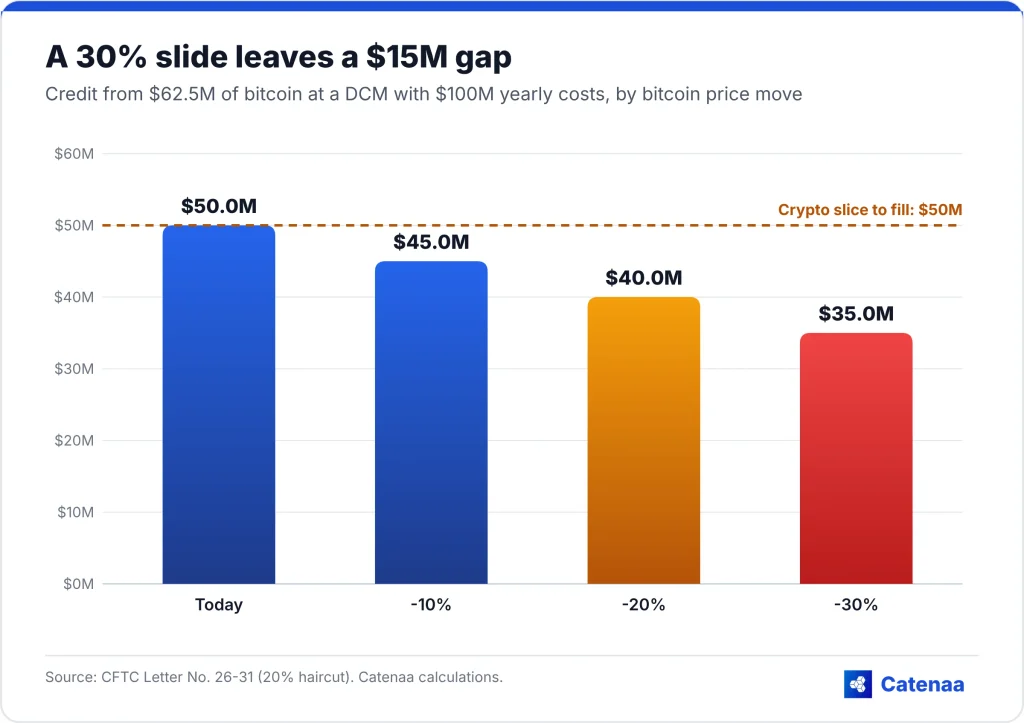
On Catenaa calculations, $62.5 million of bitcoin earns $50 million of credit, but a 30% fall cuts that to $35 million.
US derivatives venues can now treat bitcoin as capital, within firm limits. On 23 November, two CFTC staff divisions issued Advisory 26-31. It covers swap execution facilities (SEFs), designated contract markets (DCMs) and derivatives clearing organizations (DCOs).
Each venue must keep enough resources to cover one year of operating costs. Until now, staff had not said whether crypto could fill that buffer. Many venues and applicants already hold crypto, and they had asked for an answer.
What the bitcoin as capital advice allows
The advisory says bitcoin, ether and payment stablecoins can count toward the 12-month buffer, subject to haircuts. However, the relief is narrow. The views come from staff only, and the advice is not a rule or a no-action position, the CFTC said.
Staff also limited the scope. The advice covers operating-cost resources, not a clearing house’s default resources. Moreover, a venue that wants to use any other token must first talk to staff.
The haircut math
Venues may use the same haircuts that staff already accept for futures commission merchants. That means at least 20% off bitcoin and ether, and 2% off payment stablecoins. Any crypto that is not readily marketable takes a 100% haircut, so it counts for nothing.
In practice, $1 million of bitcoin earns only $800,000 of credit. By contrast, $1 million of qualifying stablecoins earns $980,000. Those charges match staff answers in the crypto FAQs reissued on 24 September.
The haircut is not a one-time step. Venues must mark these assets to market at regular intervals, so the credit moves with prices. Clearing houses face an extra test. Their haircuts must also reflect liquidity risk, and they must revalue at least monthly.
The cash floor caps the crypto share
The tighter limit sits in the liquidity rule. Crypto is not cash under US accounting rules, and it is not a highly liquid security either. Therefore, it cannot fill the liquid slice of the buffer. For SEFs, that slice equals three months of costs, which gives them more room. For DCMs and DCOs, it equals six months.
As a result, crypto can cover at most 75% of a SEF’s buffer and 50% for the others. Take a DCM with $100 million in yearly costs. It must still keep $50 million in cash or liquid securities. To fill the other half with bitcoin, it would need $62.5 million of coins. That is about 1,054 BTC at the 29 November price of $59,285 on Kraken. With stablecoins, it would need only $51 million.
Wrong-way risk is the catch
Staff told venues to weigh wrong-way risk. A crypto venue’s business losses and crypto prices may fall at the same time. Recent trading shows the danger. Bitcoin closed near $84,740 on 3 October and is now about 30% lower.
So a venue that sized its bitcoin at the October level would now fall short. For example, $62.5 million of bitcoin that drops 30% leaves $35 million of credit. That is $15 million below the $50 million slice it needed to fill.
The advice also extends a run of staff steps. In December 2025, staff issued letters on digital assets as margin collateral and on tokenised collateral. This advisory now applies similar thinking to a venue’s own balance sheet.
For now, the practical effect is modest. Crypto-native venues gain room to hold coins on the balance sheet. Still, the cash floor and the haircuts keep most of the buffer in dollars.